
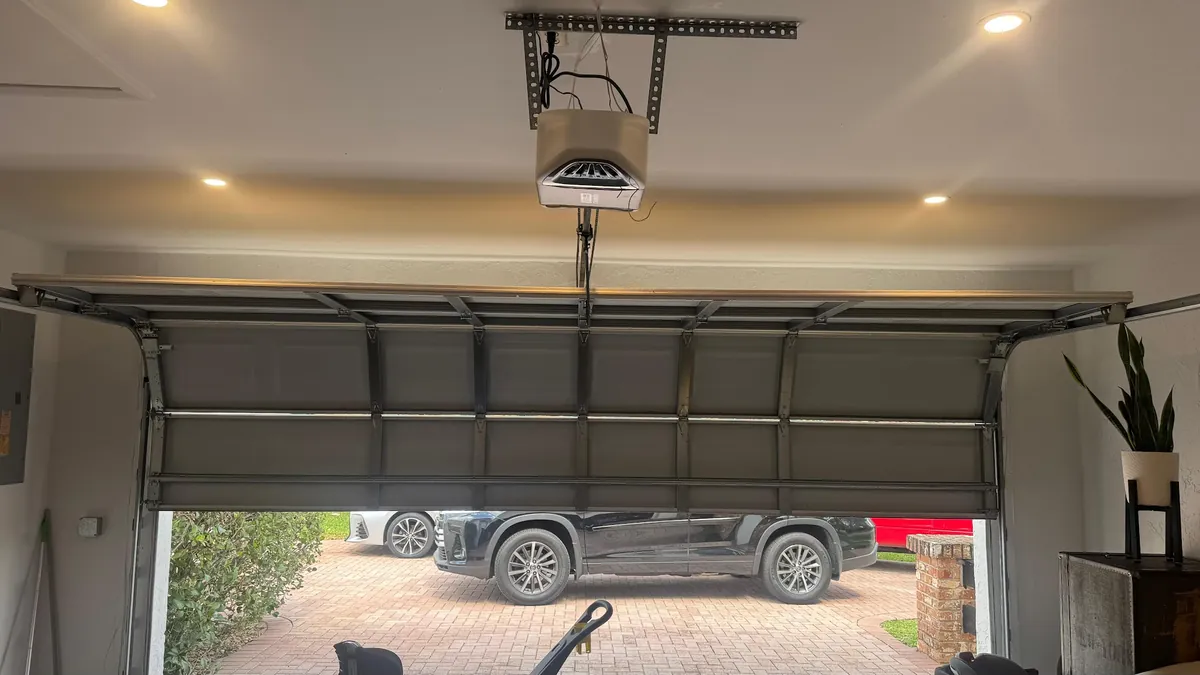
Why openers work hard in South End garages
The opener is the part of a garage door you use every day and think about least, until the button does nothing or the door stops halfway. LiftMaster opener repair in Boston covers the motor unit on the ceiling, the rail and drive, the remotes, the wall control and the safety sensors at the bottom of the tracks, and replacement when the unit is past saving.
Close to the shop, behind the brick terraces of Shawmut, Tremont and Columbus, alley carriage houses tend to have short headroom, and some buildings put a parking bay at ground level with living space directly above the opener. Tight ceilings, old wiring and doors that are opened many times a day all put the opener to work.
- Check whether the opener’s light comes on and the motor makes any sound
- Look at the small lights on the safety sensors near the floor on each side
- Try both the remote and the wall control to see whether one works and the other does not
Opener problems we repair
Motor runs, door stays put
The motor hums or whirs but nothing moves. It may be a stripped gear, a slipped drive or a door that is too heavy to lift. The cause is found before parts are changed.
Door reverses or will not close
A door that goes back up or only closes while the button is held usually points to the safety sensors: misaligned, dirty or with a damaged wire.
Remote not working
A remote that has stopped responding may need a battery, reprogramming or a replacement. Remotes are set up to the opener before the visit ends.
Wall control not working
A dead wall button can be the control itself, the wire running to the opener, or the opener’s own board. Each is tested in turn.
Noisy or straining opener
Grinding, jerking or a motor that labours often means wear in the drive, or a door that has fallen out of balance and is too heavy to lift.
Opener replacement
When an opener is worn out or damaged beyond sensible repair, it is replaced with a new LiftMaster unit fitted to the door and the ceiling.
What goes wrong with an opener
LiftMaster opener repair in Boston usually comes down to one of four areas: power and control, the drive that moves the door, the safety system, or the door itself. A good diagnosis checks them in that order, because the cheapest explanation is often the right one.
Power and control problems include a tripped circuit, an unplugged unit, a failed wall control or a remote that no longer pairs. Drive problems show up as a motor that runs while the door stays still, a chain or belt that has gone slack, or a worn gear inside the unit. Safety problems are almost always the sensors near the floor: when their beam is blocked or out of line, the opener refuses to close the door and reverses it instead. And a door problem, such as a broken spring, makes the door too heavy for the opener to lift at all.
Quick checks before you call
Some opener problems have simple causes you can check safely:
- Make sure the opener is plugged in and the circuit has power
- Replace the battery in the remote and try again
- Look at both sensor lights; if one is off or blinking, wipe the lens and check nothing is in the beam
- Check whether a lock switch on the wall control has been pressed by mistake
- See if the door has been released from the opener by the red emergency cord
If none of that helps, stop pressing the button. An opener that keeps trying to lift a door that will not move can burn out its motor or strip its gears.
Do not let the opener hide a door problem
An opener is built to guide a balanced door, not to lift its full weight. If a spring has broken, the door can weigh far more than the motor is meant to handle. Pressing the button repeatedly may lift it a few inches, or not at all, and damages the opener in the process.
Be careful with the red emergency release as well. Pulling it disconnects the door from the opener, which is right during a power cut with a working door. With a broken spring, releasing the door can let it drop suddenly. If the door looks crooked, a cable is loose or there was a bang from the garage, leave the release alone and call. Our garage door spring repair and garage door cable repair pages explain those problems.
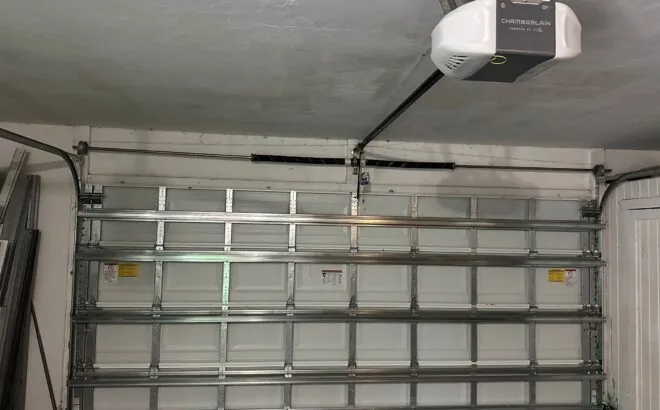
Safety sensors and the reversing system
The two sensors near the bottom of the door send an invisible beam across the opening. Interrupt that beam during a close and the motor halts, then sends the door back up. It is a safety system, and it should never be bypassed or taped over.
Sensors go wrong in ordinary ways. One gets knocked by a bin or a bike and points slightly off line. Dirt or condensation clouds a lens. A wire along the wall is pinched or chewed. Sunlight shining straight into one sensor late in the day can also confuse it. Each of these is checked, and the sensors are realigned or replaced so the door closes reliably and still reverses when it should.
The opener also reverses if the door meets resistance on the way down. That force setting is tested on every visit, because a door that does not reverse when it touches something is a hazard.
Remotes and wall controls
Remotes and wall controls fail more often than the opener itself. Batteries go flat, buttons wear out, and remotes lose their pairing after a power cut or a board change. New remotes and keypads are programmed to the opener before the visit ends, and old remotes that are lost or no longer trusted can be cleared from the opener’s memory.
A wall control that does nothing can be the control, the thin wire running to the opener, or the opener’s logic board. Testing each in turn avoids replacing a part that was never at fault.
Openers in older Boston garages
Electric openers arrived long after most of the city’s garages were built. In a carriage house with short headroom, the opener rail can sit within inches of the ceiling, and the door’s top section passes close to it. Under a building, the unit is often bolted to old joists or masonry, and its power often comes from a circuit added years later.
Those conditions shape LiftMaster opener repair in Boston. A loose mounting can shift the rail out of line and make the drive slip. An outlet that also feeds other equipment can trip and leave the opener dead. Any vibration from the opener in a bay with rooms above is worth looking at, since worn parts and loose fixings make far more noise than a sound unit should. Each of those is checked on the visit along with the opener itself.
Repair or replace
Most LiftMaster opener repair in Boston stays a repair: sensors, remotes, wall controls, drive parts and the logic board are all replaceable on their own, and a sound opener goes back into service once the fault is fixed.
Replacement makes more sense when the motor itself has failed, when several parts are worn at once, or when the unit has been damaged by a door that was pushed too hard. If the door has been changed for a heavier one, such as a glass door, the existing opener may not be suited to it. Our full view glass garage doors page covers that case. When replacement is the better option, a new LiftMaster opener is fitted and set to the door, and both choices are explained plainly before anything is done.
For openers by any other maker, see our garage door opener services page. The rest of the door is covered on garage door repair, and the whole range is gathered under all of our services.
Book a repair
Call us when the opener stops, or book online if the door still opens by hand. With the line open 24 hours, 7 days a week, LiftMaster opener repair in Boston can be called in whenever the door lets you down. If the door is stuck open overnight, our emergency garage door repair page explains how urgent calls work.
Questions about LiftMaster opener repair
Why does my LiftMaster make a noise without lifting the door?
Usually one of three things: the door is released from the opener, the drive inside the unit has worn or slipped, or a snapped spring has left the door far heavier than the motor can manage. Stop pressing the button and check the door for a loose cable or a gap in the spring above it before calling.
Why does my door go back up when it is almost closed?
That is the safety system at work. The sensors near the floor may be out of line, dirty or blocked, or the force setting may be wrong. Wipe the lenses and check both sensor lights. If that does not fix it, the sensors and settings are checked on the visit.
Can you replace my old LiftMaster with a new one?
Yes. LiftMaster openers are both repaired and replaced. If the old unit is not worth repairing, a new LiftMaster opener is fitted, set to the door, and paired with its remotes and wall control.
Can you program a new remote to my opener?
Yes. New remotes and keypads are programmed to the opener on the visit, and lost remotes can be cleared from its memory so they no longer open the door.
What should I do when the power is out?
Pull the red emergency release cord, then lift the door by hand. Only do this if the door is balanced and the springs and cables are intact. If the door is crooked or heavy, leave it closed and call.
Do you only work on LiftMaster openers?
No. This page is about LiftMaster openers, but openers of other makes are repaired and replaced too, as described on our garage door opener services page. Coverage across Greater Boston is set out on the service areas page.