
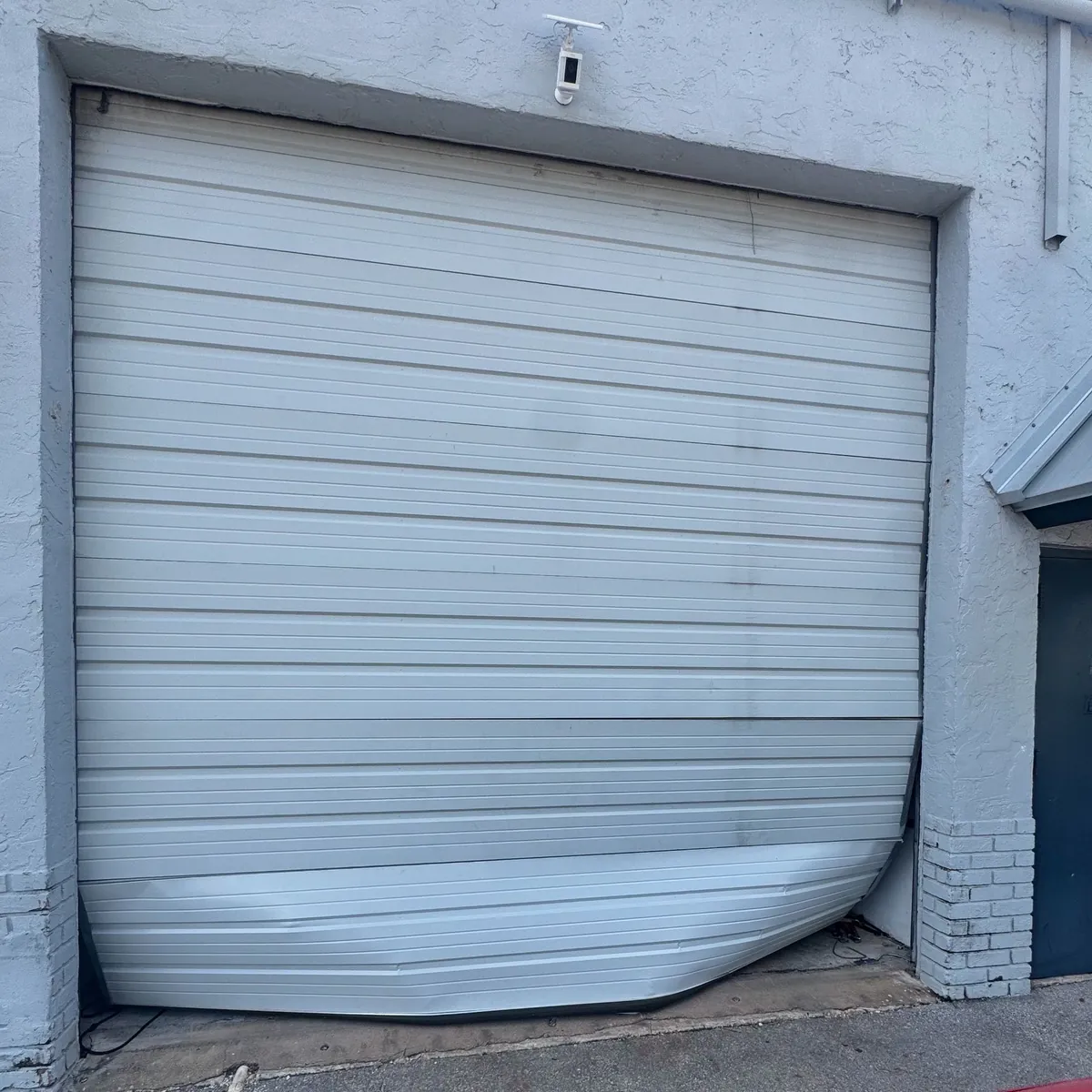
What the two-car garages of Braintree Highlands put their doors through
Around Braintree Highlands the typical house is a cape or a colonial with the garage joined to it, usually at one end, and a driveway in front that is wide enough to park two cars side by side. Two-car openings are the norm here, and that single fact shapes almost every repair we do in town. When we talk about garage doors Braintree MA homeowners rely on, we mostly mean one wide door spanning a double bay, or two single doors set next to each other in the same wall.
A double-width door is a big, heavy thing. It carries more sections, more hinges and more rollers than a single door, and it hangs from a spring system sized for all of that weight. When a part wears, the extra width magnifies it: a tired hinge in the middle lets the door bow, a weak spring on one side makes the whole span rise unevenly, and the opener feels every bit of the difference.
Because the garage shares a wall with the house, a failing door is more than an outdoor nuisance. For many households it is how everyone comes and goes, it stands between the weather and a heated room next door, and it is the route the car takes every morning. From the driveway, three things are worth a look before you call:
- Is the bottom edge parallel with the slab from one bay to the other, or does the left or right end dip?
- Has the spring over the opening split into two pieces with a gap between them?
- Is either lift cable slack, or curled loose beside a bottom corner?
Garage door services in Braintree
Each card points up to the fuller page for that kind of work. Most calls about garage doors Braintree MA owners make start with one of these.
Two-car door repairs
Bowed middles on wide doors, split centre hinges, rollers that grind, a bottom section dented by a bumper, tracks knocked out of plumb. The repair overview has the wider detail.
Paired torsion springs
A double-width door usually hangs from twin torsion springs on the shaft above it. When one parts, its partner cannot carry the door alone, so both are normally renewed on the one visit. Spring work is explained on the springs page.
Openers, remotes and keypads
Two cars tend to mean two remotes, a wall button and an outside keypad. Opener repairs and replacements cover LiftMaster units too, and the opener services page goes further.
Help at an awkward hour
A door jammed open at bedtime, or the family car trapped behind a dead door before the commute. Someone picks up whatever the hour; see emergency garage door repair for what to do first.
Lift cables on a wide span
A long spring shaft puts heavy load on each cable. When one frays or slips off its drum, one end of the door drops and the span twists. The cable repair page shows what gets replaced.
Doors out of their rails
On a door this wide, a single roller leaving its rail can pull everything crooked. Read about off-track garage door repair before touching it.
Replacing the whole door
Once the sections themselves are finished, a new door is supplied and fitted to the existing opening, as set out under new garage door installation.
One wide door or two single doors
The first question about any two-car garage is how the opening is closed. Among the garage doors Braintree MA capes and colonials carry, some span both bays in one piece, while others have a centre post with a separate door on each side. Each arrangement fails in its own way.
A single double-width door is the more common sight on houses built with the garage attached. One opener runs it, which keeps things simple, but everything about it is scaled up. The spring shaft is long, the cables are under heavier load, and the top section has a wide unsupported span that tends to bow over time unless it carries a reinforcing strut. When the door starts to sag in the middle, the hinges along that line wear fastest, and you will often see daylight at the top of the opening at the centre while the ends still seal.
Two single doors split that load in half, and they bring another advantage: if one door fails, the other still works and a car can get out. The drawback is that there are two of everything to wear out, two openers to keep in step with the remotes, and a centre post that takes knocks from both directions when cars are turned in a full driveway.
Neither layout is better in every case. What matters on a repair visit is that the parts suit the door actually hanging there. A replacement spring has to match the real weight of the door, not a nominal size, and a wide door that has gained hardware, insulation or a windload kit over the years may weigh more than it did when new.
Springs on a double-width door
Of all the urgent calls we take, a snapped spring tops the list, and in a two-car garage it announces itself. The door that rose smoothly yesterday lifts a hand’s width and quits, or the opener labours and the span comes down crooked.
Most wide doors use torsion springs mounted on a steel shaft directly above the opening. Many use two, one on each side of the centre bracket, sharing the load. Their coils tighten as the door descends, and that stored energy is what lets a heavy double-width door be raised by hand. That stored tension is dangerous, and swapping one of these springs yourself is not a DIY repair, however simple an online video makes it look. Let a winding cone slip and a steel bar can spin off the shaft hard enough to break a wrist or worse.
When one of a pair breaks, the survivor has been working twice as hard and seldom has much left in it. Replacing both together keeps the door balanced evenly from side to side and stops the next break arriving a few weeks later. Some older or lighter doors still run on extension springs stretched along each horizontal track; those need a safety cable threaded through them so that a breaking spring cannot whip across the garage.
Openers, remotes and the door into the house
An attached garage usually has a door into the house, often through a mudroom or kitchen, so for whoever drives, the garage is the front door in all but name. That makes the opener one of the most used machines in the house.
Typical faults on these garages:
- A motor that whirs while the door stays put. That is more often a spring problem than a motor problem.
- A door that touches down, then climbs straight back up. Usually one photo eye at floor level has been nudged or has a film of dust across its lens.
- The second car’s remote gone dead while the first still works: a flat battery, as a rule, and occasionally a remote that needs pairing again.
- An outside keypad that stops answering after a hard winter.
Opener work starts with the door, not the motor. First the trolley comes off and the door gets lifted by hand, because a motor straining against an unbalanced door will fail again even after it is mended. Once the door glides and holds its place at mid-height, the opener is taught the door’s top and bottom positions, its closing force is set to suit, and every remote and the keypad are tried in turn. Where the motor or its gear is worn out, the opener is replaced.
A full driveway in front of the door
A driveway wide enough for two cars is a gift on a repair visit, since there is room to work and to lay a door section down flat. It also explains a fair share of the damage we see. Cars parked close to the door get nudged into the bottom section when someone else pulls in behind; a car reversing out at an angle catches the edge of the door before it is fully open; a basketball hoop or a row of bikes ends up leaning on the panels.
The garage behind a full driveway is often used more for storage than for parking, because the cars live outside. That brings its own trouble. Shelving creeps toward the tracks, boxes get stacked under the horizontal rails, and a bike hung from the ceiling ends up in the door’s path. Before a visit, it helps to clear a space at each side of the opening and under the tracks so the whole door can be inspected along its travel.
Winter adds snow. A plough or a snowblower piles it at the foot of the door, and a door that closes onto packed ice may sit crooked, freeze to the slab or strain the opener trying to lift. Clearing the threshold before the first cold night, and keeping the bottom seal in good shape, saves a surprising number of calls.
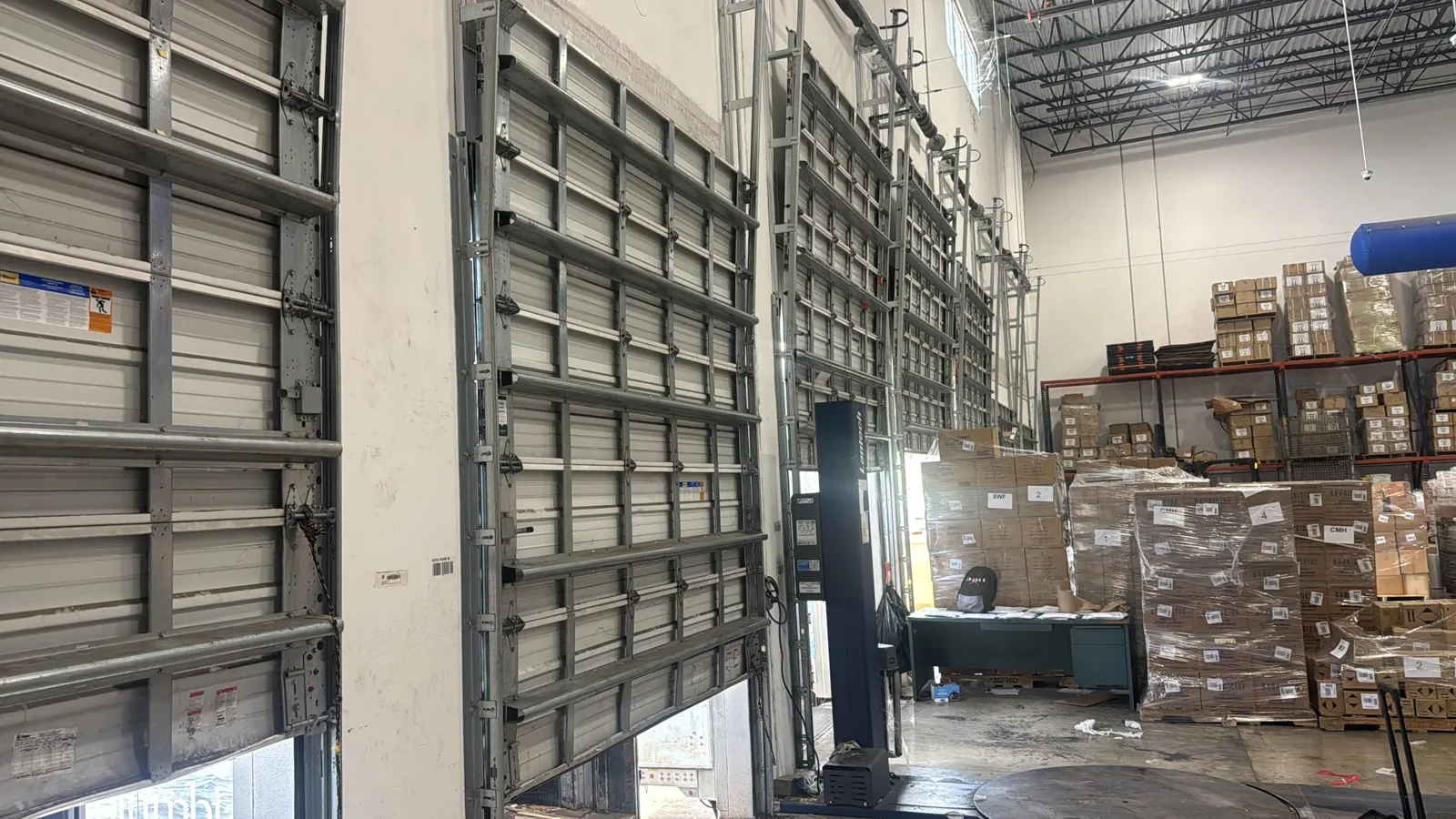
Cables, rollers and the track on a wide span
Each lift cable is clamped at a bottom corner bracket and wraps around a grooved drum fixed near each end of the torsion bar. On a two-car door those drums sit a long way apart, and both cables have to stay at equal tension for the door to rise level. When one frays, slips off its drum or snaps, that side of the door is suddenly unsupported and the span twists in the opening. The opener may keep hauling on the centre while one end hangs low, which is how a cable fault turns into a bent track or a cracked top section.
Rollers take a lot of wear on a wide door, simply because there are more of them and they carry more weight. Worn rollers wobble, scrape and eventually crack, and a cracked roller can let the door jump its track. If the door has started to grind, or to shudder at the same point on every trip, rollers are a good first suspect.
An off-track door across a two-car opening is a hazard. It is wide enough that one side can drop while the other is still in its rail, leaving the full weight hanging from one cable and one roller. Leave the door where it hangs and don’t attempt to shove it straight. Unplug the opener, keep cars and people well back, and call.
What a visit involves
Every visit starts with the door working by hand. The trolley is released so the door is no longer tied to the opener, then it is raised to about waist height and let go. If it hovers there, the springs are matched to it. If it sinks, a spring is weak or broken; if it creeps upward, the springs are wound too tight.
Next comes a full look at the hardware. Both springs, both cables and drums, every hinge across the width, each roller in the vertical and horizontal tracks, the track brackets and the brackets at the bottom corners. On a wide door the centre hinges and the top section get extra attention, because that is where a sag begins. The opener, the remotes, the keypad and the safety sensors are checked on their own.
Then you are told what is broken, what caused it and what is likely to go next, and nothing is replaced until you agree. After the work, spring tension is trimmed until the door hovers at mid-height, the opener is reset to match, and a scrap of timber laid on the threshold proves the reversing feature still does its job.
Repair or replace
For most two-car doors in town, repair wins. The moving parts on any door are consumables, and renewing them gives a sound door years more service. A wide door that has started to bow can often be straightened and fitted with a reinforcing strut.
The sums change once the skin of the door gives out. Watch for steel bottom sections eaten through where plough snow has sat against them for weeks, wooden panels gone soft or split, or a door carrying so many earlier repairs that it no longer balances. A door with dents in several sections from driveway knocks may also cost more to mend piece by piece than to replace.
A new door goes into the existing opening, and on an attached garage the choice also affects the house. An insulated door helps keep the cold off the wall the garage shares with the living space, and a door that seals well at the bottom keeps out drifting snow and leaves. When garage doors Braintree MA homes already have are past saving, we supply and install the replacement and set up the opener to suit it.
Small checks that are safe to make
Safe to do from the garage floor, without tools:
- If the door has stopped halfway, unplug the opener at its ceiling outlet, so the motor cannot have another go.
- Look at the two photo eyes near the floor. If one shows a steady light and the other blinks or stays dark, one has been knocked; a gentle nudge back into line or a wipe of the lens may sort it.
- If the wall button still runs the door but a remote doesn’t, put a fresh battery in the remote.
- Look along both vertical tracks for anything wedged against them, such as a rake handle or a storage box.
The springs, cables, bottom brackets and drums are off limits. They are loaded in every position of the door, and loosening the wrong fastener can release that load all at once. With a spring gone, the door is a dead weight: don’t heave on it, and leave the wall button alone.
Getting a door looked at in Braintree
A door that has stopped working rarely gives notice, and when the garage doubles as the family’s main entrance, a stuck door upends the whole morning. Since our line is staffed through the night and the weekend, a Sunday-evening jam or a spring that lets go before dawn can be reported the moment it happens. For the wider picture of where we work, see our service areas page, and if you live just over the line, our pages for Quincy and Weymouth cover the neighbouring towns.
When you get in touch about garage doors Braintree MA homes depend on, it helps to say whether the opening has one wide door or two singles, what the door is doing now, and whether the second car is stuck in the bay. Then call us or book online.
Questions from Braintree
Our two-car door goes up a few inches and stops. What has gone?
Usually a spring. Without its spring, a wide door is far heavier than the opener can lift, so the opener cuts out after a short distance. Pull the opener’s plug, stand back from the door, and check the coils above the opening for a gap.
One of the two springs above our door snapped. Should the other be changed too?
In nearly every case, yes. The springs on a wide door share the load, and the one that survived has been carrying more than its share. Renewing the pair keeps the door level and stops a second break following soon after.
The middle of our wide door has started to sag. Is that serious?
It is wear worth dealing with early. A sag across a double-width door strains the centre hinges and the top section, and it can make the door bind in its tracks. Often the hinges are replaced and a reinforcing strut is added.
Our door touches the floor and then goes back up. Why?
The usual culprit is a photo eye nudged off its aim, a smeared lens, or has something from the garage shelves in front of it. If clearing and wiping both eyes does not help, the opener’s down limit or force may need resetting on a visit.
Can just the bottom section be replaced after a car hit it?
Often, yes, as long as a section matching the door’s profile and finish can be sourced. If the knock also bent a track or strained a cable, those are put right at the same time.