
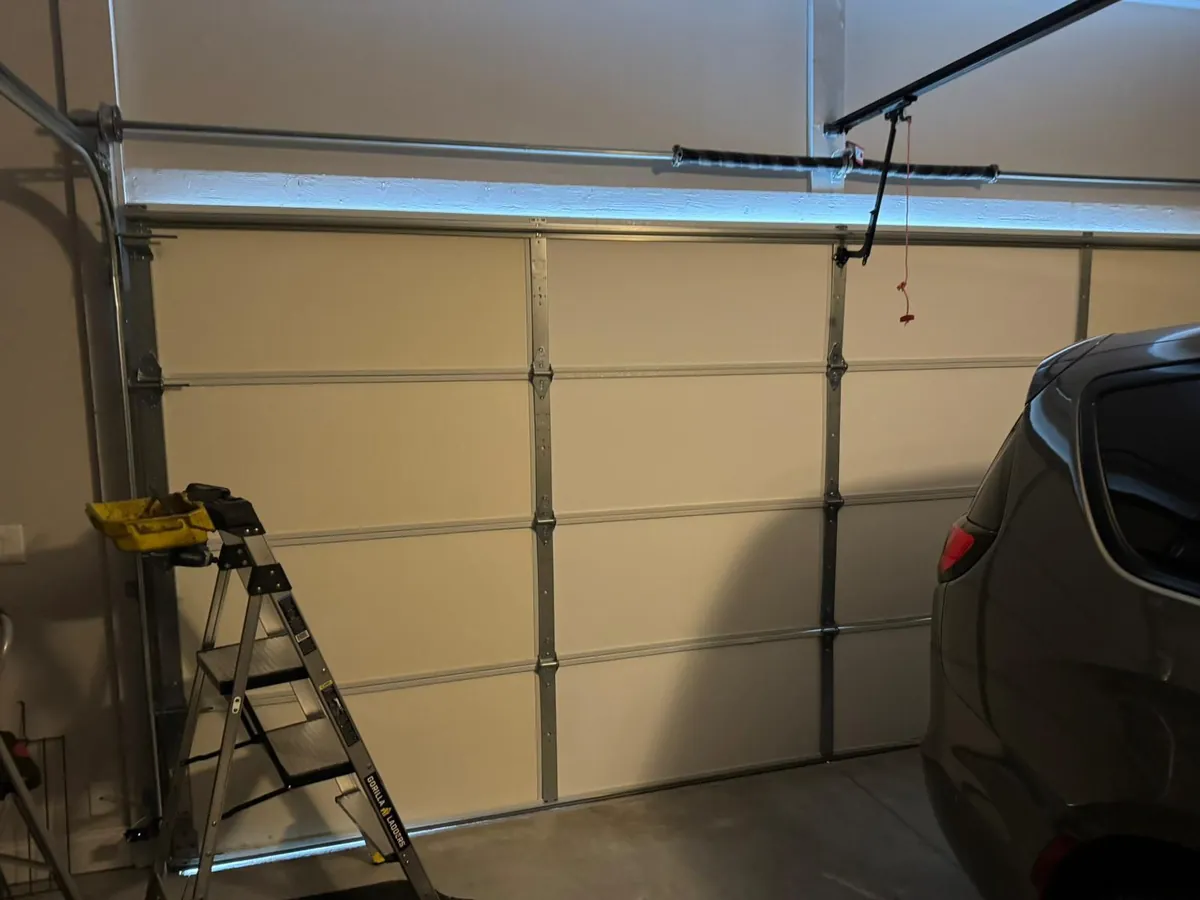
Snug openings on the numbered streets, and townhouse garages by the water
Two quite different kinds of garage share this neighbourhood. On the numbered streets, triple-deckers and row houses sit close together, and where a lot has a garage at all it is usually a small rear one at the end of a narrow driveway squeezed between two buildings. Down toward the waterfront, the newer townhouses carry their garages inside the building, at street level beneath the rooms. Most calls about garage doors South Boston MA homes rely on come from one group or the other, and the work differs between them more than the shared postcode suggests.
Whichever kind you have, the openings are tight. A back-lot garage gives the door a few inches of wall at each jamb and not much more above, and a townhouse garage tucked under the living space has its own limits on headroom. Tight openings leave little margin: a bracket that shifts slightly, a roller that wears a little or a panel that bows a fraction is enough to make the door rub, bind or jam.
From where you stand, without reaching up into the hardware, look for:
- A coil above the door that has separated, leaving a gap.
- A door that now catches on the same side every time it moves.
- A bottom corner that no longer reaches the floor when the door is shut.
Parking comes before the door
On these streets, the first problem of any visit is where to put the van. Curb space is scarce, a narrow driveway may be blocked by a parked car, and a rear garage can sit some distance from the nearest legal place to stop. That does not prevent a repair, but it shapes it. Ladders, toolboxes and parts usually travel on foot down a strip of paving with clapboards brushing either elbow, and a long torsion spring or a fresh door panel gets walked around the corners of two neighbouring houses.
You can make the day go far more smoothly by telling us, when you book:
- Whether there is any off-street space where a van can pull in, even briefly.
- Who else parks along the drive, and whether their cars can be moved for the hour or two of work.
- Whether the garage can be reached from the house as well as from the drive.
If you have a residential parking arrangement that might help, mention it; we will work with whatever the street allows.
Back-lot garages on the numbered streets
Rear garages here were built for small cars on small lots, and their doors were fitted into whatever opening the building had. With the wall stopping just past each jamb, the upright rails hug the very edge of the opening. A low ceiling decides where the coil goes and leaves the motor crammed under the rafters. Many of these garages serve more than one unit of a triple-decker, so the door is opened and closed by several households and wears accordingly.
The repairs we carry out most often in these garages include:
- Rollers worn flat or seized, making the door grind or jump.
- Track brackets loosened in old framing, letting a track lean inward.
- Hinges cracked between sections from years of heavy use.
- Bottom sections creased by a car reversing out at an awkward angle.
- Bottom seals torn or flattened, letting in water, leaves and cold.
More on these, and on every other part of the door, is on our South Boston garage door repair page.
In a small garage it is particularly important to find the cause of a fault rather than just its symptom. A door that rubs might have a worn roller, or the jamb beside it might have moved. A door that will not seal might have a torn seal, or the slab might have dropped at one corner. Getting that right first saves a second visit.
Townhouse garages near the water
The newer townhouses along the waterfront have garages that are part of the house itself, usually on the ground floor beneath the living space. The doors are more modern and the openings more regular than in the older rear garages, but they come with their own pattern of faults. Plenty of owners come and go through the garage rather than the front step, so the door here rises and falls far more often than a back-lot door. Openers are often mounted close to the ceiling with little room to spare, and the door may sit right beside an entry to the house, so noise and vibration matter more.
Faults we see in these garages include openers that have started to strain, remotes and keypads that lose their pairing, safety sensors knocked by bikes or bins stored along the wall, and springs worn out early by a door that seldom gets a rest. Damp air near the water can also be hard on exposed steel hardware, so a look at hinges, brackets and the bottom fixture of each cable is part of any visit.
Noise travels, too. With bedrooms and living rooms directly above, a door that bangs, an opener that rattles its mounting or rollers that squeal carry straight up into the house. Quieter running is often a matter of fresh rollers, tightened hinges, a properly balanced spring and an opener firmly fixed to the structure, rather than anything more drastic. When a townhouse door is replaced, the same thinking applies: a door that suits the opening and is balanced correctly puts less strain on the opener and makes less racket overhead.
Garage doors South Boston MA townhouses carry also tend to sit flush with the street or a shared courtyard, so a dented bottom panel or a sagging section is on show to everyone who passes. Panel replacement is often possible without changing the whole door.
Springs: the call we take most
Snapped springs top our list of urgent calls on these streets, as they do across the city. Typically there is a crack from the garage, then the motor manages a few inches and gives up, or the handle will not budge the door at all.
The torsion coil over the lintel stores enough twist to break bones. Letting it down or changing it is not a DIY repair; it calls for proper winding bars and practised hands, and a slip can do serious harm. In a cramped rear garage, with little room to stand clear, the risk is greater still. Extension springs along the tracks are under less force but are still under load, and an old pair without safety cables can whip loose.
If you find a broken spring:
- Leave the door as it is, open or closed.
- Switch the opener off or unplug it so nobody runs it by accident.
- Keep people and cars out from under an open door until it has been made safe.
Our South Boston spring repair page explains torsion and extension spring work in more detail.
Openers, keypads and photo eyes
In older rear garages the opener may run off a single outlet installed long after the building was put up, and its power can be the first thing to check. In townhouse garages the opener is often wired in neatly but packed into a small ceiling space, where heat and vibration take their toll.
Typical faults: the motor whirs while the door sits still, which usually points to a worn drive gear or a disconnected trolley; a door that goes back up just before it reaches the floor, usually because a photo eye is out of line; a keypad or remote that no longer works; and a wall button that does nothing because its wire has been damaged. Opener repair and replacement is everyday work for us, LiftMaster models included. The South Boston opener repair page has more on these faults.
A practical point: in a narrow garage the photo eyes sit right where a scooter or a recycling bin gets parked. If the door refuses to shut, clear the floor by both jambs and confirm the two little lenses still point straight at one another before you ring.
Doors that fail at the worst moment
A door tends to fail when it is needed most: on a cold morning when the car has to get out, or late at night when the garage will not close. Ring us at any hour; the person on the line will go over which parts of the door are safe to handle while a visit gets booked. There is no promise of a set arrival time, only a truthful estimate.
Until then:
- Do not keep pressing the button on a door that has stopped; it can turn a broken spring into a broken opener.
- Do not try to force a jammed door up or down by hand.
- With the garage left gaping overnight, carry bikes and tools indoors where that can be done without passing under the door, rather than wrestling it shut.
More on urgent calls is on the South Boston emergency garage door repair page.
Cables and doors that leave their tracks
In a tight opening, a door has very little room to go out of square before it rubs. A frayed or broken lift cable lets one bottom corner drop, the door twists, and a roller can come out of its track. The door then jams at an angle, and in a small garage there may be no safe way to get past it.
Do not try to lever the door back into place or run the opener. The springs and the remaining cable are still loaded, and a section can drop suddenly. Our citywide pages cover lift cable replacement and doors that have come off track.
What happens when we come out
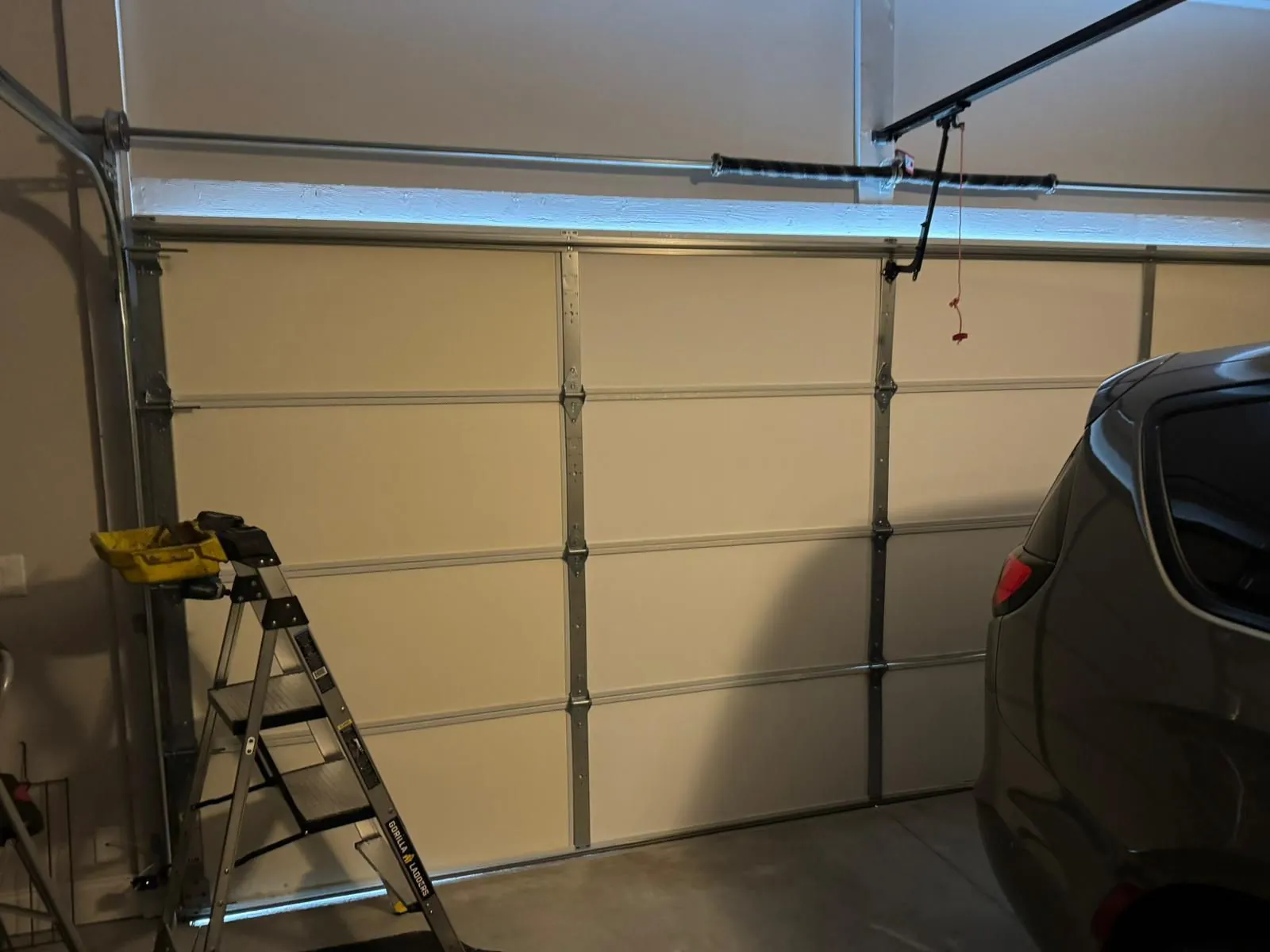
Once the van is parked and the tools are carried in, a visit follows the same steps whatever the garage:
- An unhurried look over every moving part, the weatherstrip, and the framing the door hangs in.
- With the trolley released, a gentle hand lift, if the springs allow it, to judge balance.
- A test of the opener, its limits, the photo eyes, the wall button, keypads and remotes.
- An explanation of what has failed and what the choices are, before any part is replaced.
- The repair, then repeated full cycles to check the door runs smoothly, closes fully and reverses when a photo eye is blocked.
Should a part need collecting, nobody leaves until the door is shut and locked.
Repair or replacement
Most doors in these garages repair well; one snapped coil, a frayed wire, new rollers, a bashed panel or a perished seal is routine stuff. Replacing the whole door earns its place when damage spreads over three or more panels, when the door has been patched so often it no longer balances, when an old door is simply too heavy for its opening, or when the garage is being put to new use.
New doors are supplied and hung by us, with the old one carted away. In a tight opening, a new door has to be chosen and set up for the side room and headroom the building really has, while under a townhouse the ceiling height and the existing motor govern the choice. See new garage doors in South Boston for more.
Points to settle first:
- Would a new door simply inherit a crooked jamb or a sunken slab?
- Is the garage shared between the units of a triple-decker?
- With fresh springs, would the existing door hang balanced again?
Working in tight spaces
A word on shared garages first. When the upstairs and downstairs flats of one triple-decker all keep a remote for the same back-lot door, everyone with a remote should know the door is out of action, and the opener should stay unplugged until the repair is done. One household pressing a button while another is under the door is exactly the accident we want to avoid.
Tight openings affect more than just the door. A back-lot garage may leave a sliver of concrete beside each rail, hardly enough to stand aside from a spring or get a wrench onto a bracket. Bikes, bins and garden tools stacked along the walls eat into that sliver. Clearing an arm’s length by each jamb and the floor beneath the motor before the visit makes the work safer and lets it go faster.
The same applies to townhouse garages, where the car often takes up almost the entire floor. If the car can be moved out before the visit, the door, its tracks and the opener can all be reached properly.
Garage doors in South Boston come in two broad families, but nearly all of them work inside a tight frame, and every repair is planned around that. For the other neighbourhoods and towns we cover, see our service areas page.
Old doors, new hardware
Many of the doors in back-lot garages here have outlived several sets of parts. A door may carry hinges from one era, rollers from another and a spring that was fitted by a previous owner, and the mix does not always suit. A spring sized for a lighter door, for instance, leaves a heavier replacement door drifting down; rollers of the wrong stem length sit loose in their hinges and wobble in the track. Part of any repair is checking that what is fitted actually matches the door it is on.
The same goes for openers. A motor installed for an older, lighter door may labour once a heavier insulated door has been hung in its place. If an opener has started to strain after a door was changed, the answer may be to rebalance the springs to the new door rather than to replace the motor. We look at the whole set-up before recommending either.
Booking a visit
If your door has started to grind, rub, jump or strain, it is better to have it seen before it stops working altogether. Describe the symptom, say whether the garage is out back or under a townhouse, and warn us about the curb situation. For garage doors South Boston MA homes depend on, from small rear garages to townhouse garages near the water, call us or book online.
Questions from South Boston
Parking on our street is very tight. Can you still get to the garage?
Yes. Parking is the first problem of almost every visit here, and we plan for it. Mention any spot off the street, who shares the drive, and any route in from the house, and we will work around what the street allows.
Our back-lot garage is barely wider than the car. Is that a problem for repairs?
It makes some work slower, but it rarely limits what can be done. Springs, cables, rollers, tracks, openers and the door itself can all be repaired or replaced in a tight garage, using parts set up for the room the building has.
Our townhouse garage door has started to strain on the way up. What could it be?
A tired spring is the most common cause, especially on a door that doubles as the front entrance. Rollers worn flat or an opener that needs adjusting are other possibilities. Stop using the door if it is getting worse and call us.
Inches from the floor, our door changes its mind and heads back up. Faulty motor?
Rarely. Here the culprit is nearly always a photo eye nudged off target by whatever is stored against the wall. Check both lenses are unobstructed and aimed at each other; if the reversing continues, ring us.
The spring over our door has parted. Can we keep using the door until the repair?
No. Without that spring the motor ends up hoisting the door’s dead weight and can wreck its gears. What remains of the torsion coil is still wound hard enough to hurt someone, so leave it to us. Keep the door where it is and switch the opener off.