
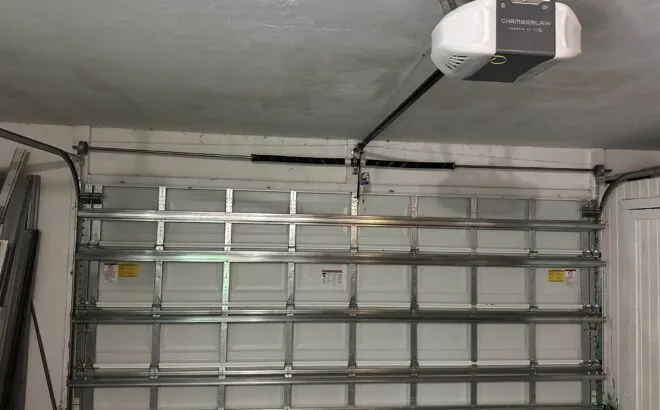
Two-car garages under the trees
Lynnfield’s larger colonials tend to sit well back from the road on wooded lots, with an attached two-car garage at one side of the house and a long driveway winding up to it. Most of the work on garage doors Lynnfield MA owners call us about comes down to that setting: wider, heavier doors, plenty of shade and leaf fall, and a garage that may be some distance from the street and the mailbox.
Closing off a two-car opening takes one of two forms. On some houses one broad slab covers both parking spaces; on others, twin single-width doors flank a centre post. A wide door weighs far more than a single, so its springs are larger and its cables and drums carry more load. A pair of doors halves the weight per door but doubles the hardware, and the two often wear at different rates because one bay gets used more than the other.
Before you ring, these three observations save time:
- Which door has the problem, if there are two, and whether the other one still works normally.
- Whether the bottom edge of the faulty door is level or slanted across its width.
- Whether leaves, needles or twigs are packed along the threshold or inside the vertical rails.
Garage door services in Lynnfield
Repair work
Bowed sections on wide doors, split hinges, rollers worn flat, a bottom rubber chewed by grit and leaves. Faults are traced before parts change. See garage door repair.
Spring breaks
Wide doors usually ride on a pair of torsion coils; when one snaps, the other cannot carry the load. Extension-spring doors fail too. Our spring repair page covers both.
Openers and long-range remotes
Remotes that only work halfway up the drive, a motor straining with a wide door, safety eyes clogged with cobwebs. LiftMaster units are among those repaired and replaced. See opener services.
Late-night breakdowns
A door wedged open with the house beyond it, or shut on the only way out for the car. Our line is answered at any hour. See emergency repair.
Cables and drums
A wide door hanging from one frayed cable drops hard on that side. Both cables are renewed, and the drums inspected. See cable repair.
Off-track doors
A twisted wide door can pull rollers out along its whole height. It is braced before anything moves. See off-track repair.
New doors
For doors with rotted bottom sections or warped panels, new doors are supplied and installed, single or double width. See new garage door installation.
What leaf fall and shade do to a door
A garage surrounded by mature trees collects debris that a door on an open lot never sees. Each autumn, on garage doors in Lynnfield set among tall trees, leaves drift up against the threshold and get pressed into the bottom rubber each time the door closes. Pine needles and seed pods drop into the vertical rails, where rollers grind them into a paste. Twigs lodge in the hinge knuckles. Over a season this adds friction and, eventually, a roller that skips or a bottom edge that no longer seals.
Shade adds damp. A door that rarely sees full sun stays wet longer after rain, and on wood doors that shows first along the lowest section, where the paint lifts and the timber softens. Steel doors are not immune: where the finish is scratched, rust starts along the bottom edge and around the hinge screws. The vertical rails can corrode at the base where water sits.
A sweep of the threshold and a look inside the lower rails in late autumn does a surprising amount of good. Anything more than that, such as replacing a softened section, a worn seal or corroded hardware, is a straightforward visit.
A room over the garage
On many colonials the garage is not a bare shed tacked onto the side. There may be a bonus room, a playroom or an office built over it, or a family room sharing the inside wall. That changes what a noisy or badly balanced door means. A worn chain drive clanking right beneath a room is more than an annoyance; the racket usually means the springs no longer carry their share and the motor is making up the difference. Rollers that have flattened on one side thump with every revolution, and the sound carries up through the joists.
It also makes insulation worth thinking about. A thin, uninsulated door on a two-car opening is a large cold panel next to heated rooms. Gaps along the bottom and sides let cold air pour in. Renewing the perimeter seals is a small repair that keeps the rooms overhead noticeably warmer, and an insulated replacement door does more again.
When an opener is replaced under a room, the drive type matters. A belt drive runs more quietly than a chain, and mounting the motor on rubber isolators helps keep vibration out of the floor above. Those are choices we talk through on a visit.
The weight of a double-width door
A single door spanning a two-car opening is long, and long doors behave differently. Each section is a wide horizontal panel that wants to sag in the middle, which is why such doors often carry steel reinforcing struts across the top sections. Where a strut is missing, or its bolts have backed out, the door bows as it rolls back under the ceiling, the middle rollers bind, and the opener has to push harder.
Its springs are rated to match that heft. Many use two torsion springs on one shaft, one each side of the centre bracket. If one breaks, the other is suddenly asked to do the work of two, and it will not manage it for long. Replacing both together keeps the pair balanced and avoids a second visit when the older one fails shortly after.
On these wide slabs a torsion spring holds dangerous tension; heavy coils store a great deal of it. Adjusting, unwinding or replacing them is not a DIY repair. Nor are the cable drums or the corner brackets near the floor, because the spring’s pull runs straight through them. If a spring on a wide door has snapped, leave the door down, keep the cars out of its path, and call. More on the two spring types is on our spring repair page.
A long driveway and the remote control
On a lot where the house sits far back from the road, the remote is expected to work from a long way off. When it stops reaching, owners often blame the battery first, and that is often right. But range also drops when the opener’s antenna has been folded up against the motor, when a new light fitting near the opener interferes with the signal, or when the receiver itself is failing.
Keypads help on a long approach, letting someone open the garage on foot without a remote. Mounted outside by the opening, they face the same rain, leaves and cold as the door, and contacts corrode. A keypad that ignores its code after a cold snap may need nothing more than a battery, or it may need replacing.
For the opener, a heavy wide door is a demanding job. An opener sized for a single door will strain on a double one, especially if the door has fallen slightly out of balance. So any opener we repair or put in on a double bay is chosen with that door’s span and heft in mind. LiftMaster openers are among those we work on, both repair and replacement. See our opener services page for remotes, keypads and safety sensors.
Two doors, two openers
Where a two-car opening has a pair of single doors, each normally has its own opener, its own wall button and its own channel on the remotes. That arrangement is handy, since a broken left bay never strands the car parked on the right, but it brings its own small puzzles.
Remotes get swapped between cars and reprogrammed for the wrong door. A wall control panel with two buttons gets wired up the wrong way round after an electrician has been in. One opener is replaced and the other is not, so the two doors run at different speeds and sound quite different. And because one bay usually holds the daily car while the other holds the second car or the mower, one door racks up far more trips, wearing its rollers, springs and opener first.
When a pair of doors is serviced, both are looked at, even if only one has failed. The door that has been carrying most of the traffic often shows the same wear that has just failed on its neighbour, and catching it on the same visit saves a second call. Remotes and keypads can be re-paired to the right door at the same time.
Cables, rollers and a door out of line
On a wide door, a cable failure is dramatic. The side that loses its cable drops, the opposite side stays up, and the door racks across the opening. Rollers along the dropped side are pulled out of their rail, and the panels can crease where they twist. Even a door with one frayed but unbroken cable will start to lift unevenly, which strains the hinges and pushes rollers against the rail edges.
Never try to lever a racked double door level, and do not run the opener on it. It is heavy, the spring on the other side may still be fully wound, and it can drop without warning. When we arrive, the door is clamped in place, tension is released safely, the rollers are guided back in or the bent rail section is replaced, and a fresh cable goes on each side so the slab rises square. Our cable repair and off-track repair pages go further.
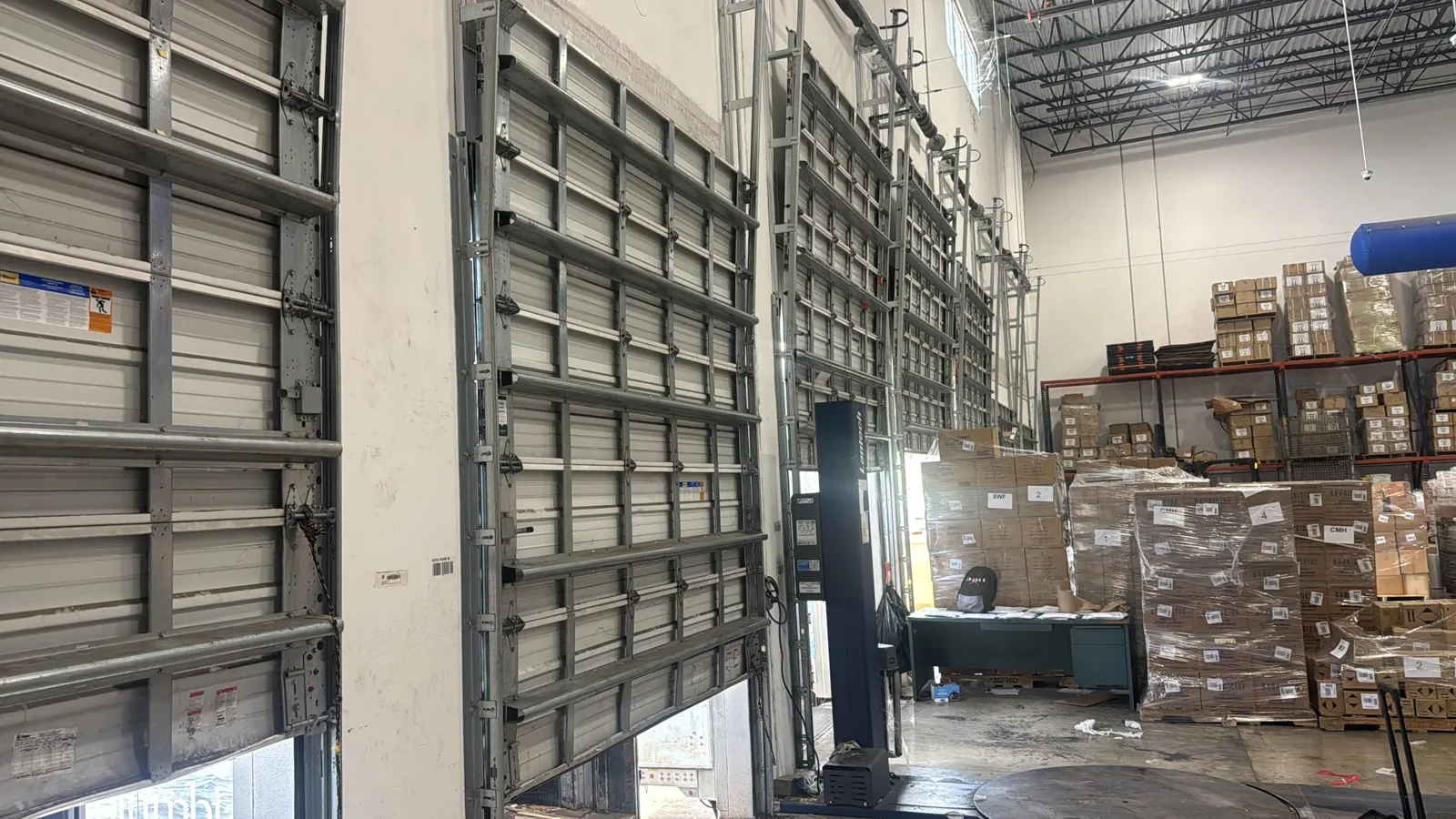
Storms, fallen branches and lost power
Wooded lots bring the occasional broken branch, and branches sometimes land on a driveway or against a garage. A limb that strikes the door can dent sections, bend a rail or knock rollers loose. After a strike like that, keep the motor idle until the bay has had a proper inspection, since a kinked rail or a cracked section can wedge it halfway.
Storms on wooded streets can also cut power. With the opener dead, the car stays in unless the door is released by hand. The red cord hanging from the opener rail disconnects the door; with the door closed and the springs intact, it can then be lifted by hand and should feel reasonably light. Should it feel as heavy as a piano, or sink as soon as your hands leave it, a spring has failed, so lower it gently and leave it shut. When power returns, running the opener normally re-engages the trolley.
Slopes, puddles and the bottom seal
A long driveway rarely runs dead level. Where it drops towards the garage, rain and meltwater head straight for the doors and pool along the threshold. The rubber seal on the bottom of each door is the only thing keeping that water out, and it wears faster than any other part of the door. Leaf grit pressed into it each autumn cuts it, cold makes it stiff, and the door’s weight flattens it.
A failing seal shows itself as a damp strip on the garage floor after rain, a line of light under a closed door, or leaves and needles blown into the corners. On a wooden door, constant wet at the bottom edge is what rots the lowest section first. On steel, it starts rust along the bottom rail.
Replacing a bottom seal is a modest repair, done in the same visit as anything else. While it is off, the bottom section and the corner brackets are checked for rot and corrosion, because a softened bottom rail can let the cable bracket pull loose under the spring’s tension.
In winter, that pooled water can freeze the seal to the slab. When a frosty morning finds the slab and rubber fused, quit pressing the button before the opener strains or a cable jumps its drum. Clear the ice along the bottom edge and try once more, or call.
What a visit involves
- Any door that is hanging, racked or out of its rails is secured before work begins.
- Both doors on a pair are checked, not just the faulty one: springs, cables, drums, rollers, hinges, struts, rails, seals, the opener and its sensors.
- Nothing is swapped until we have walked you through the fault and the proposed fix.
- The fix goes in, the springs are wound until the slab floats, and the opener is tuned for how much this particular door weighs.
- Together we cycle the door a few times and confirm it backs off when something blocks its path.
On a long driveway, leaving a car or two parked near the road, and the garage floor clear just inside the doors, gives room to work on both faces.
Repair it or replace it
A double door with sound panels is almost always worth keeping, since everything that moves on it can be swapped piece by piece. Starting over becomes sensible only once the panels are beyond help: soft or rotted wood at the bottom, deep dents across several panels, a door that has bowed permanently along its length, or rust that has eaten through the steel.
On a colonial, the garage doors are a large part of what is seen from the drive, so a replacement is also a choice about appearance. A wide single door gives one clean span; a pair of singles keeps the two-bay look and lets one door keep working while the other is serviced. Insulated doors suit a garage with a room above or beside it. New doors are supplied, fitted to the opening and balanced, and the old doors are taken away. The new garage door installation page walks through the steps.
Getting help with garage doors Lynnfield MA
If one of your garage doors in Lynnfield is stuck, noisy, crooked or slow, tell us which door it is and what it is doing. Someone is on the line at any hour, holidays included, and Google reviewers rate us 5.0. Our work reaches the neighbouring towns too, Peabody and Wakefield among them, and every covered town is listed under service areas. For garage doors Lynnfield MA homes rely on, call us or book online.
Questions from Lynnfield
One of my two doors works and the other does not. Is it the opener?
If each door has its own opener, and the remote for the stuck door does nothing, the opener is a likely suspect. If the motor whirs yet the door rises only a little, suspect a snapped spring on that side instead. Either way, call before trying to force it.
My remote only works close to the garage. Is that repairable?
Usually. A new battery, an unfolded antenna or moving a light that interferes can restore range. If the receiver is failing, the opener may need repair or replacement.
Should both springs be replaced when one breaks?
On a door with two torsion springs, yes, as a rule. They age side by side, and the survivor rarely lasts long alone. Because a torsion coil stores serious force, its replacement belongs with a technician.
Leaves keep jamming my door. What can I do?
Sweep the threshold and clear the lower rails regularly in autumn. If the bottom seal has split or the rollers are worn, those can be replaced on a visit.
Do you fit new double-width doors?
Yes. New doors are supplied and installed, single or double width, sized to the opening and balanced on matching springs.