
Why a Mission Hill garage is worth keeping in working order
Garages are scarce on the steep streets that climb away from Tremont. Most of the brick row houses and triple-deckers there were built with no garage at all, so the ones that do exist carry a lot of weight: they are where a car goes when the kerb is full, and the kerb usually is. When one of these doors stops working, the car either stays shut inside or ends up circling for a space. Garage door repair Mission Hill MA owners ask us about is nearly always about getting that one door back in service and keeping it there.
The hill itself puts its own wear on a door. A garage on a grade often has a floor or an apron that falls away toward the street, so the bottom section meets the ground unevenly and the rollers on one side do more of the work than the other. Rain and meltwater run downhill and straight at the threshold. Over the years that shows up as a torn bottom seal, a rusted bottom section, a track pulled slightly out of plumb and a door that no longer closes square.
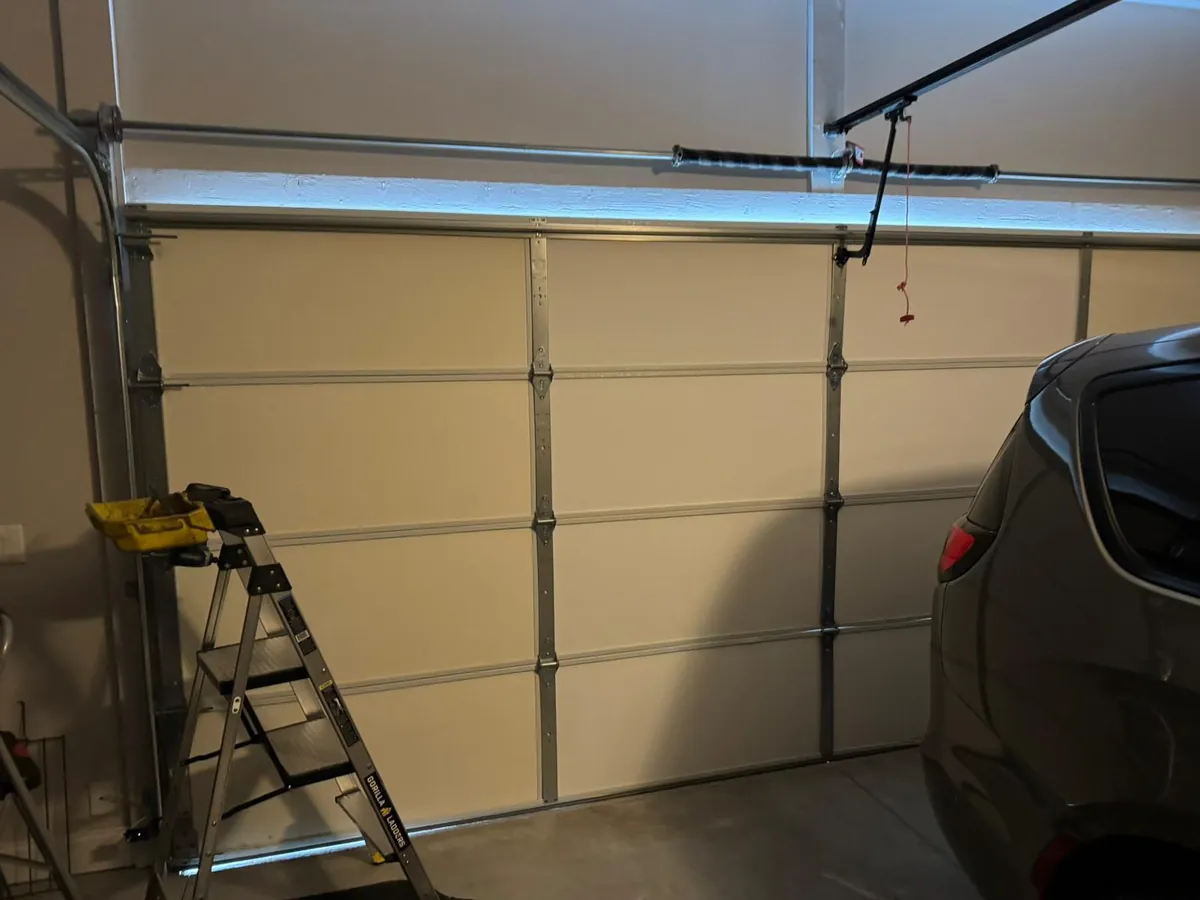
From a safe distance, and with your hands off the springs and cables, look for these three clues before picking up the phone:
- Whether the spring over the opening has split into two pieces, or a side spring is dangling from its pulley.
- Whether a lift cable near the lower corners looks loose, kinked or unspooled.
- Whether the door hangs level, or tilts so one side sits lower.
What a repair can cover on these garages
Springs
Without its springs, a door is far too heavy for the opener, which stalls a few inches up. Torsion and extension springs each get their own treatment on our Mission Hill spring repair page.
Cables and drums
Steel lift cables hold up the two lower corners. Lose one and that side drops, wedging the door crooked in its frame.
Panels and the bottom section
The lowest section takes the water, the salt and the knocks from a sloping apron. Single sections can often be replaced on their own.
Openers and remotes
Motors that drone but never move the door, remotes that only reach from the driveway, dead wall buttons. More on the Mission Hill opener repair page.
Tracks and rollers
Flat-spotted rollers, brackets working loose from old brick, rails bent out of true, and doors that have left the rails altogether.
Safety sensors
Paired photo eyes near floor level, whose beam makes a descending door reverse. A floor that is not level makes them harder to keep lined up.
A door that has to work on a slope
An overhead door is designed around a level floor. The tracks stand plumb, the bottom section closes flat along its whole width and the seal squeezes evenly. Steep streets do not always allow that. Where a garage floor or the apron in front of it falls toward the street or across the opening, the bottom of the door meets one side of the threshold before the other.
A door in that position still works, but it works harder. When the door closes onto the high side first, the opener has to push the rest of the way down against resistance, and on some settings it reads that resistance as an obstruction and reverses. If the down limit is set to close the low side properly, the high side gets crushed into the seal every time. The rollers on the low side carry a little more of the door’s weight, and the hinges between the sections flex a little more on each trip.
None of this needs a new door. It needs the door set up for the opening it actually sits in. Typical fixes are a bottom seal chosen to fill an uneven gap, track brackets reset so both vertical tracks stand true even where the jamb does not, and the opener’s travel and force adjusted for that particular floor. When garage door repair in Mission Hill involves a garage on a grade, those adjustments are part of the job, not an extra.
Water at the threshold
On a hill, water goes downhill, and a garage door that faces down the slope sits in its path. Rain sheets off the pavement, meltwater runs down from the snow banks along the kerb, and a heavy storm can push a shallow stream against the bottom of the door. Salt spread on the street in winter goes with it.
That is hard on the lowest part of the door. A steel bottom section starts to rust from the inside of its lower edge, where water sits behind the seal. A timber door soaks up water along its bottom rail until the wood softens and the door gets heavier, which in turn throws off the spring balance. The bottom seal itself hardens, cracks and pulls out of its retainer.
Replacing a worn seal and the retainer that holds it is one of the most useful small repairs a garage on a slope can have. Where the bottom section has already rusted through or rotted, that one panel can usually be swapped out without touching the rest, so long as a match for it can still be sourced. If the damage has crept up into the sections above, the conversation shifts toward a new door, which is covered further down.
The parts that make a door move
Whatever its age, an overhead door is a small system of parts that only works when each does its share. Most of a repair is tracing the failure to the part that started it, then checking what that part took with it.
Springs. A typical door relies on a torsion spring fixed above the header on a steel tube, winding up as the door descends and unwinding to help lift it. Lighter or older doors may instead hang from two extension springs that stretch beside the overhead rails. Whichever kind is fitted, it is the spring, not the opener, that supports the load, and once it snaps the full weight of the door is back in play.
Cables and drums. Steel cords lead from the spring system down to brackets at the foot of each side. Torsion setups reel them onto grooved drums at the shaft ends; extension setups thread them through sheaves. Fraying usually starts where a cable rubs, and a cable that leaves its drum lets that side sag.
Rollers, hinges and tracks. The rollers ride in the rails, the hinges let the sections fold over the curve at the top, and the brackets anchor everything to the building. Trouble in any one of them shows as drag, a crooked fold, or a rail that slowly creeps out of position.
Opener and sensors. An opener is built to steer a door that the springs already balance, not to hoist dead weight. Its photo eyes report anything blocking the doorway. Ask it to haul a door that is binding or out of balance and it labours every cycle until its gears or the door give way.
What happens on a visit
First the door is tried without the motor. With the opener’s trolley released, the door is raised by hand to roughly hip height and let go. A properly balanced door hovers there; a door with a failing spring either sinks back or will hardly lift at all.
After that comes a methodical look at the hardware, from the top of the door down: spring and shaft, the drums or pulleys, each cable along its length, every roller and hinge, the rails from floor to back hanger, and the fixings into the wall. Old brick and old timber deserve care here, since a bracket set into soft mortar or worn wood will work itself loose again no matter how good the part hung from it. Where the opener is suspect, it is tested on its own with the door unhooked, along with each remote, the wall control and the alignment of the eyes.
You are shown what broke, the reason it broke and anything else that is close behind, and nothing is done without your say-so. When the repair is finished the door is balanced, the opener’s travel and force are set for this door on this floor, and a length of timber is laid across the threshold so the auto-reverse can be proved before we leave.
Getting a van and parts to the door
Heavy on-street parking is part of working on these streets. There is rarely an empty space right outside the garage, so a technician may have to park further along and carry springs, cable, track sections and a ladder up or down the hill to the door. That is normal, and it does not change the repair, but a few things make the visit go more smoothly.
If you can keep the space in front of the garage door clear, do. A car parked across the apron can block the door from opening fully, and a door that cannot open cannot be balanced or tested. Clear the floor just inside the door too, since the work happens on both sides of the bottom section. And if the garage is reached through a shared passage or from the back of a row of buildings, mention it when you get in touch, and the route to the door will be worked out in advance.
What is safe to check yourself
Some checks are harmless and can point straight at the problem:
- A door frozen halfway should not be asked to move again. Pull the opener’s power cord out at the ceiling.
- Check the photo eyes on either side near the floor. An uneven slab nudges them out of alignment easily; when one indicator glows and its partner flickers or stays dark, a gentle realignment and a wipe of the lenses may be all it takes.
- One remote dead and the rest fine? Use the wall control. If the door answers, change the remote’s battery before anything else.
- Sight down each rail for an obstruction: a rake, a fallen bracket, a bag caught in the curve.
Do not touch anything that holds the door’s weight. That means the torsion spring and its winding cones, the set screws on the shaft, both cables, and the lower corner brackets that anchor them. They are loaded at all times, open or shut, and if that load is let go carelessly the parts can fly loose hard enough to injure someone. A torsion spring holds dangerous tension; treat it, and the cables tied to it, as a job for us and never a DIY repair. If the spring has gone, let the door stay exactly where it stopped, and the wall button should be left alone.
When rollers leave the rails
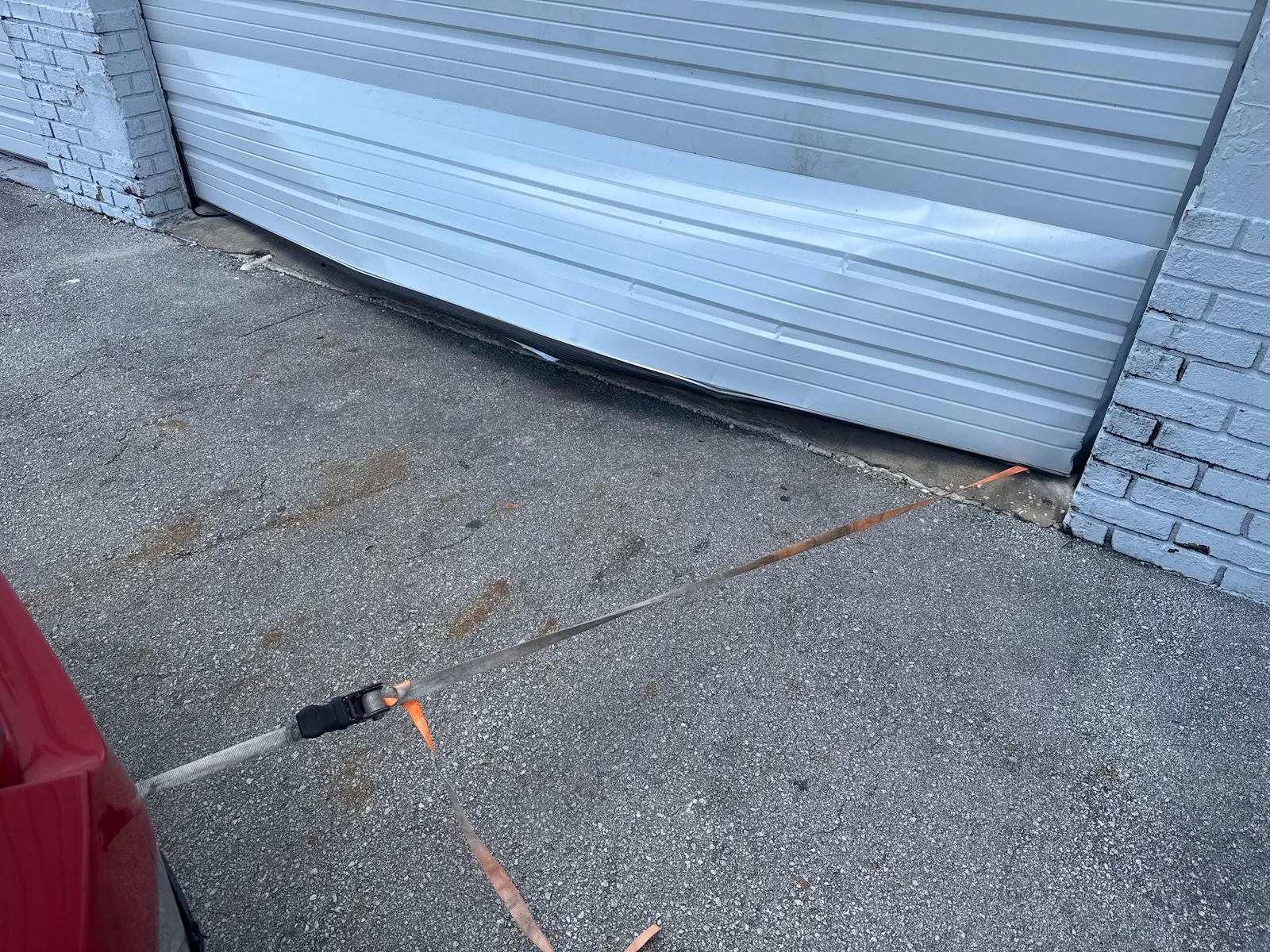
A door on a sloping floor that closes unevenly, or a door that catches a car bumper on the way down, can push a roller out of its track. With one side loose, the door tilts in the opening and could come down. Running the opener at that point drags the door further out and usually bends the track as well.
The fix starts by locking the door in place with clamps so its weight comes off the rollers. Each roller is then eased back into its rail, any kinked length of track is trued or renewed, and the cables are set to share the weight evenly before anyone operates it. On a hill, where the door may already have been closing unevenly, it also means finding out why it came out in the first place, so it does not happen again a month later. Derailed doors have their own explanation under off-track garage door repair.
Old brick, new hardware
Many garages in older brick buildings were not built for the door they now carry. Openings were widened, headers were added, and doors have been swapped more than once over the life of the building. Each change can leave a jamb a little out of plumb or a header with less room above it than a modern door would like.
That affects how parts are chosen. Low headroom above the opening limits where a torsion spring can sit and which opener will fit. A jamb that is not plumb means the track has to be set off it rather than to it. A masonry wall needs the right anchors, and a bracket that has already been moved once may need a new position in sound brick. These are ordinary problems on older garages, and dealing with them is part of doing the repair properly rather than just fitting a part.
Repair or replace
On this hill, fixing usually wins. Springs and cables, like rollers, hinges and seals, wear out by design and are renewed as a matter of course; behind them, a sound set of sections can keep going for many more years. On the hill there is a further reason: getting a whole new door up these slopes is hard work, so a door already hanging in the opening is worth holding on to when it has life left in it. Garage door repair Mission Hill MA owners choose over replacement also avoids losing the garage for longer than the repair itself takes.
The case for a new door builds when the sections, rather than the hardware, are giving out: rust eating up from the bottom edge, timber gone spongy or cracked across several panels, or a wooden door so swollen with rainwater that no spring can balance it any longer. Every garage door repair Mission Hill MA visit ends with a plain verdict on which of those camps your door falls into. If a new one is the better use of money, our new garage doors in Mission Hill page sets out how a door is carried to and fitted in a garage on these streets.
When the door will not wait
Doors pick their moment badly: a car locked in ahead of an early shift, a door jammed open onto a busy street after dark, a spring letting go on a cold evening. Someone picks up our phone whatever the hour, weekday or holiday, which means a failure at midnight need not sit unreported until morning. For a door stuck open, one that will not lift, or one hanging out of its rails, read the Mission Hill emergency repair page for what to do in the meantime.
Beyond this neighbourhood, our general garage door repair page describes the service citywide, and the Mission Hill page brings together everything we do locally.
Booking a repair
For garage door repair Mission Hill MA homes rely on, the useful details are how you get to the garage, whether its floor slopes, what the door is doing or refusing to do, any part that is visibly damaged, and whether your car is shut in. With those details to hand, the next step is easy: call us or book online.
Questions from Mission Hill
The door closes on one side but leaves a gap on the other. Is that a fault?
Often it is the floor rather than the door. On a sloping garage floor the bottom section touches down on the high side first. A bottom seal suited to the gap and a careful setting of the opener’s travel usually fix it, but a gap that has appeared suddenly can also mean a cable or spring problem, so it is worth having looked at.
There is nowhere to park outside the garage. Can the repair still be done?
Yes. The van may have to park further along the street, with parts carried to the door. What matters most is that nothing is parked across the front of the garage, so the door can be opened all the way for balancing and testing.
Water comes in under the door when it rains. What can be done?
A worn or hardened bottom seal is the usual cause, especially where the street runs down toward the garage. Replacing the seal and its retainer usually closes the gap. If the bottom panel has corroded or gone soft along its lower edge, it can usually be changed by itself.
The opener struggles and stops halfway. Should I replace it?
Not before the door is checked. An opener that stops partway is often reacting to a weak or broken spring that has left the door too heavy for it. Unplug it, stop using it, and have the door looked at first; the opener may be fine once the door is balanced again.
Should I keep running a door that has begun to shudder or scrape?
Better not. Shuddering and scraping usually come from a part on its way out, such as a roller, hinge, cable or spring, and every cycle passes the strain on to the parts around it. Where a garage is shared, let the others know to leave it closed until it has been checked.