
A stuck door on a service alley cannot wait for morning
Garage doors fail at awkward hours. A door that refuses to close after a late return leaves a carriage house open to the service alley all night. A spring that snaps before dawn traps the car inside a ground-floor bay just when it is needed. Emergency garage door repair in Back Bay rests on one simple fact: the phone is answered at any hour, every day of the week, so the problem can be reported the moment it is found, whether the door is on Commonwealth Avenue, Marlborough Street or the alley behind Newbury Street.
In the first few minutes, a little calm makes everything safer. Three things to establish before you call:
- Is the door closed, open, or stuck partway, and is it level or hanging at an angle?
- Is anyone, or any car, trapped inside the bay?
- Is there an obvious broken part: a gap in a spring, a loose cable, or rollers out of the track?
The breakdowns we are called out for
Door will not open
Usually a broken spring, a failed opener or a door that has jammed in its track. The car is often inside.
Door will not close
Often the safety sensors, a door off its track, or an opener that has stopped with the bay left open to the alley.
Broken spring
A loud bang, then a door too heavy to move. The most common urgent call of all. See spring repair in Back Bay.
Off-track door
A door hanging crooked, with rollers outside the rail. Unstable, and never one to run with the opener.
Why a breakdown matters more in this neighbourhood
Most Back Bay brownstones have no private garage at all. Where one exists, it is a single bay cut into the ground floor of the house or a carriage house facing the service alley behind it. There is rarely a second bay to fall back on and rarely a driveway to leave the car on instead, so a single failed part takes the whole garage out of action at once.
The position of these garages adds to the pressure. A carriage house door that is stuck open faces a narrow alley used by neighbours, deliveries and bin collections, so the bay and whatever is stored in it are exposed until the door is closed again. A ground-floor bay that is stuck open may give direct access into the house itself. And a door that has dropped at an angle in a tight opening can block the alley-side entrance completely. These are the situations in which emergency garage door repair in Back Bay is most often requested, and the reasons that a broken door here is treated as urgent.
What to do in the first few minutes
The instinct is to keep pressing the button, or to try to lift or pull the door by hand. Both can make things worse. Some steps are safe and useful:
- Stop using the opener. If the door is stuck partway, unplug the opener so it cannot try again.
- Keep people, pets and cars away from the opening, especially if the door is at an angle or partly open.
- Look, without touching, at the springs above the door and the cables at its bottom corners.
- If the door is closed and intact, leave it closed.
- If the door is open and the springs and cables look sound, the release cord on the opener may let you lower it gently by hand. If it feels heavy or starts to fall, let it go and step back.
Other parts must be left alone. A torsion spring holds dangerous tension whether the door is open or closed, and so do the cables and the bottom brackets they attach to. Loosening a bolt, prying at a bracket or trying to wind a spring at night with a torch in one hand is how people get hurt. It is not a DIY repair. A door with a broken spring is a dead weight that nothing is holding up.
Doors that will not open
When the car is trapped inside, the cause is usually one of three things. The most common is a broken spring: the opener lifts the door a few inches, then stops, because it cannot lift the full weight on its own. The second is an opener fault: the motor hums, clicks or does nothing, while the door itself is fine. The third is a door that has jammed, often after it came off its track or after a cable snapped on one side.
The manual release is the test. With the springs and cables intact, pulling the cord and lifting gently should raise the door. If the door is far too heavy to lift, the spring has failed, and the door should stay down until it can be repaired safely. Forcing it up, or propping it open with something, risks the door dropping without warning.
Doors that will not close
A door stuck open is the security problem. The most common cause is the safety sensors. In an alley-facing bay, a bin or a delivery nudged against one of the photo eyes near the floor knocks it out of line, and the opener refuses to close the door. Wiping both lenses, clearing the beam and checking whether the small lights on each sensor glow steadily solves a surprising number of night-time calls.
If the sensors look fine, the problem may be the opener’s limit setting, a door that binds in its track, or a door that has come off its track entirely. An off-track door must not be closed with the opener. If you cannot close the door safely, keep the bay as secure as you can: move valuables out of reach, lock the internal door into the house if there is one, and call. It is better to describe a door that is stuck open than to try to force it shut.
Broken springs and off-track doors at night
Broken springs and off-track doors are the two breakdowns that most often need urgent help. They are also the two that are most dangerous to tackle alone.
A broken spring usually announces itself with a bang loud enough to be heard through the house. On a door cut into a brownstone ground floor, it may be heard in the rooms above. Afterwards, the door will not lift, and the cables may hang slack. The door should stay where it is until a technician can unload the remaining tension, fit a new spring and balance the door. The spring repair page for Back Bay explains the work in detail.
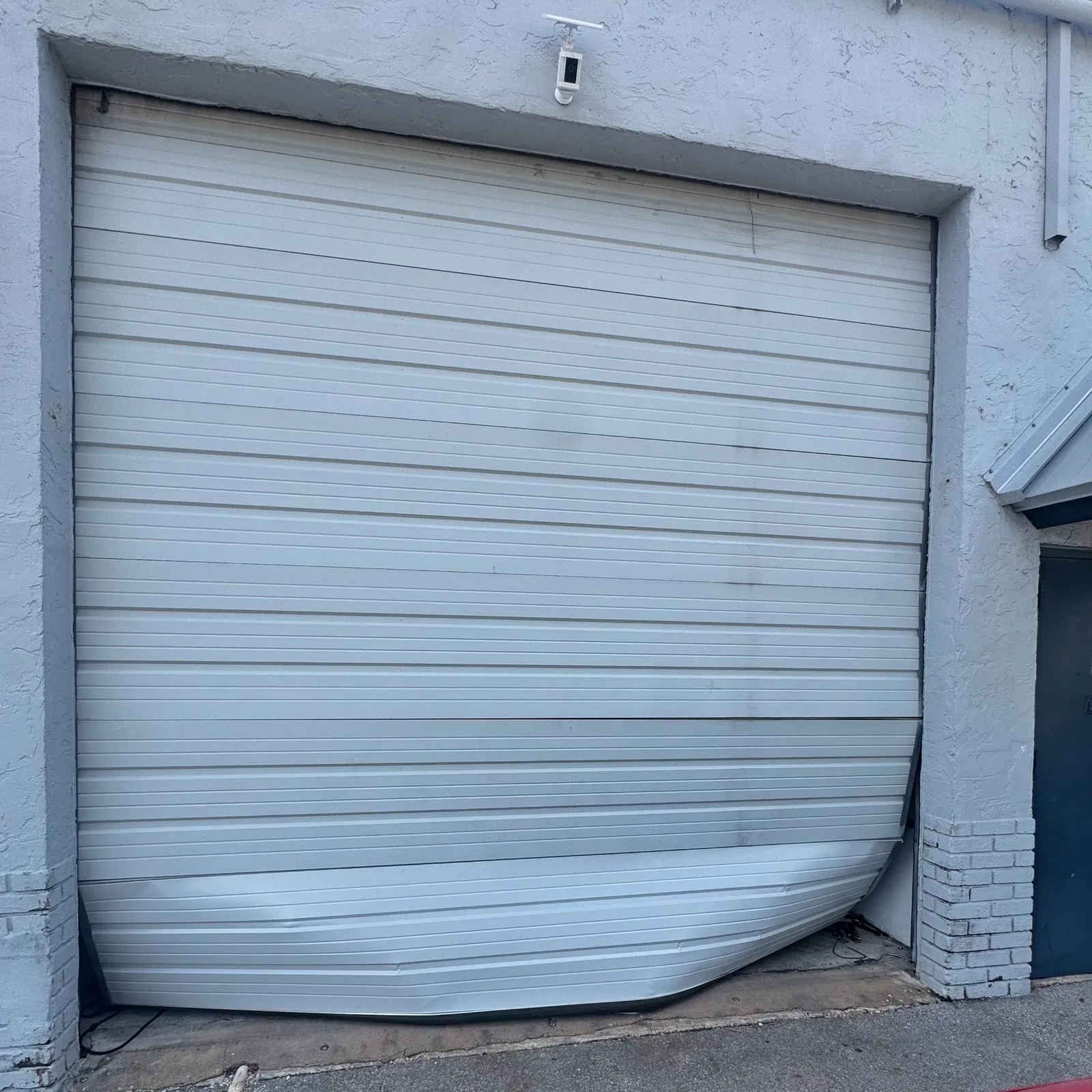
An off-track door is one where one or more rollers have left their rail. In a tight Back Bay opening this often follows a car clipping the door while turning in from the alley, a snapped cable on one side, or an opener that kept pushing against an obstruction. The door hangs crooked and is unstable. It should not be run, pushed or pulled. Bringing it back means taking the weight off the door safely, freeing the rollers, straightening or replacing bent track and checking both cables before the door runs again.
What happens when you call
When the call comes in, the questions are practical. What is the door doing? Is it in a ground-floor bay or a carriage house on the alley? Is a car or a person trapped inside? Can you see a broken spring or a loose cable? Is the bay open to the alley? The answers help decide what to bring and how to approach the door.
The phone being answered at any hour is a fact about the line, not a promise of an arrival time. When you call, you will hear what is possible for your door and when, and you can decide how to proceed from there.
Winter breakdowns
Hard weather brings its own urgent calls. Slush and runoff collect in the service alleys and pool along the bottom of carriage house doors, and on a freezing night that water can lock the bottom seal to the ground. An opener that tries to lift a frozen door strains against it, may tear the seal, and can pull the door out of line or burn out its motor. If a door will not move on a cold morning and the springs look intact, unplug the opener and check the bottom edge before trying again. Gently breaking the ice along the seal is safe; prying under the door with a bar is not, because it can bend the bottom section.
Cold also makes spring steel less forgiving, so the first deep freeze of the season tends to bring a run of snapped springs. Grease in the rollers and hinges stiffens at the same time, and an opener that was coping in autumn can give up altogether. Many of the calls for emergency garage door repair in Back Bay arrive on exactly those mornings.
Keeping the bay secure while you wait
If the door cannot be closed, a few steps help until it can. Move bicycles, tools and anything of value away from the opening or into the house. If the garage connects to the house through an internal door, lock that door. Turn on the garage and outdoor lights, which makes an open bay less inviting and makes the door easier to work on when help arrives. Do not try to wedge the door down, tie it or prop it with timber: a door that is off its track or carrying a broken spring can shift under that kind of pressure, and a sudden drop is far more dangerous than an open bay.
If the door is closed but will not open, and the car is needed, it is usually safer to make other arrangements for the morning than to try forcing the door. A closed, stable door is the best situation to be in while waiting for a repair.
What an emergency visit involves
- The door is made safe first. If it is off its track, at an angle or stuck partway, it is secured so it cannot move or fall. The opener is disconnected.
- The cause is found. Springs, cables, drums, rollers, tracks and the opener are checked, because an urgent failure often has a second problem behind it.
- You are told what has failed and what it will take to put right, and the repair is carried out: a spring replaced, a door put back on its track, a cable renewed, sensors realigned or an opener repaired.
Once the door works again, it is balanced, the opener’s limits and force are reset, and the safety reverse is tested. The door is closed fully at the end of the visit, so the bay is secure. If a full repair cannot be completed straight away, perhaps because a large part needs ordering, the door is left closed and safe until it can be.
Working in the alley at night
Carriage houses sit on the service alleys behind the main streets, and those alleys are narrow. A service vehicle has limited room to stop, and resident permit rules shape where it can park and for how long. At night the alley is usually quieter, which can make access easier, but lighting is often poor. A garage light, an outdoor light or simply leaving the bay lit helps a technician see the door, the tracks and the springs safely.
Bays cut into a brownstone’s ground floor are reached from the street side or the alley, depending on the house. Letting us know which, and where a vehicle can stop nearby, saves time on arrival.
Remotes, wall buttons and power cuts
Some night-time failures are electrical rather than mechanical. A power cut stops every opener at once, and a ground-floor bay whose door is its only exit can leave a car stuck until the power returns. The red release cord on the opener’s trolley lets the door be raised by hand, as long as the springs and cables are intact. Once power is back, pull the door along until the trolley reconnects, or run the opener and let it pick the door up.
If the power is on but the opener does nothing, check that it is still plugged in and that the circuit has not tripped; in a ground-floor bay the garage circuit may be shared with parts of the house. A remote that has stopped while the wall button still works points to the remote or its battery, which is irritating at midnight but rarely an emergency.
Calls that can wait for daylight
Not every fault needs a night-time visit. A noisy door that still opens and closes, a remote that has stopped working while the wall button still does, or a slightly torn bottom seal can all be booked for a normal hour. The test is simple: if the door is secure, nobody is trapped, and nothing is hanging at an angle, the repair can usually wait. If any of those are not true, call. The general repair page for Back Bay and the opener repair page for Back Bay explain the everyday faults.
When the door is beyond saving
Occasionally an emergency reveals a door that should be replaced rather than repaired: sections rusted through at the bottom from standing water in the alley, a wooden door too waterlogged to balance, or a door so badly damaged by a vehicle that it no longer fits the opening. In that case the door is made safe and closed for now, and replacement is planned. Because alley width and resident permit rules decide when a door can be delivered, the new garage doors page for Back Bay is worth reading if that is where things are heading.
Calling us at any hour
The phone line is open 24 hours, 7 days a week. If your door has failed, describe what it is doing, where the garage is, and whether anyone or anything is trapped inside. For emergency garage door repair in Back Bay, call us or book online. The main emergency garage door repair page has more on urgent breakdowns, and the Back Bay page lists everything else we do in the neighbourhood.
Questions from Back Bay
My carriage house door is stuck open on the alley at night. What should I do first?
Stop using the opener and check the sensors near the floor. If a bin or delivery has knocked one out of line, clearing it may let the door close. If the door is off its track or a spring has broken, leave it, secure what you can inside, and call.
The car is trapped in a ground-floor bay and the door will not lift. Can I force it?
No. If the door will not lift with the opener released, the spring has almost certainly broken, and the door is a dead weight. Forcing or propping it risks it dropping. Call for emergency garage door repair in Back Bay instead.
Will someone come straight away?
The phone is answered at any hour, every day of the week. When you call, you will be told what is possible for your door and when, so you can decide what to do.
Is it safe to close a door that is hanging at an angle?
No. A door that is crooked in the opening has usually come off its track or lost a cable. Running it can bring it down. Keep clear of it and call.
What details help when I call?
What the door is doing, whether it is open or closed, whether the garage is in the house or on the alley, whether a car is inside and anything visibly broken. Mention where a vehicle can stop nearby.