
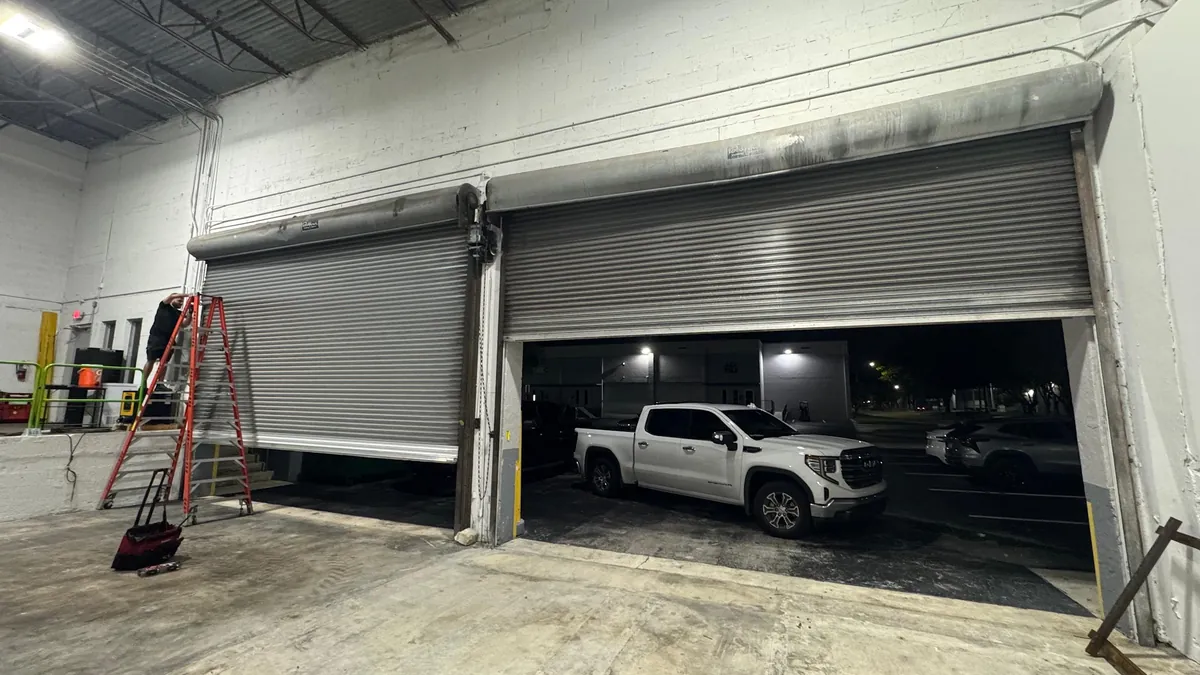
Carriage houses on the alley, bays under the brick
Stand on Shawmut, Tremont or Columbus and the blocks read as one long run of brick row houses, stoops and bay fronts, with hardly a garage in sight. The garages are round the back. Many sit along the rear alleys as carriage houses, low brick or frame buildings that once sheltered a horse and cart and now hold a car behind an overhead door. A smaller number are single bays tucked under a building, where a ground-floor opening has been cut and fitted with a door.
Both kinds put a modern sectional door into a structure that was never drawn up for one. The brick opening may be arched, slightly out of square or narrower than a standard door. The ceiling inside a carriage house can be low, and in a bay under a building there is often a floor of living space directly overhead.
When something fails in one of these garages, it tends to be one of three things:
- A spring that has lost its tension or snapped, leaving a heavy door the opener cannot lift.
- A track or bracket that has worked loose from old brick or timber and let the door drift out of line.
- An opener crammed into a tight ceiling that strains, reverses or stops part way.
Everything we do in this neighbourhood
The South End is where our own shop is, so this is home ground: these are the streets we know best, and the garage doors South End MA owners have are the doors we see more often than any other kind. Every service we offer is available on these blocks, and each has its own page. A door that binds, scrapes, sags or stops falls under garage door repair in the South End. A snapped coil over the opening is handled through South End spring repair. Motors, remotes, keypads, wall buttons and sensors come under opener repair and replacement in the South End. A door jammed open onto the alley at night is a case for our South End emergency repair line. Once a carriage house door is beyond saving, replacement doors for the South End are supplied and installed.
Neighbouring hubs for Bay Village, Back Bay and Roxbury cover garages much like these, and every place we work is listed on our service areas page.
Working in a rear alley
Almost every South End garage job starts with the alley. A rear lane behind a block of row houses is narrow, often shared by every house on that block, and used all day for bins, deliveries, bikes and cars nosing in and out of other garages. Working on a carriage house door means keeping that lane passable while ladders, tools and parts come and go.
For most repairs the footprint is small: a ladder inside the garage, a toolbag, perhaps a spring or a set of rollers. The door can usually be worked on from inside with the alley left clear. Larger jobs, such as replacing a full set of panels or taking out an old door, need room to lay sections down and carry them past the neighbours’ doors. On those, timing matters, and it helps to know what the alley is like before anyone arrives.
When you book, tell us a little about access: whether the alley runs straight through or dead-ends, whether it is paved or cobbled, whether cars usually block it at certain times. Those details shape the visit far more than the door itself does.
A modern door inside an old opening
Carriage houses were built for swinging or sliding doors. The overhead sectional doors in them now were added much later, sometimes more than once, and each change left something behind. Old hinge pockets in the brick, filled holes in the jambs, shims stacked behind a track bracket, a header that was packed down to suit a door that has since been replaced.
That history affects how repairs are done. A track bracket screwed into soft mortar or into a timber that has held several sets of screws can pull loose a little at a time until the door rides out of line. The fix is not always a new bracket; it may be moving the fixing to sound material or adding a backing plate so the load spreads properly. A door that rubs on one side of an arched opening may be perfectly square in itself, and the issue is the opening.
Headroom is the other constraint. A low carriage house ceiling limits the spot a torsion spring can occupy, whether the tracks need a low-headroom arrangement, and how much space an opener has above the door. Any part that is replaced has to suit the room the building actually gives, not the room a catalogue assumes.
The bay under a building
The other South End garage is a single bay let into the street level of a brick building. These openings sit in load-bearing masonry, so the frame is fixed and cannot easily be enlarged. The door has to fit the hole that exists.
Two things make these bays different. First, there is often a bedroom, a kitchen or another unit right above the door, so noise and vibration from the opener and the springs carry straight upstairs. Second, the bay may open directly onto the street or onto a lane where cars and people pass close, so a door that stops half way or will not lock is more than an inconvenience.
Quieter running is often possible. Worn steel rollers can be swapped for nylon ones, a chain drive that clatters can be replaced with a smoother drive, and loose hinges and track bolts that rattle can be tightened. None of that changes the door’s structure; it just stops the whole building hearing it every morning.
Springs on a heavy door
Most garage doors in South End carriage houses and bays hang from a single torsion coil wound around a steel bar over the lintel, or from two extension springs stretched beside the overhead rails. That stored energy is what really raises the panels; the motor merely steers them, and was never meant to haul the whole dead weight.
Of all the late calls from these alleys, broken springs come up most, and in a brick carriage house it announces itself: a crack like a gunshot echoing off the walls, and afterwards a door that stays shut, or one the motor drags up a hand’s width before quitting. Stand back, glance up at the bar over the lintel, and there will usually be a visible split somewhere along the coil.
That coil over the lintel is no place for a screwdriver: a torsion spring holds dangerous tension, and this is not a DIY repair. Winding one up or down needs proper winding bars and a set routine, and a slipped bar can break a wrist or worse. Leave the door shut, disconnect the opener at the socket so nobody in the house presses the button out of habit, and ring us. If the break left the door raised, resist the urge to haul it shut; with its counterbalance gone, a sectional door weighs far more than anyone expects.
On older doors the springs are often renewed as a matched set, since the surviving coil has lifted the door exactly as often as the broken one and is rarely far behind. New springs are matched to what the door weighs today, which counts for a lot in carriage houses, where a door patched, re-skinned or braced over the decades may be much heavier than it started out.
Openers in a tight ceiling
Openers in South End garages work in cramped conditions. In a carriage house, the rail may run almost touching the rafters. In a bay under a building, the motor head may hang from joists that carry a neighbour’s living room.
Typical opener faults on these blocks:
- A hum from the motor head with no movement, usually a failed spring upstream or stripped gearing inside.
- A door that heads down, then bounces back up, nearly always the photo eyes knocked out of line, dusty, or a bin parked across the beam.
- A remote that only works standing in the doorway, not from the far end of the alley, which is often a tired battery or signal interference between close-packed buildings.
- A dead wall button, which may be a broken wire run along old brick, the button itself or the board in the motor head.
We repair and replace openers, LiftMaster openers among them, and fit each one to its door and its ceiling. In a low carriage house, a replacement unit has to sit within the headroom there is, and its up and down limits and its closing force are tuned to that particular door so it stops and reverses properly.
Cables, rollers and a door off its track
Each lift cable is anchored at a bottom corner of the door and winds onto a grooved drum fixed on the spring bar. Once a cable frays through or lets go, that corner sags while the other holds firm, and the door ends up cocked in its brick opening. Both cables are renewed together so the two sides wind evenly again.
Rollers wear out faster on doors that are used often or that run in slightly misaligned tracks, both common in older carriage houses. A worn roller can bind, jump out of the rail or chew its edge. A door that has jumped its rails, leaning into the garage or wedged crooked, should stay exactly as it is. Shoving it back by hand can kink the rail or drop the door. Keep people and cars clear, ring us, and it will be lifted back, the rail straightened and the door re-hung.
A door left gaping after dark
A carriage house door that will not close leaves a car, bikes and whatever else is in the garage open to the alley. A bay door that will not close under a building can leave a direct way into a home.
Calls are taken here at any hour, any day, so an urgent repair can be reported the moment it happens. A few observations make that call more useful: did you hear a bang, is the door level or hanging lower on one side, is the opener’s light blinking, is anything lying on the floor under the door? With those answers we can talk through the safest way to leave the garage until the work is done.
With the door stuck high and its spring broken, do not try to lower it yourself. Pull the opener’s plug, keep everybody from walking beneath it, and take anything valuable out of the garage only if you can reach it without passing under the door.
What you can safely check
A short list of checks needs no tools and carries no risk:
- Find the two photo eyes low on either jamb. Clean their lenses with a cloth and move anything, even a recycling bag, that sits in the line between them.
- Swap the remote’s battery for a fresh one, and then try the wall button. Wall button fine, handset dead: the handset is your culprit.
- With the door shut, look along the rails for grit, a stone or a twig caught in the channel, and pick it out.
- From a distance, look at the springs and cables for an obvious break or a cable hanging slack.
Beyond that, especially springs, cables and drums, leave it to us. These parts are loaded even with the door closed.
Cold, damp and an unheated garage
Most carriage houses holding garage doors in the South End are unheated, and many are damp, with brick walls that hold moisture through the winter. Cold makes springs more brittle and lubricant stiffer, so a coil already near the end of its life tends to give way on the first bitter morning of the season. Damp air speeds up rust on springs, cables, hinges and the bottom brackets.
Watch for these over a winter: a door that moves more slowly or more noisily than usual, rust along the spring coils, a bottom seal that has gone stiff and cracked, or a door that freezes to the ground after rain. Light lubrication of hinges and rollers helps, but do not oil a door that is behaving strangely; call instead and let us look at what is wrong.
Panels, seals and the face on the alley
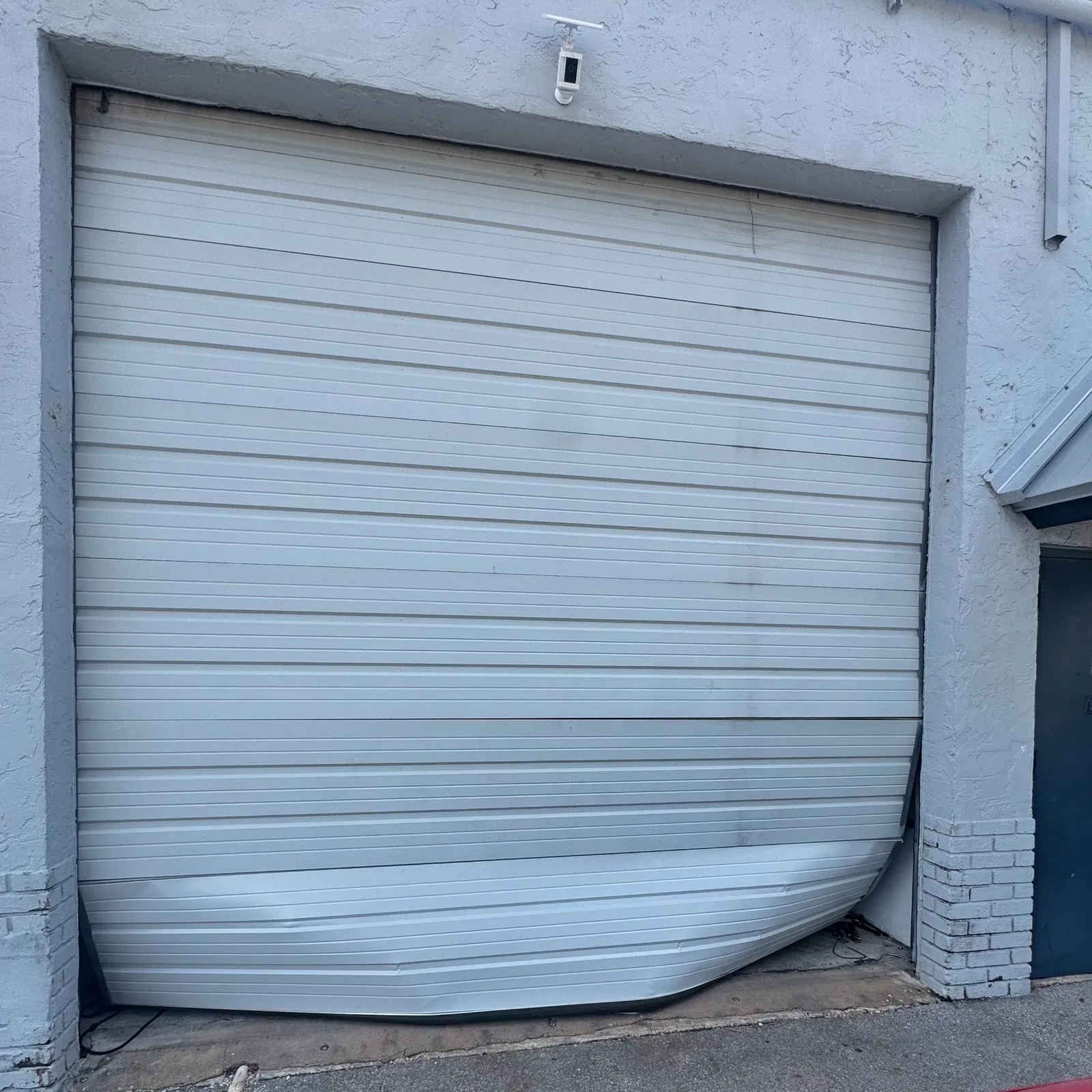
The outside of a carriage house door faces the alley, where it takes knocks from bins, bikes, cars backing out and anything carried past. Dented, cracked or rotted panels are common. Single sections can often be replaced on a sectional door if a matching panel is available; otherwise the choice is between a patch and a new door.
The bottom seal and the weatherstripping round the opening matter too. On an old opening that is not quite square, a good seal is what keeps rain, leaves and cold out of the garage. A seal that has split or flattened is a small problem to put right, and it makes a real difference over a winter.
Repair, or a new door
Plenty of older South End doors deserve another round of repairs: fresh springs, two new cables, a set of rollers and a re-tuned opener can keep a sound carriage house door going for a long while. But there comes a point when a door has been patched too often, when its panels are rotting or cracking along their length, or when it is simply too heavy and draughty for the opening.
Signs a replacement may make more sense:
- Several panels are damaged or rotting, and matching sections are not available.
- The door has been reinforced and patched so often it no longer runs properly even after repairs.
- Springs, cables and rollers are all failing together.
- The door lets in cold, water and noise that a seal cannot stop.
We supply and install new garage doors made to fit the opening the building has. In an arched or out-of-square brick opening, that means measuring carefully and planning how the new door, tracks and springs will sit in the space, including the low ceiling and anything overhead. You can read more on our new door installation page and in our guide to when to replace a garage door.
What a visit looks like
A visit on these blocks follows a set order. The whole door gets looked over first, from the spring bar down to the bottom seal, opener and photo eyes included. You hear which parts have failed, which are wearing out and which are sound, and no work starts until you say yes. After the fix, the door’s balance is set and it is cycled from floor to fully open, and the opener’s stopping points and reversing are tested.
For garage doors South End MA owners rely on every day, a balanced door matters as much as any single part. A door that is out of balance makes the motor strain, wears the springs out sooner and tugs at the brick or timber it hangs from.
The shop around the corner
Our premises are here in the neighbourhood, on the same streets as the row houses whose garages we look after. That does not change what we promise about timing; it simply means the alleys, the carriage houses and the quirks of the brick openings round here are the ones we know best. Whether the garage is a carriage house on a cobbled lane or a single bay under a building on a busy street, the approach is the same: understand the building first, then fix the door to suit it.
Book a visit
Tell us what kind of garage you have, how it is reached, and what the door is doing. For the garage doors South End MA alleys and bays hold, that short description shapes everything about the visit. Whether it is a broken spring, a stuck opener or a door that needs replacing, call us or book online.
Questions from the South End
Our carriage house opens onto a shared alley. Does a repair close the lane?
Usually not. Spring, cable, roller and opener work is done from inside the carriage house with a stepladder, so the lane stays usable. Swapping the whole door is different: old and new sections have to be laid down somewhere, so that day is arranged with the lane and its other users in mind.
Why does our door rub on one side of the brick opening?
Old carriage house openings are often slightly out of square or arched. The door may be straight while the opening is not, or a rail bracket may have worked loose in crumbling mortar and let the door wander. Both can usually be corrected without changing the opening.
The opener under our bay is loud and wakes the flat above. Is there a cure?
Usually. Worn steel rollers, slack hinges, a rattling rail and a clattering chain drive all add up. New rollers, tightened hardware and, where needed, a quieter opener can take most of the racket out of the floor above.
Is it safe to wait until morning with a broken spring?
With the door shut, yes. Disconnect the opener at the socket and let the carriage house sit as it is overnight. If it is stuck open and the garage cannot be secured, call at any hour and we can talk through what to do.
Will a new door suit an arched or uneven brick opening?
Yes. The opening is measured carefully, and the door, tracks and springs are planned around its shape, the headroom inside and anything above it, so the new door suits the old brick instead of fighting it.