
Why springs wear out on Oak Square’s older garages
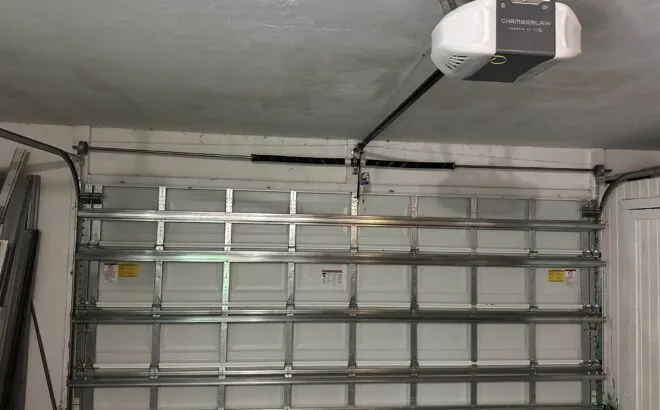
Springs do the real lifting on any garage door, and on the old single-car garages tucked behind the nineteen-twenties houses near Oak Square they shoulder an unusually heavy load. Plenty of those doors are still original timber, thick with coats of paint and damp along the lowest rail, and a wooden door like that leans on its springs hard every single trip. As a result, garage door spring repair in Brighton is the call we take most from these streets, whether the door hangs from torsion springs on a shaft above the header or from a pair of extension springs reaching back alongside the tracks.
A spring seldom warns anyone on its final cycle. Usually there is one sharp crack from the garage, often on a frosty night, and by morning the door hardly budges.
Three clues point to a spring, and none of them involve touching it:
- A visible break, wide enough to slip fingers into, in the coil wound across the doorway.
- An extension spring dangling loose, or lying on the slab, beside one of the side rails.
- An opener that groans, raises the door a hand’s width and quits.
Spring faults we put right
Torsion spring snapped
One or two coiled springs on a steel shaft over the opening. A fracture leaves a plain break in the coil and a door that refuses to rise.
Extension spring broken
Long springs above each horizontal rail, typical of older single-car doors. Lose one and the door lifts lopsided, or stays put.
Containment cable missing
Every extension spring should have a cable threaded down its middle so a broken one cannot whip across the garage. Many older setups never had one.
Springs too weak for the door
A timber door that has gained weight from paint and moisture can outgrow springs that once suited it, leaving it heavy and its opener labouring.
Worn pulleys and drums
Sheaves on an extension system and drums on a torsion shaft wear alongside their spring, so each is looked over during a replacement. Cable faults are covered under cable repair.
Two kinds of spring, two ways of failing
Torsion springs ride on a shaft fixed across the header. As the door lowers, cables pulling on drums at each end twist those springs tighter; as it rises, they unwind and hand the stored energy back. A torsion spring fails by fracture: the steel fatigues after years of daily cycles and one coil parts cleanly, typically where rust has taken hold. From that moment the door has only its own dead weight acting on it.
Extension springs work by stretching rather than twisting. One hangs above each horizontal rail, hooked at its rear end into the ceiling framing and at its front end onto a sheave. Cables leave the door’s lower corners, pass over a fixed pulley, run through the sheave riding on the spring, and tie off at an anchor. With the door shut those springs are pulled long; with it open they relax. Simple and once standard, they still turn up in many garages near Oak Square. They tend to fail either by stretching out until the door feels leaden, or by snapping at a hooked end.
Neither type wins in every garage. Torsion springs share the load evenly between both sides and run more quietly, though they need a sound header and a little clearance for the shaft. Extension springs fit almost anywhere, yet they must have a containment cable and they put extra strain on the pulleys and ceiling joists.
Detached garages, hard frosts and heavy doors
Behind these two- and three-families, the garages stand apart at the end of long driveways, well away from any warmth from the house. In January the inside of one is about as cold as the yard around it. Spring steel turns more brittle as temperatures drop, so a spring already near its limit often breaks on the season’s first hard frost, when it is asked to raise the door first thing after a bitter night.
Weight is the rest of the story. An original timber door starts out heavy. Layer upon layer of paint adds more, and the lowest section wicks up rain and melted snow that sits against it. The springs were sized for the door as it was when new, not as it is now, so a wooden door quietly demands more of them each year. Whenever a spring is replaced, the door is weighed by feel and by balance, and the new spring is matched to that real figure rather than copied from whatever came off.
Garage door spring repair in Brighton often uncovers a second issue along the way: the joist or header that the spring hardware bolts into. In an old outbuilding that timber may have dried, split or softened where a roof leak ran down it. A new spring needs solid wood to anchor into, and if the old anchor point looks doubtful, you will hear about it before any spring goes up.
Why spring work belongs to a technician
A torsion spring is wound tight enough to raise a heavy door unaided, and it keeps holding that force the whole time the door sits shut. Slip with a winding bar, back off the wrong set screw, or reach for a screwdriver in place of a proper bar, and the spring can wrench the bar or its cone loose with enough violence to break a wrist or a jaw. The cables, and the brackets fixed low on the door, take that strain too. This is a job for someone with correctly sized winding bars, locking clamps and the habit of keeping clear of the bar’s swing.
Extension springs look tamer because they hang slack once the door is open, but one that breaks without a containment cable can fly the length of a garage, and the snapped end is as sharp as cut wire. Leave them lying where they fell. The same goes for the hooks, eyebolts and S-shaped links at each end of an extension spring, which can be bent or cracked by the jolt of a break and should be replaced rather than reused.
Here is what is safe while you wait:
- Stop trying the opener. Every attempt strains its motor and gearing and can drag the door out of line.
- Leave a closed door closed. Without its spring it weighs a startling amount, and raising it by hand means carrying all of that yourself.
- If it is stuck open, nobody should walk or park beneath it until it has been secured.
- Note whether there was a bang, and whether the broken coil is on the left or the right.
A spring visit, start to finish
Once you book garage door spring repair in Brighton, the visit runs in the same order whether your door uses torsion or extension springs.
- Locking pliers or clamps go on the track so the door cannot shift, and the opener is unhooked.
- Both springs are examined, not just the broken one. On a two-spring door, the pair is normally renewed together, because the survivor has done exactly as much work.
- Cables, drums, sheaves and bottom brackets are checked for fraying, cracks and wear. Any frayed cable is renewed alongside the springs.
- New springs go on and are wound or stretched to suit the door’s actual weight, then the balance is checked by letting the door rest midway with no hand on it.
- Finally the opener is hooked back up, its limits and lifting force are reset for a door that is now light again, and its auto-reverse is proved against a block on the floor.
Before any part comes off, you are shown what has broken and what the visit will involve.
Switching from extension to torsion
A few older single-car garages near Washington Street still run on extension springs that have been swapped out several times over. Nothing says they have to change. A sound extension setup with containment cables fitted works well for a long while. Where there is room over the opening for a shaft and the header is solid, converting to torsion is worth talking through, especially on a heavy wooden door, because the load spreads more evenly and the springs live on a shaft instead of hanging loose.
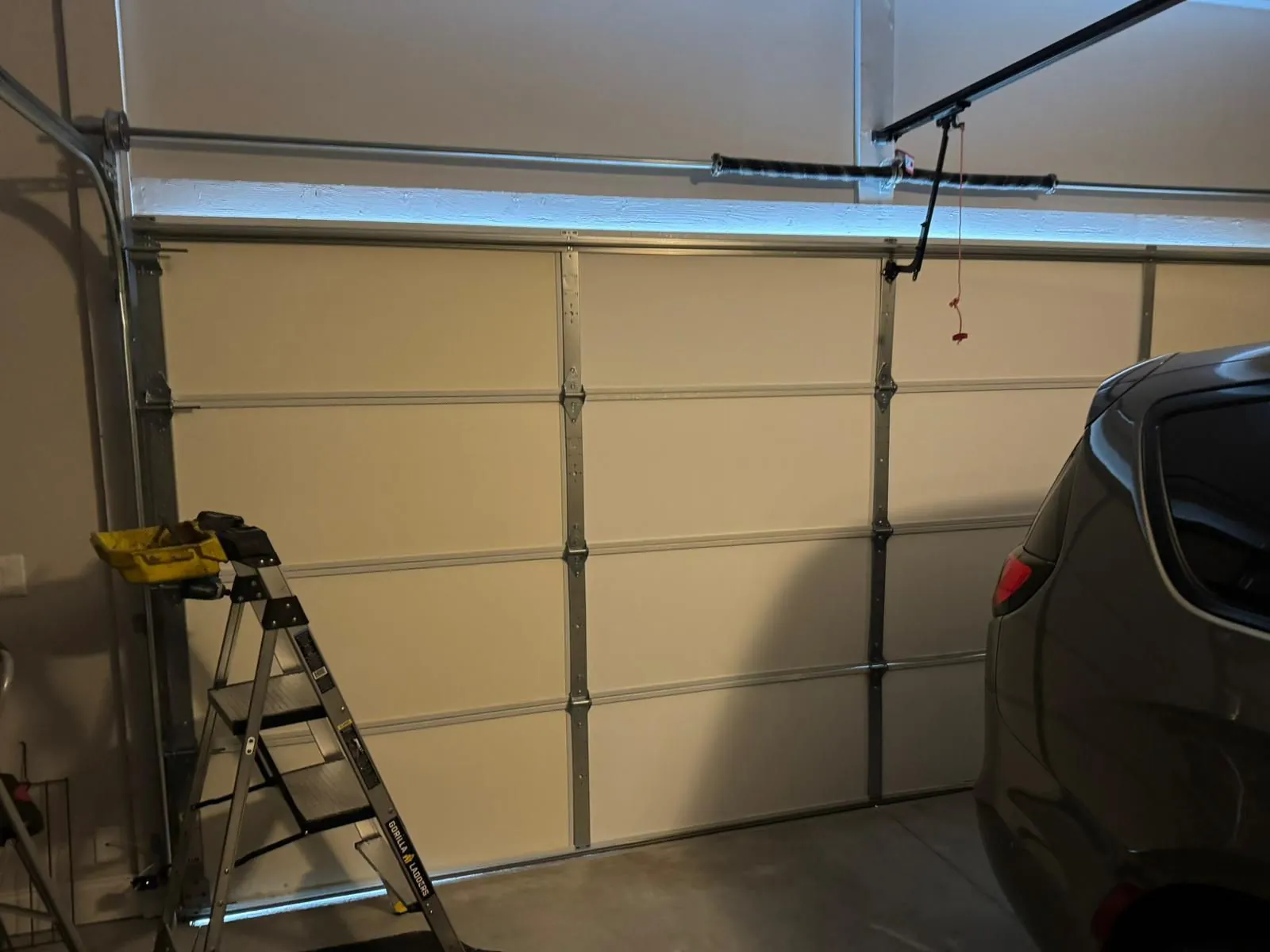
Clearance decides it, together with the state of the header. A torsion shaft is carried on a centre bearing plate screwed into the wood above the opening, and the whole spring force bears on that plate, so an old header that is split or soft needs reinforcing before it can take one. Old detached garages often have only a modest space between the door’s top edge and the rafters. If a shaft would crowd the roof framing, or rafters would need altering, extension springs with proper containment cables remain the sensible answer. You will see both options laid out wherever both would fit.
One-piece wooden doors and their springs
Not every original door on these garages is sectional. Some are single slabs of timber that swing outward at the bottom and tilt up into the garage on a pair of pivoting arms. Their springs are different again: a heavy spring on each side, fixed to the jamb or the side wall and hooked to the arm, stretches as the door closes and pulls it up and over as it opens. There are no cables and no drums, but the springs on a one-piece door still hold a lot of energy, and the arms they pull on can pinch fingers and snap closed if a spring lets go.
These doors fail in their own ways. A broken side spring leaves the door hanging heavily to one side and scraping the jamb as it moves. A pivot bolt worn loose lets the slab drop at one corner. The timber frame of the door itself can twist over the years, so it no longer closes square in the opening. Springs and hardware for one-piece doors can usually be replaced, and garage door spring repair in Brighton includes this older type as well as torsion and extension systems.
Where a one-piece door has twisted badly or rotted at the bottom, a sectional door is often the better long-term answer, because it rolls up out of the way rather than swinging out into the driveway, and its springs are easier to match to its weight.
How long springs last, and why yours may not
Springs are rated by cycles, one cycle being a single trip up and back down. A door used a couple of times a day wears through its springs far more slowly than one that serves several households coming and going at all hours. In a two- or three-family where one garage is shared, the door may cycle much more often than a single-family garage of the same size, so its springs use up their rated life in fewer years.
Other things shorten spring life. Rust is the biggest: a spring in a damp, unheated garage, with water dripping from a roof or wicking up from a wet slab, corrodes along its coils, and the rust pits become the weak points where fractures start. An unbalanced door, one whose springs were never matched to its real weight, overworks the springs on every trip. And a wooden door that grows heavier through a wet season keeps loading the springs a little more than they were designed for.
Keeping the slab dry under the springs, fixing a roof drip over the door and having a heavy door rebalanced when it starts to feel sluggish all help a new pair of springs go the distance. How often a shared door is used, and what that means for the springs chosen, is talked through at the visit with the door in front of you.
Signs a spring is wearing out
Springs usually drop hints before they fail, for anyone who knows where to look:
- Lifting the door by hand takes more effort than it used to.
- Released from the opener, the door sinks toward the floor instead of resting midway.
- One side of the door climbs ahead of the other.
- The opener sounds louder or slower, and sometimes reverses for no clear reason.
- Rust has crept along the coils, or an extension spring’s coils no longer close up tight when the door is raised.
A door showing two or three of those hints is worth a look before the spring gives out, because a planned replacement on a dry afternoon beats a door stuck shut on a freezing morning. Planned garage door spring repair in Brighton is also easier to fit around a shared driveway than an urgent call is.
When the door itself should go
Springs can go on almost any door, but a spring can only lift what it is given. If the lowest section of a timber door has rotted so far that brackets will not grip, or the door has grown so heavy that springs strong enough to balance it would overload the framing, a new door deserves a conversation. Our new door page for this neighbourhood describes how a lighter modern door is hung in an older single-car opening, usually with fresh springs and track in the same job.
Other work on the same garage
A broken spring often travels with other faults. An opener may have burned itself out straining against a dead door; that is the subject of opener repair in Brighton. Cables, rollers, panels and tracks fall under general garage door repair in this area. If a spring snapped at night with your car inside, see emergency help for Brighton garages for what to do first. Torsion and extension springs across the whole city are described on our main spring repair page, and every local service is listed on the Brighton page.
Ready to get the door moving
A broken spring tends to show itself at an awkward hour, and our phone line stays staffed overnight as well as by day, so you can report it the moment it happens. Say which kind of spring the door has, overhead shaft or side-mounted pair, whether you heard the break, and whether a car is shut inside. Then call us or book online and we will take it from there.
Questions from Brighton
Something went bang in the garage overnight. Was that a spring?
Very likely. A torsion spring breaking sounds like a gunshot or something heavy hitting concrete. Look up at the shaft above the door for a break in the coil, and check along both rails for a slack or fallen extension spring. If you find one, keep the door shut and leave the opener alone.
Only one spring broke. Do both need replacing?
On a two-spring door, almost always. Both have lifted the door through exactly the same history, so the survivor is nearly worn out as well, and matching both sides lets the door rise squarely.
There is no cable running through my extension springs. Does that matter?
It does. A containment cable stops a broken extension spring from flying across the garage. Fitting one is a small part of a spring visit and is done whenever extension springs are renewed.
My spring broke with the door open. Can I drive out?
Only if the door is already open and secured, and even then it is wiser to have it clamped first. A door whose spring has gone should never be raised by hand or with the opener.
Why do springs always seem to break in winter?
Spring steel grows brittle in the cold, and the detached garages behind these houses are unheated. A spring that was already worn often lets go on a hard frost, when it is asked to raise a heavy door after a freezing night.