
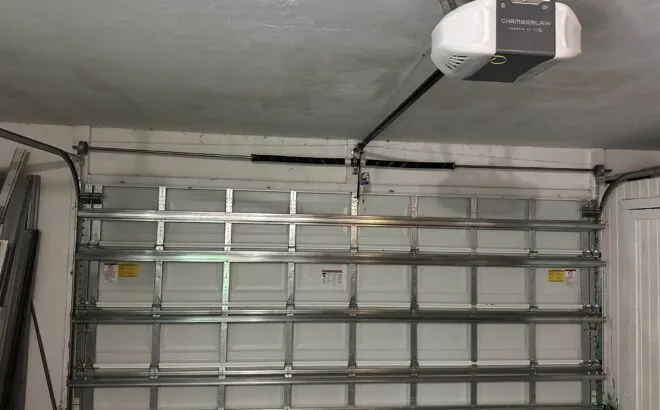
Why spring failures hit Charlestown garages hard
In a neighbourhood where few houses have a garage, the ones that do get used constantly. The newer townhouses near the Navy Yard often treat the garage as the everyday way in and out, and every opening and closing is one more cycle on the springs. Garage door spring repair in Charlestown covers both kinds of spring a residential door uses: torsion springs wound on a shaft above the opening, and extension springs stretched along the horizontal tracks. When one breaks, it is replaced and the door is balanced again.
A spring rarely fails without warning. Three signs from the past few weeks suggest one is close to the end:
- Lifting the door by hand takes noticeably more effort than it did.
- The opener sounds laboured on the way up, or stalls partway.
- The door will not stay put halfway open and drifts down or creeps up.
Spring problems we deal with
A torsion spring that has snapped
A clean break somewhere along the coil, usually with a loud report. The door stays down and feels like a dead weight.
A tired torsion spring
Still in one piece but no longer holding the door’s weight, so the opener does the lifting it was never built for.
A broken extension spring
One of the long side springs has parted or a hook has let go. These need their containment cable in place, or the broken spring can whip loose.
Uneven springs on a two-spring door
One spring weaker than its partner makes the door lift lopsided and wears the cable on the weak side.
Springs that no longer match the door
A replacement section, added insulation or a heavier bottom seal changes the door’s weight, and the springs have to be sized again.
How the springs carry the door
The opener is not what lifts a garage door. The springs are. A sectional door can weigh as much as several adults, and the spring system is sized so that, when it is set up properly, that weight is almost cancelled out. A balanced door rises under a single hand, and it hangs still wherever it is let go.
Torsion springs manage this through twist. Each sits on a steel tube spanning the header, fixed at one end to a bracket and at the other to a winding cone. Lowering the door pays the cables out from a grooved drum on either end of the tube, and that motion winds the spring tighter, banking energy. Raising the door releases it: the spring relaxes, the drums turn the other way, and the cables are reeled back in, drawing the door upward. Some doors have one torsion spring, wider or heavier doors have two.
Extension springs work by stretching. They run parallel to the horizontal tracks on each side, connected through pulleys to the cables. When the door closes, the springs stretch out; when it opens, they contract and pull the door up. They are common on older doors and in garages without much room above the opening, which makes them more likely in a bay squeezed into an older building than in a purpose-built townhouse garage.
Why springs give out
A spring is a fatigue part. Each trip up and back down counts as one cycle, and every spring is rated for a set count of them before fatigue cracks the wire. It does not wear down gradually like a brake pad; it holds on and then breaks. When the garage door is how the household comes and goes, the cycles pile up, and the spring meets its limit years ahead of one on a door opened only at the start and end of the day.
Cold speeds it up. Steel becomes less forgiving in hard frost, and the first properly cold mornings of the season bring a run of broken springs. Damp adds rust, which pits the coils and gives the fatigue cracks somewhere to start. In a garage at the bottom of a sloping driveway, where rain and slush run toward the door and sit against the bottom seal, the air inside the bay tends to stay damp through the winter.
A spring that is undersized for its door fails early as well. That happens most often after a door has been altered, with a heavier section, a new layer of insulation or a different bottom seal, and nobody has reassessed the springs.
Garage door spring repair Charlestown townhouses need
The townhouse garages near the Navy Yard are the main source of garage door spring repair in Charlestown. They are typically a single sectional door in a bay set into the ground floor, with a torsion spring above the opening and an opener on the ceiling. Because the bay sits beneath the rooms upstairs, the moment a torsion spring breaks is hard to miss: the sharp crack travels through the structure, and people often describe it as sounding like something heavy falling on the floor above.
What follows is usually a door that will not lift and a car stuck on the wrong side of it. On streets where the driveway is barely a car deep and parking is hard to find, a trapped car is not a small thing. Do not try to get it out by forcing the door. Without its spring, the door is carrying its own full weight on nothing, and the opener cannot safely lift it.
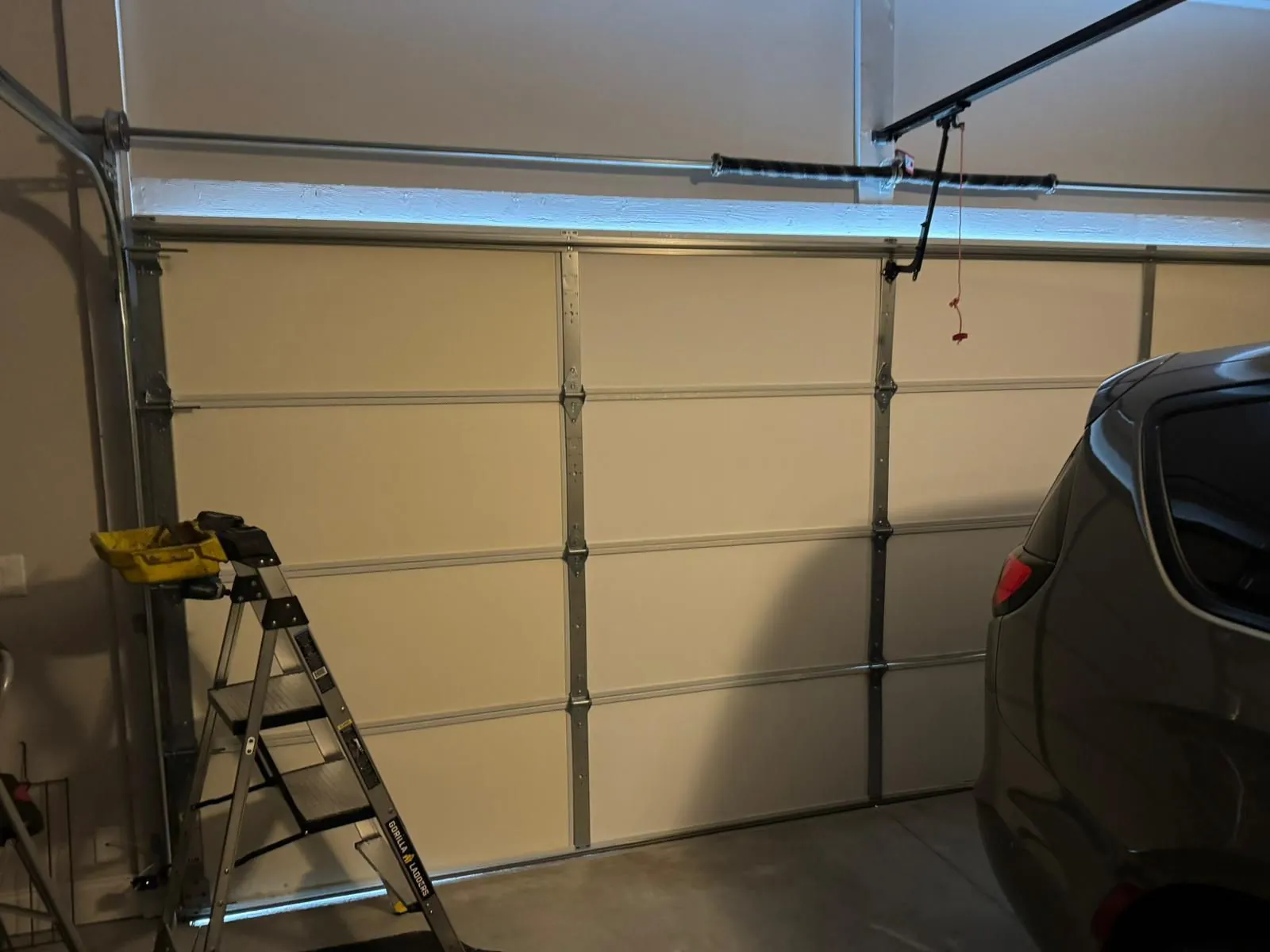
Older bays and low headroom
Where a Federal row house near the Training Field or along Main Street has had a garage made in it, the space above the door is often tight. Floor joists often run only a hand’s width over the header, leaving little room for a standard torsion shaft. Those doors are set up in other ways: extension springs along the tracks, or a torsion arrangement mounted lower or at the back of the horizontal rails. Spring work in these bays has to match what fits, and a replacement spring has to suit both the door’s weight and the space available to wind it.
Tight side walls also limit access, which makes the job slower but not impossible, and the technician may need the bay cleared along both sides of the door to reach the brackets safely. When you call, it helps to say whether the springs run across the top of the door or along the sides.
A broken spring is not a DIY job
Be clear about one thing first. The torsion spring above your door holds dangerous tension, and a winding bar that slips out of the cone under that load can break bones. The tension is present whether the door is open or shut, and part of it remains even after a spring has broken. The set screws on the winding cone, the cone itself and the bottom brackets where the cables attach are all under load. Loosening any of them without the right tools and procedure can release that energy instantly.
Extension springs carry their own hazard. When one breaks without a containment cable threaded through it, the loose end and its hook can be thrown hard across the bay. If you see a broken side spring with nothing running through its centre, keep everyone clear of the door.
Safe steps while you wait:
- Leave the opener switched off. It cannot lift a door with a broken spring, and trying will strain or strip it.
- Leave the door where it is, whether open or closed. If it is open and stable, do not try to bring it down by hand.
- Keep children, pets and cars away from the opening.
- Leave the red release cord on the opener alone unless the door is all the way down; with the door up, freeing it from the opener can let it drop.
Springs on a door that meets a sloping floor
On a steep lot, the garage floor at the opening is not always level from one side to the other. That affects the spring system more than people expect. If the door touches down at one corner first, the cable on the high side goes slack before the door is closed, and the next time the door lifts, that cable can jump the groove on its drum. On a two-spring torsion door, or on an extension spring door where each side has its own spring, an uneven floor can also hide a weak spring, because the door looked crooked anyway.
Part of any garage door spring repair Charlestown homes on sloping lots need is getting the cable lengths right for the floor as it is. With torsion springs, that means setting each drum so both cables are taut at the moment the door is fully closed. With extension springs, it means setting each spring on its own pulley position so both sides lift together. The goal is a door that comes off the floor squarely, without one corner leading.
When the opener hides a weak spring
Modern openers are strong enough to lift a door that is badly out of balance, at least for a while. That is why a weak spring often goes unnoticed: the opener simply works harder. Signs that the opener is doing the spring’s job include a motor that slows near the top, a chain or belt that flexes visibly as the door starts to move, and a door that thumps down the last stretch when closing. If you are not sure, pull the release cord with the door fully closed and try lifting by hand. If it takes real effort, or if it will not stay put at waist height, the springs need attention before they break, and before the opener wears out with them.
What a visit involves
Spring work starts with taking the load off safely. If any tension is left in the broken spring or its partner, it is unwound in a controlled way with proper winding bars, never by loosening the set screws. The door is clamped or supported so it cannot move while the old spring comes off.
The door’s size and weight are then checked against the spring that failed, because the old spring is only a guide if it was the right one to begin with. The new spring is fitted on the shaft or hooked into place along the tracks, then wound or stretched to the correct tension. On a two-spring door, both springs are normally replaced together: they went in at the same time, have opened the door exactly as often, and the survivor is usually close behind.
Checking the balance after a new spring
Fitting the spring is half the job. The rest is balance. The cables are checked for even tension on both drums, and the drums for secure set screws. The door is lifted by hand from the floor to the top and stopped at several points: a well-balanced door stays where you leave it. If it drifts down, the spring needs a little more tension; if it floats up, it needs a little less.
Rollers, hinges and tracks are looked over at the same time, since a stiff roller or a kinked track makes the door feel heavy even with a good spring. In a townhouse bay that doubles as the front entrance, worn rollers are common, and swapping them while the door is already apart saves a second visit. Hinges on the top section, which take the twisting load where the door turns from vertical to horizontal, are checked for cracks around their fixings. The bottom brackets get a close look too, because the cables pull directly on them, and on a door that sits in damp air at the foot of a sloping driveway they are often the first hardware to rust. A corroded bracket can be replaced at the same time as the spring, before it becomes the next failure. Spring work also leaves the bay tidier than it was found: the old spring, any broken hardware and the packaging go away with the van, and nothing is left hanging from the shaft. Then the opener is reconnected and run through a full cycle, with its force and travel adjusted for a door that is now properly balanced, and the safety reverse is checked.
Repair the spring, or think about the door
Replacing a whole door because one spring broke is rarely justified. Most of the time the right answer is a new spring or a matched pair, correctly sized and balanced. A new door becomes worth discussing when the spring has failed because the door has become far heavier than it should be, for example a wooden door that has soaked up years of water, or when the sections are rusted through at the bottom where meltwater from the driveway sits. In those cases a new spring will hold, but the door around it is near the end. The page on new garage doors in Charlestown covers that option.
Related work on the same door
A spring failure often shows up in other parts. A door that has been running on a weak spring puts extra strain on the opener, which may have stripped its gear or burned out its motor trying to compensate; see opener repair in Charlestown. When a spring breaks with the door partway open, a cable can jump its drum or the door can twist in the tracks, which falls under general garage door repair in Charlestown. And a spring that goes well before dawn, with the car inside and an early start ahead, is exactly what our emergency garage door service for Charlestown is for.
Booking a spring repair
For garage door spring repair Charlestown MA homeowners can call whenever the break happens, weekends included. Say where the springs are mounted, what position the door is stuck in, and if a vehicle is shut in behind it. Spring work elsewhere in Greater Boston is described on our spring repair page, and the neighbourhood’s full set of services is gathered on the Charlestown page. To get a new spring on the door, call us or book online at whatever hour suits.
Questions from Charlestown
We heard a bang from the garage under our townhouse. What happened?
Most likely a torsion spring broke. Look at the bar above the door from a safe distance: a gap in the coils confirms it. Leave the door alone, unplug the opener and call us.
Can I still use the opener with one spring broken on a two-spring door?
No. The remaining spring is not sized to carry the door alone, and the opener will be lifting most of the weight. It may manage once or twice before something else fails, and the door is far more likely to come down hard.
Why replace both springs if only one broke?
The pair has lifted the door through an identical history of openings, so the survivor is generally near its own break. Pairing a fresh spring with a worn one also pulls the door up lopsided. A matched new pair lifts evenly.
Our bay has hardly any headroom above the door. Is a new spring possible?
It is. Low-headroom garages in older buildings often use extension springs or a different torsion setup. The replacement is chosen to fit both the door’s weight and the space available.
Does cold weather really cause springs to break?
It plays a part. Frost makes the steel less tolerant, so a spring with few cycles left tends to choose a frosty morning to go. Low temperatures do not use up a spring on their own; they tend to pick the day.