
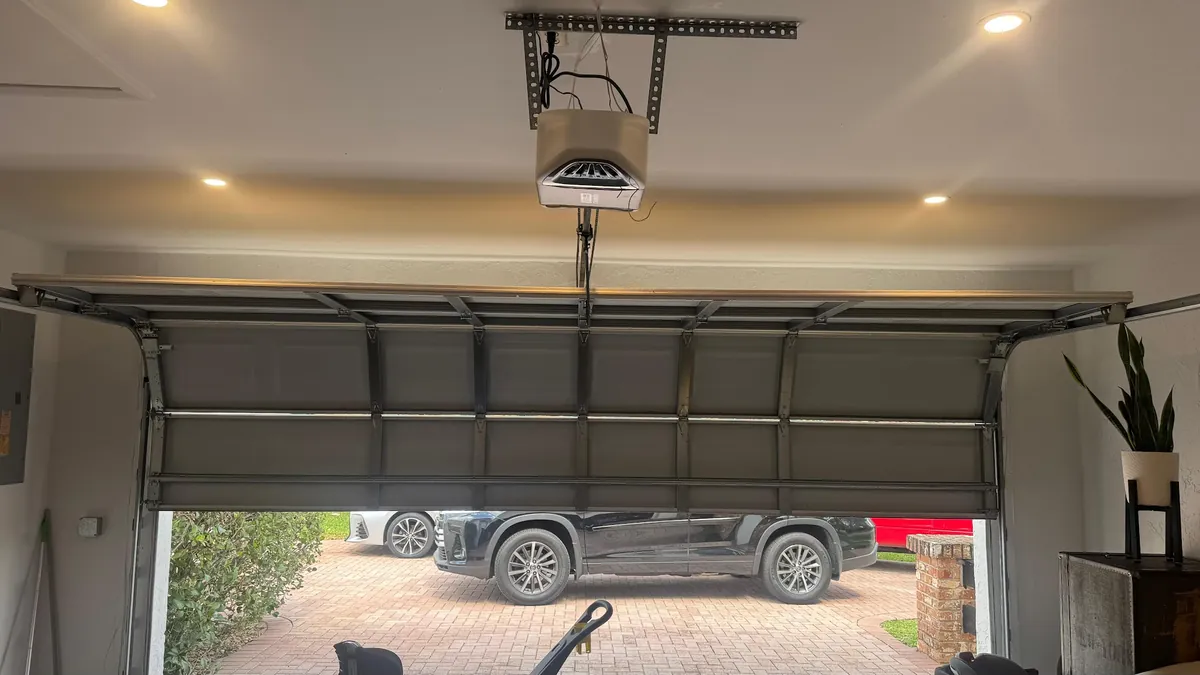
Openers in Cambridge’s freestanding garages
Behind the triple-deckers and Victorians of Cambridgeport, North Cambridge and Porter, a garage is usually a compact building of its own at the end of a skinny driveway, and the opener inside it lives a harder life than the one in a garage attached to a newer house. It shares an unheated shell with the weather, often hangs from low rafters that leave little room for its rail, and is worked hard because, with so many lots lacking any garage and street parking handled by resident permit, the bays that exist get used for everything. Garage door opener repair Cambridge MA households ask us for covers the whole control side of the door: the motor unit, the rail and its carriage, remotes, keypads, wall buttons and the safety sensors near the floor. We repair openers that have faulted and install replacements where repair no longer makes sense.
Before you call, three quick checks narrow the problem down:
- Press the wall button and glance at the bulb on the motor housing. A bulb that stays dark hints at a power fault rather than a broken opener.
- If pressing the wall control still runs the door and only the handheld transmitter is dead, suspect the transmitter, its cell or its pairing.
- If the door creeps down and then climbs back up, look first at the two little eyes mounted low on the jambs.
Control-side faults we handle
Motor hums, door stays put
The unit sounds alive but nothing moves. A worn drive gear, a seized trolley, a failed capacitor, or a door so out of balance the motor cannot shift it.
Door bounces back up
Commonly an eye knocked out of aim or a beam blocked by clutter, occasionally a closing-force adjustment that drifted out of step with the door between summer and winter.
Remotes and keypads that fail
A transmitter that only answers when you stand at the door, a keypad by the side entry that has gone dark, or a remote that lost its pairing after a power cut.
Wall button that does nothing
A broken button, a chewed or loose wire running up to the motor unit, or a lock-out setting switched on by accident.
Noisy, jerky travel
A slack chain slapping its rail, a worn belt, or a carriage binding on a rail that has come out of alignment with the door.
Openers past saving
Units with cracked housings, burned-out logic boards or no spare parts left in circulation, exchanged for a fresh unit chosen to suit the door.
Where the opener sits in the system
An opener is more like a helmsman than a winch. Springs hold up the door’s weight, and the motor merely nudges a door that is already counterweighted. Along a rail running from the header back to the motor housing slides a carriage, the trolley, hauled along by whichever drive the unit uses: roller chain, rubber belt or threaded screw. A curved arm connects that trolley to the uppermost section. Pressing a button sends the trolley back toward the motor to raise the door, and forward toward the header to lower it, halting at the travel limits programmed when the unit went in.
Two separate safeguards watch every descent. Low on the jambs, a pair of photo eyes shine a beam across the doorway; interrupt it and the door reverses. Independently, the motor monitors how hard it is working, and if the descending door meets something solid the sudden load makes it back off. Both must function, and both are proven before a visit is finished.
Because the opener relies on the door, plenty of supposed opener failures are really door failures in disguise. A snapped spring leaves the motor heaving dead weight. A kinked rail or frozen roller makes it labour. A slack cable lets the door skew and jam. So any honest look at an opener includes the door it moves, and a door fault is sometimes the true reason a motor burned out. Those door-side faults are covered on our garage door repair in Cambridge page.
Small bays, low rafters and the opener
Many single garages here were framed long before automatic openers were common, and fitting one in can be a tight squeeze. The rail of a standard ceiling unit needs clearance between the top of the opened door and the rafters, plus solid timber to hang the motor from. In a building with a low ceiling or a pitched roof, that clearance may be a matter of a hand’s breadth. Older installations often show the strain: a motor slung from one offcut of wood, a rail bowed where it meets the header, or a unit set off centre to dodge a beam.
Each of those shortcuts makes the opener work harder and wear out sooner. A rail that is not square to the door twists the trolley as it runs. A motor swaying on a flimsy hanger shakes its own fixings loose. In an older bay, garage door opener repair in Cambridge, MA includes checking how the unit is hung and aligned, and correcting what was bodged. Where a ceiling unit simply does not suit the space, a jackshaft motor fixed on the side wall and coupled straight onto the spring tube, is worth discussing, because it needs no rail overhead at all.
The walk from back door to garage
A garage at the far end of the lot can be quite a walk from the kitchen, sometimes across a yard or past a fence. That distance affects an opener in two ways.
Range comes first. A handheld transmitter that reached easily when new may seem to weaken as its cell runs down, or as metal or electronics end up between the car and the building. If the remote only responds when you are nearly at the door, start with a new cell. If that changes nothing, the receiver inside the motor housing, its trailing antenna wire, or the transmitter itself is the next suspect.
Power comes second. A freestanding garage gets its electricity through its own cable run from the house, and if that circuit trips, the opener and the garage light go dark together. When the bulb on the motor housing will not light at all, confirm the building has power before blaming the opener. Plugging a lamp into the same socket settles it in seconds.
Long cable runs and wall buttons
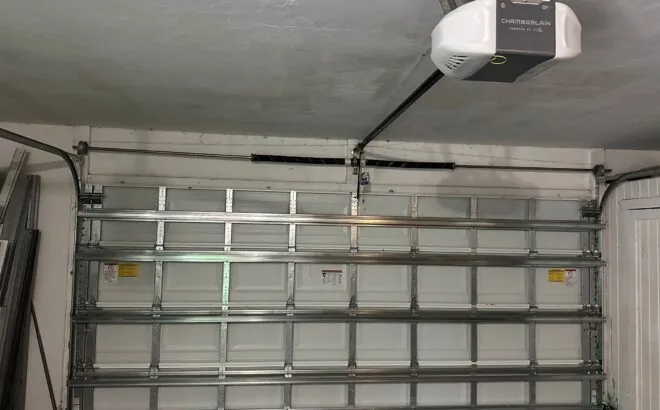
In a detached garage, the wall button is joined to the motor by a thin low-voltage wire that often runs a long way, across rafters, down a stud and around a window frame. In an older wooden building that wire has plenty of chances to be stapled through, nibbled by rodents, or pulled loose when shelves go up. The sensors are wired the same way, and their wires run right along the floor where bins and bikes knock against them.
A button with moods, fine at breakfast and dead by supper, or sensors whose lamps flicker when the door moves, often point to a wire problem rather than a failed part. Tracing those runs end to end is part of the visit, and a damaged length is replaced or rerouted somewhere it will be left alone.
Clutter by the jambs and the photo eyes
When a driveway barely fits one car and the street is permit parking, the garage tends to fill with bicycles, bins, strollers and tools, often stacked just inside the opening. The photo eyes live low on each jamb, squarely in harm’s way. One knock shifts a bracket, the beam misses its partner, and the opener will not close or retreats partway down.
Most of the time you can sort this out yourself:
- Shift anything sitting at floor level near either jamb.
- Clean both lenses gently; a cobweb or a film of road grime is enough to cut the beam.
- Check the tiny indicator on each eye. Both lit and steady means they see each other; one dark or flickering means it has been bumped.
- Ease the bracket of the unlit eye by hand until its indicator settles.
If the brackets are bent, the wire has been crushed or chewed, or neither indicator lights, the eyes or their wiring need repair. Never disconnect or tape over the sensors to make a door close. They exist to keep a descending door off children, pets and bikes.
Keypads, cold and the side door
Many detached garages here have a keypad on the outside of the frame, so the door can be opened from the driveway without a remote. Those keypads face the weather head on. Frost, driven rain and snow piled against the jamb can kill the cells early, crack the cover or let moisture into the buttons, and a keypad that works in summer may start missing digits in January. A new cell and a dry cover often bring it back; if not, the keypad is replaced and paired with the opener again, and its code is set afresh.
Cold affects the motor unit as well. In an unheated building, lubricant along the rail and inside the drive thickens, so a door that ran smoothly in autumn may make the opener strain and hit its force limit on a frozen morning, stopping or reversing for no obvious reason. Turning up the force to push through is the wrong answer, because it blunts the safety reverse. The better fix is to find what is dragging, whether stiff rollers, a dry rail or a weak spring, and put that right so the opener can run at a safe setting all year.
Outages and the release handle
Every opener carries a release, normally a red handle on a cord dangling from the trolley. In a power outage, or when the opener has failed, a pull separates the door from the drive so it can be moved by hand. Two cautions. Pull it only with the door fully down, since a raised door freed from the motor can drop, especially if a spring is tired. And if the door is startlingly heavy once freed, stop there: that is a spring fault, not an opener fault, and the door should not be forced higher.
When power returns, most openers re-engage the trolley on the next run. If one does not, or the door stops in the wrong place afterwards, the limits may need resetting. Some units also forget their paired remotes after a long outage and need them re-learned.
What a visit involves
Our garage door opener repair in Cambridge always opens with freeing the door from the drive and lifting it manually, since no motor can cope with a door that is overweight or sticking. If springs, cables or rollers turn out to be the root cause, you are told that before anything else.
The opener is then put through its paces. The motor runs while the drive is watched for slipping or chatter, and the trolley is examined for wear where it slides. The header bracket and the motor’s hangers are checked for play. Each remote, keypad and wall button is tried in turn, and the wiring between button, eyes and motor housing is traced for damage. The photo eyes are tested by blocking the beam, and the force reverse by placing an object under the descending door.
Fixes range from a new drive gear or trolley, a tensioned or renewed chain or belt, fresh sensors or wiring, a replacement wall button and newly paired or new remotes, to a straightened rail and properly fixed hangers. Once the fault is cleared, the travel limits and force are retuned for this particular door, and both reverses are demonstrated before the van leaves.
LiftMaster and other openers
LiftMaster is a make we repair and replace, and we handle the other makes found in garages around the city. With any make the same questions decide the answer: whether parts are still available for that model, how worn the motor and drive are, and whether the unit has the safety features a door ought to have now. An old opener with no photo eyes at all, for example, is not one to keep patching. More about that make is on our LiftMaster opener repair page.
Keep the motor, or retire it
A good deal of opener trouble comes down to a single worn component, and renewing it is the sensible route. Gears, trolleys, sensors, buttons and remotes can each be swapped individually, and an opener with its tired part renewed, set up against a well-balanced door, can carry on for years.
Replacement deserves a conversation when the logic board has died and no part exists to fix it, when the motor windings have cooked, when the unit has no functioning photo eyes, or when it was mounted in a way that cannot be made right in a cramped bay. Then a new opener chosen for the door’s size and the room available is usually money better spent. Any garage door opener repair Cambridge MA owners weigh against replacement gets the same treatment from us: the reasons set out plainly before anything is ordered.
Other Cambridge services that often go with it
Opener trouble is often linked to something else. A door that suddenly became too heavy for the motor may have a broken coil; see spring repair in Cambridge. When the opener quits late at night with the car trapped inside, our after-hours door service for Cambridge covers what to do next. How we approach motors and controls region-wide is explained under opener services, and every service for this city is gathered on the Cambridge page.
Booking opener work
The phone line stays open through every night and every holiday, so an opener that gives up on a frozen evening can be reported at once. Let us know how the opener responds to the button, whether its bulb lights, and whether the door slides easily by hand once disconnected. If it is garage door opener repair in Cambridge you are after, call us or book online.
Questions from Cambridge
The bulb on the opener lights, yet the door sits still. What is going on?
Electricity is arriving, so the fault lies in the drive or the door. A stripped gear, a trolley that has slipped, or a snapped spring leaving the door far too heavy are the likely culprits. Pull the plug and ring us.
The remote only responds when I am standing beside the garage. Is the opener dying?
Not necessarily. Fit a fresh cell in the remote first. If range stays poor, the receiver’s antenna, the receiver or the transmitter itself may need attention, which takes little time to check on a visit.
The door gets partway down, stops, and heads back up. Why?
In most cases the photo eyes near the slab are out of aim or blocked. Clear the doorway, clean both lenses and confirm each indicator lamp is lit and steady. If they are fine, the closing force may need adjusting.
Our garage has a very low ceiling. Can an opener still go in?
Usually. A slim ceiling unit, or a jackshaft unit beside the door coupled to the spring tube, can fit where a standard rail cannot. The choice depends on the door and the space.
Is LiftMaster one of the makes you service?
It is. We repair and replace LiftMaster openers, as well as the other makes that turn up in garages here.