
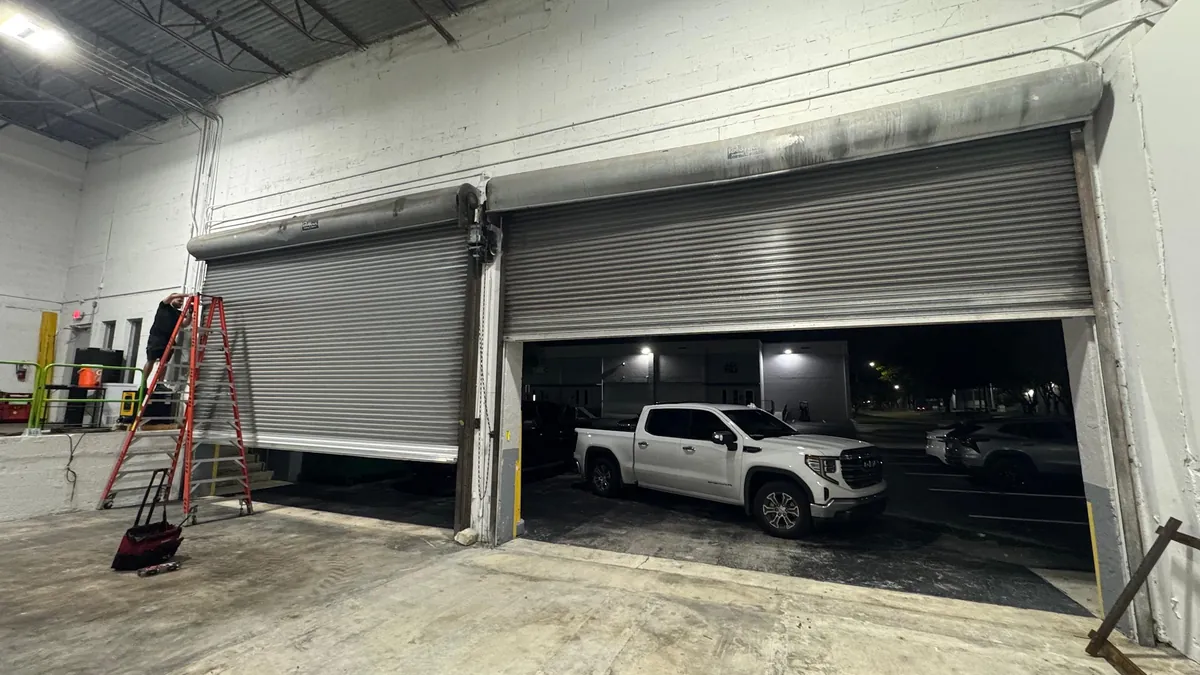
One door, one bay: the single garages beside Stoughton’s Capes and ranches
Nearly every call about garage doors Stoughton MA homeowners make to us concerns a single-bay door. The town’s Capes and ranches sit on modest lots, and the garage that goes with them is usually one bay wide, either built onto the side of the house or standing on its own at the end of the driveway. The two-families follow the same pattern, often with one detached single garage serving a house that holds two households.
A single door has less to go wrong than a double, but it has no spare. When the one door in a one-car garage stops, the car is either shut in or shut out, and on a modest lot there is rarely a second spot off the street to fall back on. That is why a stuck single door feels urgent even when the fault turns out to be small.
Before calling, have a look from inside the garage, keeping your hands off the springs and cables, and note three things:
- Whether there is a visible gap in the coils, either in the spring above the door or in one running alongside a track.
- Whether the door lifts a hand’s width and then stalls, or refuses to budge.
- Whether every control has quit, remote, wall button and keypad alike, or just one.
Garage door services in Stoughton
Garage door repair
Dented bottom sections, loose hinges, worn rollers, a door that rubs one side of the frame or closes crooked. On a single door every part is working all the time, so wear tends to show up in one place first. See our garage door repair service.
Spring repair
A one-bay door here usually hangs on a single torsion coil above the header, or on two stretch springs alongside the overhead rails. Whichever it has, a snapped spring turns the door into dead weight. Read about spring repair.
Openers, remotes and keypads
Motors that drone but stay put, remotes whose range has shrunk, keypads beside the side door, wall buttons, and the safety eyes at ankle height. That includes LiftMaster openers, which we mend or change over. See opener services.
Emergency calls
A door jammed half open in the evening, or a car shut in before an early start. Someone picks up whatever the hour, whichever day you ring. Read about emergency garage door repair.
Cables and off-track doors
When a lift cable slackens or parts, that corner of the door sinks; a door that lands hard can shove a roller clean out of its rail. Both come under our cable work and our page on doors off their tracks.
A new single door
When a single door has been patched too many times, it makes sense to bring in a replacement, made to suit that opening exactly as it stands. See new garage door installation.
What a one-bay garage asks of its door
A two-car garage spreads the work. One door gets used more than the other, but if it fails, the second bay still lets a car in and out. A single garage has no such slack. The door beside a Cape or a ranch goes up and down for every trip, every bag of groceries and every bin night, and on a two-family it may do that for both households. All of those cycles land on one set of springs, one pair of cables, one track on each side and one opener.
That concentration shapes the faults we see. Springs and rollers on a single door wear out ahead of the same parts on a door that shares the load. Openers on single doors tend to have their gears and chain or belt worked hard, especially where the garage doubles as the daily entrance to the house. And because the door is narrow, a small twist, a single loose hinge or one flat-spotted roller shows up quickly as rubbing, juddering or a door that stops short.
None of this means a single door is fragile. It means that a repair here is best done with the whole door in view: when one spring breaks, the other side of the system has been carrying the same load for the same number of cycles. We tell you what we see on the rest of the door before anything is replaced, and you decide what gets done.
Attached to a Cape or ranch, or standing on its own
The single garages in town come in two broad kinds, and each has its own habits.
The attached single garage
On many Capes and ranches the garage is built onto the end of the house, sharing a wall with a kitchen, mudroom or hallway. A door that leaks air or drags its bottom seal lets cold straight into the house side of that wall, and a door that bangs on the way down is heard inside. The opener usually hangs from the ceiling joists of the garage, wired into the house circuit, with a wall button by the door into the house.
Headroom in an attached single garage varies. Some have a full ceiling a good way above the door; others have a lower ceiling where the roofline of the house comes down. That decides where the spring can sit and how much room there is for an opener rail, and it matters when a door or opener is replaced.
The detached single garage
Behind a lot of the two-families, and some of the Capes, the garage stands apart at the end of the driveway. These buildings are often simpler: a slab, a timber frame, a door and not much else. An opener out there often draws its power from one line brought across from the house. If the opener is dead, that circuit, or the outlet it plugs into, is worth checking before anything else.
A detached garage also takes the weather from every side. Wind drives rain under a worn bottom seal, and a timber frame that has moved over the years can pull a track bracket loose or leave the door rubbing one jamb. Fixing the door here often means fixing the timber around it first.
Two-families and the shared garage
A two-family on a modest lot often has one garage for two households, and sometimes one door. That changes how a door wears and how a fault gets reported. A door that is used by both units cycles more than any single-family door in the same style. A remote may be lost when a tenant moves, and the opener’s memory then holds a code nobody controls. One unit may spot a fault and the other hear nothing of it until the door quits.
If you own a two-family here, a few things help:
- Keep a note of how many remotes and keypads the opener has been programmed to accept.
- When a unit changes hands, have the opener’s memory cleared and the remaining remotes paired again.
- Agree who calls when the door misbehaves, so a fraying cable is not left for weeks.
Where each unit has its own single garage, the doors are usually the same age and type, so one breaking spring is a good reason to look at the other door too.
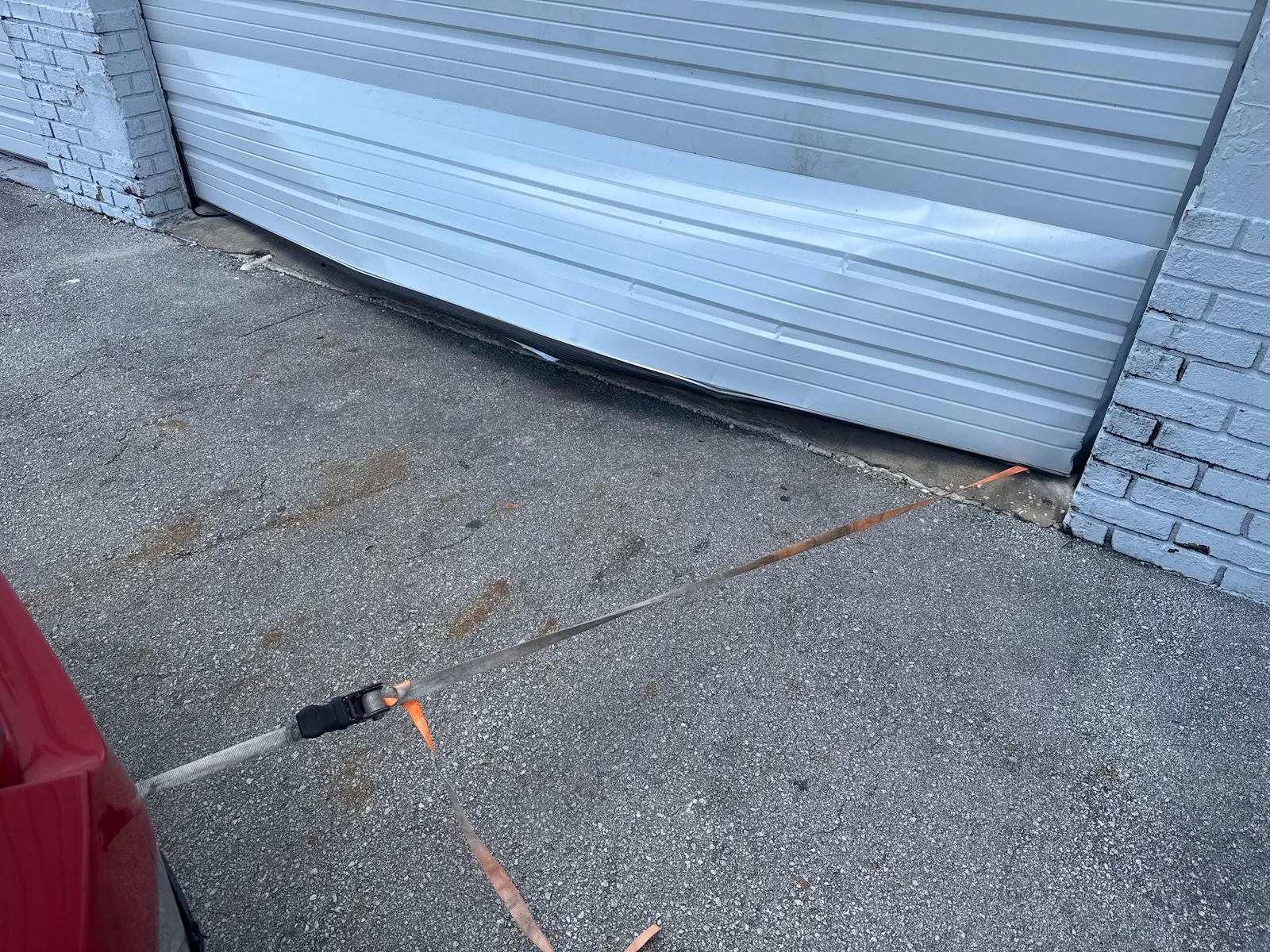
Springs: the call we get most
Across all garage doors Stoughton MA owners call about, nothing brings in more urgent calls than a snapped spring. On a single door it is usually sudden: a loud bang from the garage, and then a door that will not open, or opens a few inches and stops while the opener strains.
Single doors here use one of two systems. On a torsion system, the coil wraps a steel shaft above the header and tightens each time the door lowers. Extension springs hang beside the overhead rails, lengthening as the door shuts, and should each have a containment cable running through the middle. Both store the force that lifts the door, and that force is released all at once if something gives.
A torsion spring holds a dangerous amount of tension and is not something to adjust, unwind or replace yourself. Every piece clamped to that shaft is loaded, and a slipped tool can be thrown with real force. Extension springs carry their own risk: one that lets go with no containment cable can lash across the bay. With a broken spring, let the door stay wherever it came to rest, keep your hands off it, and stop pushing the button.
When we replace springs on a single door, we match the spring to the door’s weight and height, check the cables and drums that work with it, and set the balance so the door hovers, neither rising nor sinking, at mid-height. On older doors with extension springs, we can talk through whether converting to a torsion spring makes sense for that door and that garage.
Openers, remotes and the side-door keypad
An opener on a single door is often the hardest-working motor in the house. The faults are familiar: a motor that drones without result, a door that bounces back up unprompted, a remote that only works when you are nearly touching the panels, a keypad that ignores its code.
Some of these are worth checking before calling:
- If the closing door changes its mind and climbs again, check the pair of safety eyes mounted low on the jambs. In a narrow garage they get knocked by bikes, bins and mowers, and a small knock is enough to put them out of line.
- If the opener’s bulb lights and nothing else happens, look for a manual lock that has been slid across, or a release cord someone has tugged.
- If only one remote has stopped, try a new battery in it first.
If none of that works, or the opener has stripped a gear or broken a belt, we repair it or replace it. LiftMaster is one opener make we regularly fix and change, and on a single door the choice of a replacement usually comes down to noise, headroom and how the garage is used. A belt drive is quieter, which matters in an attached garage with a bedroom above or beside it.
Cables, drums and a door that drops at one corner
Each lift cable is pinned low on one door edge and rises to a grooved drum on the spring shaft’s end, or over pulleys on an extension spring system. They do the actual lifting, and when one frays or snaps, the door stops lifting evenly. The usual sign is a door that hangs lower on one side, or a loose cable lying on the floor of the garage.
On a single door with a short drive, cables also take knocks: a bumper nudging the bottom section, a bin dragged past the track. A cable that has jumped its drum can often be seen wound loosely or sitting off the grooves. Do not run the opener with a cable off; the door can twist and bind in the opening. We replace cables in pairs so both sides lift together, and check the drums and bottom brackets while we are there.
When the door comes out of its track
A door that has slipped its rails and hangs askew is an unnerving sight. A roller has left the rail, the door has tilted, and a section may be hanging in the opening. On single garages it usually follows something else: a cable let go, a bracket worked loose on an old timber frame, or the door was driven into or opened against something.
Leave it closed or open as it is, keep the car out from under it, and unplug the opener at the ceiling so a stray press does nothing. Realigning the door means taking the weight off safely, straightening or replacing any bent track, swapping any roller whose wheel has cracked or worn flat, and checking every bracket on the way. On a detached garage, we also look at whether the frame the track is fixed to has shifted.
What happens on a visit
A visit runs the same way whatever the fault.
- We look at the whole door before touching it: springs, cables, rollers, tracks, hinges, sections, opener and safety eyes.
- We tell you what is wrong, what is worn, and what can wait.
- You decide what gets done. Nothing is replaced without your say.
- Before we go, the door gets balanced, the opener’s limits and force get adjusted, and the auto-reverse gets tried against an obstruction.
On a modest lot, it helps if the driveway in front of the garage is clear, so the van can get close and the door can be run fully open while we test it. For a two-family, let the other household know we are coming so their car is not parked across the door.
Keep the old single door, or start again
Many of the single garage doors in Stoughton, on Capes and ranches alike, have been in place a long time. A sound door with worn hardware is usually worth repairing: every spring, cable, roller and hinge can be swapped, and a door that is balanced and moving smoothly on new parts can carry on for years.
A new door starts to make more sense when:
- More than one section is cracked, rotted or badly dented.
- Repeated patching has left it sitting out of square in the frame.
- A wooden door has soaked up water along the bottom and is soft at the edges.
- On an attached garage, the old door leaks winter air toward the rooms on the other side of the wall.
When a door is replaced, we supply it, take the old one away, and fit the new one to the opening that is actually there, which on older single garages is not always a standard size. If the garage is attached, an insulated door is worth considering. Styles range from plain panels to raised panels and carriage-style designs, and we can help you pick one that suits the front of a Cape or the long, low line of a ranch.
Looking after a single door between visits
A few minutes every few months makes a difference to a door that does all the work on its own:
- Watch and listen to the door through a full cycle. Jerks, scraping or a door that slows near the top are early signs.
- Keep the bottom of the tracks clear of grit, leaves and salt.
- Test the safety reverse by placing a soft object under the door as it closes.
- Look at the cables for fraying where they meet the bottom brackets. Look, but do not touch the spring or cable assemblies.
If something looks wrong, call before it fails rather than after. A fraying cable found early is a much calmer visit than one that lets go with the car inside.
Nearby towns we also cover
We work across the area around Stoughton, including Canton, Sharon and Avon. Every town on our patch appears on the service areas page. Whether it is garage doors Stoughton MA or one of those neighbouring towns, the same range of repairs and new doors applies.
Next step for a stuck single door
If the door is stuck now, or you have noticed a cable fraying or a spring with a gap, there is one thing to do: call us or book online. The line stays open through the night and over the weekend, so trouble with garage doors Stoughton MA homes rely on can be reported the moment it starts.
Questions from Stoughton
Our two-family shares one garage door. Can one of us book the repair?
Yes. Whoever is at the property can book and be there for the visit. It helps if the other household knows, so the door can be cycled top to bottom with nothing parked in its way.
The garage is detached and the opener is dead. Is the opener broken?
Not always. Detached garages often run on a single circuit from the house, so check the outlet and the breaker first. If the opener has power and still does nothing, it needs looking at.
Can a single door with side springs be switched to a torsion spring?
Often, yes, depending on the headroom above the door and the condition of the door itself. We can look at the garage and tell you whether it suits that door.
Is it worth insulating the door on a garage attached to the house?
Where the garage shares a wall with the living space, an insulated door usually keeps that side of the house warmer and quieter. It is worth considering whenever the door is replaced.
Our door touches the floor and then rises again. Why?
Usually a photo eye has been nudged or something is breaking the beam. Clear the gap between the two eyes and see whether each indicator glows steadily. If the door keeps bouncing back, the opener’s adjustment or the track needs a closer look.