
A new door for the front of a Federal row house
On a street of Federal row houses, a garage door is not tucked away at the back of a lot. Where a house in Bay Village has a garage, it is usually a single bay in the ground floor, and its door sits in the brick front of the building at street level, in full view of the sidewalk. New garage doors in Bay Village, MA therefore have two jobs at once: they have to work smoothly in a tight bay under living space, and they have to sit well in an old brick facade on a narrow street.
The setting also changes how a door is delivered. There are no driveways here and nowhere to stage a door, so a new one is never wheeled in whole. It comes off the street in pieces, section by section, and is built inside the bay.
Three signs that a replacement is worth discussing rather than another repair:
- Several sections are cracked, split or rusted through along their lower edges.
- The door has been bent out of shape by a fall from its tracks or a knock from a vehicle.
- Parts for the old door are no longer made, so each repair is a workaround.
What a new door project covers
Supply and installation
A complete new door, chosen to fit the opening, carried in and assembled in the bay, then balanced and tested.
Removing the old door
The old door is taken apart in the bay and carried out to the street in pieces, along with its old springs and track.
Springs and track sized to the door
New tracks, rollers, cables and springs matched to the new door’s weight, rather than reused from the old one.
Opener set to the new door
Your current motor re-tuned for the replacement door if it is sound, or a fresh unit hung where the old one is worn out.
When a door has come to the end
Most garage door faults can be repaired. Springs, cables, rollers, hinges and openers are all parts meant to be replaced over a door’s life. A door becomes a candidate for replacement when the faults are in the door itself rather than the parts that move it.
The bottom section is usually the first to go on a street-facing bay. With no driveway, rain, slush and salt reach the door directly, and a lower panel that has rusted, swollen or delaminated along its edge cannot be patched for long. Above it, sections that have been dented repeatedly stop folding cleanly at their hinges, and the door begins to bind as it turns from the vertical track to the horizontal. An old wooden door may have rot where the paint has failed, and an old door of any kind may simply be heavier than its tracks and springs were ever meant to handle after years of repairs and added weight.
Then there is the case of a door that is no longer safe to keep repairing: one that has come off its tracks and twisted, one with a cracked frame, or one where a broken spring was left so long that the opener tore the top section. At that point a replacement is usually both the safer and the more sensible choice. If you are not sure which side of the line your door is on, our repair page for Bay Village doors explains what can be fixed.
New garage doors in Bay Village start with measuring the bay
A garage under a row house is rarely a standard size, and no two old openings are quite alike. Before anything is ordered, the bay is measured, and a few dimensions decide what will fit:
- The opening itself: its width and height, checked at several points because old brick openings are seldom perfectly square.
- Headroom: the space above the top of the opening before the ceiling joists, which decides how the spring and the horizontal tracks can be arranged.
- Side room: the wall on each side of the opening, which needs to hold the vertical tracks and their brackets.
- Backroom: the depth of the bay behind the door, which has to take the door when it is fully open, plus the opener if there is one.
In a single bay under living space, headroom is often the tightest of these. Low-headroom track arrangements exist for exactly this situation, and the choice of spring system and opener follows from them. Measuring first means the door that arrives is the door that fits, which matters when it has to be carried in from the street by hand.
Choosing a door for a brick row-house front
The look of a new door matters more on a street like this than on a suburban cul-de-sac, because the door is a large part of the building’s ground floor face. Most owners want a door that sits quietly in the brick rather than one that looks borrowed from a newer house. The usual choices are:
- Panel style. Raised or recessed panels, flush sections, or a carriage-house pattern that echoes the look of older swing doors while opening as a modern sectional door.
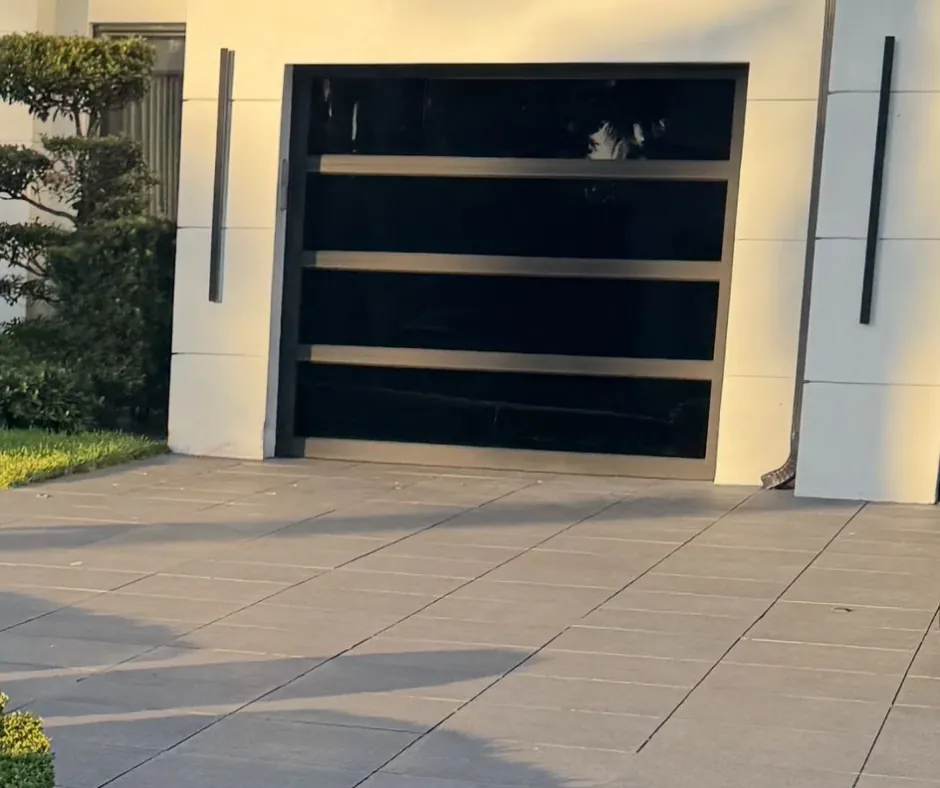
- Material. Steel sections are common and durable; insulated steel sections add stiffness and reduce noise. Aluminium and glass full-view doors suit some buildings and bring daylight into the bay.
- Colour. A colour that suits the brick, the front door and the window trim of the house.
- Windows. A row of glass panels in the top section adds light to a dark bay, while a solid door keeps the bay private from the street.
Which particular styles and finishes are available for a given door is confirmed when the door is chosen. The aim stays fixed whatever the catalogue: a door that reads as part of the original frontage.
Insulation and noise when rooms sit above the bay
A garage set inside a row house’s lowest storey shares its ceiling with the rooms above, and often a wall with the house as well. That makes insulation more than a comfort feature. An uninsulated door in a street-facing bay lets winter cold straight under the floor above, and a thin steel door can rattle and boom as it moves.
Insulated sections help on both counts. They are stiffer, so they flex and rattle less in the tracks, and they slow heat loss through the largest opening in the ground floor of the house. Paired with nylon rollers, a properly balanced spring and a quiet opener, an insulated door can make a real difference to how much of the garage is heard and felt upstairs. A new bottom seal, sized to the threshold, keeps out the water, slush and leaves that a street-level bay collects.
The trade-off is weight. An insulated door is heavier than a single-skin door of the same size, so the springs, cables and possibly the opener are chosen for the new door rather than carried over from the old one.
The threshold deserves attention too. Street-level bays in old buildings often have a sill that has settled, cracked or been patched over the years, so the floor under the door is not quite level from side to side. A new door closing onto an uneven sill leaves a gap at one end, and that gap lets in water, cold air and leaves. Setting the bottom section level and fitting a seal that can follow the floor, or dealing with a badly broken sill before the door goes in, gives the new door a clean line along the bottom where it meets the street.
How a new door comes in off the street
There is nowhere in Bay Village to unload a door, lay it out and lift it into place in one piece. The work is planned around that from the start.
- The old door comes out in pieces. With the spring tension released safely, the old door is unbolted section by section, and each section, the old springs and the old track are carried out to the street.
- The opening is prepared. The jambs and header are checked, and any rotten wood or loose fixings around the brick opening are put right, giving the new track brackets sound timber and masonry to bolt into.
- The new door comes in in sections. Each section is carried in from the street and stacked inside the bay, along with the tracks, springs, cables and hardware.
- The door is built in the opening. The bottom section is set and levelled, then each section is added above it with its hinges and rollers, and the tracks are fixed and aligned.
- Springs and cables are fitted and set. The coil goes up over the opening and is wound for this door’s weight; each lift cable is wrapped so both drums pull alike.
- Hand trial for balance. Raised by hand, the door should glide and then hover wherever it is let go.
- The opener is fitted or adjusted. Its travel and force are set for the new door, and the safety reverse is tested.
Because each piece is carried by hand and the bay is the only working space, this is done carefully and in order. The street stays clear, and the bay is not left open longer than the work requires.
Weighing repair against replacement
The decision is rarely about one part. It is about the whole door, and how much more repair it will reasonably take. A door with sound sections and a broken spring should be repaired. A door with one dented section, where a matching section is still made, can usually be repaired too. The case for replacement builds as problems stack up: a rusted bottom section on a door whose sections are no longer made, hinges cracking along several folds, a door that has been off its tracks more than once, or an old door that is so heavy for its springs that it keeps wearing out the opener.
Appearance counts as well on a street like this. A door patched with mismatched sections, or one whose paint and panels have weathered unevenly, sits awkwardly in a brick front. For new garage doors in Bay Village the visit to measure the bay is also the time to look at the old door honestly and say which parts are worth keeping, which are not, and why. You hear that before any door is ordered.
Full view glass for a dark bay
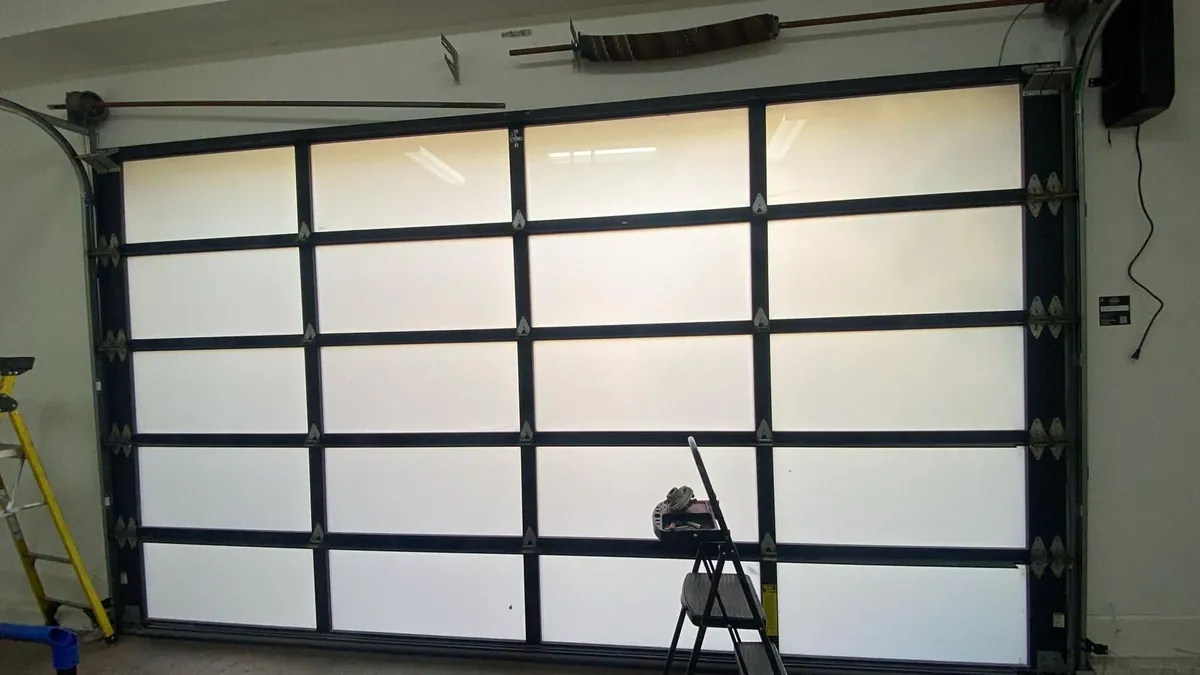
Single bays under row houses are often dark, with no window of their own and light only from the street when the door is up. A full view door, built from aluminium frames with glass panels, lets daylight into the bay with the door down. That can make a garage that doubles as a workshop or storage space far more usable.
Glass is not the right answer for every bay. It shows more of the inside to the street, and it insulates less well than an insulated steel door, which matters with rooms overhead. Frosted or obscured glass can keep the light while hiding the contents. Our page on full view glass garage doors goes further into how they are built, and whether one suits your bay is something to talk through on the measuring visit.
Springs, opener and the whole system
A new door is not just new panels. Every part that carries or guides the door is chosen for it. The springs are sized to the new door’s weight, which is why reusing old springs on a new door is rarely right. The tracks are new and set to the opening, the rollers and hinges come with the door, and the cables match the drums. A torsion spring system holds dangerous tension and is set by the installer, never adjusted afterwards by hand.
The opener is the one part that might stay. An opener in good working order can often be kept and reset for the new door, as long as it is powerful enough for the door’s weight and fits the headroom. An opener that is old, noisy or struggling is better replaced at the same time, so the whole system starts fresh. Our opener page for the neighbourhood covers that side, and the springs are explained on our Bay Village spring repair page.
Replacing a door after an emergency
Sometimes the decision is made for you. A door that has dropped out of its rails, taken a hit from a vehicle or torn itself apart on a broken spring may not be worth repairing. In that case the first step is to make the bay safe and secure, which our page on urgent garage door calls here explains. The choice of a new door can then be made calmly, with the opening measured and the options discussed, rather than in the middle of the night.
Planning new garage doors in Bay Village around the house
A door replacement in a row house takes over the bay while the work goes on, so a little planning helps. Any car needs to be out of the bay before work starts, which on these streets means finding a space nearby. Anything stored near the door, along the side walls or under the horizontal tracks needs to be cleared, because the installer works along the full height and depth of the door. If the bay is also the way into the house, the inner door will be the way in and out until the new door is running.
Once the new door is in, it is worth looking after. Keeping the bottom seal clear of salt and grit, wiping the sensor lenses, and listening for changes in how the door sounds upstairs will catch small problems early. New garage doors in Bay Village, MA spend their lives facing the street, and a little attention keeps them running smoothly.
Talk to us about a new door
If you are weighing a repair against a replacement, or your door has reached the point where repairs no longer hold, tell us about the bay: whether it sits under the house, how the door is failing and whether you have an opener you want to keep. There is more on door supply and fitting throughout the city on our door supply and installation page, while the Bay Village page collects all our work for this neighbourhood. To arrange a visit to measure the bay, call us or book online.
New door questions from Bay Village
There is no driveway. How does a whole door get into the garage?
It never arrives whole. A sectional door comes as separate sections, tracks, springs and hardware, which are carried in from the street one piece at a time and assembled inside the bay.
Will a new door suit an out-of-square brick opening?
In most cases. Widths and heights are taken at the top, middle and bottom before any order goes in, and the jambs and tracks are set so the door runs true and seals along its full width.
Is an insulated door worth it if there are rooms above the garage?
For a bay under living space it often is. Insulated sections help keep winter cold away from the floor above and tend to run more quietly than single-skin doors.
Does my current opener have to go?
Not necessarily. Provided it runs well, has the strength for the heavier door and clears the ceiling, it can stay and be re-tuned. One that is noisy or labouring is worth swapping during the same visit.
Where does the old door end up?
We dismantle it inside the garage and carried out to the street in pieces, along with its old springs and tracks, as part of the replacement.