
Two-car doors under the trees: what wears out on Bedford’s wooded lots
The houses on Bedford’s wooded lots, mostly post-war colonials and ranches, nearly all have an attached two-car garage at the end of a full driveway. When we are called about garage doors Bedford MA homeowners are having trouble with, it is usually one of those doors: wide, heavy, opened several times a day, and sitting under trees that drop leaves, needles, twigs and the odd branch onto everything below them.
Trees are good for a house and hard on a garage door. Shade keeps the lower sections damp after rain. Leaves and needles collect in the bottom of the tracks and against the bottom seal. Sap and pollen gum up rollers. And a wide door has a long bottom edge for all of that to gather along.
Before calling, have a look without touching the springs or cables:
- Is anything lodged in the bottom of either track, or packed along the bottom seal?
- Does the door sit level when closed, or is one side higher than the other?
- Is the spring over the opening one piece, or is there a gap in its coils?
Garage door services in Bedford
Garage door repair
Rollers seized with grit, hinges cracked between sections, a bottom section swollen or split by damp, a door that shudders in the tracks. Our garage door repair covers the whole door.
Springs
A double door is heavy, and its torsion springs carry all of that weight. When one snaps, the opener cannot lift the door on its own. See spring repair.
Openers and sensors
Openers straining under a badly balanced double door, remotes, wall buttons, keypads, and safety eyes misaligned by a rake or a mower. We handle LiftMaster openers among the rest. More on opener services.
Emergency calls
A double door stuck wide open after dark, or both cars trapped behind a snapped spring. Someone answers whenever you ring, any day. See emergency garage door repair.
Cables and doors off track
A frayed cable on a wide door lets one end sag first; a door that keeps running crooked can climb out of its rails. See cable repair and off-track door repair.
Replacement doors
Replacing a tired double door with a new one, supplied and fitted to the opening. See new garage door installation.
Why a wooded lot is hard on a garage door
A garage on an open lot dries out quickly after rain. A garage among trees does not. The bottom section of the door, the bottom seal and the base of the tracks stay damp for longer, and in autumn they sit in a drift of wet leaves. Over time that shows up in a few predictable ways.
Damp at the bottom of the door
Wooden doors, and wooden trim around steel doors, soak up water along the bottom edge. The wood swells, then shrinks, then swells again, and eventually it splits or softens. Steel bottom sections can rust from the inside where water sits in the seal channel. Once the rubber seal along the bottom stiffens or splits, rain blows in under the door, and once it has started to leak it holds water against the bottom section rather than shedding it.
Grit and needles in the tracks
Rollers run in the curved channel of the track, and the lowest part of that channel is where needles, seeds, grit and leaf litter end up. A roller that hits a packed clump at the bottom of its travel lifts the door slightly out of line, and repeated cycles can wear a roller flat or bend the lower track. On a double door, one side catching while the other keeps going is enough to twist the door.
Branches, roots and the driveway
A fallen limb across a driveway is one thing; a limb that lands on a door that was partly open is another. Wind can also throw small branches against the door’s face and dent a panel. Roots lifting the edge of a driveway or the apron in front of the garage can leave the floor under the door uneven, so the door never quite seals on one side.
None of this needs a special door. It needs a door that is set up and looked after for the place it sits, and hardware that is checked with the trees in mind.
The weight of a two-car door
A two-car door is roughly twice as wide as a single and much heavier, and it is lifted by the same kind of system: a torsion spring assembly across the top of the opening, cables running to drums at each end, and rollers in a track on each side. Everything in that system carries more load than on a single door.
That has consequences:
- Springs. A double door often runs on a pair of torsion springs. When one breaks, the other is left carrying the whole door and, having made exactly as many trips as its twin, is rarely far behind it.
- Cables. A wide door that drops unevenly puts a sudden load on one cable. Frayed strands at the bottom corner are a warning sign.
- Openers. An opener should guide the door, not lift it. Once the springs weaken, the motor is left hauling dead weight and chews through its gears or drive.
- Sections and hinges. Wide sections flex more. Hinges and the struts across the top section keep a double door stiff, and a cracked hinge lets the door sag in the middle.
When we work on a two-car door, we look at all of these together, because a fault in one usually started with another.
Colonial or ranch: how the garage meets the house
The post-war colonials and ranches put their garages in different places, and that changes what we find when we arrive.
Beside a colonial
On a colonial the two-car garage is usually built onto one end of the house, sometimes with a room or a bonus space over it. A room above the garage means the opener and the spring assembly are working directly under someone’s floor. Noise and vibration travel up through the joists, so a door that judders or an opener with a worn chain drive is heard upstairs long before it fails. A quieter belt-drive opener, fresh rollers and a well-balanced door make a real difference in that kind of garage.
At the end of a ranch
On a ranch the garage often continues the long, low roofline of the house. Headroom over the door can be tighter where the roof pitch comes down, which affects where the torsion bar sits and how much space there is for an opener rail. When we replace a spring assembly or an opener on a ranch, we fit the parts to the room that is actually there, and where headroom is tight, a low-headroom track arrangement may be the answer.
The shared wall
Either way, the garage backs onto lived-in rooms on at least one side, and usually a door into a mudroom or kitchen. That is why so many garage doors Bedford MA owners ask us about are really questions about draughts, damp and noise in the house as much as the door itself. A torn bottom seal, worn weatherstripping along the jambs, or an uninsulated door in a shaded garage all make that shared wall colder.
Springs: the most common urgent call
Of all the faults on garage doors Bedford MA households call about, a broken spring is the one that most often arrives as an urgent call. Usually it is heard first, a crack like a gunshot from inside the garage, and then the double door either stays shut or lifts a little and stalls.
Torsion springs hold a dangerous amount of tension. They are wound tight on a steel bar above the door, and the cones, bar and brackets are all under that load. They are not a DIY repair, and neither is unwinding a broken one. When a spring has failed:
- Leave the door where it is. Do not lift a double door by hand; without a working spring it is far too heavy.
- Do not keep pressing the opener button.
- If a car you need is shut in, ring us instead of trying to force the door up.
New springs are sized to what the door weighs and how tall it is, usually both springs on a two-spring door, and then adjust the tension until the door holds still at mid-height. Cables, drums and bearings are checked while the spring assembly is unloaded.
Openers, remotes and the safety eyes
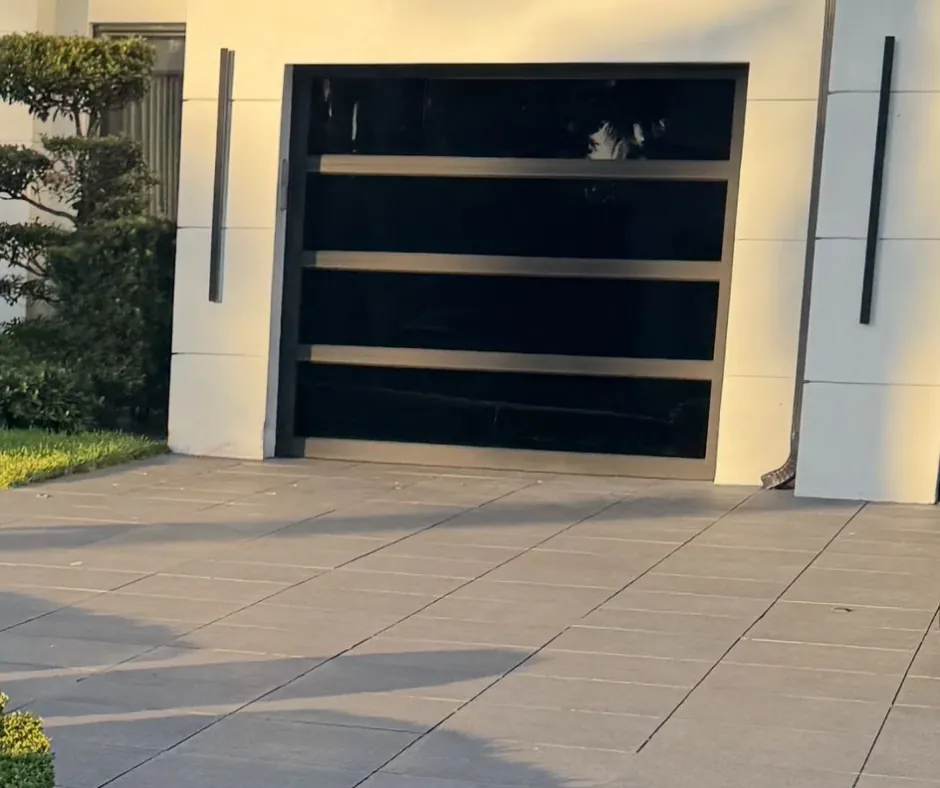
The opener on a two-car door works hard, and the faults follow a pattern: a motor whirring away beside a motionless door, a door that halts midway or turns back, a remote that works only near the house, or a keypad that has stopped taking its code.
On a wooded lot the safety eyes deserve a look first. Mounted just above the floor at both jambs, they are easy to knock out of line with a rake, a leaf blower or the edge of a mower. Leaves and cobwebs across their path can also stop a door from closing. If the door goes down and comes straight back up:
- Check that nothing is between the two eyes.
- Wipe the lenses.
- See whether the small light on each eye is steady.
When the motor hums and the door stays put, the door may be locked or the emergency release pulled, or the springs may have failed and left the door too heavy. If the opener has stripped its gears or broken its drive, we repair or replace it. Our opener work includes LiftMaster repairs and replacements, and on a heavy double door a replacement should be chosen with that weight in mind.
A full driveway and a busy door
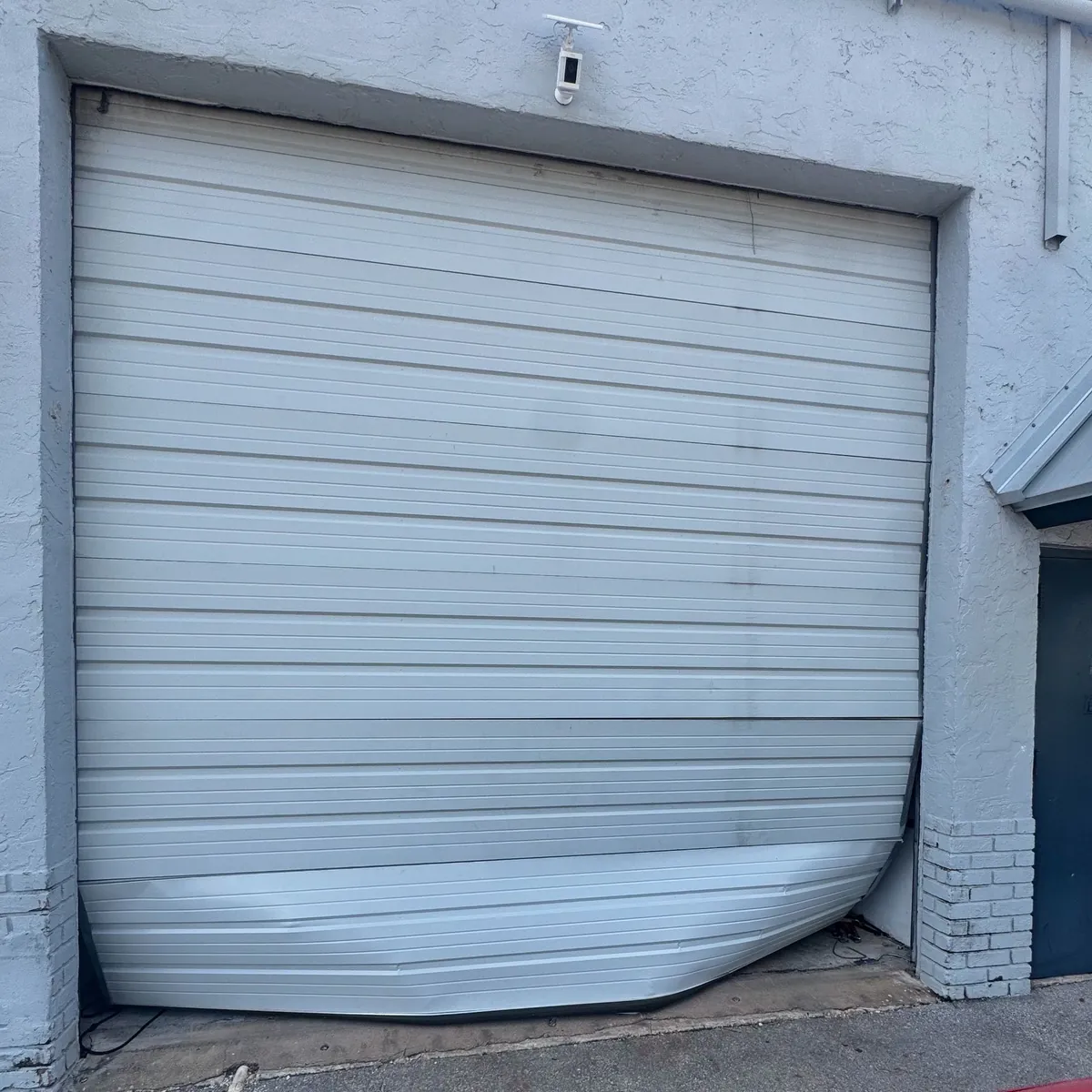
The full driveways on these lots tend to hold several cars, and the two-car garage at the end of them gets used far more than the front door. That means the door cycles many times a day, and the cars that come and go pass close to it. A door struck by a reversing car, or closed onto a car roof, bends sections and often the track as well.
After a door takes a knock:
- Leave it unused until someone has checked it. One more cycle on a kinked rail can pop a roller out.
- Look at the bottom corners for a loose cable or a bracket pulled away.
- Unplug the opener if the door is sitting crooked in the opening.
We straighten or replace bent track, replace damaged sections where the door is otherwise sound, and reset the opener’s travel so the door stops where it should.
Doors that have left their tracks
An off-track door happens on wide doors more than narrow ones, because a double door twists more easily when one side binds. Debris at the bottom of a track, a parted cable or a bump from a bumper can all start it. Once a roller is out of the rail, the door hangs at an angle and can drop further if it is moved.
Clear people and vehicles away from beneath it. Unplug the opener. Then call. Putting a door back on track means taking the weight off safely, reshaping or replacing the track, fitting new rollers where needed, and rehanging the door level. We also check the lower track for the same leaf-litter build-up that may have caused it in the first place.
What happens on a visit
- We look at the whole door first: springs, cables, drums, rollers, tracks, hinges, sections, seal, opener and safety eyes.
- You get a plain account: what has failed, what is tired, what can be left for now.
- You choose what is done. Nothing is replaced without your agreement.
- We balance the door, set the opener’s force and travel, and test the safety reverse.
It helps if the cars are out of the garage, or at least clear of the door, and the driveway in front of it is open so the door can be run through a full test.
Repairing a post-war door, or replacing it
Many of the two-car doors here are not the first door the house has had, and some of them are well past middle age. A door with sound sections and worn hardware is usually worth repairing: new springs, cables, rollers and hinges give a heavy door a lot more life.
Replacing makes more sense when:
- Seasons of shade and damp have eaten through the lowest section.
- Several sections are dented or cracked.
- The door has been mended so often it now tracks crooked.
- A garage attached to the house is letting cold and damp through a poorly sealed door.
A new door is supplied, the old one is taken away, and the new one is fitted to the opening. A colonial often suits a raised-panel or carriage-style door with windows across the top section; a ranch often suits a simpler, longer-lined panel. For a garage attached to the house, an insulated door with a good bottom seal is worth considering, especially on a lot that stays shaded and damp.
Looking after a door in the shade
On a lot ringed with trees, a little routine goes a long way:
- Sweep or blow out the bottom of both tracks in autumn, and again after storms.
- Clear leaves away from the bottom seal so it can close fully.
- Look at the bottom section for swelling, splitting or rust.
- Run the door through a full cycle and listen for scraping or a roller catching low down.
- Check the safety eyes after any yard work near the garage.
Leave the springs, cables and drums to us. If you notice a frayed cable or a gap in a spring, call before it fails.
Nearby towns
We also work in the towns around Bedford, including Lexington, Burlington and Concord. Every town we cover is listed on our service areas page, and repairs on garage doors Bedford MA neighbours have are handled in the same way.
Arranging a visit
If the door is stuck, crooked or closing on its own, the quickest way forward is to call us or book online. There is a person on the end of the line however late it gets, any day of the week, so a fault with garage doors Bedford MA homes depend on can be reported straight away.
Questions from Bedford
Leaves keep packing into the bottom of our tracks. Is that doing damage?
It can. Rollers that hit a clump at the bottom of their travel lift the door out of line and wear unevenly. Clearing the tracks in autumn and after storms helps; if a roller is already flat or the track bent, we can replace it.
One of the two springs on our double door broke. Can only that one be replaced?
It can. The surviving spring has opened the door just as many times as the broken one, though, so it rarely lasts much longer. We will tell you what we see and you decide.
A branch hit the door. Can it be repaired or does it need replacing?
A single dented section can often be swapped out when the others are still in good order. If several sections or the track are bent, a new door may make more sense. We look before advising.
Our wooden door has gone spongy along the bottom edge. Can it be saved?
A soft bottom section can sometimes be replaced, depending on the door. If the rot has spread, a new door with a sound bottom seal is often the better choice on a shaded lot.
The opener struggles to lift our two-car door. Does it need a new opener?
Not necessarily. An opener straining on a heavy door is often a sign that the springs have weakened. Once the door is balanced again, the opener may be fine.