
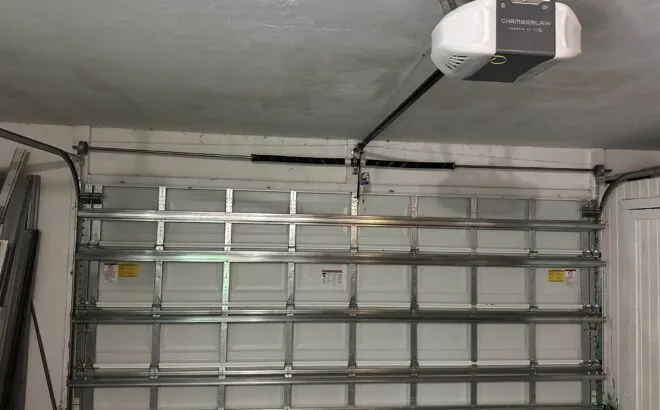
Spring trouble in the West End’s shared tower garages
Almost every building in the West End is a post-renewal tower, and the parking that goes with it is a shared garage behind a building roll-up or a gate system. That makes garage door spring repair in the West End a different job from swapping a spring on a family’s single door. The springs are bigger, they work much harder, and when one lets go a whole building’s cars are affected at once.
A spring is the part that actually lifts a garage door. It stores energy as the door comes down and gives it back as the door goes up, so the motor merely steers a load the spring has already taken off its hands. Of all the urgent calls the phone takes, a snapped spring is the one heard most, whatever the door.
Management handles access to these garages, so they are usually the first to hear that something is wrong. Three signs point to a spring:
- A loud bang from the garage, often heard with the door shut and nobody using it.
- The door rising a short way, then stopping or reversing as the motor gives up.
- A visible gap in the coils above the door, or a roll-up curtain that feels like solid lead.
Springs this page deals with
Torsion springs on sectional doors
Mounted on the steel bar spanning the header, they twist as the door closes and unwind to turn the cable drums as it opens. Heavy shared doors often carry two or more.
Barrel springs inside roll-ups
A roll-up curtain hides its counterbalance inside the barrel it coils on. When that spring breaks, the curtain cannot be lifted by the operator or by hand.
Extension springs on lighter doors
Stretched along the horizontal tracks and pulling through pulleys and cables, they are found on lighter doors and older bays. They should always run with safety cables through them.
Spring replacement and rebalancing
Replacement coils chosen for this particular door’s heft and travel, wound to the correct turns, then the door balanced so its operator coasts rather than hauls.
Why springs fail sooner under a tower
Every spring has a design life measured in cycles, one cycle being a single open and a single close. A household door might complete a few in a day. The door at the bottom of a West End tower’s ramp may cycle for nearly every resident’s car, every visitor, every delivery van and every contractor, from early morning until late at night. A spring that would see out many seasons on a house can be worn through far sooner here, which is why garage door spring repair in the West End comes up as often as it does.
Fatigue builds quietly. With every cycle the steel coils twist and relax, and microscopic cracks grow at the point of greatest stress, usually near the cone at one end of the spring. There is rarely a warning before the break, though a door that feels heavier when lifted on its manual release, or that drifts down when it should stay put halfway, is telling you the coil has begun to tire.
Cold weather is the other trigger. Chilled spring steel snaps more readily, and garages under buildings are not heated like the floors above them. Once the first proper freeze arrives, snapped coils pile up across the city, and shared garages see their share.
Torsion springs hold dangerous tension
Plain words first: a torsion spring holds dangerous tension. Replacing one is not a DIY repair. Exactly the same goes for of the springs inside a roll-up barrel. To lift a heavy shared door, the spring is wound tightly enough to store a great deal of energy, and that energy is still there when the door is closed. The winding cones, set screws, cables and bottom brackets all carry part of it.
Unwinding or winding a spring takes purpose-made winding bars and a set order of steps. Using the wrong tool, or loosening a set screw in the wrong order, can let the spring spin loose and throw whatever is in its path. On a door built to serve a whole tower, those forces are larger than on any house door.
What a building manager or resident can safely do:
- Stop using the door from every remote, fob and wall station.
- Switch off or unplug the operator if it can be reached safely, so no one calls the door by habit.
- Rope off or guard the entrance so neither residents nor cars pass beneath a half-raised door.
- Note what was heard and seen, and when, so it can be passed on when you call.
Never heave on a spring-broken door, and never ask the operator to raise it. Without the spring nothing is holding it, and it will come down hard.
Torsion, barrel or extension: telling them apart
You do not need to identify the spring to report a problem, but knowing what to look for helps when you describe the door on the phone.
With a panelled sectional door, glance up at the header wall. A steel bar spanning the width of the door, carrying a thick coil and a grooved wheel at each end, means a torsion system. If that coil has separated into two pieces with daylight between them, the spring has snapped. Some heavy doors have a spring on each side of a centre bracket, and only one may have gone.
On a roll-up, the springs are hidden. The barrel above the opening, inside its hood, holds them, and a break shows itself only as a curtain that refuses to budge, or an operator that groans and quits. Some roll-ups have a tension wheel at one end of the barrel; leave it alone.
Extension springs are long, thin coils stretched above each horizontal track, parallel to the ceiling. A broken one usually hangs loose, and if the safety cable through it was fitted, it will have stopped the spring from flying across the garage.
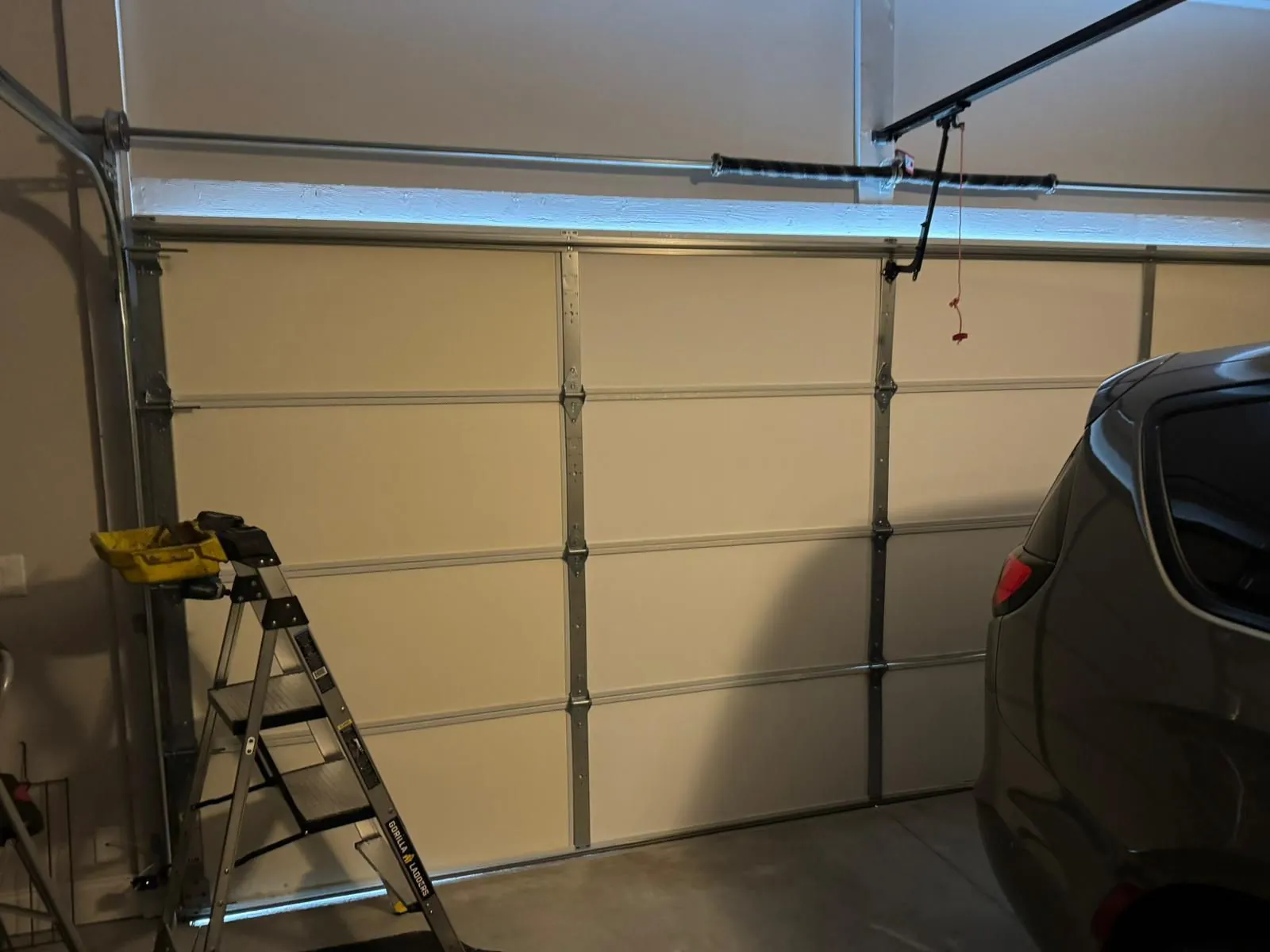
What a spring repair visit involves
Getting into a shared garage usually goes through management, so the visit starts by agreeing access, where the van can wait and whether residents should be warned that the entrance will be closed for part of the day. At the door itself:
- The operator is switched off and clamps or locks fitted so the door can neither fall nor be summoned.
- The broken spring, and its partner if there is one, is examined along with the cones, shaft, bearings and drums.
- The door’s weight, height and drum size are checked so the replacement spring matches the door rather than simply matching the old part.
- Tension is let off the failed coil step by step with winding bars before it comes down, and its replacement is mounted and wound turn by counted turn.
- Both lift cables are inspected for broken strands and brought to matching tautness.
- A hand lift confirms the door now floats at mid-height; only then does the operator go back on, with its travel limits, force and auto-reverse each proven.
You or the building’s manager are told what has broken and what the door needs before any spring comes off. If a partner spring on the shaft looks worn out as well, that is mentioned too, with the reasons, and the choice is yours.
Replacing in pairs and matching the door
Twin springs age in step, because every lift loads them together. One giving way is a strong hint its partner is close behind, and renewing the pair keeps the shaft twisting evenly from both ends instead of setting up a second breakdown soon afterwards. It also means the two springs share the load equally, which the operator, cables and drums all benefit from.
Matching matters as much as replacing. Undersized steel leaves the door heavy, so the operator grinds away at a load it should never carry. Oversized steel makes the door leap upward and creep off the floor when it ought to stay shut. Spring sizing depends on the door’s weight, its height and the drums it turns, so a door that has had sections or slats replaced, or a heavier bottom bar fitted, may need different springs from the ones it came with. Sizing it properly is part of every garage door spring repair in the West End we carry out.
What a broken spring does to the rest of the door
Once the counterbalance is gone, its job lands on everything nearby. The operator tries to haul the full weight of the door, and its motor, gears or drive chain can be damaged by the effort. On a sectional door, the cables may unspool from their drums or tangle as the tension drops, and a door that dropped on one side can twist and push rollers out of the track. On a roll-up, the curtain can drop unevenly and jam in its guides.
For that reason a spring call never stops at the spring: cables, drums, rollers and operator are all looked at. If any of them has been hurt by the failure, you will hear about it. The West End garage door repair page covers those other parts, and the West End opener repair page covers an operator that was strained or burned out by a weak spring.
Warning signs before a spring snaps
Coiled steel does not always fail without a hint, and the people who pass through a tower garage every day are the ones most likely to catch one. Pass any of these on to the building’s manager:
- The door takes longer to start lifting, as though the operator is gathering itself before each trip.
- A panelled door no longer hangs level when stopped halfway, or a roll-up curtain drifts back down on its own.
- A dry, rhythmic creak from above the opening while the door travels.
- On a torsion shaft, coils that look stretched apart or rusty compared with their neighbour.
- The operator reversing at the top or bottom of travel when nothing is in the way.
None of these is proof on its own, but together they suggest the counterbalance is weakening. Replacing a tired spring before it breaks spares the operator and the cables, and it lets the work be planned with management rather than forced on the building late one evening.
How access timers and auto-close add wear
Many shared garage doors are set to close by themselves once a car has passed, and some are called again by the next vehicle before they have fully shut. Each partial run still flexes the spring. A door that reverses halfway, or is stopped and restarted repeatedly at a busy moment, can rack up far more spring movement than a simple count of cars would suggest. A door whose closing timer is set very short, or whose sensors trigger it to reopen often, will wear its springs faster still.
None of that means the settings are wrong; a shared garage needs to stay secure. It does mean that when a spring is replaced, it is worth asking how the door is actually used. Knowing that a door sees heavy traffic helps when the replacement is chosen, because the spring can then be picked with that workload in mind.
Rust, grime and the spring’s surface
Springs in an underground garage live in damp, still air, with exhaust and road salt drifting in from the ramp. A film of rust on the coils roughens the steel and makes the turns rub against one another as the spring winds, which adds friction and speeds up fatigue. A light coat of suitable lubricant, applied as part of a service by someone who knows which parts may be touched, helps the coils slide. Heavily pitted springs, though, have lost strength that no lubricant restores, and are better replaced before they fail on their own.
Springs on doors serving a whole building
Residents in a tower have no single garage of their own; they share one door with their neighbours. So the effect of a broken spring is felt by everyone at once, and a door stuck shut traps every car inside, while a door stuck open leaves the garage unsecured. Both situations matter to building management, and both can be reported at any hour.
When a spring breaks at night, the West End emergency repair page explains how calls are handled after the working day ends. Our garage door spring repair in the West End follows the same steps whether the call comes at noon or near midnight: make the door safe, find out exactly what failed, then fix it properly.
When the spring is not the whole problem
Sometimes a spring breaks because the door around it has deteriorated. A door that has been struck repeatedly, that has rusted through at the bottom where salt sits in winter, or that has been patched with mismatched sections may be heavier and rougher than its springs were ever sized for. Fitting a new spring will get it moving, but it will keep wearing parts faster than it should.
If a door has reached that stage, it is worth talking about replacement. Supplying and fitting a replacement door for a tower garage is described on the West End new garage doors page. For the wider view of how spring work is done across the city, see our main garage door spring repair page, and for the neighbourhood as a whole, the West End garage doors page.
Arranging a spring repair
Spring failures do not wait for convenient moments, and our phone is staffed right through each night and weekend, so a request for garage door spring repair in the West End can be made the moment the bang is heard. Have the building’s name and garage entrance ready, say whether the door is shut, open or stuck partway, and mention whether it is a coiling curtain or a panelled door, and how many springs you can see if any. If cars are trapped inside, say so. Then call us or book online.
Questions from West End
Residents heard a loud snap from below during the night, and this morning nothing moves. Was it a spring?
Almost certainly. Coiled steel letting go under load makes that report, and it tends to happen with the door shut and the garage empty. Leave the door alone and keep residents back from it until it has been inspected.
Can the operator open the door with one spring broken?
Sometimes it will try, but it should not be allowed to. An operator has no business carrying that dead load alone, and forcing it can damage the motor or make the door fall unevenly. Switch it off and call us.
Our door has a matched pair and only one snapped. Is the other one due too?
Usually, yes. The remaining coil has shared every single lift with the one that failed, so it is living on borrowed cycles. Renewing the pair keeps the shaft evenly loaded, though the decision stays with the building.
Could our building’s own handyman swap the spring?
Please do not ask them to. Whether it sits on a shaft or inside a roll-up barrel, the spring stores dangerous tension and needs the right tools and procedure to release and wind. It is not a DIY repair.
Why did our spring break when the door is not very old?
A door under a tower is worked many times harder than a house door, and a spring’s life is counted in cycles rather than years. Cold weather and a door that has become heavier through damage can shorten that life further.