
Why springs on Milton’s wide doors break
The houses around Milton Village and up toward the Blue Hills are mostly larger single-families, and their garages are attached, wide and reached by long driveways. A double-width door on one of those garages is a heavy curtain of steel or timber, and the only thing making it liftable is the spring above the header. That is why garage door spring repair Milton MA calls so often come from these houses: big doors, frequent use, and coils that quietly lose strength until one cold morning they part with a crack like a gunshot.
A broken spring rarely leaves room for doubt. Usually the door refuses to rise more than a hand’s width, the opener whines and stops, and someone in the house remembers a loud bang from the garage the night before.
From the garage floor, with the door left closed, three quick looks will usually confirm it:
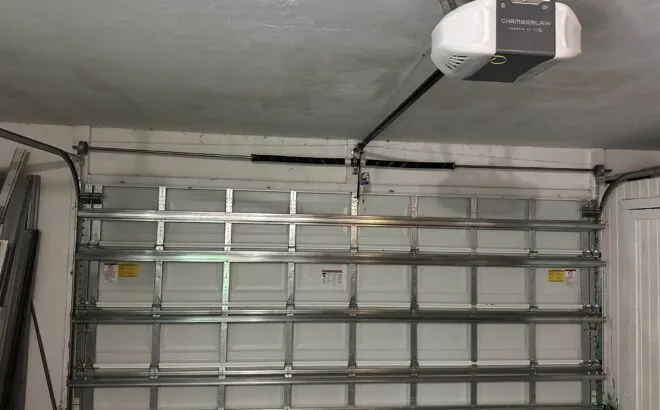
- A clear break in the coil over the door, with its two halves sitting apart along the bar.
- Cables hanging loose from the drums instead of drawn taut down each side.
- Panels that will not budge, or barely shift, when the opener is unhooked and the handle is tried gently.
The springs and parts this covers
Torsion springs
Coiled steel wrapped round a bar that spans the top of the opening. Most attached garages here use them, and wide doors often carry a matched pair.
Extension springs
Pairs of long coils running beside the overhead rails, drawing the door upward by way of pulleys. Typical of older or lighter doors.
Snapped and stretched springs
A coil that has broken clean through, or one that has lost so much tension the door drifts down or feels heavy.
Cones, drums and bearings
The winding cone, the drums the cables wrap on and the bearings that carry the shaft, all checked whenever a spring is replaced.
Spring safety cables
On extension systems, the restraint cable threaded down the centre of each coil that stops a broken one whipping across the garage.
What a spring actually does
Picture lifting a double-width door with no help. Even a lightweight insulated steel door on a two-car opening is far beyond what one person should raise from the floor, and a timber carriage-style door weighs a great deal more. The spring exists so that nobody has to. It is wound or stretched by exactly the right amount to counter the door’s weight, so that in good order the door floats: lift it to waist height, let go, and it stays where it is.
Torsion works through twist. The coil is fixed at one end to a bracket over the middle of the opening and at the other end to a winding cone clamped to the shaft. As the door comes down, the cables unwind off the drums, the shaft turns, and the coil is wound tighter. Raising the door reverses the process, the coil gives back its stored energy, and the drums reel the cables in. Extension springs get there by stretch instead: lowering the door draws them out alongside the ceiling rails, raising it lets them shorten again.
Either way, the spring is doing the lifting. The opener only steers the door and stops it at each end of its travel. That is the single most useful thing to know when a door fails: if the spring is broken, no opener can make up for it, and running the opener against a door with no spring support strains its motor, gear and rail.
Why springs wear out
Spring steel has a working life counted in cycles, one cycle being a full trip up and back. Each trip bends the wire a little, and metal that is bent often enough eventually tires and cracks. A door opened and closed many times a day, as attached garage doors often are, uses up that life faster than a door on a detached garage visited at weekends.
Other things shorten it:
- Cold. Steel grows more brittle as temperatures fall, and the first hard frosts of the season bring a run of breaks.
- Rust. Moisture on the coils roughens the surface, adds friction between the turns and starts small cracks.
- The wrong size. A spring that is too light for its door is worked harder on every cycle. This often happens when a door has had a panel replaced, gained insulation or soaked up water, and its weight has drifted away from what the spring was chosen for.
- An imbalanced pair. When one of two torsion coils fails, the remaining one is forced to carry the entire load on its own if the door is used.
On a wide door, that last point matters a great deal. Two coils fitted together have usually done the same number of cycles, so when one breaks, its partner is close behind. Replacing both together is often the sensible approach, and the reasons are explained on the visit.
Garage door spring repair Milton MA: a door that has stopped
When the spring goes, the door is suddenly a dead weight, and the safest choice is to leave it alone. A few steps are sensible while you arrange garage door spring repair Milton MA homeowners can trust:
- Disconnect the opener at its outlet, so a stray press on a remote in someone’s car cannot set it grinding.
- If the door is down, leave it down. If it is part-way up, keep people, pets and cars well clear of the opening.
- Leave the red emergency cord alone if the door is up. With no spring behind it, the door can fall the instant the trolley lets go.
- Keep children and pets on the house side of the connecting door until a technician has secured things.
What not to do matters even more. Be clear about the risk: a torsion spring holds dangerous tension, and a good share of it lingers in the unbroken coil, the cables and the corner brackets after a break. Its winding cone is locked to the shaft with set screws, and loosening them without the right bars and the right training invites a bar wrenched from the hand with bone-breaking force. Cables can also snap back if a bottom bracket is unbolted while under load. None of this is a DIY repair; the tutorials that make it look easy rarely show what happens when a bar slips.
The visit, step by step
Safety comes first on arrival. The opener gets unhooked, locking pliers or a clamp go on the rail beneath a roller to pin the panels in place, and any tension left is wound off a quarter turn at a time with proper bars. Only then is the broken spring removed.
The new coil is chosen for the door hanging in the opening today, which is not always the door the old coil was chosen for. Because a door’s weight can change over its life, the technician considers the door as it is now: its width and height, its material, any added insulation and its current weight, so the new spring balances it properly. On a wide door with twin coils, the pair is matched to each other and to the door.
Once fitted, the coil receives its calculated number of winding turns, its set screws are snugged down, and the cable on each drum is checked for equal tension so neither side leads. The technician then runs the door by hand, stopping it near the slab, at mid-height and close to the top to confirm it holds still at each point. Only after that is the trolley reconnected, the opener’s limits retuned for a door that now weighs less on the motor, and the reversing feature tried against an obstacle.
While the door is apart, it makes sense to look at the parts that wear alongside a spring: the drums, the shaft bearings at each end, the cables, and the rollers that carry the door’s weight once it is moving. Anything nearing the end of its life is shown to you, leaving you to decide whether it should be dealt with at the same time.
Clues that a coil is tiring
Springs give hints long before they finally part, and catching them early lets the work be booked at a convenient moment instead of on a frozen morning with the car shut in.
- The door creeps. Raised by hand to mid-height and released, a balanced door hovers. One that sinks back toward the slab is short of lift; one that drifts upward is wound too tight.
- The opener sounds laboured. A motor that slows and groans through the first stretch of travel is often making up for a coil that has lost strength.
- The coil looks stretched open. On a torsion spring, turns that were once tight against each other show light between them as the steel loses its set.
- Extension springs sag. With the door raised, a healthy extension spring is drawn up close; a tired one hangs visibly looser than its partner on the other rail.
- Rust bloom. Orange flaking on the coils means pitting, and pitted steel cracks sooner.
- Uneven landing. If a pair of springs has weakened unequally, one end of a wide door may reach the floor first.
None of these needs you to touch anything under tension; they can all be seen or heard from a safe distance. Mentioning them when you call helps the technician come prepared. Booking garage door spring repair Milton MA homeowners schedule on their own terms, before the break, also avoids the strain an ailing coil puts on the opener, the cables and the drums in the meantime.
On attached garages with a room overhead, a weakening spring can also make the door land harder at the bottom of its travel, a thud that carries into the floor above. That noise is often the first thing anyone in the house notices.
Wide doors on long driveways
The double-width doors common on Milton’s larger single-family houses put more demand on their springs than a pair of single doors would. One wide door has more surface, more panels and more hardware, and it usually needs two torsion coils sharing the shaft. If the driveway is long, the door also tends to be opened from the car well before it is reached, so it runs fully up and down more often than a door opened only when someone is standing beside it.
Timber and carriage-style doors on these houses deserve a special mention. Wood absorbs water through the winter, and an unsealed or weathered panel can grow noticeably heavier between autumn and spring. A spring that balanced the door when it was installed may be struggling a few seasons later. Garage door spring repair Milton MA visits on doors like this often include rebalancing the door for its current weight, not simply swapping a broken coil for an identical one.
Torsion or extension: which do you have?
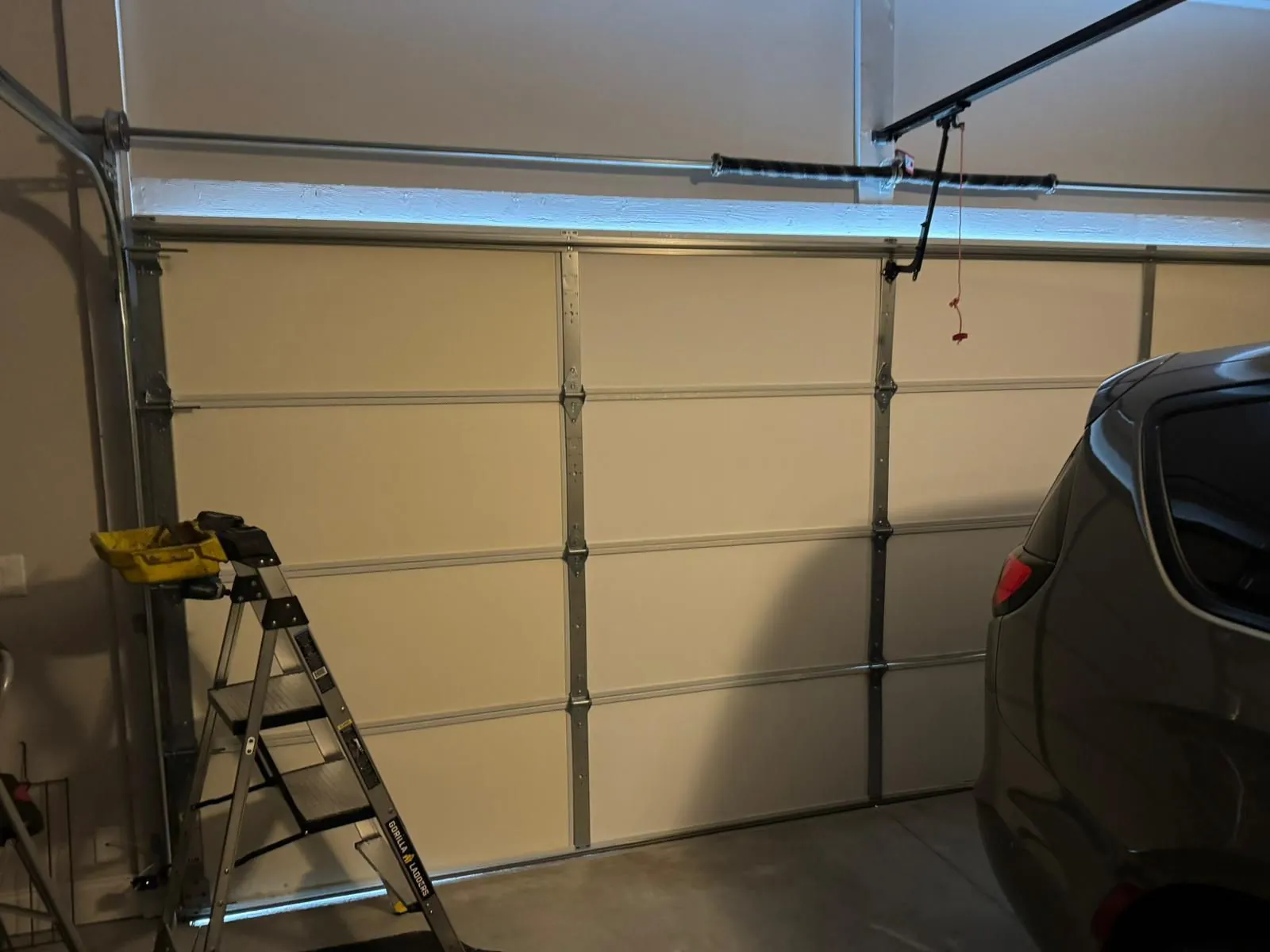
Stand inside with the door shut and look up. If there is a horizontal steel shaft crossing the wall over the opening and carrying a coil or a matched pair, the door uses torsion springs. If instead there are long springs running parallel to the ceiling tracks on each side, usually with a pulley and cable at one end, it uses extension springs.
You will mostly see extension setups on older or lighter doors. They work well, but each spring must have a safety cable threaded through its centre and anchored at both ends. Without it, a broken extension spring can fly across the garage, damaging a car or injuring anyone nearby. Part of any extension spring visit is checking that those safety cables are present and secure, and fitting them where they are missing.
A common question is whether an extension system can be converted to torsion. On many doors it can, and torsion springs tend to give a smoother, more controlled lift on a wide door. Whether it is worthwhile depends on the door, the headroom above the opening and the door’s remaining life, and it is talked through rather than assumed.
New spring, or a new door altogether
In Milton, full door replacements come up more often than single-part repairs, and spring visits are often where that question is first raised. A new spring on a door that is otherwise sound is almost always the right call: the door goes back into service balanced and safe. But a spring break sometimes reveals a door that is struggling in other ways.
It may be time to consider a new door if:
- The bottom panel is rusted through or the timber is rotting from the threshold up.
- Several panels are cracked, or hinges keep splitting at the same places.
- The door has grown so heavy that a spring large enough to balance it would be out of proportion to the door’s remaining life.
- The same parts have needed attention several times in a short span.
You will be told honestly which applies. When a new door is the sensible choice, the new garage doors page explains how new doors are supplied and installed, and why a new door is always paired with springs sized for it.
Related work in Milton
Spring failures often come with other problems. A door that dropped hard after a break can bend a track or jump its rollers; a cable can slip off its drum at the moment the spring lets go. The Milton garage door repair page covers those wider repairs. Where an opener has been driven against a broken coil and now hums, clicks or refuses to respond, see opener repair in Milton. A coil giving out after supper, with a car needed at dawn, is exactly what the Milton emergency repair page is for. For everything in one place, visit the Milton garage doors page, and for how this work is handled across Greater Boston, the main garage door spring repair page.
Book the work
Springs choose their own moment, often the coldest morning of the week. Somebody answers the line at every hour, weekdays and weekends alike, which means a snapped coil found at midnight can be phoned in at midnight. Say where the door has stopped, whether its springs sit on a bar over the opening or beside the ceiling rails, and whether a car is inside. Getting a coil replaced starts the same way as any job on the map: call us or book online.
Questions from Milton
Something cracked like a shot out in the garage overnight. What was it?
Most probably a torsion coil parting. The stored tension lets go with a report loud enough to carry through the house. From the floor, check whether the coil over the header has parted, disconnect the opener at the outlet and leave the door untouched until a new spring is on.
Only one of our twin coils snapped. Is replacing that one enough?
It can be done, but both coils have usually worked the same number of cycles, so the remaining one is likely to fail soon. Replacing the pair keeps the door evenly balanced and avoids a second visit before long. The choice is yours, and the trade-off is explained on the day.
Can the car be driven out with a broken spring?
Only if the door can be raised safely, and with a broken spring it usually cannot. Do not try to lift a double-width door by hand or with the opener. If the car must come out, say so when you call so the job can be planned around it.
Why did the new door feel heavy a few years after installation?
Often because the door has gained weight, for example timber that has absorbed water, or the springs have lost some tension with use. A balance check and adjustment, or springs sized for the door’s current weight, usually put it right.
Do you replace extension springs as well as torsion springs?
Yes. Both kinds are repaired and replaced on Milton garages, and the safety cables that run through extension springs are checked and fitted where they are missing.