
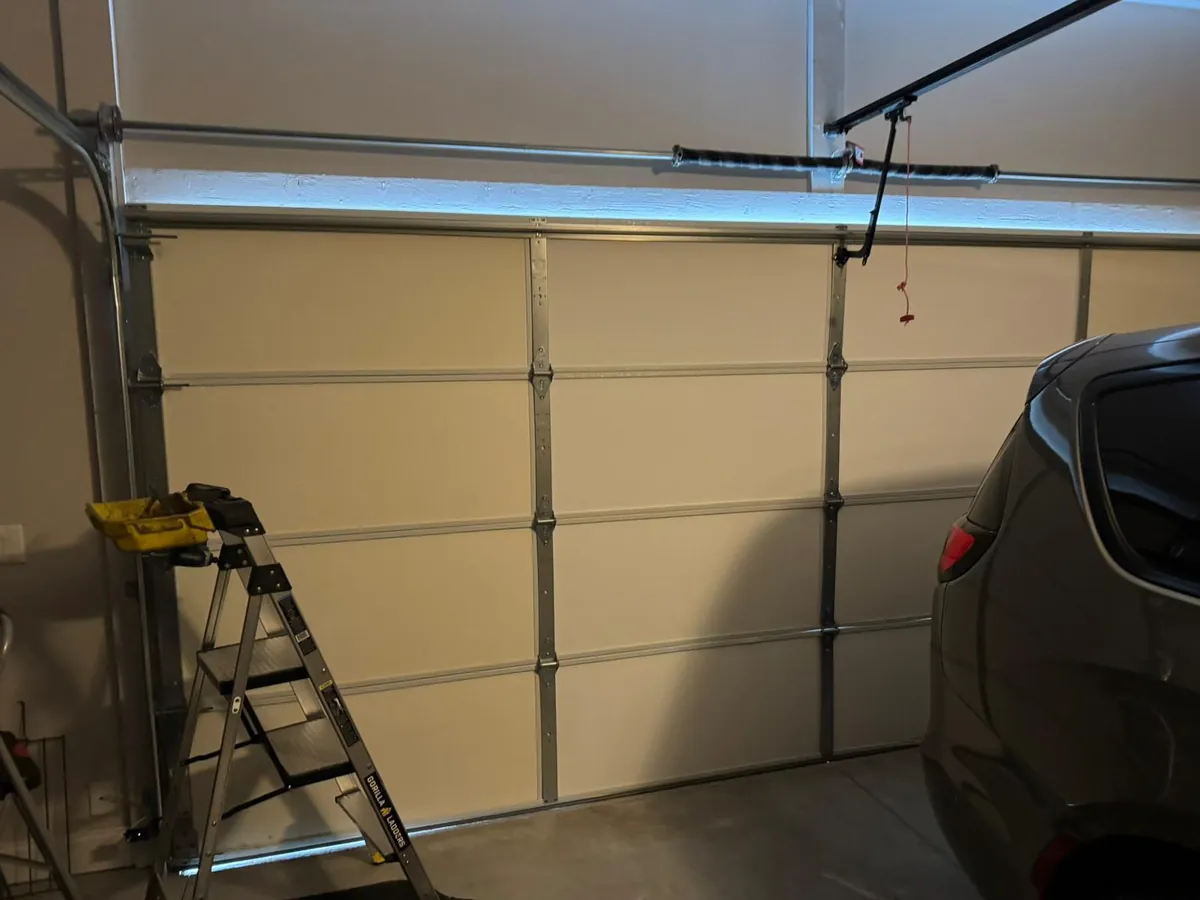
Why a garage under a Fenway building needs careful repair
Private garages are scarce around the Fens. Most of the apartment buildings and brownstones here have none at all, and their residents park on the street or in shared lots. Where a garage does exist, it is usually a single bay set into the base of the building, with flats or offices directly overhead and the inside of the bay reached through a lobby or a service door. Garage door repair Fenway MA owners and managers ask about almost always involves one of those bays, and that setting changes the job.
A door built into a building is not a stand-alone structure. Its rails are fixed to masonry or to framing that also carries the storey above. Its motor unit is bolted to a ceiling that doubles as somebody’s floor. The spring sits in whatever headroom the original builders left over the lintel. Every repair has to fit that space, and every part has to come in by the same route a person would use.
Before calling, look at three things from a safe distance and touch none of them:
- The spring over the opening, or the springs along the side tracks, for a clean break or a gap in the coils.
- The two lift cables at the bottom corners, to see whether either one hangs slack.
- The bottom edge of the door, to see whether it sits level on the floor or rides higher on one side.
What a repair in a Fenway bay can cover
Springs
Whatever the door weighs, the spring is what holds it up. Once it snaps, the motor is left straining against the whole weight. The Fenway spring repair page has more on this.
Cables and drums
Two steel cables tie the bottom of the door to drums up on the spring bar. If one parts, that corner sags and the whole door cocks sideways.
Panels and sections
A section dented by a bumper in a tight turn, or a cracked panel at the bottom where road salt and slush collect, can often be swapped by itself.
Openers, remotes and wall buttons
Motors that whine but stay put, a handset that suits one driver and ignores the next, a push button by the service door that has gone dead. See Fenway opener repair for more.
Tracks and rollers
Grinding wheels, rails knocked crooked, fixings loosened in old brick, and doors that have jumped out of their guides entirely.
Safety sensors
Two small eyes facing each other across the floor of the bay. If their beam is blocked as the door comes down, it turns round. Bins and bikes in a narrow bay knock them askew.
A garage door that belongs to the whole building
In a detached garage, a door problem stays in the garage. Under an apartment building it does not. A door stuck open leaves a gap in the building’s ground floor that anyone can walk through. A door that will not open can leave a car shut in for every household that shares the bay. A motor that bangs and shudders sends that noise up through the slab into the rooms above. That is why a fault in one of these bays tends to matter to more people than the one who parks there.
It also means the door often sees more use than its parts were sized for. A shared bay under a building may be opened and closed by several drivers through the day and into the night. Each trip is one cycle on the springs, one more pass for every roller and hinge, one more start for the motor. Parts wear in proportion to that use, so a busy door gives out sooner than an identical one that moves twice a day.
The structure around the door matters too. Many of these bays were built into masonry, with rail brackets anchored into brick, block or concrete. Old anchors work loose, mortar crumbles around a fixing, and a rail that was straight drifts slowly out of line. A door that has started to bind at one spot in its travel is often telling you about a bracket, not about the door itself.
How the parts of an overhead door share the load
A sectional door works because its weight is balanced against a spring. Garage door repair in Fenway MA usually comes down to working out which link in that chain has given way and what else was strained when it did.
Most doors here carry a torsion spring, a heavy coil wrapped round a steel bar running across the head of the opening. Lowering the door twists that coil tighter, storing the energy that will lift it again. Older and lighter doors may use extension springs instead, long coils stretched beside the overhead rails. Lose either kind and the door is no longer balanced at all.
Between the spring and the door are the cables. With a torsion spring, each cable coils round a drum fixed to the end of the bar; with extension springs, the cables pass over pulleys instead. Rubbing against a sharp edge, a cable loses one strand at a time until it lets go.
Rollers and rails decide the path. The door climbs the upright rails beside the jambs and then turns to run flat beneath the ceiling. In a bay with very little height to spare, those flat rails can sit tight against the slab above, so a roller with any wobble soon starts to scrape.
The motor is meant to steer a balanced door, not to hoist a dead one. A weak spring or a sticking roller quietly wears its gears and burns its windings. The pair of sensors across the opening simply watches for anything in the way.
Reaching the bay: lobbies, service doors and shared lots
Here the route in is usually the first thing to sort out. Some bays open straight onto the street with no other way in. Others can only be reached from inside, through a lobby, a corridor or a service door at the back of the building, and some open onto a small shared lot behind it. Ladders, rail sections, winding bars and tools all have to follow whichever route is open, and a door jammed shut on the street side may leave the inside route as the only one.
When you call, it helps to say how the bay is reached, whether a key or a code is needed for the service door, and who can open up on the day. If the bay sits under a managed building, the person who holds the keys to the back corridor is often the one who makes the visit possible. Cars in a shared lot, bins stored against the door and bikes in the corner all cost time if they have to be shifted first.
None of this stops the work. It only changes how the visit is laid out, and a visit planned around the real route goes better than one that finds a locked corridor on arrival.
What a visit involves
The first step is always a diagnosis, never a part. The motor is uncoupled with its red release cord, then the door gets lifted a little way off the floor by hand and let go. If it stays roughly where it was left, the spring is doing its job; if it sinks or refuses to rise, the spring is the suspect. A door that balances but sticks sends attention to the rails, the wheels and the building around them.
From there the inspection works through the hardware piece by piece: cables and drums on both sides, the spring and its mounting plates, every hinge and wheel, the upright and overhead rails along their length, and the anchors fixing all of it to the structure. Where the bay is masonry, those anchors get real scrutiny, since a new rail screwed into a crumbling hole will soon wander again.
When the motor is part of the trouble, it gets tested by itself, uncoupled from the door. The push button and every handset are tried one after another, and the sensor pair is checked for line of sight.
Next comes the explanation: the failed part, the reason it went, and anything else showing wear. No work starts until you say yes. Once the parts are renewed, the spring tension is set for this door, the motor’s stopping points and closing force get reset for it, and the safety reverse is proved against a piece of timber on the floor.
Safe checks while you wait, and what to leave alone
A few things are safe and often useful:
- A door halted mid-travel that keeps jerking is best stopped by unplugging the motor where it hangs from the ceiling.
- Look at both sensor lenses. In a narrow bay, a box, a bin or a bicycle wheel in the beam will send the door back up on every attempt. Move it and clean the glass with a dry cloth.
- When one handset has stopped but the push button still works, the handset’s cell has most likely run down.
- Run your eyes along each rail for anything caught in it, without pulling on the door.
Everything that carries tension is out of bounds. That means the torsion coil and the cones at its ends, the set screws, both cables, and the bottom corner fittings where the cables hook on. They hold stored force with the door open or shut, and undoing one out of sequence can fling a steel bar or fitting across the bay. Put plainly, the torsion spring stores enough tension to injure, so replacing it is no job for an owner. If the spring has snapped, leave the door where it is and stop pressing the button; there is nothing left supporting its weight.
Doors knocked off their tracks in a tight bay
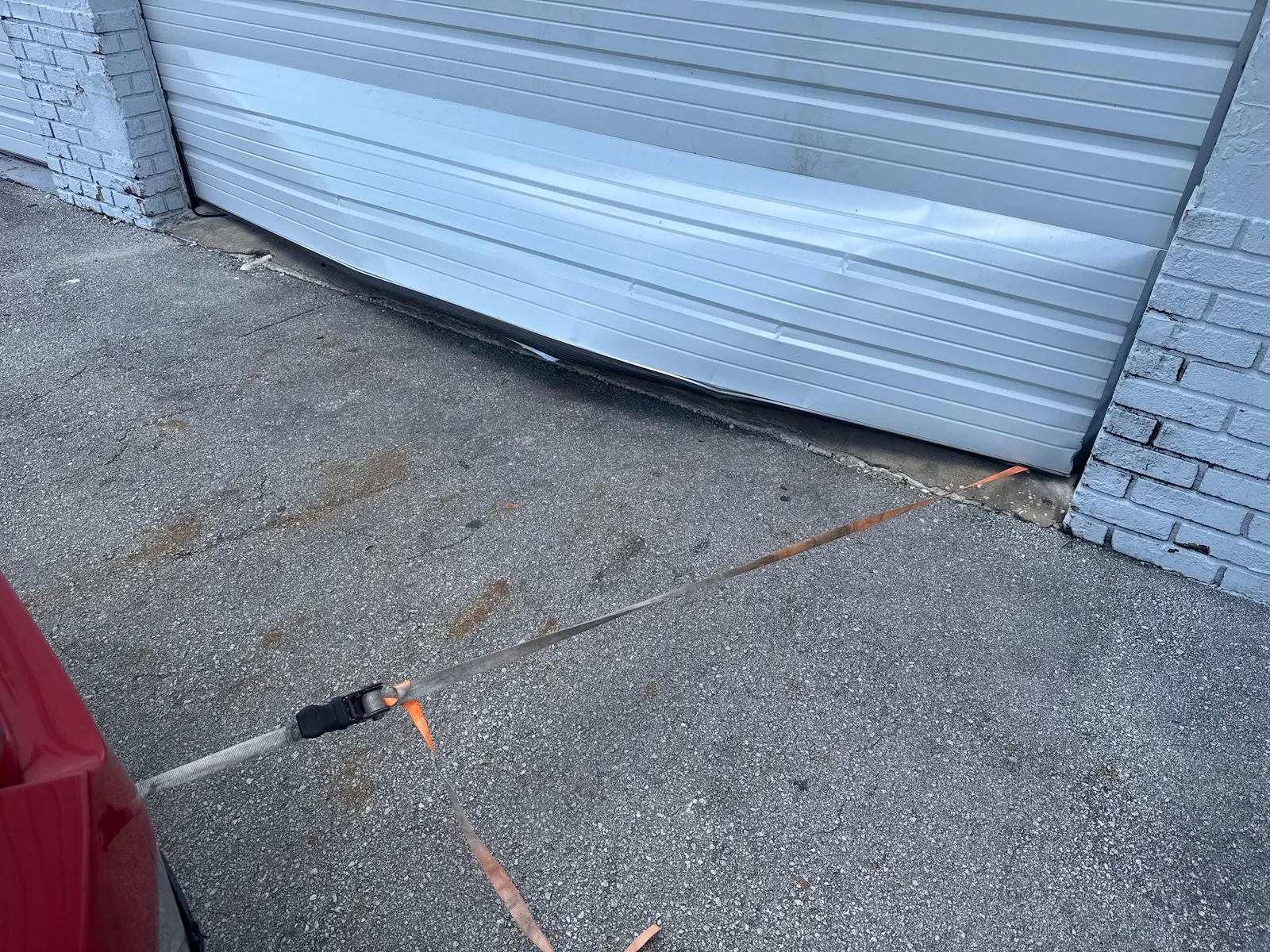
A single bay under a building leaves little room to manoeuvre. A car swinging in on an angle, or backing out slightly askew, can clip a corner of the door or strike the foot of a rail. A door left half up can be pushed by wind funnelled along the street. A motor that carries on driving a jammed door will kink the rail it has jammed in. With wheels out of their guides, the door hangs crooked and may come down.
Hitting the button again, or heaving the door straight, tends to add damage. The proper fix is to clamp the door firmly so the wheels carry none of its load, feed each wheel back into its guide, true up or swap any kinked rail, and even out the two cables before anything moves under power. Our off-track garage door repair page describes the method step by step.
Panels, hinges and the bottom seal on a street-facing door
A bay door set into a building’s ground floor usually faces the street or a shared lot. It takes knocks from cars turning in, from bins rolled past on collection day, and from snow ploughed or shovelled up against its lowest section. Most dents and cracks on these doors come from contact like that, not from the years.
Often one damaged section is replaced and the rest of the door stays, as long as a section with the same profile and finish is available. The hinges joining the sections are checked on that visit too. A cracked hinge lets the door flex as it moves, which shows as a dip across the middle or a knock heard at one fixed spot in the travel.
The rubber strip along the bottom works hard on a street-facing bay. Torn or squashed flat, it lets rain, grit and leaves blow in, and the lowest section begins to corrode or decay from its edge. On a floor that falls back toward the door, a worn strip is often the first thing worth changing.
Noise, vibration and the rooms above
The ceiling of a garage under a building is the floor of the space above it. A motor fixed to that ceiling, wheels rattling along the flat rails, or a spring that has run dry can all be heard upstairs. Owners of these bays often call about the noise before anything has actually broken.
Noise usually has a cause worth finding. Dry wheels squeal. Worn wheels rumble. A loose rail bracket knocks once per trip. A stretched drive chain slaps against its boom. Each of these is an ordinary garage door repair Fenway MA bays need from time to time, and dealing with them early spares the rest of the door the extra strain.
Repair or replace
Most doors in these bays are worth repairing. Springs, cables, wheels, hinges and seals all wear by design and get renewed, while sound sections keep going long after that renewal. In an old opening that is no longer perfectly square, the existing door has usually been adjusted over time to fit, so keeping a door in good order makes sense there.
A new door becomes the better choice once the sections are failing: steel corroded through at the base, wooden panels split or gone soft in several places, or an old timber door so soaked that no spring setting will balance it. Every garage door repair Fenway MA owners book ends with a plain view of where their door stands on that question. When replacement wins, new garage doors in Fenway sets out what changing the door in an older building’s opening involves.
Getting the door looked at
Doors seldom fail at a convenient hour, and a car shut in for the night or a door stuck open under a building is the usual result. Our line is staffed at any hour, seven days a week, which means a fault noticed late in the evening need not wait for morning. Where the door is jammed open, will not rise or has left its rails after dark, the Fenway emergency repair page covers what to do meanwhile. For how we handle this work across the city, see the main garage door repair page, and for every service in this neighbourhood, the Fenway page.
To book garage door repair in Fenway MA, jot down the route into the bay, the door’s behaviour at the button, any part you can see is damaged, and whether a vehicle is stuck in there. With those notes made, call us or book online.
Questions from Fenway
Our garage is a single bay under an apartment building. Can it be repaired like any other?
Yes. The parts are the same as on any sectional door. What changes is the space around it, the low ceiling, the anchors in masonry and the route in, so the visit is planned around those.
The only way into our bay is through the lobby. Is that a problem?
No. Tools and parts simply come in that way. Mention it when you call, and arrange for someone to open the service door or lobby on the day.
Neighbours upstairs can hear the door. Does that mean something is wrong?
Often it does. Dry or worn wheels, a loose rail bracket or a slack drive chain all make noise that carries through the slab. Each can be put right, and catching them early protects the rest of the door.
The door touches the floor and immediately rises again. What causes that?
The motor believes something is in its path. Make sure neither sensor is blocked and both lenses are clean. If it keeps happening, the sensors may have been knocked out of line, or the door may be meeting resistance in a rail.
Can I push an off-track door back into place myself?
No. The door can fall, and the spring and cables are still under tension. Unplug the motor, keep people and cars clear, and call.