
Roll-up shutters and service doors on the oldest streets in the city
Private garages are close to absent here. The streets are the oldest and tightest in Boston, the buildings run wall to wall, and whatever overhead doors exist belong to shops and to buildings: commercial roll-ups across ground-floor fronts, and building service entries through which crates, rubbish and kit pass. When someone asks about garage doors North End MA properties rely on, these are the doors in question: a coiled steel curtain over a shopfront or a back entry, or a sectional door on a building’s service bay. Much of the work behind garage doors North End MA owners call about is commercial in character, even on a mainly residential street.
Those doors live a hard life. They go up early and come down late, they are pulled by hand or driven by a motor many times a day, and they are hit by hand trucks, kegs and the corners of crates. A roll-up that grinds, sticks halfway or drops unevenly is not a cosmetic problem; it decides whether the business can open, take a delivery or lock up for the night.
From the street side, and without reaching into the coil or the guides, check:
- Whether the bottom bar meets the sidewalk evenly, or one end touches down first.
- Whether either side guide is bent inward where something has struck it.
- Whether the door now crashes down or will not stay up when it is let go.
A door that sets the hours of the building
On a street where every opening faces the sidewalk, the overhead door is often the only way to secure the ground floor. A shopfront with its shutter stuck open cannot be left; a service entry that will not lift means stock waits on the curb. That is why the work here tends to be about restoring the door to service first and discussing anything larger afterwards.
Most of what we see on these streets falls into a few groups. Roll-up curtains made of interlocking steel slats that wind onto a barrel above the opening. Sectional doors on the occasional service bay, with panels that ride up into horizontal tracks under a ceiling. Hand-operated doors with a pull chain or a lift handle. Motor-driven doors with a wall station or a key switch. Every one of them can be repaired, and each fails in its own way.
If your building has a door that has started to labour, our North End garage door repair page goes through each repair this neighbourhood’s doors tend to need. The other neighbourhoods and towns we cover are listed under service areas.
Narrow streets and time-restricted access
Access to Hanover Street and Salem Street is narrow and time-restricted, and that shapes every visit. A van cannot always stop at the door, a ladder has to go up without blocking the sidewalk for long, and some work has to fit around the hours when vehicles are allowed in at all. We ask about this when you call, so that the visit is planned around the access the street actually allows.
Practical things that help on the day:
- Tell us which street the door faces and whether there is a rear or alley entrance.
- Say whether there is a way in behind the door, through the shop or a corridor, as well as from the sidewalk.
- Mention anything stacked against the door or the coil housing, so it can be moved before work starts.
On a tight street the job is often done partly from inside the shop or the service corridor, where the coil, the barrel and the operator are mounted. Clear room under the head of the door makes that far easier.
How a roll-up curtain fails
A roll-up door has fewer parts than a sectional door, but every one of them works hard. The slats interlock along their full length, and a single bent slat can stop the curtain from winding cleanly onto the barrel. The end locks that keep the slats in line can wear or snap, letting a slat drift sideways until it rubs against a guide. The bottom bar takes the knocks from the sidewalk, and once it bends the curtain will not close square.
The guides on each side are steel channels fixed to the masonry. A hand truck swung too wide, or a delivery pallet pushed against the curtain while it is half up, can fold one inward. The curtain then binds at the same height every time. Straightening or replacing the guide, and checking that the slats it chewed are still sound, is a common repair on these streets.
Above the opening, the barrel carries the springs that balance the curtain. On a well-set door a person can raise the curtain by hand with steady, modest effort, and it stays where it is left. When that changes, the problem is usually in the barrel, not in the slats.
Springs inside the barrel
Most roll-up doors are counterbalanced by torsion springs coiled within the barrel itself. A sectional service door carries its torsion spring on a steel rod across the header, or uses extension springs running beside its horizontal tracks. Any torsion spring is wound up with a dangerous amount of stored energy; adjusting, releasing or swapping one is not a DIY repair. On a roll-up the spring is hidden inside the barrel, so nobody can even see how much load it is carrying.
Signs that a spring has broken or lost its strength:
- The curtain suddenly feels far heavier to lift by hand.
- A motor-driven door labours, stalls or reverses near the bottom of its travel.
- The door will not stay up and slides down on its own.
- A loud bang came from the coil housing, followed by a door that no longer behaves.
Should any of these show up, stop operating the shutter and clear the sidewalk beneath it. Once its counterbalance is gone, a curtain can crash down hard. Spring replacement on sectional doors has its own page for North End spring repair, and the same caution applies to the barrel of a roll-up.
Operators, wall stations and safety devices
Many ground-floor doors here are driven by a motor mounted beside the coil or above the head of the door, with a wall station or a key switch at the entry. Some have photo eyes across the opening; others carry a pressure-sensitive strip on the bottom bar, which reverses the curtain on contact. On a busy sidewalk those safety devices matter more than anywhere: people, bags and strollers pass under the door all day.
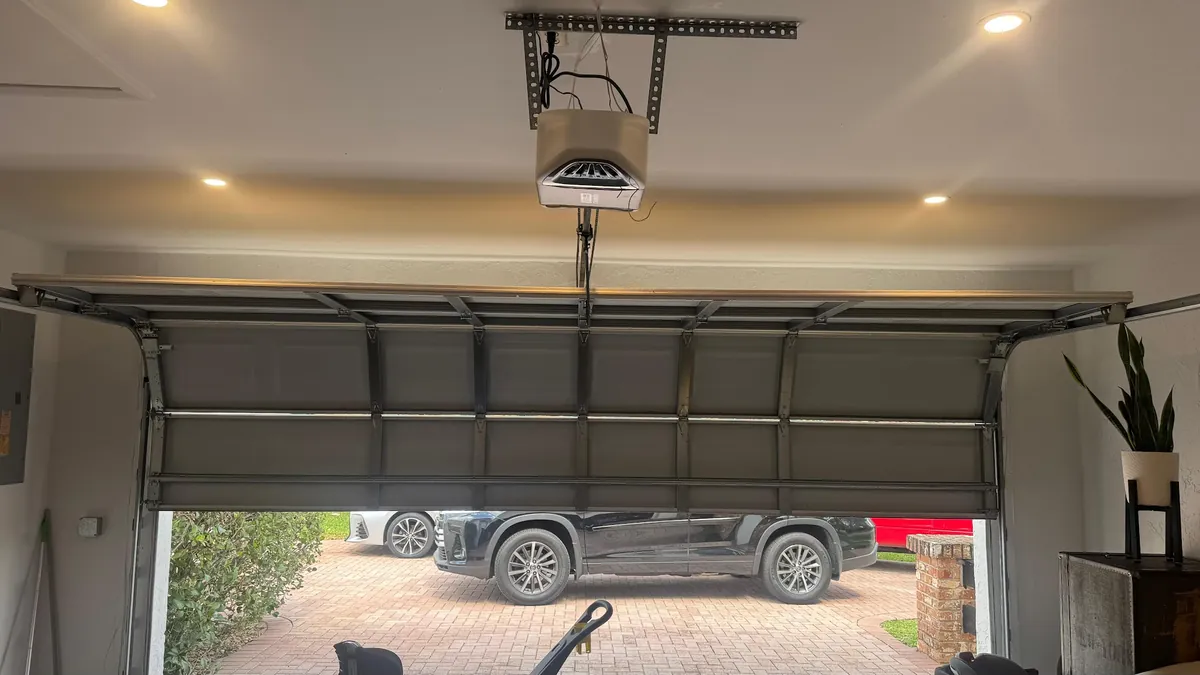
Faults we are called about include a motor that hums but does not turn, a door that runs up and then stops a few inches short, a wall station that responds only on the second press, and a door that refuses to close because a photo eye has been knocked out of line. Residential-style units on a building’s parking entry bring remotes and wall buttons into it too; a LiftMaster unit there is something we fix or swap out like any other. More on operator faults is on the North End opener repair page.
A practical point for operators: a motor-driven door with a broken spring should not be run. The motor is not designed to lift the full weight of the curtain, and running it can strip gears or burn the motor out, turning one repair into two.
Doors that come off their guides or tracks
A curtain can leave its guide when a slat is struck hard or when an end lock fails, and a sectional service door can come off its track when a roller breaks or a track is bent. In both cases the door hangs crooked and usually jams. Do not try to force it back in by running the motor or pulling on it. The door is under spring load, and pulling it can drop a section or bend the guides further.
For a sectional door that has jumped its rails, see off-track door repair; snapped lift cables are dealt with under cable repair. On a roll-up, the equivalent work is reseating the curtain, replacing end locks and slats, and straightening or replacing the guide.
When the shutter will not come down at closing time
The worst time for a roll-up to fail is when the business is locking up and the curtain will not drop, or in the morning when it will not lift and the doors are due to open. Someone picks up overnight, on Sundays and on holidays, so a shutter that jams after the last customer leaves can be reported there and then. No arrival time is promised; you get an honest estimate of when a van can reach the street.
Until then, these steps carry no risk:
- Leave a door that is stuck partway exactly where it is, and keep people from walking under it.
- If the door is motor-driven, switch the operator off at the wall station or its power so it cannot be triggered by accident.
- Do not prop the curtain with a crate or a pole. A spring that has let go can shift the load without warning.
For more detail on urgent calls, see the North End emergency garage door repair page and the citywide emergency garage door repair service page.
What a visit involves on these streets
A visit begins with how we get to the door. On a time-restricted street that might mean arriving inside the permitted window, parking around the corner and carrying tools in, or working from the inside of the building. Once at the door, the order of work is the same whatever the door type:
- Look at the door and its surroundings before touching anything: the guides, the curtain or panels, the bottom bar, the coil housing and the operator.
- Raise the door by hand, if it is safe to, to judge the balance and find where it binds.
- Check the springs, the barrel or shaft, the cables on a sectional door, and the safety devices.
- Go through the fault and the choices with you before a single part comes off.
- Carry out the repair, then run the door through several full cycles and check that it stops and reverses as it should.
Because many of these doors are part of a building’s security, we leave a door either working or secured. Where a replacement part is not on the van, the curtain is not left loose above an open entry.
Repair it, or put in a new door
Most roll-up and service doors can be repaired, often several times over their life. A bent bottom bar, a damaged guide, a few broken slats, a worn operator or a tired spring are all normal repairs. Replacement makes sense when the curtain is bent across much of its width, when the slats are corroded through, when guides and barrel have worn out together, or when the shop behind the shutter now uses its entry in a different way.
We supply and install new doors for homes and businesses and take out the old ones, including the commercial roll-up and sectional types common here. On a building like these, a new door is measured to the masonry opening as it actually is, which in an old building is rarely perfectly square. For the details, see new garage doors in the North End and our commercial garage doors page.
A few questions are worth asking before deciding:
- How many times a day does the door actually cycle, and will it keep doing that?
- Is the operator worth keeping, or will a new door need a new one too?
- Is the problem in the door, or in the opening around it?
We will tell you plainly what we found and which way we would go.
Service entries and back-of-house doors
Not every overhead door here faces the main street. Many buildings have a service entry at the side or the rear, used for deliveries, rubbish and equipment, and in the North End those entries are often small, tucked into an alley or a passage barely wider than a hand truck. Those doors tend to be neglected because the public never sees them, and they are often the ones that fail first.
The usual faults are rollers or guides worn by constant use, a bottom seal flattened or torn, a curtain that drags because the guides have shifted in old brickwork, and an operator that has been run with a weak spring for too long. Because the space around a service entry is tight, the coil and the operator are often mounted in awkward places, and simply reaching them can take longer than the repair. If there is a way to reach the head of the door from inside, let us know.
Masonry openings and old fixings
Many doors here are fixed into brick or stone walls that have stood much longer than any door now hanging in them. The fixings for guides and brackets go into that masonry, and over years of vibration they loosen. A guide that has started to move away from the wall lets the curtain wander, and the door begins to bind or scrape.
Repairs on old masonry are about solid fixings: reseating a bracket in sound material, moving it where the original hole has crumbled, and making sure the guides are plumb before the curtain runs in them again. It is slower than tightening a bolt, but a guide fixed into poor masonry will simply work loose again.
Garage doors in the North End also include the odd small parking entry at street level, shared by the units above. Those doors work much like a commercial door, cycling many times a day for many users, and the same attention to fixings, springs and safety devices applies. Garage door repair for those entries is the same work we carry out on shopfront shutters.
Getting your door looked at
Whatever the door, a shopfront shutter, a service entry or a building’s parking door, the first step is to describe what it is doing and where it is. Tell us the street, the type of door, what happened just before it failed and whether it is stuck open, stuck closed or partway. You will hear from us which parts are fine to leave alone, and the visit gets planned around the street’s access rules.
When it comes to garage doors in the North End, the job is as much about the street as about the door. For a stuck shutter or a tired back entry, call us or book online.
Questions from the North End
The shutter jammed partway down as we were locking up. Now what?
Leave it where it is and keep everyone from passing under it. If it is motor-driven, switch the operator off so it cannot be triggered. Do not prop it or force it down. Ring us whatever the hour; we will say honestly when we can reach the door.
Can you work within the delivery and access windows on Hanover Street and Salem Street?
Access there is narrow and time-restricted, and we plan each visit around it. Tell us which street the door faces, whether there is a rear entrance, and whether the coil housing is reachable from inside, and the visit is arranged to suit.
The curtain suddenly feels much heavier to lift. Is that the spring?
Very often, yes. The counterbalance on a roll-up is a torsion spring wound within its barrel. That spring is loaded with dangerous tension, and dealing with it is never a DIY repair. Stop using the door and do not run its motor until the spring has been checked.
A delivery cart bent one of the side guides. Does the whole door need replacing?
Usually not. A bent guide can be straightened or replaced, and any slats it damaged can be swapped out. Replacement is worth discussing only when the curtain is damaged across much of its width or several parts are worn out at once.
Do you work on the motors as well as the doors?
Yes. We repair and replace operators, wall stations, key switches, remotes and safety devices. That includes fixing or swapping out LiftMaster openers.