
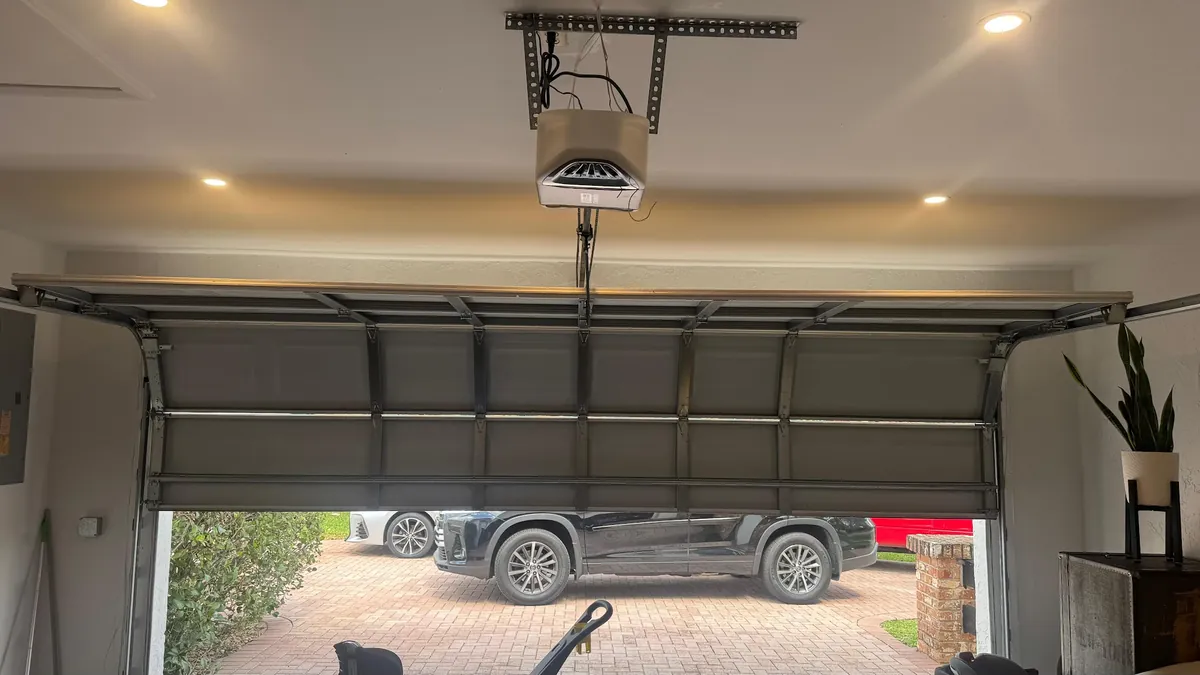
Two generations of garage under one town name
Burlington’s houses fall into two broad groups. There are the post-war capes and ranches, most with an attached single garage built for one car of its era, and there are the newer subdivisions, where houses open onto the street through two-car doors. The questions people ask about garage doors Burlington MA homes have depend heavily on which of the two they live in.
The older single-bay garages often carry a door that has been replaced at least once, sometimes hung on hardware that dates from an earlier door. Spring systems vary, headroom can be tight, and an opener may have been added long after the garage was built. The newer double doors are heavier, often insulated, usually run by a more recent opener, and tend to see heavy daily traffic from everyone in the household.
Whichever kind you have, three observations help before you ring:
- Whether the springs wrap a bar over the opening or lie stretched out beside the ceiling rails.
- Whether the door rises evenly or one side leads the other.
- Whether the opener has started to sound different, labouring, clicking or grinding where it used to run quietly.
Garage door services in Burlington
All of the shop’s services reach both the older streets and the subdivisions. Every card carries a link up to its full service page, where there is more detail on garage doors Burlington MA households run every day.
Door and hardware repair
Bent sections, cracked hinges, worn rollers, loose track brackets and damaged seals, on single and double doors alike. See garage door repair.
Extension and torsion springs
Older single doors may still run on extension springs; newer doors use torsion springs. Both store enough energy to injure. See garage door springs.
Opener trouble
Motors, belts and chains, logic boards, remotes, keypads, wall buttons and the photo-eye sensors. See opener services.
Stuck at an awkward hour
A commuter’s car shut in on a weekday morning, or a door that will not shut at midnight. Ring at any hour. See urgent repair.
Lift cable faults
A snapped or slipped cable that has left the door hanging at a slant. See cable repair.
Derailed doors
Rollers out of the track after a knock from a car or a door forced while binding. See off-track repair.
Replacing an outdated door
A new door supplied and installed in the existing single or double opening. See new garage door installation.
The post-war single garage
A cape or a ranch from the post-war decades was typically built with a garage for one car, attached to the house and often sharing its roofline. Those garages were sized for the cars of their time and for the doors of their time. Many have since been fitted with an overhead sectional door, and many of those have been replaced again since.
That history leaves its mark. You can find a modern door hung on tracks salvaged from its predecessor, a spring system mismatched to the current door’s weight, or brackets fastened into jambs that have already been drilled for a previous set. A door like that may run well for years, but when something goes wrong, the fix is not always a straight swap of one part. The repair has to start with understanding what is actually holding the door up.
Headroom is the other constraint. Where the ceiling or the roof framing sits close above the opening, there is only so much room for a torsion spring, the curve of the track and an opener rail. Special low-clearance track kits are made for garages like these, and the choice of opener follows the space as well. Any replacement part has to fit the garage as built.
Extension springs on older doors
Plenty of single-car doors on the older streets still hang from extension springs: a pair of long coils lying parallel with the overhead rails, tied to the door through a run of pulleys and cable. As the door comes down they are drawn out under load, and as it rises they shorten again. When one breaks, it can release its stored energy violently, and if no safety cable runs through the middle of the spring, the broken pieces can fly across the garage.
If your door has extension springs, look along each spring for a thin cable running through the coils and tied off at both ends. That containment cable is what keeps a broken spring from whipping. If it is missing, mention it when you call. Do not try to unhook, stretch or replace an extension spring yourself; the pulleys, cables and spring hooks are all under load while the door is closed.
Some older single doors are better off switched to a torsion shaft mounted over the opening, provided the ceiling leaves space for one. That is a conversation to have on the visit, after the door has been weighed up and the clearance overhead measured.
Torsion springs on the newer doors
The two-car doors in the subdivisions almost always run on torsion springs mounted on a shaft above the opening. A heavier insulated door may carry two springs, and the pair must be matched to the door’s weight to keep it balanced.
Torsion springs hold dangerous tension. Every turn of winding stores more of it, and the bars used to wind them can be torn out of a hand if the spring slips. That is why spring work is never a homeowner job, even when the spring looks broken and harmless; part of the coil can still be loaded. When a torsion spring fails you usually see a gap in the coils and find the door unusually heavy or the opener unable to lift it more than a short way.
Where a double door hangs on two springs, the survivor is retired along with the broken one, so the door is balanced by a fresh, matched set. Cables, drums and the shaft bearings are inspected while the system is slack.
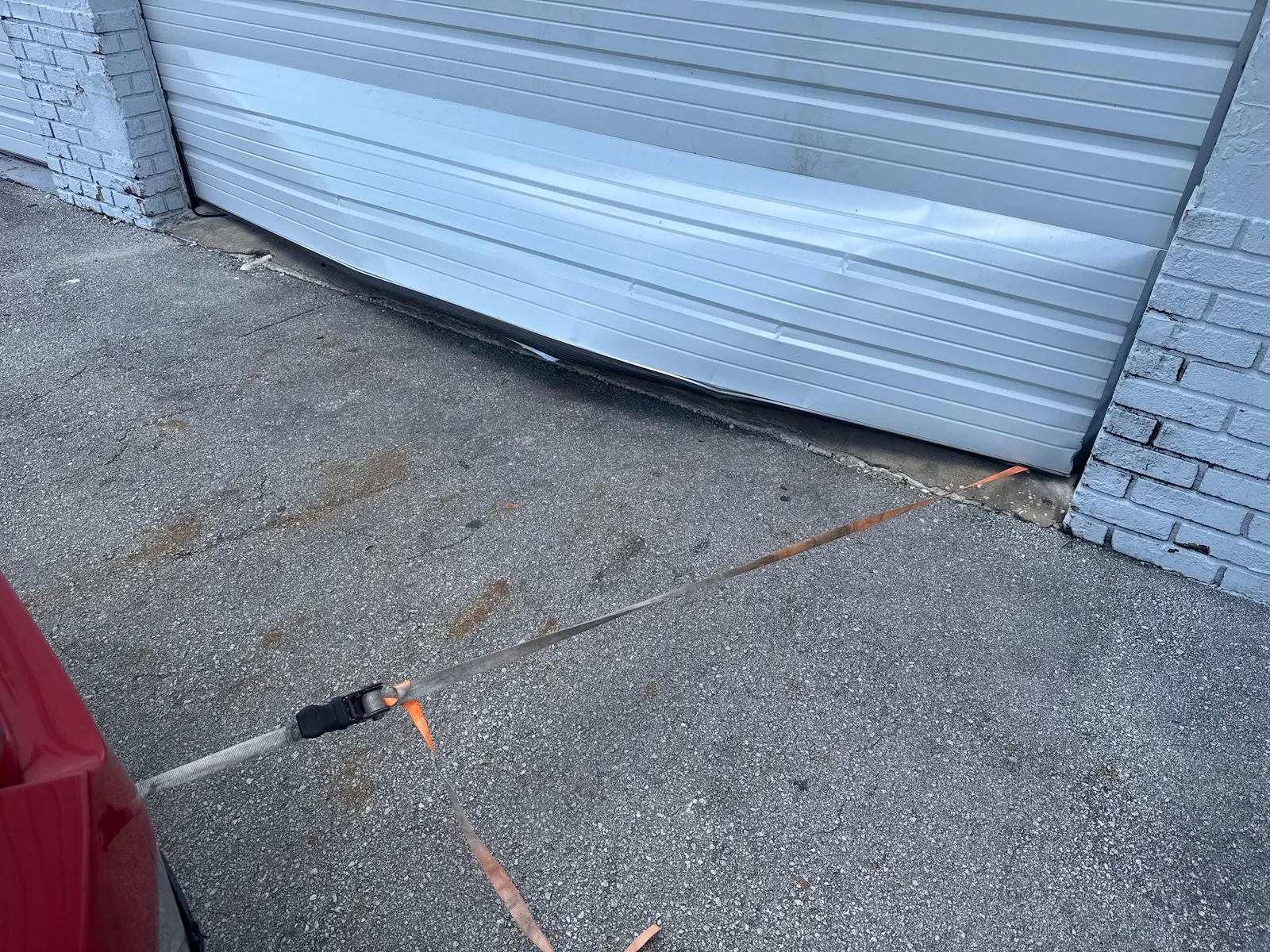
Double doors used by a busy household
A double door in a newer subdivision may open and close many times a day as different people come and go. That steady cycling is what wears rollers, hinges, cables and springs, and it shows up as gradual changes: a door that gets louder, a slight jerk at the top of travel, a roller that has started to wobble in its track.
Wide doors also need reinforcing struts across the top sections to keep them from bowing under the opener’s pull. If a strut works loose, the top section can kink at its hinges, and you will often hear it as a knock when the door reaches the curve in the track. Retightening or replacing the strut and any split hinges usually cures it before it becomes a bent panel.
Openers, sensors and remotes
The single garages on older houses often carry an opener that was fitted after the fact, and sometimes one that has outlived its useful life. The double doors in the subdivisions usually have a newer unit with more features, and more remotes, keypads and wall controls in the household. Either way, the faults tend to fall into the same handful: a motor that runs while the door sits still, a drive chain or belt skipping teeth, a remote or keypad that has lost its pairing, and a door that reverses as it closes for no visible reason.
That last one is usually the photo-eye sensors, the pair of small lenses low on the jambs. A sensor nudged by a bicycle, a bin or a car bumper only has to move slightly to break its beam. Wipe the lenses and check that both are pointing at each other; if the door still reverses, the alignment or the wiring needs attention on the visit.
An opener that is no longer worth fixing makes way for a unit chosen to match the door’s weight and the garage’s headroom. LiftMaster openers are among the units this shop repairs and replaces.
A cable that lets go
Both styles of door depend on lift cables. With torsion springs, each cable coils around a grooved drum at one end of the bar; a door on extension springs instead threads its cables through a sheave fixed to each stretched coil. When a cable snaps or comes off its drum, the door drops on one side and can jam crooked.
Leave a door in that state where it is and switch off the opener. The weight is now hanging unevenly and the remaining cable is doing more than its share. Both cables are replaced together, the drums or pulleys checked, and the door levelled and rebalanced.
When a door comes off its track
Single-car garages are tight, and a bumper that catches the bottom section on the way in or out can push it far enough to pop a roller from the track. On double doors, a door that has been lifting unevenly for a while is the more common cause. Either way, a derailed door is unstable; give it room, and leave the wall control untouched. The repair straightens or replaces bent track, refits rollers, secures brackets to solid framing and adjusts the door so it travels square.
Repair or replace
On a post-war single garage, the question often comes down to the door itself. Where the sections themselves are solid and it is the fittings that have aged, repairing them makes sense. If the door is old, damaged, mismatched to its springs, or simply heavier than it needs to be, a new door can solve several problems at once. On the newer double doors, repair is usually the answer unless a panel has been badly damaged or the door has been bent beyond straightening.
The shop supplies the new door and hangs it in the opening already there, with new springs, cables, rollers and tracks matched to the new door. On an older garage that sometimes means moving from extension to torsion springs at the same time. For anyone weighing new garage doors Burlington MA openings can take, the visit records the opening’s size and headroom before anything is chosen.
How a call-out runs
A visit to either kind of house follows the same four steps.
- The door is operated and observed, so noises, jerks, uneven lifting and the way it lands on the floor are noted.
- Springs, cables, drums or pulleys, rollers, hinges, struts, tracks and brackets are checked, along with the opener, remotes and sensors.
- You get the findings in plain English: broken parts, tired parts, and parts that can be left be.
- With your approval the repair proceeds, the springs are wound to suit this particular door, the opener’s settings are trimmed, and its reversal is proven on an obstruction.
Insulated doors on attached garages
The double doors in the subdivisions are often insulated, with a foam core sandwiched between steel skins. Insulation helps an attached garage stay closer to the temperature of the house, but it also adds weight, and that weight changes what the springs and opener have to do. An insulated door that has had a section replaced, or extra hardware added, may no longer be balanced to its springs, and the opener ends up doing work the springs should be doing.
Insulated sections also show damage differently. A dent in a single-skin door is usually just a dent; in an insulated door it can separate the skin from the foam, and a section that has delaminated along its edge may flex more than it should at the hinges. When a panel like that is found, the choice is between replacing the one section, where a matching section can be had, and replacing the door.
Fitting a new door to a cape or a ranch
Seen from the curb, the single garage door on a post-war house takes up a surprising slice of the facade, so swapping it alters the character of the entire frontage. A single-car opening on a modest cape or ranch suits a door in proportion with it: panel layout, window placement and colour that sit comfortably with the house’s own windows and trim. For garage doors Burlington MA owners are replacing on these older homes, it is worth looking at the house from the street before deciding, not just at the opening.
The practical side matters as much as the look. The new door’s weight sets the springs it needs; its thickness and track type have to fit the headroom; and an older opener may not be a good match for a heavier insulated door. Those points are settled on the visit so the door that goes in suits both the house and the garage behind it.
Habits that help either kind of door
Listen for changes in sound, which are usually the earliest warning. A ranch’s single door that has always rumbled may be fine; a subdivision double door that has suddenly started to bang at the top is not. Watch, too, for the door drifting down when you stop it halfway with the opener released, which points to springs losing their strength. Keep the photo-eye lenses clean and clear of bins and bikes. On an older door with extension springs, check that the containment cables are present. On a busy double door, watch the top section as it reaches the curve in the track. Leave springs, cables and drums to a technician.
What to do next
Whether you have a single door on a post-war house or a double door in a newer subdivision, the first step is describing what it is doing. Any hour suits, so call us or book online. For the full list of towns the shop serves, see service areas, or look at nearby Woburn and Lexington. Getting a door looked at early is one of the simplest ways to keep garage doors Burlington MA drivers use daily working the way they should.
Questions from Burlington
Which kind of spring does my door have?
Stand inside and look up. A torsion setup sits on a steel bar spanning the top of the opening. An extension setup shows as a stretched spring beside each ceiling-height rail, with a pulley at its end. Treat either one as loaded and keep hands away.
My extension springs have no cable through them. Does that matter?
Yes. That threaded safety cable is what holds a snapped extension spring in place instead of letting its fragments lash out. If they are missing, mention it when you call so they can be fitted or the system reviewed.
Can an older single door be converted to torsion springs?
Often, if the ceiling leaves enough clearance over the opening. That gets measured during the visit, and you choose whether to go ahead once the choices are laid out.
Why does my double door knock as it reaches the top?
That is often a loose or missing reinforcing strut letting the top section flex at its hinges. Left alone it can kink the panel. Tightening or replacing the strut and any cracked hinges usually fixes it.
Just one of the pair snapped. Must the other go too?
The pair have lifted the door the very same number of times, so the unbroken one is living on borrowed time. A matched new set keeps a heavy double door balanced and spares a second call a few weeks later.