
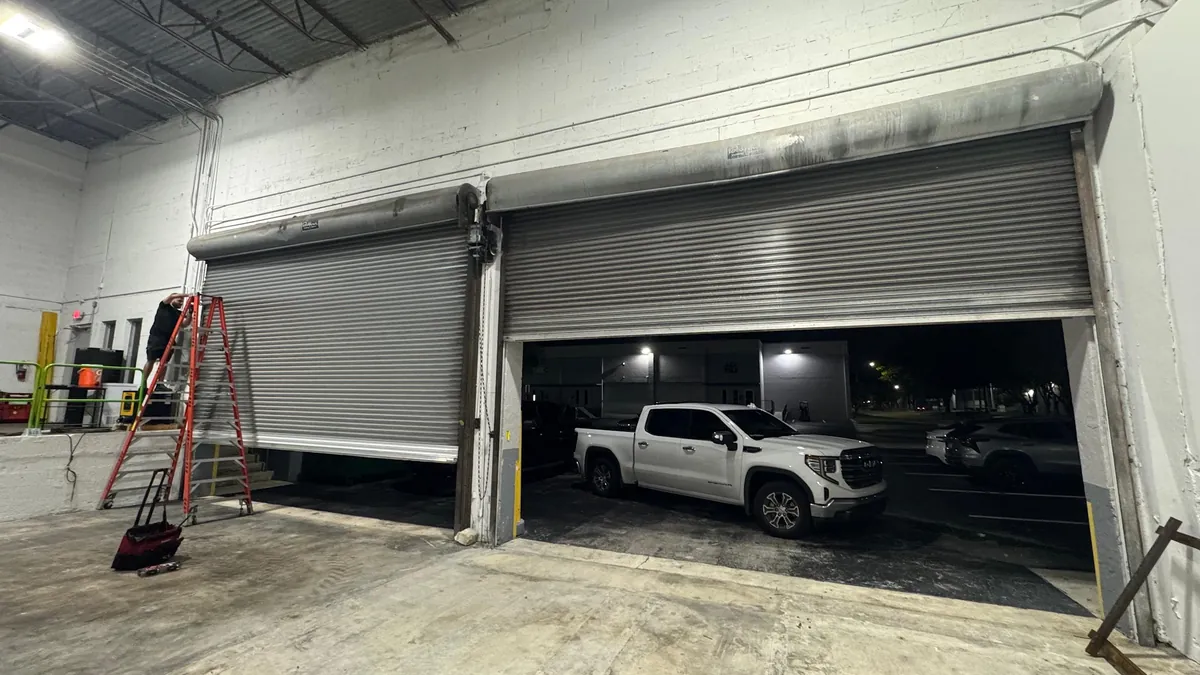
When the alley door will not shut at midnight
Overhead doors seem to choose their moment. Late evening with the car nosed halfway in; the grey hour before dawn with a flight to make; a sleety night with the bay yawning open onto the lane. Emergency garage door repair in South End MA carriage houses is there for precisely those nights, and since our own shop stands among these streets, between the brick terraces of Tremont, Shawmut and Columbus, their rear-alley carriage houses and the occasional bay sunk beneath a building, the breakdown is in our neighbourhood as much as yours.
Our line is open 24 hours, seven days a week. Treat that as a fact about who picks up, not about how soon anyone pulls up outside; we will not name an arrival time we might miss. It does mean that a door which quits at a ridiculous hour can be reported there and then, talked through calmly, and put in the diary.
Three questions sort the genuinely urgent from the merely annoying:
- Is the garage, or the building above it, left wide open for the night?
- Is a car, or something you need tonight, trapped inside with the door refusing to rise?
- Is the door leaning, drooping at one corner or partly out of its channels, so that it could come down?
The emergencies we deal with
Stuck shut
Most often a snapped spring, a parted cable or a dead motor. The door may twitch upward a hand’s width and halt, or sit there like a wall.
Stuck open
Frequently a misaligned photo eye, a derailed door or a motor with sheared gear teeth. Behind a row house, that leaves the carriage house exposed until morning.
A broken spring
That startling crack from the garage. Without its spring the door becomes ballast, and it should stay put until a replacement is fitted. See spring repair in the South End.
Out of its channels
Wheels popped out of the rails and the whole door skewed in the opening. Unstable, so it is made safe before anything else.
Hit by a car
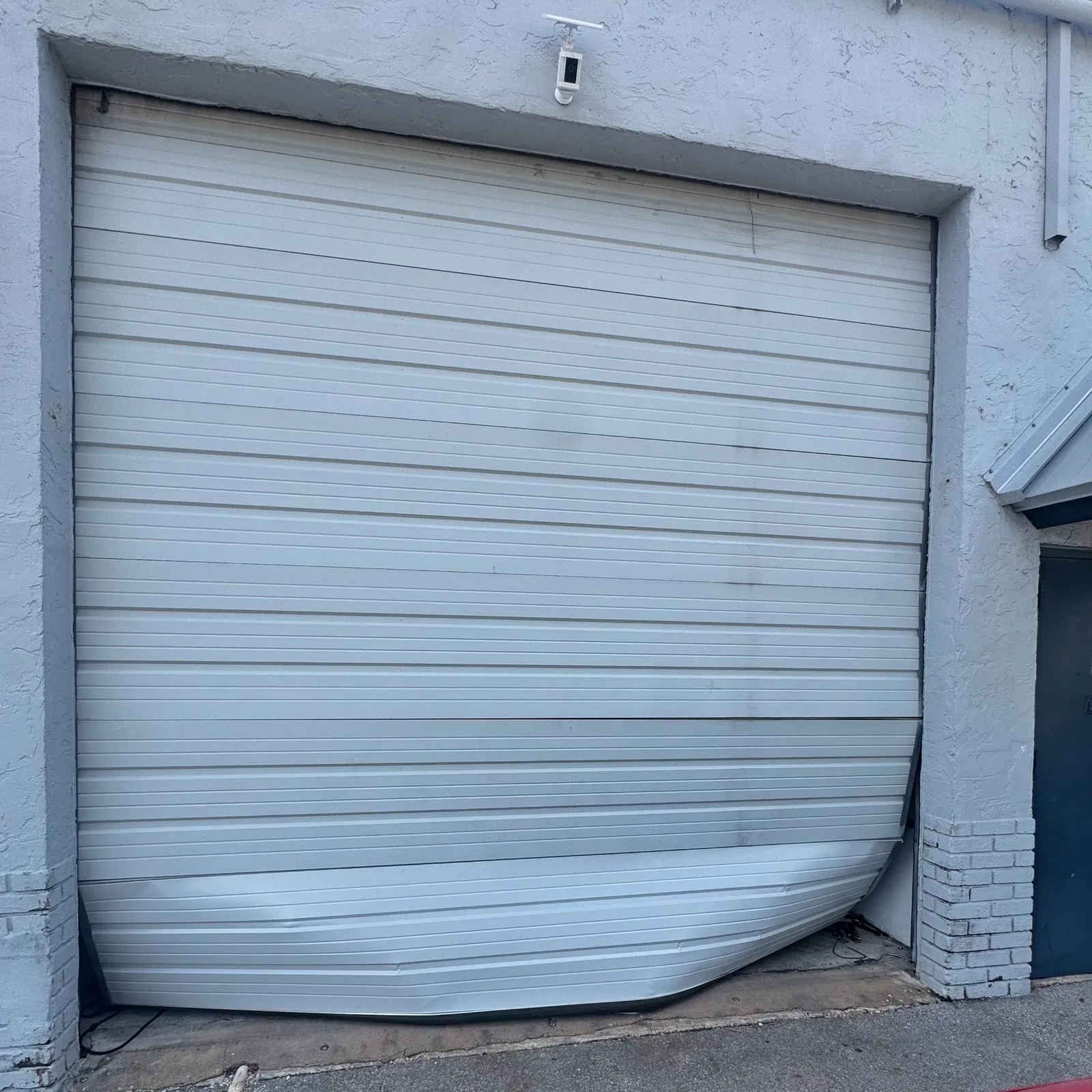
One misjudged turn in a cramped lane can crumple the bottom panel, kink a rail and knock the door out of square in a single blow.
Before help arrives: a short checklist
What happens in the first moments after a failure often decides whether the fix stays small. These steps protect people first and the door second.
Pull the opener’s plug. When a door has halted mid-travel or bounced back up, jabbing the button repeatedly only overheats the motor and can haul a damaged door further off line. Unplugging also stops someone else in the house from having a go.
Give the door a wide berth. Keep children and pets out from beneath it and away from its edges, where the springs, cables and rails live. A door that is leaning or hanging low on one side should be treated as something that might drop.
Observe without handling. From a few paces back, inspect the overhead coil for a visible break, at each lower corner for a drooping cable, and along the rails to see whether every wheel is still seated. Those three answers make the phone call far more useful.
Leave the red release cord well alone while the door is raised and a spring or cable might have failed. That cord detaches the door from the motor, and if nothing else is supporting it, gravity takes over immediately.
Why springs and cables are not a midnight job
At one in the morning, with the car trapped and an early start looming, any method of getting the door up starts to look reasonable. Resist it. Wherever the door happens to be, a torsion spring holds dangerous tension; so do the cables and the brackets they anchor to at the bottom corners carry that same force. A slackened set screw, a lever under a bracket or an improvised winding tool can unleash it with no warning at all. This is not a DIY repair, and darkness, cold fingers and hurry make it riskier still.
A door whose spring has failed weighs far more than people expect, since nothing is sharing the load. Heaving it up by hand, jacking it, or wedging it on a block of wood invites it to slip and slam down. A car left inside until daylight is a much better result than a crushed hand.
Carriage houses that open onto alleys
Behind the terraces, garages were built as carriage houses facing rear alleys, and that colours what an emergency looks like in this part of town.
An open carriage house puts its contents on display to a lane that sees people passing at all hours, and some of these buildings lead through to a yard or the back of the house. Closing and securing the door therefore comes first. If the fault is a nudged sensor or an opener that has lost its programming, the door may close properly on the first visit. If a spring or cable has gone, the door is stabilised and secured before the permanent fix is carried out.
Narrow approaches also make collisions common. A car swinging in from a cramped lane can clip the lowest panel or a jamb, kinking a rail and shoving wheels out of their channel. Often such a door will still shuffle a little, which tempts people to keep running it. Don’t. Every cycle grinds wheels against bent steel and turns a modest repair into a larger one.
Bays beneath buildings
A few garages here are single bays carved out of a building’s street level, with homes stacked above. When one of those fails, the trouble is shared. If the door refuses to close, the building’s ground floor stands open to the pavement; if it refuses to open, every car parked inside may be stuck.
There is a second consideration in these bays: the households upstairs. A spring letting go under a building is heard through the floors, and a door left to thump or scrape against a mangled rail keeps the whole building awake. Unplugging the opener and leaving the door exactly where it stopped is the considerate move, for the neighbours and for the door.
Shared bays raise one more practical point. Often several people have handsets for the same door, and any of them may come home late and press the button without knowing it has failed. If the door has jammed, a note on the wall button or a quick message to the others in the building saves the motor, and the damaged door, from another round of strain before the repair is done. Where a building has a management company or a person who looks after the garage, it helps to let them know too, so that the repair visit can get into the bay without delay.
What emergency garage door repair in South End involves
Emergency garage door repair in South End alleys starts with a phone conversation. Expect questions about what the door is up to, whether it is up, down or stranded between, whether anything went bang, what looks broken, and whether a vehicle or a person needs to get in or out. Your answers decide what gets loaded for the job.
On site, safety sets the sequence:
- Stabilise first. A leaning, derailed or spring-less door has its load taken off before anything else is touched.
- Find every fault. Springs, cables, drums, wheels, rails, the motor and the photo eyes are all examined, since one failure tends to injure its neighbours.
- Explain. You are told plainly what broke and what the repair entails.
- Fix or secure. The door is repaired there and then, or, if a part has to be sourced, it is locked down closed so neither garage nor building is left open.
- Prove it. After the repair the door is rebalanced, the motor’s travel and force are tuned, and the auto-reverse is checked against an object on the floor.
The usual causes, and how they show
Snapped springs top the list of urgent calls. They introduce themselves with a bang, followed by a door that creeps up a few inches and gives up, or never stirs at all. Cold snaps bring them in batches, since spring steel grows brittle in a hard frost.
Cable trouble is close behind. The door climbs lopsided, one corner leading, and may wedge in its rails. Cables and springs often fail together, in either order.
A derailed door slumps sideways, one or more wheels hanging loose of the channel. Common triggers are a bump from a car, a cable letting go on one side, or a motor still pushing after the door had stuck. It is unstable and can fall.
A motor failure is the mildest emergency, since the door is usually healthy. With sound springs and cables, the release cord lets the door be moved by hand. Our opener repair page for the South End covers motors, handsets, wall buttons and sensors in detail.
Ice, snow and the bottom seal
Plenty of urgent calls arrive on foul nights. Sleet and drifting snow make an alley threshold treacherous and stiffen the rubber seal, and a door can freeze to the concrete overnight. The opener, trying to break it free, labours and trips. If that happens, stop pressing. Chipping the ice away along the bottom edge frequently releases it, whereas yanking on a frozen door can rip the seal or overload the cables.
Snow banked against the outside of a carriage house door brings its own problem: the door may open, but the motor strains pushing the bottom panel through the drift, and the photo eyes may be buried. Clearing a strip in front of the door, and brushing snow off the sensors, often solves what looked like a breakdown. Alley garages suffer from this more than most, because plough spoil and shovelled snow tend to end up piled against whatever door faces the lane. A shovel-width of clear ground across the threshold before a heavy fall is forecast is worth the effort, and it keeps the bottom seal from freezing into a ridge of packed ice.
Darkness, torches and judging the damage
At night, everything is harder to read. A torch held from a couple of steps back is plenty to inspect the spring over the door and the cables at each corner; there is no reason to step under the door or put a hand near the rails. If you are unsure what you are looking at, leave everything as it is and simply describe it on the phone. A photo taken from a safe spot can also help, since it lets the fault be identified before anyone arrives.
Securing a door until the part is in hand
Not every emergency can be finished in one visit. Springs come in a great many sizes, older carriage house doors sometimes use unusual hardware, and a panel crumpled by a car has to be matched to the rest of the door. When the right part is not on hand, the aim of the first visit changes: leave the garage closed, stable and secure, with nothing under tension that could let go unexpectedly.
In practice that can mean lowering the door carefully under control and locking it shut, clamping it in its rails so it cannot be lifted from the alley, disconnecting the opener’s power so the motor stays idle, and making sure any hanging cable or loose spring is restrained. The garage is then safe to leave overnight, and the lasting repair is booked for when the part is ready. You are told exactly what has been done and what remains.
Shopfronts and service doors
The South End is mixed, and businesses on the same streets have their own overhead doors: roll-up shutters on shopfronts, sectional doors on service entrances and loading bays. A commercial door stuck open at closing time leaves stock and premises unprotected, and one stuck shut can stop deliveries cold. Those doors are repaired as well, and the same rules apply: unplug the motor, keep people back, and leave springs and cables alone. Larger doors carry larger forces, so the warning about stored tension counts double.
When a door has been hit
A car strike in a narrow alley turns into several faults at once. The bottom panel buckles, the rail on the impact side kinks, the wheels on that side may pop out, and the cable on that corner can be pulled off its drum. If the door still closes, it may be safest to leave it closed and stop using it until it has been checked. If it is jammed open, it is made safe and secured first. Once the door is stable, the damaged panel, rail and cable are assessed separately, because a bent panel left in place will keep pushing the wheels out of line even after the rail is straightened.
Repair tonight, decide about replacement later
Most emergencies finish with a repaired door: a new spring, fresh cables, a straightened rail or a re-programmed motor puts it back to work. Now and then the crisis exposes a door that was nearly finished anyway, with rotted or rusted lower panels, a wooden door too heavy for any spring, or damage across several sections after a collision. Then emergency garage door repair in South End garages gets the door safe and working for now, and you are told honestly that a replacement deserves thought. How a replacement is ordered and hung in an old masonry opening is set out on the South End new garage doors page.
How to reach us
Whatever the time, let us know how the door is misbehaving, what is visible from where you are standing, and whether someone or something is shut in. Less pressing faults on the same doors live on our everyday South End repair page; across Greater Boston, the emergency garage door repair service has its own page; and the South End page brings together all our neighbourhood work. For emergency garage door repair in South End garages, alleys and bays, call us or book online.
Questions from South End
Jammed open in the small hours: what now?
Unplug the opener, keep well back, and from a distance look at the spring over the door and at both bottom cables. Then ring; someone answers whatever the hour. Hauling the door down by hand is a bad idea, particularly if a spring or cable might be broken.
Will you give me an exact arrival time?
No, because we will not make a promise we might break. What we can say is that the phone is answered at all hours and the job goes into the schedule the moment you ring.
There was a bang and the car is shut in. Can I raise the door myself?
Please don’t. A bang and then a stubborn, immovable door nearly always means a snapped spring, which leaves the door as dead weight. Lifting it, or pulling the release cord, risks it crashing down.
One side of the door has dropped and it is hanging at an angle. Is that dangerous?
Potentially, yes. A cable or the wheels on that side have probably given way, and the door can shift or fall. Keep everyone clear, unplug the opener and ring.
The door seems frozen to the ground. What should I do?
Stop pressing the button so the motor is not strained. Chipping the ice along the bottom edge often frees it. If it still will not budge, leave it and ring, since forcing it can tear the seal and stress the cables.