
When a door fails at the back of a shared driveway
Garage doors choose their moment badly. On the older lots off Washington Street and around Oak Square, the garage usually stands where a long driveway ends, a drive used by every unit in a two- or three-family house, so a door that refuses to open, or refuses to close, soon becomes a problem for the whole building. Emergency garage door repair in Brighton deals with the breakdowns that cannot sit until a convenient weekday: a door shut fast with a car behind it, a door stuck up once the light has gone, a snapped spring, and a door that has slid out of its tracks. Someone answers our phone whatever the hour, weekdays and weekends, so there is no reason to sit on the fault until morning.
Priority one on any urgent call is making the door safe. Priority two is learning why it failed.
From where you stand, without going near the door, take note of three things:
- Its position: shut, open, or caught somewhere between, and whether it sits level or slumps to one side.
- Any spring with a visible break, or a cable hanging limp.
- Any roller sitting outside its rail, or a length of track kinked out of line.
Breakdowns we handle at short notice
Door won’t open
Usually a snapped spring, a broken cable, or an opener without power or with a stripped gear. The car stays put until the cause is clear.
Door won’t close
Photo eyes knocked askew, track kinked by a bumper, or an opener that backs off on every attempt, leaving the garage open overnight.
Broken spring
A crack like a gunshot after dark, then a door that will not rise. Far and away the most frequent urgent fault. More under spring repair.
Door off its tracks
Rollers out of their channel, the door slanting in a narrow opening. Unstable, and capable of falling. More under off-track repair.
Snapped cable
One corner sags while the other holds, and the door racks sideways. More under cable repair.
Right after the door fails
The moment a door gives out is when people get hurt, because the urge is to force it. A few calm steps stop a bad morning from turning dangerous.
- Leave the button alone. Once the opener has tried and failed, every further attempt strains its motor, may strip its gearing and can drag the door further out of line.
- Pull the opener’s plug when the door hangs partly open, so no remote in a pocket or a car can start it moving.
- Keep children, pets and cars well back. A door whose spring or cable has gone can drop without warning.
- Resist lifting by hand once a spring has snapped. The door weighs a startling amount, and with its spring gone nothing is holding it up.
- Keep hands off springs, cables and the brackets at the door’s lower corners. They store dangerous tension and can release it in an instant.
- Do not try to coax a derailed door back. Shoving rollers into place or running the opener can bring the whole thing down.
Once the door is still and everyone is clear, ring us. Describe what you see, what you heard and whether a car is trapped.
A car shut in behind a closed door
The call we get most is a door that will not lift in the morning with the car still inside. On these lots, more than one person may be stuck: a car in a single-car garage at the end of a shared drive is not always the only vehicle that needs to move, and a neighbour may be parked behind it, waiting.
Most often the culprit is a spring. Torsion springs wound on a shaft over the header, or extension springs reaching back beside the rails, fatigue over years of use and very often let go on a cold start. Without them the door is a dead load, and the opener will raise it a few inches at best before cutting out. For this kind of call, emergency garage door repair in Brighton means clamping the door, fitting new springs, checking both cables and the balance, and then getting the car out.
If the door itself seems fine but the opener is dead, power to the garage may be the problem. Many detached garages here are fed from the house, and a tripped breaker, or a ground-fault outlet that cut out after a wet night, will silence the opener. Provided the springs and cables look whole, tugging the opener’s release cord and raising the door manually may let the car out until the opener can be dealt with.
A door stuck open after dark
A door that will not close at night leaves a garage open to the street, frequently with tools, bikes and stored belongings from several households inside. Typical causes are photo eyes knocked out of line, track bent by a car or a trash barrel, a cable that has slipped off its drum, or an opener whose force setting reverses the door before it reaches the slab.
Some of these are quick to check yourself. Wipe the sensor lenses, make sure nothing is breaking the beam, and see that the small lamp on each sensor is steady. If the door closes while the wall switch is held down, the sensors are almost certainly to blame. If instead the door is slanted, a roller has escaped its rail, or a cable dangles loose, leave it alone and ring.
Doors that leave their tracks
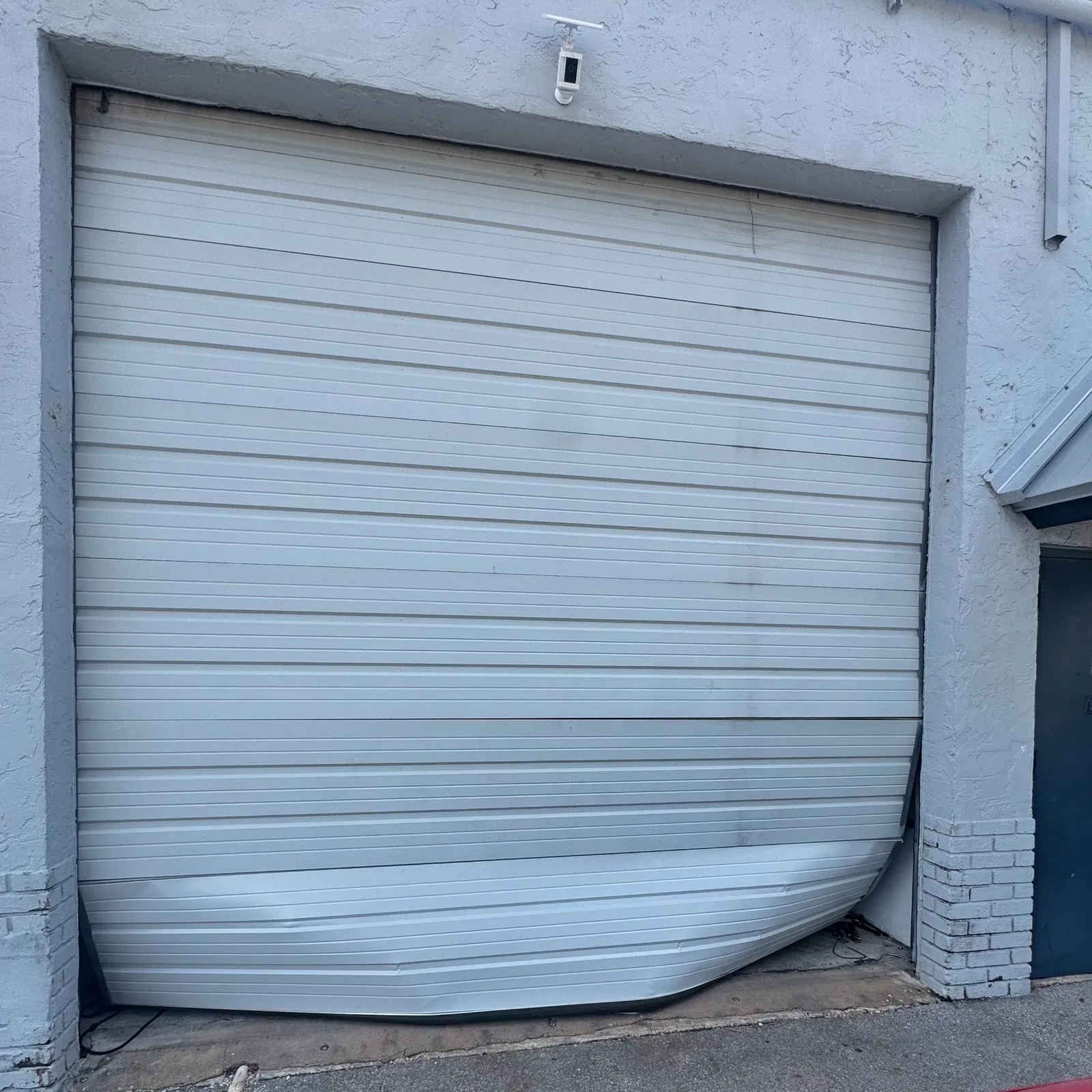
Single-car openings in old detached garages allow only a slim gap between door edge and wall. A car that clips the door, a gust catching it half raised, or a cable parting on one side can push the rollers out of their channel. A derailed door hangs slanted, sometimes with a corner wedged against the frame. Few situations are more dangerous for a door, because its weight is no longer carried evenly and it can slip further at any second.
Emergency garage door repair in Brighton for a derailed door begins by taking the load off it so it cannot shift. Next the rollers are freed, kinked track is straightened or replaced, both cables are checked for matching length, and only then is the door balanced and test-run.
What an emergency visit involves
Each urgent visit follows one sequence, because nothing gets fixed until the door is safe.
- Clamps go on the track to lock the door where it is, and the opener is disconnected.
- The failure is traced: a spring, a cable, a roller, a stretch of track, the opener, or its power supply.
- Before work starts, you hear what broke and what putting it right will take.
- Broken parts are replaced or repaired, and the door is rebalanced until it rests midway on its own.
- The opener is reconnected and run, with its auto-reverse proven against a block laid on the slab.
Occasionally a full repair needs a part the van is not carrying that night. In that case the door is left clamped and closed, or clamped open with the car out, so the garage is safe until the job can be finished. Planning around that is part of every call for emergency garage door repair in Brighton, because a garage on a shared drive affects more than one household while it is out of action.
Wooden doors and winter breakdowns
The old wooden doors found on so many of these garages bring urgent problems of their own. Wood drinks in water, especially through the bottom rail, and a door that has soaked up rain and snowmelt all winter weighs more than its springs were set for. That extra load snaps springs and strips opener gears, usually on the bitterest days of the year.
Ice is winter’s other trap. A timber bottom section can bond itself to the slab overnight, and an opener told to raise it will either labour or rip the bottom seal clean off. When a door refuses to move on an icy start but its springs look whole, ease the lower edge loose by hand rather than pressing the button over and over. Snow pushed up against the door while a long shared drive is being cleared can also pin it shut.
Getting into a garage with no side door
Many of these detached garages have one big door and nothing else. When that door fails closed, there may be no way to reach the opener’s release cord from inside, and the car is locked away until someone gets in. Where an outside release has been fitted in the door’s top section, a key frees the door from the opener; where none exists, do not try to pry the door or break a panel to get in; explain how the garage is laid out on the phone instead.
Once inside, the cause decides what happens next. A dead opener on a sound door can be released and the door raised by hand. A broken spring or cable means the door stays clamped until it has been repaired, because lifting it without them would be dangerous. If your garage has no side door and no outside release, it is worth asking whether one can be fitted at your next visit, so a power cut or an opener fault does not leave the car stranded.
A cable that parts on one side
Lift cables run from the drums or pulleys down to brackets at the door’s lower corners, and they carry the spring’s pull to the door. On an old garage they live in damp air at slab level, and rust works into the strands where they meet the bottom bracket. When one finally parts, that corner of the door loses its support while the other side keeps pulling. The door racks in the opening, tilting until one end jams in its track or drops to the ground, and the loose cable can whip or tangle around the drum.
A door in that state is lopsided and loaded unevenly, and running the opener tends to make things worse, pulling the rollers on the high side further up while the low side stays put. Leave it where it is. On these single-car doors the fix is usually to take the tension off safely, replace both cables rather than just the broken one, check the drums and bottom brackets for damage, and then set the door square and level before it moves again. Doors with timber bottom rails often need the bracket refixed into sound wood as well, because a rotten rail is a common reason the cable let go in the first place. That is a regular part of emergency garage door repair in Brighton on older wooden doors.
A door that opens or closes on its own
Less common, but alarming when it happens, is a door that moves with nobody pressing anything, or that will not stop once it has started. A stuck button on a remote left in a coat pocket, a wall switch shorting where its wire has been damaged, or an opener whose logic board is failing can all set a door going. A door that runs past its limits and keeps pushing against the floor or the stops can bend its track or damage the opener’s rail.
The safe response is the same in each case: unplug the opener at once, so it cannot run again, and leave the door where it is if it has gone crooked. If the door is sound and level, it can be released from the opener and closed by hand to secure the garage until the fault is found.
What helps when you ring
A few details make an urgent visit go more smoothly:
- Whether the door is up, down or stuck partway, and whether it is level.
- What you heard, a bang, a grind or nothing, and when.
- Whether a car is trapped inside, and whether other cars on the drive will need to move.
- Whether the door is wood or steel, and whether it has torsion springs over the top or extension springs along the sides, if you can tell.
- Whether the garage has power, and whether it has any other way in.
Night calls and shared driveways
Urgent calls at night bring their own practical questions on these lots. A long shared driveway may be dark, narrow and lined with neighbours’ parked cars. It helps to say on the phone whether the van can reach the garage, whether any cars will need moving, and whether there is lighting at the garage end of the drive. A torch or the garage’s own light left on makes the first few minutes safer for everyone.
Noise is kept down where it can be, but some work, like clamping a track or winding a spring, cannot be completely quiet. Getting the door secure comes first, and anything that can wait for daylight is left until morning when it makes sense to do so.
Make it safe now, replace later
An urgent visit exists to get the door working, or at least safe. If the door proves to be past sensible repair, rotted through or failing in several places at once, it will be secured and you will hear plainly what the situation is. A new door can then be planned at a calmer moment, as described on new doors for Brighton garages.
Related pages
Urgent faults overlap with the rest of what we do. Brighton spring repair goes into snapped springs in depth. Openers, handsets and photo eyes are the subject of Brighton opener repair, while cables, rollers, track and panels belong to everyday garage door repair in Brighton. Our citywide emergency garage door repair page covers urgent callouts across Boston, and the Brighton neighbourhood page gathers everything local.
Reporting an urgent fault
A staffed line through the night and over weekends is the one thing that matters most when a door fails at an awkward hour. When you ring, tell us the door’s position, whether a car is shut in, what you heard and anything you can see broken, so the visit arrives ready for the right parts. To get it moving, call us or book online for an urgent visit.
Questions from Brighton
Is it all right to ring in the small hours?
Yes. Someone picks up after dark and at weekends too, so ring whenever you discover the problem.
My car is trapped and the door will not lift. Should I force it?
No, not if a spring or cable has broken. Pull the opener’s release cord and try the door only when the springs and cables look whole. If it is a dead weight or sinks back as you let go, leave it shut and ring us.
The door is slanted and a roller has come out. What now?
Leave it exactly as it is. Unplug the opener, keep everyone back and do not push the roller in. A derailed door can fall, and it has to be secured before anyone moves it.
Is a door stuck open overnight really an emergency?
It can be, especially in a garage several households share. Check the sensors first: wipe the lenses, clear the beam and see whether the door closes while you hold the wall switch. If not, or if the door is slanted, ring.
Will the van block my neighbours on a shared drive?
The van is parked wherever it causes least obstruction, and the door is made safe first so other cars can come and go as soon as possible. Mention a shared drive when you call.