
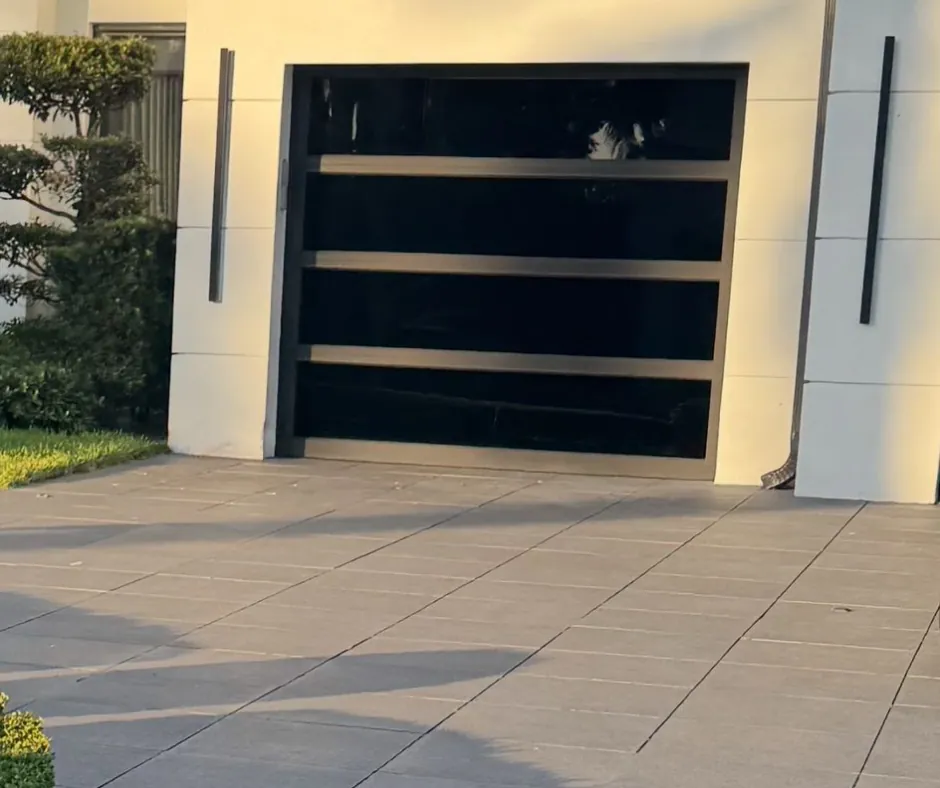
Salt air, short driveways and the detached garages of Wollaston, North Quincy and Squantum
Walk the single- and two-family streets of Wollaston, North Quincy and Squantum and the garage, house after house, stands on its own, a separate small building reached by a modest driveway. For garage doors Quincy MA owners keep in those buildings, the enemy is less the age of the structure than the weather blowing in off the water. Out toward Squantum, coastal exposure is hard on hardware: steel fittings corrode, springs pit, and cables that would last for years inland start to fray sooner.
A detached garage near the coast gets the worst of both worlds. It is unheated, so damp air settles inside it and condenses on cold metal. It is close to open ground, so wind drives salt-laden spray and fog against the outside face of the door. And because it is a separate building, its door is often opened less carefully, left half-up in a breeze or run with a fault for longer than a door on the house would be.
From the driveway, without laying a hand on anything, check for:
- Orange or brown rust on the spring coils, on the cable drums or along the bottom brackets.
- Cables with loose strands sticking out, especially near the bottom corners where salt water collects.
- Hinges or rollers that have seized, so the door shudders or stops partway.
Garage doors Quincy MA properties need, and where each service is covered
Four of our services have their own Quincy pages with more detail. A door that rubs, sags, scrapes or has a bottom section eaten through by rust belongs with Quincy garage door repair. Coils that have cracked, often from corrosion that started long before the break, are handled on Quincy spring repair. Motors, handsets, keypads and the photo eyes that salt fog likes to cloud over are on opener work in Quincy. A door that gives way after dark, with a car shut in or the garage left gaping, is what Quincy emergency garage door repair covers.
What those four have in common along this stretch of coast is corrosion. Almost every repair here involves at least one part that has failed because rust weakened it, and almost every visit includes a look at the parts that are going the same way.
How salt air works on a door
Steel is the backbone of a sectional door. The springs, cables, drums, hinges, roller stems, track and brackets are all steel of one kind or another, and most of them are coated against rust rather than made from metal that cannot rust. Once that coating is scratched, chipped or simply worn thin by years of salty damp, corrosion gets a foothold.
The effect varies by part. On a spring, rust roughens the surface of the coil and creates tiny pits, and every time the spring winds and unwinds those pits are where cracks start. A rusty spring often breaks well before a clean one would. On a cable, salt works into the strands, the wire inside goes brittle, and the outer strands start to snap one by one, which is why frayed cables are such a common find near the water. On rollers and hinges, rust seizes the moving joint; the door still moves, but it drags, and the drag is passed on to the opener and the springs.
Tracks and brackets corrode too, mostly at the bottom where water and slush sit against them. A bottom bracket holding a cable under full spring tension is not a part to let rust away. Where a bracket is badly corroded, it is replaced with the cable and spring tension safely released first.
Springs near the water
A cracked spring is the urgent call we take most often everywhere, and in Squantum and the streets nearest the shore the cause is very often visible: a coil that has been rusting for seasons until it finally parts. The door then feels like a slab of concrete, and the opener manages a short lift before it stalls.
On these streets the lifting is done either by a wound coil riding a steel bar over the header or by two long coils drawn out along the ceiling rails. With either, the spring stores the energy that lifts the door. With a torsion spring, that energy is held as twist, and it stays there with the door down. It is dangerous tension, and anyone who is not a trained technician should treat a torsion spring as no DIY repair at all: the winding cones and set screws hold that load back, and loosening them wrongly can throw a bar or a cone with real force. A stretched side spring that breaks with nothing threaded through it is liable to whip loose and strike whatever is near.
When springs are replaced on a coastal garage, it is worth talking about the conditions. Coated springs, more frequent lubrication and keeping the garage as dry as possible all slow corrosion down. The garage door springs page has more on how springs are matched to doors.
Openers in a detached, damp garage
An opener in a detached garage lives in a cold, damp box. Condensation forms on the circuit board on cold mornings, the drive chain or belt can rust or stiffen, and the photo eyes at floor level get splashed with salty water and grime. A motor that starts and stops, a door that bounces back up off nothing at all, or a handset that works only from close up are all common results.
Many opener calls turn out to be about the door, not the motor. A door dragging on seized rollers or rusted hinges asks the opener to push far harder than it should, and eventually the opener’s force limit trips and it reverses. Freeing the door often brings the opener back to normal. When the opener itself is worn out, or its circuit board has been damaged by damp, replacing it is the better spend; LiftMaster openers are among those we mend or swap in Quincy garages. The garage door opener services page goes into more depth.
Power to a detached building is worth a thought too. A long cable from the house, an outdoor socket, or a circuit shared with other equipment can all cause an opener to behave strangely. Checking the supply is part of any opener call in a separate garage.
The visit, step by step
On arrival, the door is looked at from the driveway first: how it sits in the opening, whether the sections are level, how badly the bottom section and its seal have weathered. Then, inside, the release cord is pulled and the sections are raised by hand. A door in balance can be raised halfway and left there; one that drops or will not stay up has a spring problem.
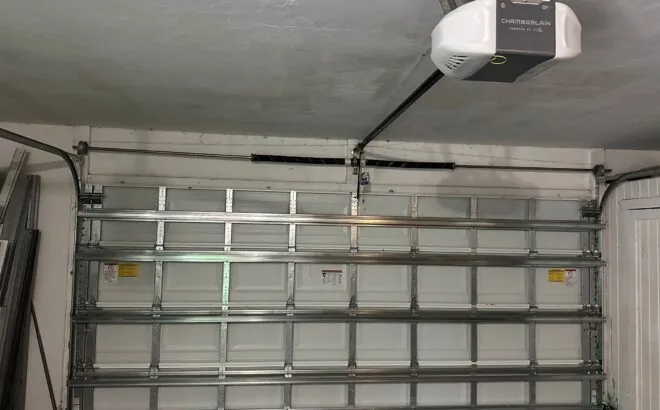
The hardware check on a coastal garage is thorough by habit. Every spring is looked at along its length for rust and pitting. Each cable is drawn slowly through a leather-gloved palm, where a snapped wire catches at once. The drums, the bottom brackets, every hinge and every roller get a look, and so does each length of track and its mounting brackets. Anything that is still working but badly corroded is pointed out alongside whatever has actually failed.
Then the opener, handsets, wall button and photo eyes are tested. You are given a straight account of what is wrong and what is close to it, and you decide what to go ahead with. When the parts are in, spring tension is trimmed for balance, the opener’s travel is re-taught, and its auto-reverse is proved against a solid object left on the threshold.
A door that gives out at night
Doors on detached garages tend to fail when nobody is watching: a spring that has rusted through gives way overnight, or a cable snaps as the door is closed late in the evening. A person picks up our line whatever the clock reads, Saturday and Sunday too, which means a coastal door that quits at midnight can be reported at midnight.
While you wait, a few steps are safe. Unplug the opener so the door cannot be run again. Keep people well clear of a door that has dropped at one corner or come out of its track. If the garage holds anything valuable and the door is stuck up, lock the side door and anything inside that can be secured. Do not prop up a door with a broken spring and work beneath it, and do not touch the spring, cables or brackets. The emergency garage door repair page has more.
Modest driveways and what they mean for repairs
Driveways in Wollaston and North Quincy tend to be short and narrow. A car parked on the driveway often sits right up against the garage door, and a car reversing out has little room to manoeuvre. That brings two kinds of damage: bottom sections dented by bumpers, and doors knocked out of their tracks when they are struck while partly open.
Short driveways also limit working room for a repair. Clearing the driveway before a visit, if possible, makes it much easier to set up ladders and work on the outside face of the door. If cars have to stay, say so when booking and the technician will work round them.
Swapping just the creased lowest section is usually possible while panels of the same pattern remain in production. On a coastal garage, the bottom section is also where rust usually starts, so a dent that has cracked the paint or the coating is worth dealing with before salt gets into the steel underneath.
Keeping hardware going near the coast
Some simple care slows corrosion down. Rinsing the outside face of the door with fresh water a few times a year washes off salt deposits before they bite. A light lubricant on the hinges, rollers and springs, applied a couple of times a season, keeps moving parts turning easily and leaves a film between the steel and the salt. Keeping the bottom seal in good repair stops seawater, rain and snowmelt from pooling against the bottom brackets.
Inside the garage, airflow helps. A garage that is closed up tight and full of damp boxes holds moisture against the hardware. Opening the door for a while on a dry, sunny day lets the air change. Keeping the floor clear around the tracks makes it easier to spot rust early.
None of this replaces a repair when something has broken, but it stretches the life of springs, cables and rollers, and it means that when a technician does come out, the problem is more likely to be a single part than a whole set.
Knocked off the rails
A short driveway leaves little margin. Back out at an angle, misjudge the clearance with a door only part-way up, or catch the bottom section with a trailer or a mower, and the rollers on one side can be forced out of their track. The door then hangs crooked, held at one corner by a cable and at the other by whatever rollers are still engaged. It can fall.
The instinct is to push it back, or to press the button and hope the opener drives it home. Both usually make things worse: the opener bends the track further, and pushing by hand puts a person underneath a door that is no longer properly supported. The safer course is to pull the opener’s plug, clear the area beneath and beside the sections, and leave everything as it hangs.
Putting a derailed door right means clamping it so the rollers carry no load, guiding each one back into a straightened or renewed track, checking that both cables carry equal tension, and only then running it again. On a coastal garage, a track that has been bent often turns out to be rusted at its base as well, so it is replaced rather than straightened. Realignment is described further under off-track garage door repair. With driveways this short, it is a risk worth knowing about for garage doors in Quincy MA.
Two-family houses and shared doors
Behind a two-family, one standalone garage often serves both floors, with each household using one side or the whole building at different times. More users mean more cycles and more handsets. A door that one person notices has started to grind may be run over and over by others before anyone mentions it. Agreeing between households to report any new noise or jolt early saves a lot of wear.
Handsets on a shared opener should be kept track of. When someone moves out, clearing the opener’s memory and re-pairing the remaining handsets keeps the garage secure. That re-pairing slots easily into a visit booked for something else.
Repair it, or replace it
Repair is usually the right answer, even near the water. Coils, wire rope, wheels and hinges are consumables by design; refit them on solid sections and the door keeps earning its place. A new door makes more sense when the sections themselves are rusting through, particularly the bottom section, or when bumper strikes and patches have left the sections too twisted to track straight.
When a door is replaced on a coastal garage, it makes sense to think about materials and finishes that stand up to salt air, and about hardware with good corrosion protection. We source the new door, hang it, and remove the corroded one from site. The new garage door installation page explains more.
Choosing to repair or to replace garage doors Quincy MA homeowners have lived with for a long time is always your decision. You get an honest view of the door’s condition and the options, and you choose.
Close by
Quincy sits next to Milton and Braintree, both on our list. Every other town and neighbourhood on our patch appears under service areas.
Getting in touch
When you contact us about garage doors Quincy MA homes depend on, mention whether yours is a standalone building, how near the shore it sits, what the door is doing, and whether you can see rust or a broken spring. Photos of the springs and the bottom corners are very useful. Your call is answered whatever the hour. When you are set, call us or book online.
Questions from Quincy
Rust has turned our springs orange, yet everything runs. Is waiting sensible?
It is safer not to. Rust pits the coil, and a pitted spring can break with little warning. A look at springs and cables before anything snaps lets the repair be booked calmly instead of in a scramble.
One of the cables has loose strands sticking out. Is it dangerous?
It can be. A fraying cable is weakened and can snap under load, letting one side of the door drop. Stop using the door, unplug the opener, keep people clear, and call.
Does living near the water mean the door will need replacing sooner?
Not necessarily. The hardware usually wears out before the door itself does, and hardware can be replaced. Rinsing off salt and keeping moving parts lubricated helps both last longer.
The opener in our detached garage keeps reversing. What causes that?
Often a dirty or misaligned photo eye, a door that is dragging on seized rollers or hinges, or a power problem in the separate building. Clean the lenses gently and check nothing is blocking them; if it continues, have it checked.
A bumper creased our lowest panel. Does the whole door have to go?
Usually not; that one section can be changed if an identical panel is still obtainable. Near the coast it is worth doing promptly, because a dent that breaks the coating lets salt start on the steel underneath.