
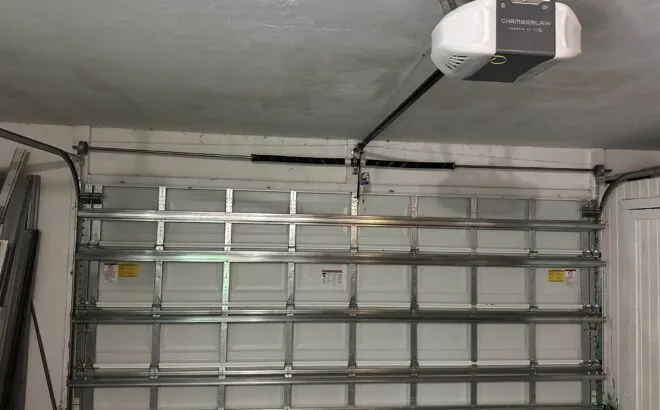
Capes, colonials and the long drive up to the door
The houses here are mostly Capes and colonials, set on larger lots, and nearly all of them have an attached garage where a full-length driveway ends. That pairing tells you a lot about garage doors Walpole MA homes depend on: the door is joined to the house, it opens onto a paved apron with room for cars to stand right up to it, and it moves many times a day. Knocks, scrapes and a door closing onto something turn up as often as plain worn-out parts.
A long drive is generous until the cars are home. Then the last stretch before the opening becomes the busiest strip of tarmac on the lot. A bonnet edged a little too close, a door descending onto a bumper that juts under its path, a sensor clipped by someone squeezing between two parked cars: on lots like these, those are ordinary reasons for a call.
Before ringing us, stand on the drive and look at:
- Whether the lowest section has a crease or a bow where a bumper may have met it.
- Whether both upright rails still run straight, or one has a kink just above the slab.
- Whether the door halts and climbs again at the identical point each time.
Garage door services in Walpole
General door repair
Bowed bottom sections, kinked track, loose hinges and worn rollers on attached garages that open and shut all day. Every bit of that falls under our garage door repair work.
Broken springs
Colonial two-car doors lean on a pair of torsion coils; a Cape’s single door may hang from extension springs instead. Either kind is replaced, as laid out on our garage door springs page.
Opener work
Several cars, several handsets and a keypad by the side door. Openers are fixed or swapped, LiftMaster units in the mix, and each handset is paired again. Read our opener services.
When it cannot wait
A door that drops onto a car roof, or one jammed open just as the lights go off for the night. Someone takes that call in the small hours too; see emergency garage door repair for how it works.
Lift cables
A cable crushed when the door came down on a bumper, or worn thin by heavy use, lets one corner slump. The two cables are always renewed as a set. More under cable repair.
Off-track work and new doors
A door shoved sideways by a car is put back true through off-track repair. Doors that have been hit once too often are replaced with new garage doors, supplied and hung by us.
Cars parked up to the door
On a larger lot, a full-length driveway seems like plenty of room. Once a few cars are standing on it, though, the apron in front of the garage is the most crowded patch of the whole property. Cars stop nose-on to the door. Bikes and bins line the edges. A car reverses away while the door is still descending, or rolls forward before it has finished rising.
That is how many garage doors Walpole MA drivers pull up to end up dented. The lowest section takes most of it: a bumper presses in, the steel creases, and that section no longer sits flat when closed. A harder hit can bend the upright rail near the slab, pop a roller loose, or rack the door so it binds on the way up. Often nothing looks wrong until the next cycle, when the door shudders, halts and climbs back.
If a car has touched the door, however lightly, watch the following cycle from a safe spot. A door that runs as it always did is probably fine. One that rubs, clicks or catches at the same height has been knocked out of true, and every extra run in that state worsens the bend.
Capes and colonials: two shapes of garage
Capes and colonials make up most of the houses here, and each tends to bring its own sort of garage.
A Cape is low and broad, and its garage is often a modest attached bay to one side, sometimes a single, sometimes a double. Under a low roofline the garage ceiling can sit lower than in a colonial, so the clearance above the header can be a matter of inches. Some of these doors hang from extension springs laid alongside the overhead rails instead of a coil over the header, precisely because there is so little room up there. Any opener has to squeeze beneath that ceiling as well.
A colonial usually has a taller, deeper attached garage, very often a two-car, with height enough for a spring bar over the header and a rail-drive opener down the centre. Those doors are wider and heavier, and they ask more of their springs, cables and motor.
Telling us which style of house you have, before anyone sets out, lets us guess the spring system, load the right parts, and know roughly what an opener or a replacement door will need to fit.
Reading the symptoms on an attached door
Doors drop hints before they quit. On these attached garages, the common ones tend to read like this.
A bang like a dropped plank, then nothing will lift
Nine times out of ten, a coil has fractured. The motor may raise the door a hand’s width and stall, or not shift it at all. Leave it down.
One corner low, the door crooked in the opening
A lift cable has frayed, parted or unwound off its drum, and the door is hanging from one side. Keep your finger off the button.
Door touches down, then rises again
With cars parked close, the first suspects are the photo eyes, kicked by a pedal or a shopping bag, and something lying on the threshold. Next comes the motor’s force setting, and after that the door’s balance.
Grinding, or a jerky climb
Flattened rollers, dry hinges or a rail nudged off line. Very common on a door that has taken a knock.
The handset works now and then, the keypad never
A flat cell in the keypad, a handset that has forgotten its code, or a weak receiver in the motor head. A nuisance rather than a hazard, and quick to put right.
Snow, ice and a long apron
Larger lots mean longer driveways to clear, and the snow has to go somewhere. Plough banks and shovelled heaps often end up against the edges of the garage opening, and meltwater runs down to the bottom seal, then freezes overnight. A door glued to the slab by a frozen seal will strain its motor, and if the opener keeps pushing, it can strip a drive gear or leave a cable unwound and loose at one end.
Of all the garage doors Walpole MA winters freeze to the slab, the ones on shaded, north-facing aprons suffer most. On cold mornings, check that the bottom edge is not stuck down before pressing anything. Chip away ice along the seal, keep heaps from piling against the jambs where they can push the rails out of line, and clear the photo eyes if snow has drifted over them. On a frosty morning, a door that lifts a little and gives up is more often stuck to the concrete than broken.
Springs, and why they are ours to handle
On these garages the coils either sit on the bar over the header or stretch beside the overhead rails. Both kinds store energy every time the door comes down, and that energy is what lifts it.
Stated plainly, every torsion spring over a Walpole garage holds dangerous tension, and winding or unwinding it calls for proper bars and a careful sequence. Should a bar slip, it whips round hard enough to shatter bone. This is no DIY repair, and that includes small tweaks to stop a door creeping down by itself. Extension springs each need a restraint line running down their centre, which catches the pieces when one breaks instead of letting them fly.
On a two-spring colonial door, one broken coil usually means its twin is near the same point. We normally suggest swapping the pair, explain why on the spot, and leave the choice with you.
Cables under a busy door
A door on a busy attached garage loads its cables with the whole of its weight every cycle, and on a crowded apron they are exposed to knocks as well. A door that settles onto a bumper or a bin can slacken one cable enough to jump it off its drum, and one that runs all day wears its cables thin at the lower brackets.
A slack or snapped cable leaves the door hanging lopsided, with the remaining cable and spring pulling at an angle, which is how rails get bent and sections cracked. Stand clear, move the car if it is safely outside the door’s path, and phone. Fresh cables go on as a pair with equal wraps on each drum, and the door is rebalanced afterwards.
Openers that serve several cars
A garage that several cars come and go through puts far more cycles on its opener than a garage with one. Openers are fixed or replaced, LiftMaster ones among those we work on, and every car’s handset, the outdoor keypad and the indoor button are set up to match.
When a motor misbehaves, the door gets checked first. A motor fighting a broken coil, a pinched cable or a dented section is doing work it was never meant for, and a new motor will not cure the door. With a sound door, motor faults usually come down to worn gears, a failing circuit board, misaligned eyes or a handset out of pairing.
Those eyes are mounted near the floor on each jamb, aimed across the opening at each other. On a busy apron they get kicked, splashed with mud or blocked by a bin wheeled too close. If the door shuts only while someone keeps pressing the inside button, look for a steady light on both eyes.
A door pushed off its rails
A car clipping a door that has not fully risen is the leading reason doors here leave their tracks. A broken cable or a worn-out roller can do the same. The result is a door at an angle, sections jammed, rollers sitting outside the rail.
The door is still hooked to its springs and far from stable. Clear the area, unplug the opener, and leave the levering to us. We let the spring tension down in the proper order, straighten or replace bent rail, fit new rollers, check hinges and sections for hidden damage, and hang the door square. There is more on our off-track garage door repair page.
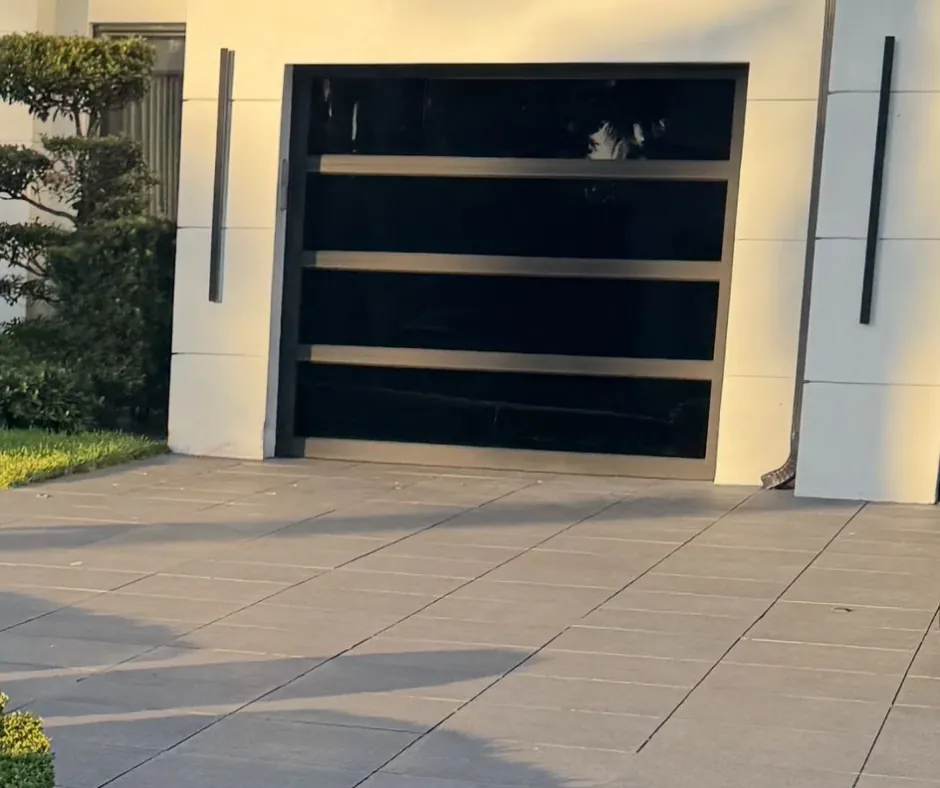
Insulated sections and an attached garage
Wherever the garage is built onto the house, the big door doubles as a stretch of exterior wall. Sealed and insulated, it stops the garage swinging between summer heat and January cold, which matters when a kitchen, a mudroom or a bedroom shares a wall or a floor with the garage. On a Cape, the room above a garage is often tucked under the roof and can feel every draught that slips under a worn bottom seal.
The seals are the cheap part of the door and the first to go. The rubber along the bottom edge flattens and splits, and the strips along the jambs and header harden and pull away. When we visit for anything else, we look at them too, and a door that closes cleanly onto a fresh seal is quieter, warmer and less likely to freeze to the slab.
Problems that turn up after dark
A door that comes down onto a car late in the evening, or will not close as the house is being locked up, is not a problem to sleep on. The phone is picked up in the dead of night and on a Sunday afternoon alike. Nobody will quote you an arrival time; you get a straight account of the options and how to keep the door safe for now.
Until then, let it be. A door stuck up on a broken coil should not be dragged down by hand, and a shut one should not be prised up. Only when the bottom edge is resting on the slab should anyone pull the red release cord.
The visit itself
On arrival we take in the whole door and its surroundings, including where the cars stand and how close the bins are to the eyes, before touching any one part. If it is safe, the door is run and watched. Then the coils, cables, drums, rollers, hinges, rails, sections, seal, motor and eyes are each checked.
The findings come to you in ordinary words, urgent items set apart from anything that can wait. Nothing starts until you give the go-ahead. With the repair finished, the door is balanced by hand, the motor is matched to it, the auto-reverse is tested with something placed in its path, and you watch it run before we drive off.
Repair or replace on a door that has taken knocks
Doors that have met a bumper are where the repair-or-replace question comes up most here. A small crease in the lowest section can sometimes be lived with; a section bowed so badly that it no longer seals, or no longer rolls cleanly round the curve of the track, usually has to go. A door struck several times may carry damage across several sections and hinges.
Where most of the door is sound, repairing it is usually the sensible route. Where the sections are failing, a new door often makes more sense over the years ahead. We supply and install new doors, sized to the opening, be it a Cape’s single bay or a colonial’s two-car. Our new garage doors page has the detail. With garage doors Walpole MA houses open and close all day long, a replacement is also a chance to choose sections stiff enough to shrug off an occasional nudge.
Nearby towns
The same work is offered in the towns around this one. See Sharon, Norwood and Medfield, or every area on our service areas page.
Book the visit
If the door on your attached garage is crooked, noisy, jammed or creased, say what it is doing, and mention any car shut in behind it or parked hard against it. The line is covered night and day. Whether the trouble is a spring, a cable or a bumper’s work, for garage doors Walpole MA Capes and colonials carry, call us or book online.
Questions from Walpole
A car nudged the door and now it shudders. Can we keep using it?
Better not. Even a light knock can push a rail or a roller out of true, and cycling the door in that state can bend the rail further or drag the door clear of it. Watch one cycle from a distance, and if it rubs or catches, leave it shut and ring us.
Our Cape has a low garage ceiling. Does that limit our options?
It shapes them more than limits them. Little space over the header may point to extension springs or a low-headroom track kit, and to a motor that fits under the ceiling. We measure first and suggest parts or a new door second.
The door climbs back up every time it nears the slab. What should we check?
Start with the threshold and the two eyes on the jambs: is anything lying in the way, and is each eye showing a steady light? Bikes and bins near the door often knock them. If both are fine, the motor’s settings or the door’s balance need a look.
Can every car have its own handset?
Yes. Openers are repaired or replaced, LiftMaster included, and handsets, the outdoor keypad and the indoor button are all paired so each car has its own.
Does a creased lowest section mean a whole new door?
Not necessarily. Sometimes one section can be dealt with on its own, and sometimes the damage has travelled into hinges, rollers and rails. We check all of it and say which case you have.