
Why East Boston garage doors wear the way they do
Behind many of the triple-deckers on Eagle Hill and up in Orient Heights sits a small detached garage reached by a short driveway, and down at Jeffries Point the newer townhouses have garages built into the ground floor. Both kinds take a beating from the salt air coming off the harbour, which works its way into springs, cables and the steel of the tracks. Our garage door repair in East Boston takes in the whole door: broken springs, worn cables, damaged panels, openers with their remotes, rollers and tracks, doors knocked off their tracks, and the pair of sensors by the floor.
Before you call, three things are worth a look from where you stand, without touching anything:
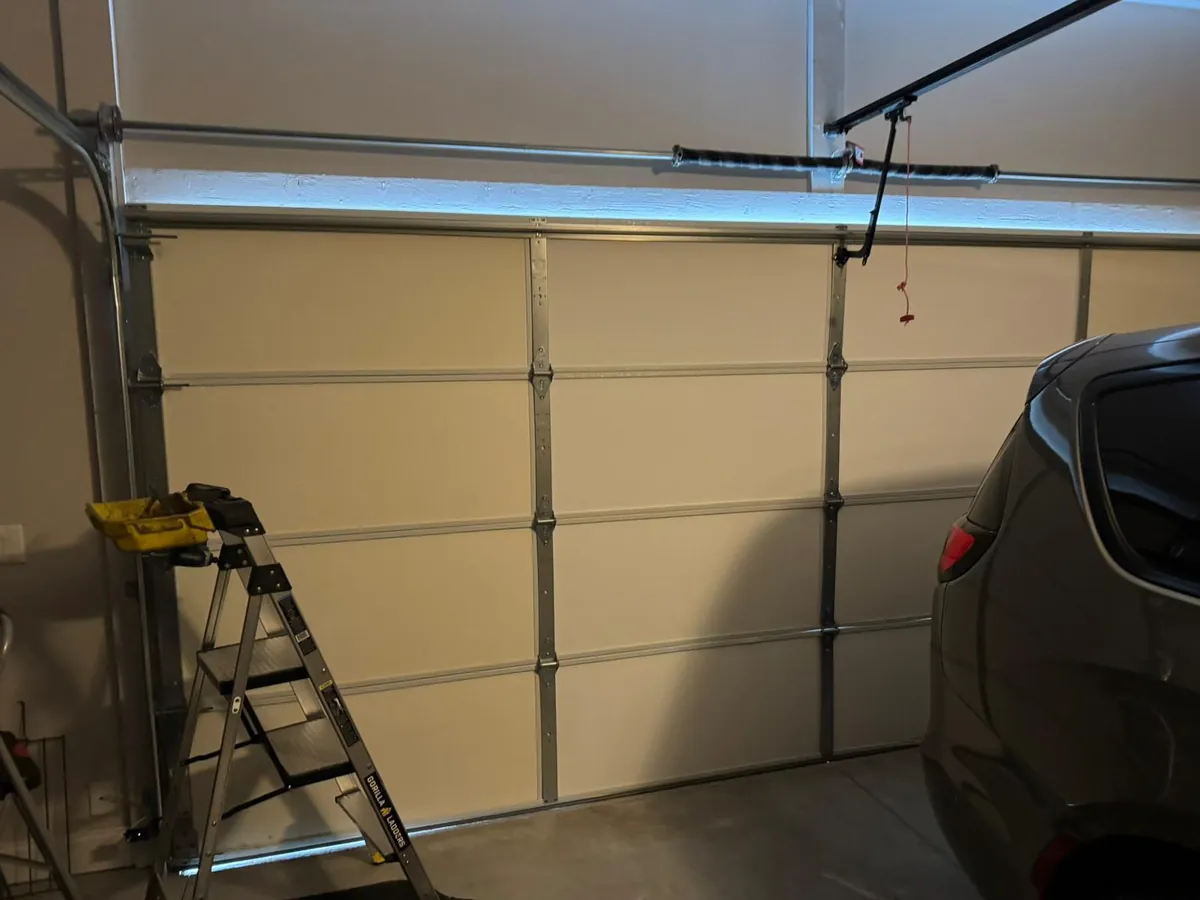
- The torsion spring over the opening: a clear gap between two coils means it has snapped.
- The cables at the bottom corners: one hanging slack, or unwound from its drum, has let go.
- The small lights on the sensors by the floor: a blinking or dark one points to the beam, not the door.
The parts a repair visit covers
Springs
Torsion springs across the top of the opening and extension springs running beside the overhead tracks. When one breaks, the door turns into dead weight. More on the spring repair page for East Boston.
Lift cables and drums
Cables corroded by salt air fray from the inside out before they snap, and a door with one cable gone hangs lopsided.
Panels and the bottom section
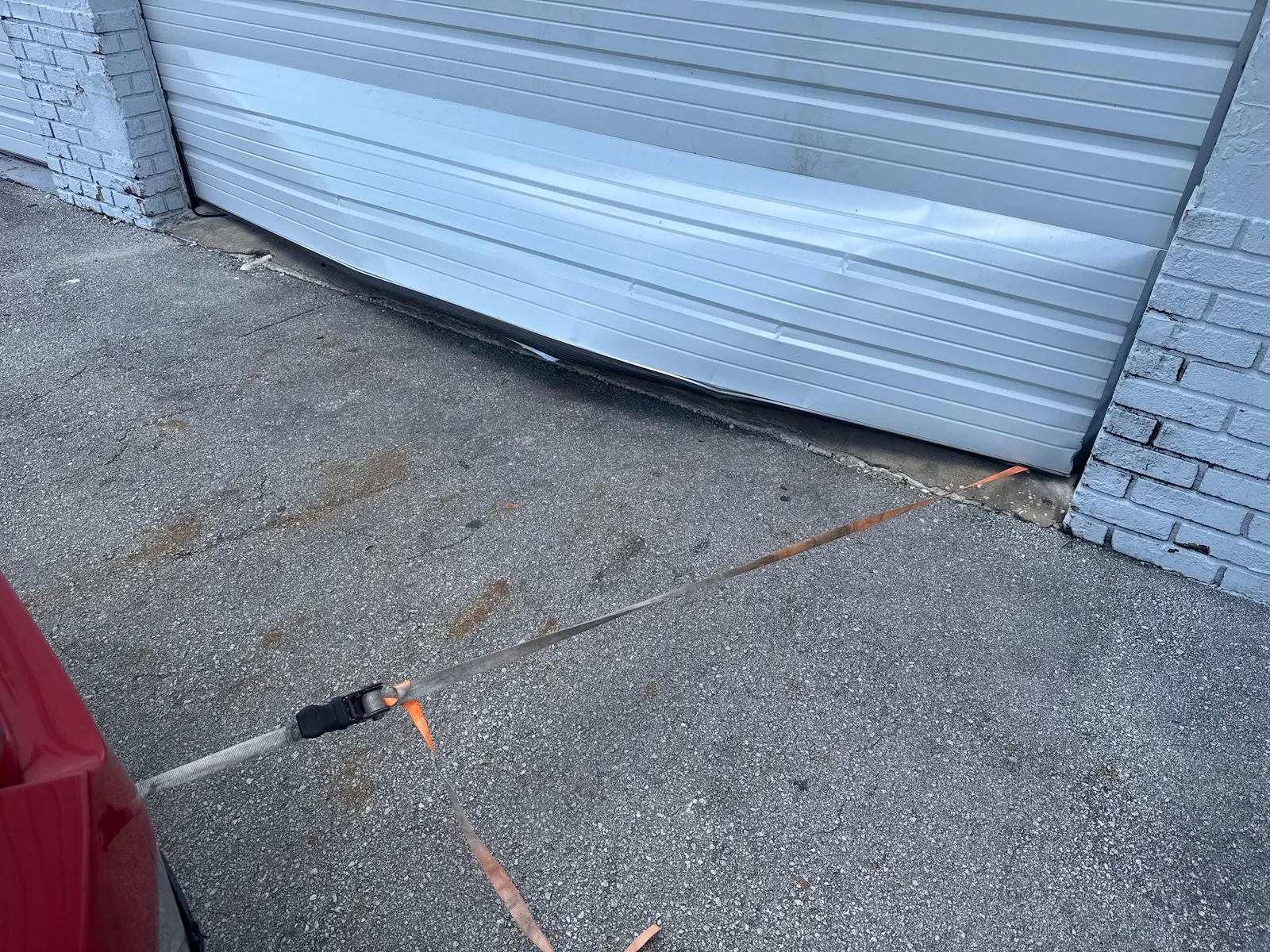
Sections dented by a bumper in a short driveway, split hinges, and a bottom panel rusting along the seal line.
Openers, remotes and wall buttons
An opener humming uselessly, a remote with no response, a wall button with no effect. See the opener repair page for East Boston.
Tracks, rollers and brackets
Rusted brackets, flat-spotted rollers, and vertical track knocked out of line in a tight garage.
Safety sensors
The paired photo eyes low on each side of the opening, there to keep the door off a car, a bicycle or a child.
A door is one system, not a list of parts
Anyone looking for garage door repair in East Boston usually starts with a single symptom: the door will not lift, it drops too fast, it groans, or it stops and reverses. That symptom almost always sits at the end of a chain. The spring does the lifting. The cables carry the spring’s pull down to the bottom corners. The rollers keep the sections running in their tracks. The opener only nudges a door that should already be balanced, and the sensors tell the opener when to stop.
So when a door misbehaves, the first job is to work out which link in that chain has failed and what pushed it there. A spring that has lost tension over a few winters makes the opener strain on every cycle. A roller that has rusted solid drags in its track and wears a groove in the steel. A cable that has thinned on one side lets that corner of the door sit lower, which twists the sections and loads the hinges. Fixing the visible fault without finding the cause tends to bring the same call back a few months later.
Here is how common complaints usually map to parts:
- Door rises a few inches, then stops: a broken spring, with the opener hitting its force limit.
- Door comes down hard over the last foot: a weak or broken spring, or a cable slipping on its drum.
- Door hangs at an angle: one cable has frayed or come off, or a roller has left the track.
- Opener hums but nothing moves: worn teeth on the opener’s drive gear, or a door the opener cannot shift.
- Door starts down, then goes back up: the sensors cannot see each other, or the door is binding in the track.
- Grinding or squealing on every cycle: dry or worn rollers, rusted hinges, or a loose track bracket.
Eagle Hill and Orient Heights: detached single bays
The garages behind the triple-deckers are usually small single bays at the rear of the lot, with a short driveway running in from the street. Several things about them shape how repairs go.
Space inside is tight. There is often little room between the door’s horizontal tracks and the side walls, and storage piled along those walls can push against the track or block the sensors. A bicycle leaning on a vertical track for a season is enough to knock it out of line by a little, and a little is all it takes for a roller to start skipping.
The short driveway puts a parked car close to the door. Bumpers find the bottom section, and a dent there can stop the door sealing to the floor or catch the section as it rolls over the curve in the track. Panels that have taken a knock are a regular part of garage door repair in East Boston, and many of them are fixable without a new door.
Detached garages are also often unheated and sometimes have no power supply worth the name, so some have older openers on long extension leads or no opener at all. A door that is lifted by hand every day puts all of its wear on the springs and cables, and a hand-lifted door with a tired spring is heavy and awkward to hold open.
Jeffries Point townhouse garages
Down at Jeffries Point, the newer townhouses usually put the garage inside the ground floor, with rooms right above the door. That changes the priorities. A noisy door or a rattling opener carries into the rooms above, so worn rollers and a slack chain or belt are worth fixing for the sake of the bedroom overhead as much as the door. These garages also tend to rely on the opener every time, so a dead remote, a failed wall button or a sensor out of line stops the household cold rather than being a minor inconvenience.
Built-in garages usually have more consistent openings than old detached bays, but they still sit close to the water, and salt air does not care how new the building is. Track hardware, spring ends and the cable ends at the bottom brackets on newer doors show surface rust within a few seasons when they are not looked after.
What salt air does to door hardware
The harbour air carries salt inland on every damp day, and a garage door has a lot of bare steel for it to settle on. The effect builds slowly and shows up in predictable places:
- Springs rust on the outside of the coils, which adds friction and roughens the surface. Rusted coils are more likely to crack, and a rusted spring often breaks with a loud bang on a cold morning.
- Cables corrode inside the strands first, so a cable can look fine from the outside and still be close to failing. Broken outer strands that stick out like bristles are a sign it is time.
- Rollers and bearings seize, and a seized roller slides along the track instead of turning, wearing flats into itself and a groove into the rail.
- Brackets and fasteners rust at the bottom corners, where the cable attaches, and at the points where the track is screwed to the wall.
Lubricating the moving metal parts lightly, twice a year or so, slows all of that down. Grease on the tracks themselves does not help, because it collects grit and slows the rollers.
What a repair visit involves
Each call-out for garage door repair in East Boston follows the same order, whatever prompted it:
- The door is checked by hand first. With the opener unhooked, the door is raised and lowered by hand and its balance felt. A door that will not stay put halfway up has a spring problem.
- The lifting parts are inspected. Springs, cables, drums and bottom brackets are looked over for breaks, fraying, rust and wear.
- The running parts are inspected. Rollers, hinges and both tracks are checked along their length for damage, binding and loose fixings.
- The opener and sensors are tested. The opener is tried by itself, then the remotes and wall button, and the sensors are checked for alignment.
- The findings are explained: what failed, what caused it, and what can wait and what cannot, all before work begins.
- The repair is made and the door is set up again. Balance is restored, the opener’s travel and force are adjusted to match, and the reversing feature is proven by closing the door on a solid object.
Safe checks, and parts to keep your hands off
Some checks take a minute and are perfectly safe:
- Pull the opener’s plug if the door has halted midway, so it cannot have another go.
- Wipe both sensor lenses and move anything sitting between them.
- Swap the battery in a dead remote, then press the wall button. A working button and a silent remote points to the remote, not the opener.
- Look along both tracks for something obvious in the way, such as a shovel or bin pushed against the rail.
Keep your hands off the springs, cables and bottom brackets. Every torsion spring holds dangerous tension in every position of the door, and everything attached to it shares that load. Loosening a set screw on the winding cone, or the fixing at a lower corner, lets the tension go in an instant. Spring work is not a DIY repair. A door whose spring has snapped should not be lifted at all, by hand or by the opener, because nothing but the person or motor lifting it is taking its weight.
When a door comes off its track
When rollers leave the rail, the door ends up skewed in the opening, sometimes with one side hanging lower. In small East Boston garages the usual causes are a car nudging the door, a cable snapping on one side, a bent vertical track, or an opener left driving a jammed door. Such a door is no longer properly held and may fall, so keep the car and everyone back and leave the opener off. Fixing it means supporting the door’s weight, working the rollers back into line, straightening or renewing damaged rail, and evening out the cables before the door is run. The off-track repair page explains more.
Cables and drums: the quiet failure
Lift cables get less attention than springs, but they fail in a way that catches people out. Each cable runs from a drum on the spring bar down the side of the door to a bracket at the bottom corner, and it carries a share of the door’s weight every time the door moves. Near the water, moisture and salt work into the gaps between the strands, and the cable rusts from the core outwards. From the floor it can look like an ordinary grey wire right up until the day it parts.
There are a few signs worth looking for from a safe distance. Single broken strands sticking out from the cable, especially near the bottom bracket where it bends, mean the cable is wearing through. A cable that sits loose on its drum instead of wound neatly in the grooves has slipped, often because the door met an obstacle on the way down. A door that sits slightly higher on one side than the other, leaving a wedge of daylight under one corner, usually has a stretched or slipping cable.
New cables go on as a matched pair, so the two sides lift together, and the drums are checked for wear at the same time. Because the cables are under spring tension, they are not something to adjust yourself.
Weather seals and the bottom of the door
The bottom of a garage door takes more punishment than any other part of it. The rubber seal along the floor line is what keeps rain, blown leaves and winter slush out, and in a single bay set back a few car-lengths from the street that seal is often the only thing between the street and whatever is stored inside. Once it is split, flattened or torn, water gets under the door and sits against the bottom section, and the steel or wood starts to go from the bottom up.
Replacing a worn bottom seal is a small job that protects the rest of the door. Side and top seals around the frame matter too, particularly on built-in garages where draughts through the door reach the house. A garage that floods along the floor line after every heavy rain, or a bottom section with a brown stain of rust along its lower edge, is a sign the seal is overdue.
Repair or replace
The usual outcome is a repair: a new spring or pair of springs, new cables, a set of rollers, a replacement section or an opener put right. A whole new door becomes the better option once several parts are going together, the lower sections have rusted through at the seal line, two or more panels cannot be saved, or an old wooden door has soaked up so much moisture that no sensible spring can balance it. Salt exposure pushes some doors over that line sooner than they would inland. You will get a straight answer on which side of that line your door sits, and the new doors page for East Boston describes how a replacement is supplied and fitted.
More on this service and this neighbourhood
This page sits under our main garage door repair service, which covers the same work across Greater Boston. Night-time breakdowns and doors jammed open are dealt with on the East Boston emergency page. Everything we do in the neighbourhood is gathered on the East Boston page.
Booking a repair
A garage door has a habit of failing at the worst moment, usually with the car on the wrong side of it. Calls are taken at any hour, seven days a week, so a fault can be phoned in the moment it appears. Mention what the door is doing, anything that looks broken, whether the garage stands apart from the house or sits inside it, and whether a car is trapped. To arrange garage door repair in East Boston at a time that suits, call us or book online.
Questions from East Boston
Ours is a small detached garage behind a triple-decker. Is that a problem for a repair?
No. Single bays at the end of a short driveway are the usual garage on Eagle Hill and in Orient Heights, and the work is planned around the tight space. It helps to clear a little room along the walls beside the tracks before the visit, so the springs, cables and rollers can be reached.
Does the salt air really make a difference to my door?
Yes. Salt carried in on damp air rusts springs, frays cables from the inside and seizes rollers. Doors close to the harbour tend to need these parts sooner than doors further inland. A light lubricant on the moving metal parts a couple of times a year slows it down.
The door opens a few inches and stops. Should I keep trying?
No. That is the usual sign of a broken spring, and running the opener again strains it and the door. Pull the opener’s plug, stay out from under the door and check the spring overhead from the floor. Then get in touch.
Our townhouse garage at Jeffries Point is very noisy. Can that be fixed?
Usually, yes. Worn rollers, dry hinges, loose track brackets and a slack opener chain are the common causes of noise, and in a garage with a bedroom over it the noise is worth sorting out. Most of it goes away with new rollers and properly tightened hardware.
Can you repair the door rather than replace it?
In most cases. Springs, cables, rollers, hinges, a single damaged section and the opener can all be dealt with on their own. Replacement only comes up when the door itself has reached the end, such as lower sections rusted right through.