
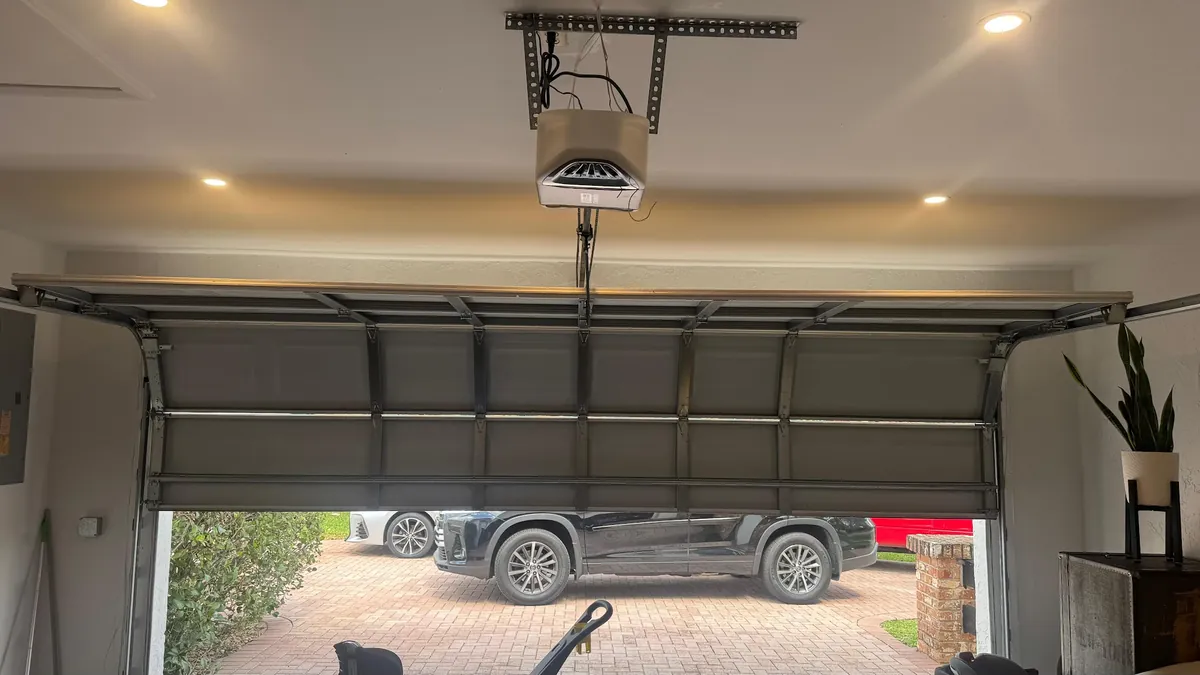
Why openers on Seaport’s parking and loading doors need repair
Seaport is newly built, and residents’ cars sit in parking structures, not private garages. The doors in question are commercial overhead doors at the vehicle ramps and loading-bay doors at the back of each building, and each is moved by a commercial operator rather than a ceiling opener from a hardware shop. Garage door opener repair Seaport MA buildings need usually starts with that operator, or with one of the devices around it: the handheld transmitters, the wall station, and the photo eyes guarding the opening.
An operator on a parking door works far harder than a house opener. It may run for every car that enters and leaves, close itself on a timer after each one, and take its commands from several sources at once. When it falters, the door either sits open, leaving the parking unsecured, or sits shut with cars trapped behind it.
Before you call, and without opening any cover or touching the door, it helps to note:
- Whether the operator makes any sound, hums, clicks or stays silent when the door is called.
- Whether the door responds to its own wall control even if it ignores remotes or other triggers.
- Whether any lights on the operator or on the photo eyes are on, off or flashing.
What an opener visit covers
The operator itself
Motor, gearbox, brake, drive sprocket or shaft coupling, limit switches and the control board. Commercial operators are serviced and repaired in place where the parts allow.
Remotes and transmitters
Handheld remotes for residents, staff or delivery drivers, programmed to the operator’s receiver. Lost or failed remotes are replaced and re-programmed.
Wall controls and stations
The open, close and stop station beside the door, and any key switch or second station at a security desk. Worn buttons and damaged wiring are common on a busy ramp.
Safety sensors and edges
Photo eyes across the opening and sensing edges on the bottom of the door, which turn the door back if it meets anything.
Replacement operators
When an operator is beyond repair or was never suited to the door, it is replaced. We repair and replace LiftMaster units along with other commercial operators.
How a commercial operator is different
A house opener is typically slung from the garage ceiling and drags the door along a rail with a chain or belt. Most parking and loading doors are too big and too heavy for that. Their operators are commercial units, often mounted on the wall beside the door and connected directly to the torsion shaft, or to the barrel of a roll-up, through a drive chain or a coupling. Some are hoist types with a hand chain so staff can wind the door up during a power cut.
Inside, they are built for more work. A commercial operator has a heavier motor and gearbox, a brake to hold the door where it stops, and limit switches or an encoder that tell it where the door is. Many have a close timer, an input for a separate safety edge, and terminals for card readers, loop detectors and other triggers. That extra capability is also extra places for something to go wrong.
The other difference is how much it runs. Operators are designed for a certain amount of work in an hour. A parking entrance that opens for a steady stream of cars at rush hour can push an undersized operator past that, and the motor overheats, trips its thermal protection and stops until it cools. That looks like a door that works, then fails, then works again.
Faults we see on parking-entrance operators
Garage door opener repair in Seaport MA parking structures usually comes down to a handful of patterns:
- A humming operator with a motionless door. Common causes: a failed capacitor, a jammed or worn gearbox, a brake that is not releasing, or a door left unbalanced by a snapped spring.
- The door stops short of fully open or fully closed. Limits have drifted, or a limit switch or encoder has failed, or the door is binding and the operator’s force setting is stopping it.
- The door reverses on its own when closing. Usually the photo eyes are out of line or dirty, a sensing edge is damaged, or the force setting is too sensitive for a door that has become stiff.
- The door works from the wall control but not from remotes or other triggers. The receiver, the remotes, or the wiring from the trigger devices is at fault rather than the operator itself.
- Nothing at all. A tripped breaker, a blown fuse in the operator, a failed transformer or control board, or a stop circuit left open.
Each of these has more than one possible cause, which is why an operator fault is tested before any part is replaced.
Remotes, wall controls and the building’s other triggers
In a residential building, the parking door may answer to several things: residents’ remotes, a card or fob reader on a post by the ramp, a vehicle loop cut into the ramp, a button at the security desk, and the wall station beside the door. Some of these talk directly to the operator; others are part of a separate access-control system that sends the operator a signal.
When the door stops responding to one of them, the first step is to find out which. If the wall control at the door still works, the operator and door are working and the fault is upstream. If residents’ remotes have all stopped at once, the receiver or its antenna is the likely cause; if only one remote has stopped, it is that remote. If the door opens from everything except the card reader, the reader or its wiring is the place to look.
Remotes are replaced and programmed to the operator’s receiver, and lost ones can be removed from its memory where the receiver allows it. That last point matters in a residential building: when a resident moves out without returning a remote, it can be cleared rather than left working.
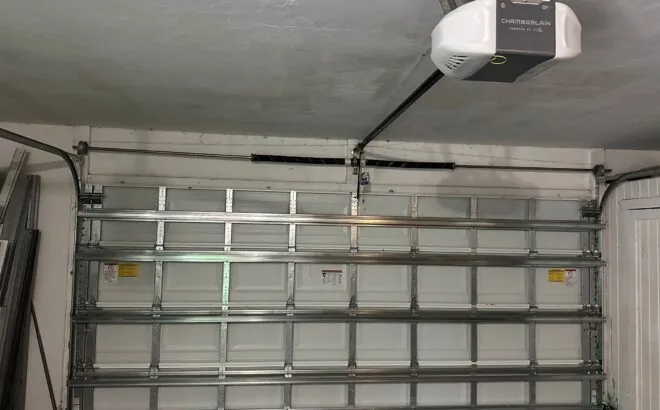
Safety sensors on a busy ramp
The photo eyes across the opening of a parking door are mounted low, close to where cars pass, and they take a beating. A wheel clips the bracket, a cleaner’s mop knocks the lens, road grit and salt coat the glass. When the beam is interrupted or the eyes drift out of alignment, the operator refuses to close the door, or reverses it as soon as it starts down.
A sensing edge on the bottom of the door is the second line of protection: a strip that tells the operator to stop and reverse when it touches something. On a loading door it is the part most likely to be crushed by a pallet or torn by a truck bed.
Both are repaired, realigned or replaced as needed, and the reversal is always tested before the door returns to service. A door that will not close because of its safety devices is doing its job; the answer is to fix the device, never to bypass it.
Close timers and a parking door left open
Many parking-entrance operators are set to close the door automatically a short while after each car has passed. That keeps the structure secure without anyone having to press a button, and it is why the door seems to run constantly at busy times. When the close timer stops working, the door stays up after the last car, and the parking is open to anyone on foot.
A door that will not close by itself is usually one of three things. The close timer has been switched off or reset, often after a power cut or after someone has changed a setting. The photo eyes or loop detector think something is still in the opening, so the operator holds the door open as it should. Or the door has stopped closing altogether because of a fault that also shows from the wall control.
The fix depends on which of those it is, and the safety devices are checked before any timer setting is changed. A close timer should only ever run on a door whose photo eyes and reversing edge work properly, because it brings the door down with nobody watching. Garage door opener repair in Seaport MA buildings with a close timer always ends with the timer and the safety devices tested together.
Power cuts and running the door by hand
When the building loses power, the parking door loses its operator, and residents need a way out. Commercial operators allow for this in different ways. Some have a hand chain that raises the door through the operator’s gearbox. Others use a release that uncouples the operator and leaves the door free to push. Some buildings have the operator on a backup supply.
These are safe to use only on a door that is properly balanced. On a door whose spring has snapped or whose cable has slipped, releasing the operator leaves nothing holding the door, and it can drop. If the door was working normally before the power went, the hand chain or release can be used as the building has been shown. If there was a bang, a strain or a crooked door before the outage, leave it and call.
After the power returns, the operator may need its limits checked or its timer reset. A door that behaves oddly after a power cut is a common reason to call, and is usually put right in one visit.
What a visit involves
The visit begins with access, arranged with building management or the concierge, and a safe work area: the ramp or bay is coned off or watched so no vehicle tries to pass, and the door is controlled by hand or held in place while the operator is opened up.
The operator is isolated from the door first and tested on its own, so the motor, brake and limits can be checked without the door’s weight confusing the picture. The door is then checked by hand for balance, because an operator that strains is often the victim of a broken spring or a binding track rather than the cause of the fault.
Next, each command source is tried in turn: the wall control, the remotes, and the building’s other triggers. Photo eyes and edge sensors get their own test. The manager, or you, then hears the diagnosis and the proposed fix, and work only goes ahead once it is approved.
With the repair made, the travel limits and force settings are adjusted to the door, the close timer is checked if one is in use, remotes are programmed, and the safety reversal is proven with the door closing on an obstruction before traffic is let through.
Noise from the operator in a residential building
In a building where homes sit above or beside the parking entrance, a noisy operator is more than an annoyance. A drive chain that has stretched and slaps its guard, a dry sprocket, a brake that drags or grabs, or a gearbox starting to wear all make a sound that carries through the structure every time the door runs, which at a busy entrance is often.
Noise is also an early warning. A chain that slaps will eventually jump its sprocket; a brake that grabs will wear out; a gearbox that grinds is close to failing. Reporting a change in sound early usually means a small adjustment or part rather than an operator that has stopped altogether. Where the door itself is the source, with rollers or hinges rattling, that is dealt with at the same visit.
When to repair and when to replace the operator
Most operator faults can be repaired: a capacitor, a limit switch, a control board, a brake, a drive chain or sprocket. On a building that is fairly new, the operator is usually young enough that a repair is the sensible spend.
Replacement makes more sense in a few cases. When the gearbox or motor has failed on an operator whose parts are hard to get. When the operator was never sized for how often the door runs, and keeps overheating however it is set. When worn parts are piling up together. Or when a door has been replaced and the old operator does not suit the new door’s weight or size.
A replacement operator is chosen for the door’s size and weight, the way it is mounted, and how many cycles it will be asked for in a day. LiftMaster is one make of operator we fix and fit. The new unit is mounted, wired to the building’s existing triggers and safety devices, programmed, and tested through its full travel.
Getting parts and the operator into the building
A commercial operator is a heavy, awkward unit, and replacing one means carrying it, its mounting hardware and a ladder or lift to the door. For a parking entrance at street level that is straightforward. For an operator serving a door higher in the structure, or a dock only reachable from inside, it means the freight elevator, which is shared with moves and deliveries. Garage door opener repair Seaport MA buildings plan in advance goes most smoothly when the elevator is reserved and the time is agreed with management before the visit.
When the fault is not in the operator
Plenty of operator complaints start somewhere else on the door. A broken spring makes the operator strain and stop; the Seaport spring repair page covers that work. Bent tracks, damaged sections or worn rollers make the door bind, which the operator reads as an obstruction; the Seaport garage door repair page covers those. For a parking door stuck open after dark, turn to Seaport emergency repair, and a door that is due for replacement on new garage doors in Seaport.
Booking an opener repair
Opener work across Boston is laid out under garage door opener repair and replacement, with LiftMaster units on LiftMaster opener repair; our Seaport hub brings the neighbourhood’s services together.
When you ask for garage door opener repair Seaport MA buildings need, say which door it is, what it does when called, which controls still work, and whether cars are trapped or the parking is open. Have the building contact and access route ready, then call us or book online to get it looked at.
Questions from Seaport
The parking door opens but will not close. What is wrong?
Most often the photo eyes. A broken beam, or eyes knocked out of alignment, keeps the operator from closing it. Clear the opening, clean both lenses with a dry cloth, and look at their indicator lights. A light still showing a fault means it is time to call.
The operator hums but the door does not move. Should we keep pressing the button?
No. A humming operator is either failing or trying to move a door it cannot lift, often because a spring has broken. Pressing again risks burning out the motor. Stop using it and call.
A resident moved out without returning a remote. Can it be disabled?
On most receivers, yes. Remotes can be cleared from the operator’s memory and the remaining ones re-programmed. Mention it when you book.
The door only fails at busy times, then works again later. Why?
That pattern often points to the operator overheating and tripping its protection after a run of cycles. It may be undersized for the door’s use, or straining against a door that is out of balance. Both can be checked on a visit.
Can a house opener be fitted to our parking door?
It is not a good idea. A residential opener is not built for the weight of a large commercial door or for how often a parking entrance runs. The operator needs to be matched to the door and its use.