
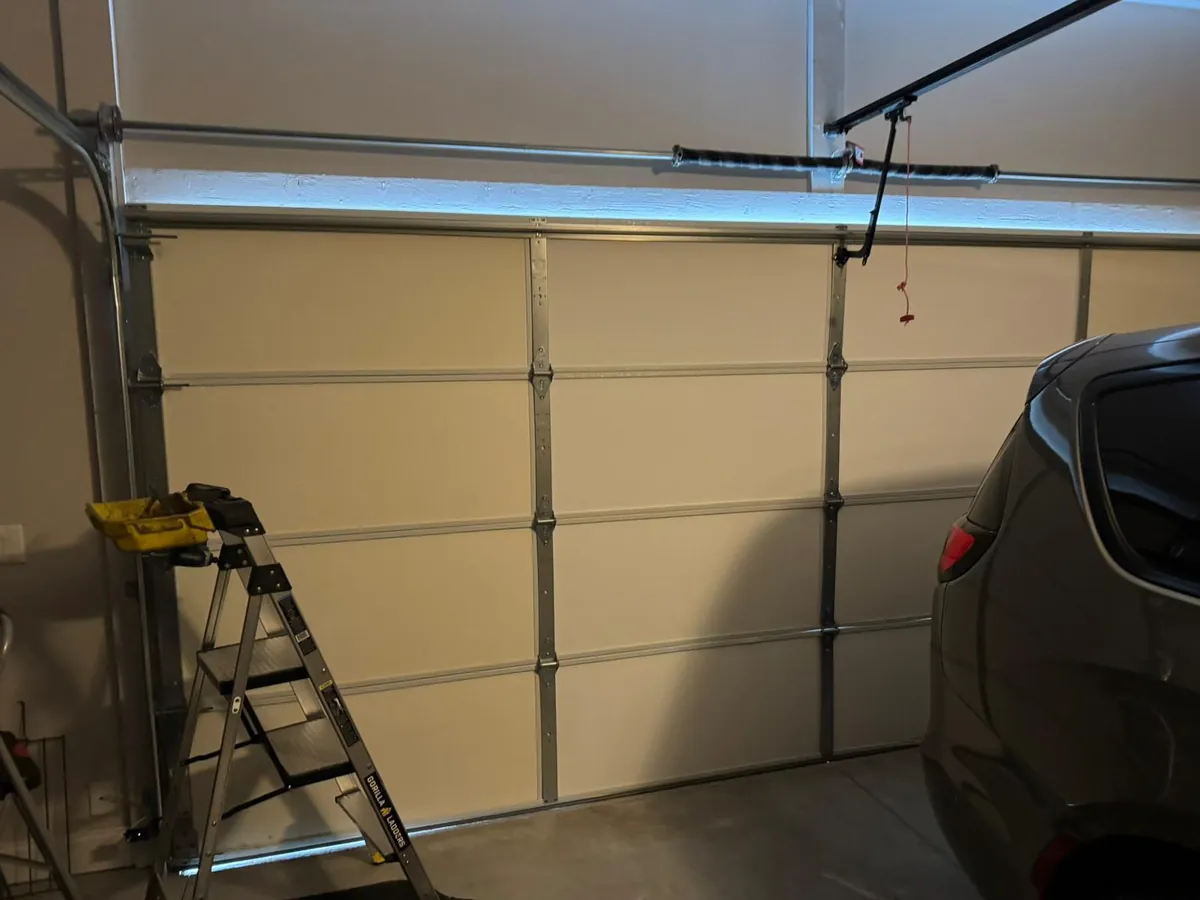
Stand-alone garages, salt air and short driveways
Walk the side streets of Wollaston, North Quincy or Squantum and the pattern repeats: a single- or two-family house, a modest strip of driveway, and at the end of it a garage built as its own little building. That separation is handy for storage and awkward for maintenance. Nobody hears a spring let go at three in the morning when it happens forty feet from the bedroom, and the first sign of trouble is usually a door that will not budge when someone is already late. Our garage door repair in Quincy, MA is built for that building and that moment, and it reaches every working part: springs of both kinds, the lift cables and their drums, panels and hinges, openers with their remotes and wall buttons, tracks and rollers, doors that have jumped clear of their channels, and the photo-eye sensors at floor level.
Three clues are visible from the driveway, with nothing touched:
- A coil above the opening with daylight between two of its turns: the spring is in two pieces.
- A slack line drooping at a lower corner: a cable has parted or slipped from its drum.
- A sensor by the floor with a blinking lamp: the two eyes have lost their line of sight.
What usually brings us to a Quincy garage
A spring has let go
Often announced by one sharp crack from the garage; afterwards the door lifts an inch and gives up. Coastal air shortens the life of these coils. More on spring repair in Quincy.
Cables gone slack or snapped
Lift cables rust where they wrap the drum, the strands unravel, and eventually one side lets go so the door hangs at a tilt.
Sections bent or cracked
On a short driveway a bumper finds the bottom panel sooner or later. Split hinges between sections make the door bow and scrape on the way up.
The opener, remote or keypad
A motor that whirs but leaves the door sitting there, a remote that only works from the curb, a keypad that ignores its code. More on opener repair in Quincy.
Rollers and rails
Wheels with seized bearings that skid instead of turning, rails knocked inward, lag bolts working loose from an old wooden jamb.
Photo-eye trouble
Two little sensors facing each other across the opening. Knock one a few degrees out of aim and the door will open happily but refuse to close.
The load path inside an overhead door
Before booking garage door repair in Quincy, MA, it helps to know which part is doing the real lifting, because it is not the motor on the ceiling. A steel sectional door is heavy, and the springs counterbalance almost the whole of that weight so that the door feels light in your hand. On most doors the spring is a torsion coil wrapped around a horizontal shaft just above the header. Pulling the door down twists the coil tighter; letting it rise lets the coil relax and spin the shaft, and a grooved drum on each end of the shaft reels in a steel cable. Those two cables are fastened to brackets on the lowest panel, so the coil hoists both sides at once. Some older or lighter doors rely on extension springs instead, long coils hung parallel to the ceiling tracks that stretch when the door is down and pull it back up by way of pulleys.
Each panel carries small wheels at its hinge line and corners, and those wheels ride in a pair of steel channels: upright beside the opening, curving at the top, then flat under the ceiling. The opener, when there is one, does very little lifting. It nudges a door that is already in balance, follows its programmed limits, and watches the sensor beam so it can stop and back away.
Seen that way, most breakdowns are a chain of cause and effect. A coil that has lost some of its strength leaves the motor hauling weight it was never meant to carry, and the motor gives out first even though the spring caused it. A wheel that stops spinning skids along the channel, grinds a flat spot onto its own rim and scores the steel. Once a cable frays, one corner sags, the door cocks sideways, and the wheels on the high side begin to ride up and out. Finding the first failure, not just the loudest one, is what keeps a repaired door from breaking again the following month.
What the shoreline does to door hardware
Coastal exposure toward Squantum is hard on hardware, and it shows in a predictable order. Salt carried on damp air settles on bare steel and stays there. Torsion coils pit along their surface and those pits become the place a coil eventually cracks. The bottom brackets, which sit lowest and catch every splash off the driveway, flake and swell with rust. The foot of each upright track goes the same way. Cable strands turn brown, then stiff, then start to separate where they bend around the drum. Wheel bearings lose their grease and seize. Even the screws holding the sensors and the opener rail corrode, which is how a sensor slowly drifts out of aim with nobody touching it.
None of this is dramatic on any one day, and that is the problem. A door by the water tends to arrive at a repair with four or five tired parts rather than one broken one, and replacing only the part that failed this week can leave the others queued up behind it. On garages nearer the shore we look at the whole set of hardware, point out what is nearly worn out, and leave the choice of what to replace now with you.
A detached building, a modest driveway
Inland streets bring their own wear. A garage that stands alone takes wind from every side, and a door left halfway open when a gust comes through can be pushed sideways in its channels hard enough to bend a rail or pop a wheel out. With limited room in front of the door, cars come close to the bottom panel when turning, and a door that has been tapped a couple of times can sit slightly out of square in its opening, rubbing on one jamb all the way up. Wooden frames on older garages soften around the lag bolts that hold the track brackets, so a bracket that looks fine can be holding on by very little.
Because these garages are out of earshot, slow failures get a long head start. A roller that has squealed for weeks, a door that has needed a hand to start rising, or an opener that has been reversing now and then are all warnings worth a phone call well before the morning the door is stuck shut.
Things you can check yourself, and what to keep away from
A handful of first moves are both safe and worth doing:
- Door frozen mid-travel? Unplug the motor at the ceiling outlet, which stops it trying again and bending a rail.
- Give the glass on each photo eye a gentle wipe, then shift anything parked between them: a bin, a bicycle, a bag of ice melt.
- Fit a new battery to a remote that has gone silent. Still nothing? Try the wall button: a door that answers the button but ignores the remote points to the handset, not the motor.
- Look down each rail for an obvious kink, a missing bolt, or a wheel sitting outside its channel.
Some parts are a hard no. Know this before anything else: a torsion spring holds dangerous tension in any door position, open, shut or jammed midway, and that stored energy runs through each cable, both drums and the brackets on the lowest panel. Turning a set screw, removing a bracket, or jamming a rod into the winding cone can release it in an instant, violently enough to shatter a wrist or a jaw. It is not a DIY repair, however many videos make it look simple. And a door whose spring has broken should stay put, neither hoisted by you nor driven by the motor: with the coil gone, the full weight of the door is resting on nothing but whoever is holding it.
How a repair visit runs
The visit starts with the door as a whole rather than the one part mentioned on the phone. The trolley release is usually pulled so the door can be moved and felt by hand. Balance is tested at a few heights, both coils and both cables are examined, wheels and hinges are spun and flexed, and each rail is checked end to end for kinks and loose fasteners. On garages close to the water the lowest few feet of hardware get extra attention, because that is where salt does its quiet work.
Before any part is swapped, you are shown the failure, its cause, and anything else that is wearing. Then the broken parts come out, new ones go in, the door is rebalanced, and the opener’s travel limits and force setting are matched to the repaired door. The last step is always the safety test: the door is closed onto an obstruction to confirm it stops and reverses, and the photo eyes are checked to be aimed and reading each other. Every job carried out as garage door repair in Quincy, MA finishes with that test, whatever part was changed.
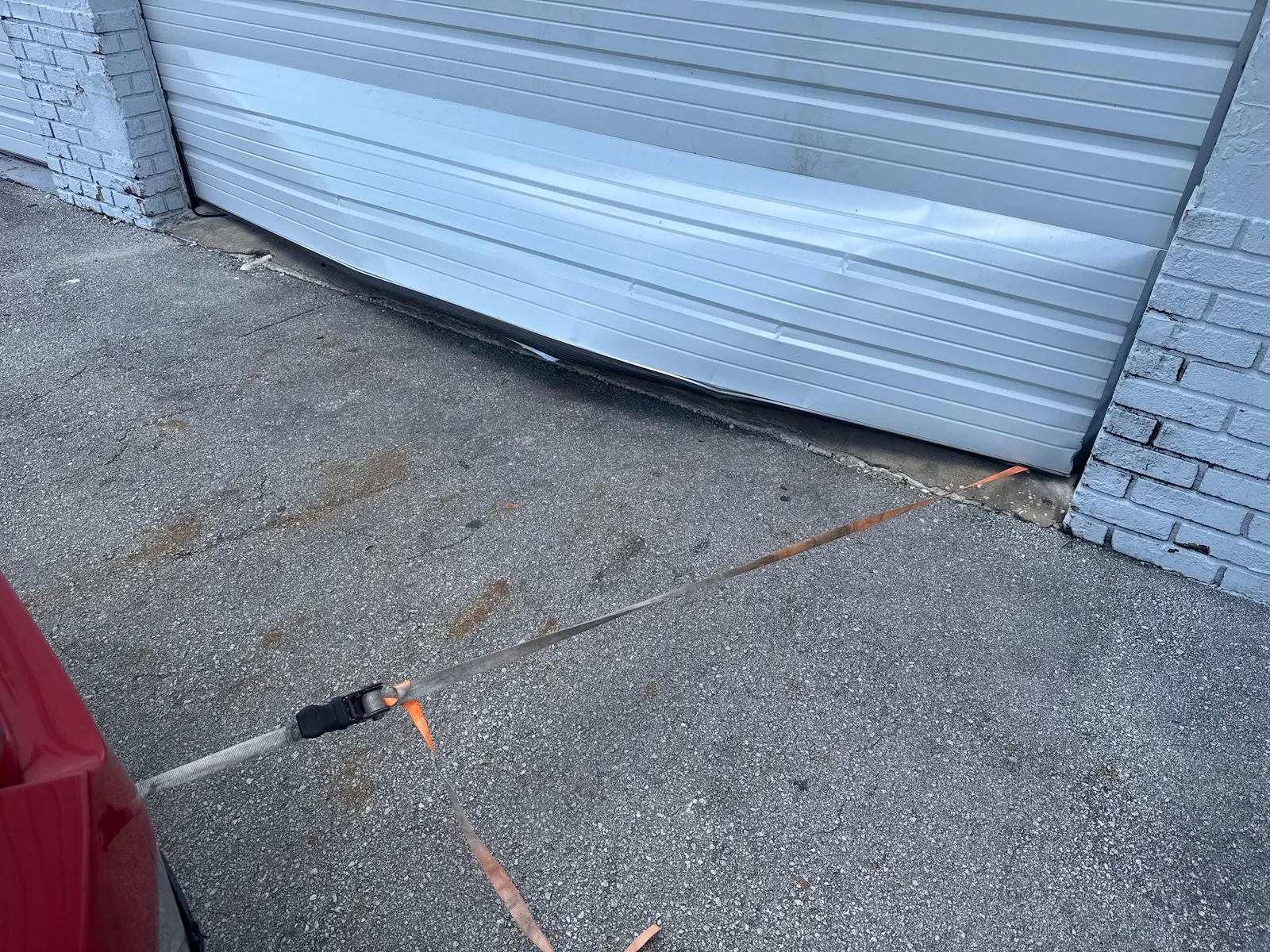
A door knocked off its rails
When a door leaves its channels it hangs askew, one or more wheels dangling loose. On a stand-alone garage the cause is usually one of four things: a car clipping the bottom panel, a cable parting on one side, wind catching a door that was partly open, or a motor that went on pushing against a jammed door. However it happened, an off-track door is unstable. It can drop or swing without warning, so leave the opener off and resist the urge to force it square yourself.
Our technician first makes the door safe by unloading its weight, then releases the stray wheels, straightening or replacing the kinked lengths of rail, re-seating the door, and making sure both cables carry equal tension before it is run again. If a rusted cable or a seized wheel started the trouble, that part is replaced as well, or the door will simply jump out again. Deeper detail on rail work lives on our off-track door page.
Panels, hinges and the weather seal
Most dents on these garages come from impact: a bumper on a tight turn, a door slammed into its stops by wind, a trash barrel rolling down the driveway. Replacing just the dented section is often possible, provided a matching panel of the same height, profile and finish can be found. Over the years the hinges joining one section to the next crack, and a door with a cracked hinge bends at that joint as it travels, which you hear as a scrape or see as a belly in the middle of the door.
The rubber strip along the bottom edge takes more abuse than anything else on a detached garage. When it splits or flattens, rain, sand and leaves blow straight in underneath, and the lowest panel begins to rust or rot from its bottom edge. Fitting a fresh strip is a small job that protects the panel above it, so it is worth adding whenever other work is being done.
Openers, remotes and sensors
If the coils and cables are sound and the door still will not move, the opener is next. Each symptom points somewhere different: a hum with no movement, a lamp on the motor head flashing in a pattern, a chain or belt hanging loose, a door that reverses just before it seals against the slab. Each is traced on the spot. Remotes and keypads are reprogrammed or replaced, wall buttons and their wiring are tested end to end, and we also work on LiftMaster openers, repairing or replacing them. When a motor is not worth saving, a new one is fitted and set up for the door it will be lifting; the garage door opener repair page covers that work.
Mend the door or start again
A repair suits most doors. A new coil, a matched pair of cables or a fresh set of wheels will keep a solid door running well, and replacing the whole door to cure one broken part rarely makes sense. Replacement starts to earn its place once several parts are giving out together, once the lowest panel has rusted through, when two or more sections are past mending, or when an old timber door is so waterlogged that a spring of sensible size cannot balance it. Shoreline garages tend to reach that point sooner, simply because salt works on every part at the same time.
Whichever side of that line your door sits on, you will be told plainly. Our garage door repair in Quincy, MA never pushes a new door where a repair will do, and where a new door really is the wiser buy, our new garage doors page walks through supply and fitting.
Getting a repair booked
Doors pick their moments badly: a bang in the night, a car trapped inside before work, a door stuck wide open as it gets dark. Someone picks up the phone at any hour, weekends included, which lets you report the fault the minute it shows itself, and the emergency garage door repair page for Quincy explains what to do with a door that has failed after hours. Everything this work covers is set out on our garage door repair service page, while the Quincy area page gathers every service offered in town. When you get in touch, describe how the door is behaving, what looks snapped or dangling, and whether your car is stuck behind it. To arrange garage door repair in Quincy, call us or book online.
Questions from Quincy
There was a bang from the garage last night and now the door barely moves. What broke?
Almost certainly a spring. When a torsion coil snaps it releases its energy with a sharp crack, and afterwards the opener can only lift the door an inch or two before its force limit stops it. Keep the door closed, cut the motor’s power at the outlet, then inspect the coil over the header for a break.
We are close to the water. Should more than the broken part be replaced?
Not automatically, but it is worth knowing what else is near the end. Salt air works on coils, cables, bottom brackets, wheel bearings and the foot of each rail, so on a shoreline garage those are all inspected and you are told which are badly corroded. Whether to replace them now or later is your call.
One cable is hanging loose. Is it safe to reverse the car out?
We would advise against it. With one cable gone, a single corner is carrying the door, which can twist in its rails or drop crookedly. Leave it closed and call us rather than trying the opener.
Why will the door open but not close?
That is the classic photo-eye fault. The opener refuses to close if it cannot see the beam between the two sensors. Clear anything between them, wipe the lenses, and check that each sensor’s lamp is steady. In a detached garage, a sensor bracket loosened by rust or a knock from a bike is a common culprit.
The door has started squealing and grinding. Does that mean it is close to breaking?
Possibly not, though the noise is a message worth reading. Wheels with seized bearings, dry hinges, a loose rail bracket or a stretched opener chain all make noise, and near the shore rusted bearings are especially common. Most of it is cured by new wheels and tightened hardware, and dealing with it early stops a worn part from becoming a broken one.