
Why the single-car doors behind Everett’s two-families wear out the way they do
Walk the side streets off Broadway and Ferry Street and the pattern repeats: a two-family or a single-family house, a proper driveway running down one side of it, and a detached garage at the back with one door wide enough for one car. A great many of those garages went up in the nineteen-fifties and sixties, and the doors on them were sized and built for that period. Most of the calls we take for garage door repair in Everett MA come from exactly that kind of building, where a narrow single door has been lifted and lowered by hand or by an opener for decades and is now showing it.
An older single-car door is not a delicate thing, but its weak points are predictable. Its springs were matched to the weight it had on day one, and a door that has since been painted, patched or fitted with heavier sections may no longer match them. Rollers with steel wheels and no bearings grind into their tracks. Hinges loosen where the screws have worked into old wood. And because the garage stands apart from the house, small faults are easy to miss until the morning the door refuses to move.
Three things worth noting from the driveway, without touching the door:
- Whether a spring above or alongside the door has a gap in it, or is hanging limp.
- Whether the bottom edge meets the concrete evenly, or one corner hovers higher than its partner.
- Whether the opener light comes on and the motor runs when the button is pressed.
Parts a repair visit in Everett deals with
Springs, torsion or extension
Some doors here carry a wound torsion coil over the header; plenty of older single-car doors still hang from a stretched extension spring beside each overhead rail. Lose either kind and the opener is left fighting the full weight. The Everett spring repair page goes into detail.
Lift cables, drums and pulleys
The lift cables climb from the bottom corners of the door to a drum or a pulley. A broken strand, or a cable slipped loose from its winding, leaves the door tilted in the frame.
Damaged sections
A bumper that misjudged the reverse, a joint that has split, or a lowest panel rusting where driveway puddles sit against it. Now and then one damaged slab is replaceable on its own, leaving its neighbours in place.
The opener and its controls
A motor that hums but will not lift, a remote that works from the garage but not from the street, a wall button that does nothing. See the Everett opener repair page.
Rails, rollers and derailed doors
Flattened rollers, brackets working loose from old framing, a rail kinked by a reversing car, and doors sitting wholly outside both rails.
The photo-eye pair
A little lens fixed low on each jamb, aimed at its twin; break the beam between them and a closing door reverses.
How an older single-car door is put together
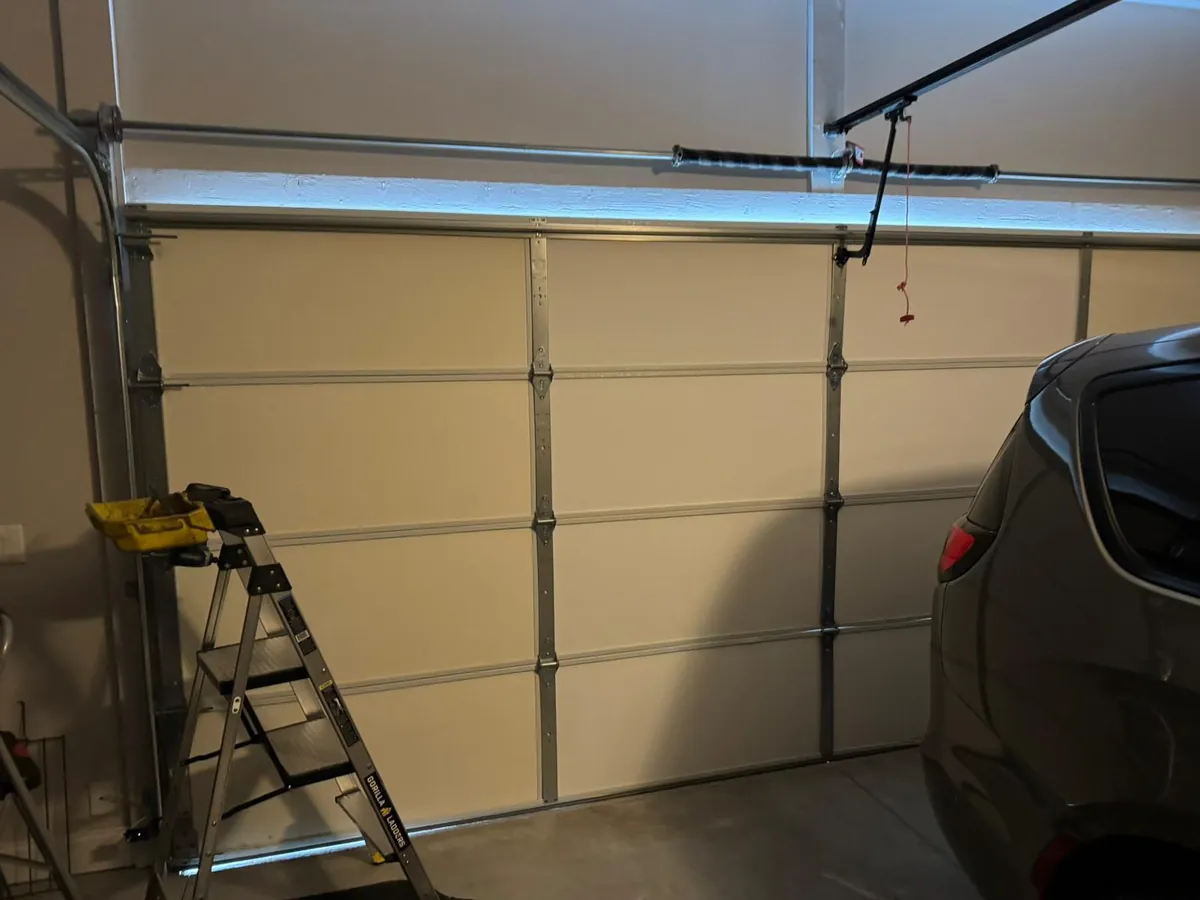
Picture the typical door on one of these garages as four or five horizontal slabs hinged together, with a roller poking out from each end of every slab; and those rollers run up a vertical track on each side of the opening and then back along a horizontal track toward the rear wall. The door weighs far more than it seems to when it glides up, because the springs are doing almost all of the lifting.
On many doors from the fifties and sixties, the lift comes from a pair of extension springs. Each one sits above a horizontal track, fixed to the back hanger at one end and connected through a pulley to a cable at the other. Lowering the door stretches the pair and banks energy in the coils; raising it lets them shorten again, hauling on the cables that lift the bottom rail. Other doors, especially ones that have been replaced or upgraded over the years, rely on a torsion coil threaded over a bar spanning the header, with drums at the bar’s two ends taking up cable as it rotates.
Either way, the system relies on balance. The springs are meant to carry the door so evenly that a gentle push lifts it, and it hovers wherever you leave it. When that balance is lost through a broken spring, a stretched cable or a section that has soaked up water, every other part begins to work harder, and the opener most of all.
What fails first on doors of this age
The single-car doors behind Everett homes tend to wear in a familiar order. Knowing it helps you describe the problem when you call, and it helps us bring the right parts.
Rollers. Old rollers with plain steel wheels flatten and wobble. They begin to grind, then catch in the track, and the door shudders as it rises. Replacing a full set is one of the most common jobs on a door of this vintage.
Springs. Every spring is rated for a limited number of cycles. A door that has been opened twice a day for years has used up a great many of them, and cold mornings make tired steel more likely to snap.
Cables. Cables rust at the bottom brackets where water collects, and individual strands begin to break. A cable with broken strands looks fuzzy along its length; once enough strands go, the whole cable lets go.
Hinges and fasteners. The screws that hold hinges and track brackets were often driven into wood that has dried and shrunk since. They loosen, the door flexes as it moves, and gaps appear between sections.
The bottom section. The lowest panel sits in the wet. On steel doors it rusts from the inside out; on wood doors it softens and rots, and either one adds weight the springs were never set up to carry.
Detached garages and the faults that hide in them
A garage attached to a house gets noticed. Its door is heard from the kitchen, and anyone who uses it walks past the opener every day. A garage standing apart, back past the length of a driveway, is another matter. The door may only be opened in the morning and evening, often in the dark, and nobody stands inside long enough to notice that one cable is fraying or that a track bracket has started to pull away.
That is why so many garage door repair calls from these streets describe a sudden failure that turns out to have been building for months. A roller that has been catching for weeks finally jumps the track. A spring that has been stretched and weak for a season finally breaks. The best habit for a detached garage is a short look every few weeks: watch the door travel all the way up and down, listen for scraping or banging, and glance at both cables and both springs.
Detached garages also tend to be colder and damper than attached ones, since there is no heated wall alongside. Damp speeds up rust on springs, cables and the bottom brackets, and winter cold stiffens old grease on hinges and rollers so the door moves reluctantly on the first frosty mornings.
What you can do while you wait, and what you should not
While waiting for us, these are reasonable:
- Door stalled mid-travel? Unplug the motor head so nobody’s thumb on a remote can restart it.
- Check that nothing is blocking the photo eyes, and wipe the lenses with a dry cloth.
- Fit a fresh cell to the remote; should the wall button still run the door, blame the remote, not the motor.
- Clear anything leaning against the tracks or the door.
The rest belongs to a technician. Every torsion spring holds dangerous tension the whole time the door is down, and that load runs straight through the cables into the bottom brackets. Extension springs carry serious force too, and an old one without a safety cable running through it can whip across the garage if it breaks. Loosening a bracket, turning a set screw or trying to wind or stretch a spring can release that energy instantly. Not a DIY repair, whatever an online clip suggests.
What happens when we arrive
Garage door repair in Everett usually starts with an easy arrival. Because most of these houses have a real driveway, the van can usually park close to the garage, and you can leave your car off to one side while the work is done. That makes the visit simpler than it is in a tight city alley.
- Opener unhooked, we raise the door manually, which shows straight away whether its springs still share the load.
- Springs, cables, drums and pulleys are inspected, along with the bottom brackets where rust often starts.
- Rollers and hinges get looked at one by one, and we sight down each rail for kinks, gaps and brackets that wobble.
- Where the opener is part of the trouble, we run it unattached and test the photo eyes.
- Before a tool comes out, you get the findings and the plan in plain words.
Once the parts are in, we rebalance the door, retune the opener’s limits so it suits the lighter or heavier door it now moves, and lay something across the threshold to prove the door reverses on contact.
Repairing the door against replacing it
Much of the garage door repair in Everett that we carry out is on doors well worth keeping. New springs, new cables, a set of rollers or one replacement section will keep a sound door working well for a long time. The sums change once three or four components are going at the same time, once rust or rot has eaten the lowest panel, once cracks spread across several sections, or once an old timber door, swollen after years of rain, weighs more than any sensible spring could carry.
There is also the question of the opening. A single-car garage from the fifties may have an opening that has shifted over time, and a door that has been forced to fit it for decades may be twisted. In that situation a new door, set square in a corrected frame, can be the better answer. You get a straight answer about which camp your door falls into. When a new one is the right call, the process is laid out on the new garage doors page.
Two-families and a garage that serves more than one household
On a two-family house, the detached garage is sometimes shared between the units, or one unit uses it while the other parks in the driveway. A shared garage means more cycles on the door, more remotes in circulation and more people pulling on it by hand when the opener plays up. Each of those adds wear.
When a door serves two households, a repair visit pays extra attention to the parts that wear fastest with use: rollers, hinges, the opener’s drive and the springs. If the remotes for both units need to be reprogrammed after an opener repair, that is done at the same time, so nobody is left without a way into the garage.
Snow, ice and the bottom of the door
A driveway is an asset, but in winter it also means a plough ridge or a shovelled bank of snow sitting right against the garage door. Meltwater runs under the bottom seal during the day and freezes overnight, and by morning the door can be stuck fast to the concrete. Pressing the opener button again and again at that point does real harm: the opener strains, the top section bows, and the bottom seal tears away from its retainer.
When ice has glued the door down, cut the opener’s power and chip away the snow and ice along the bottom edge before trying again. A worn or split bottom seal lets more water in, so replacing it is often part of a winter visit, along with the rusted bottom brackets that same water tends to leave behind.
A door hanging out of its rails
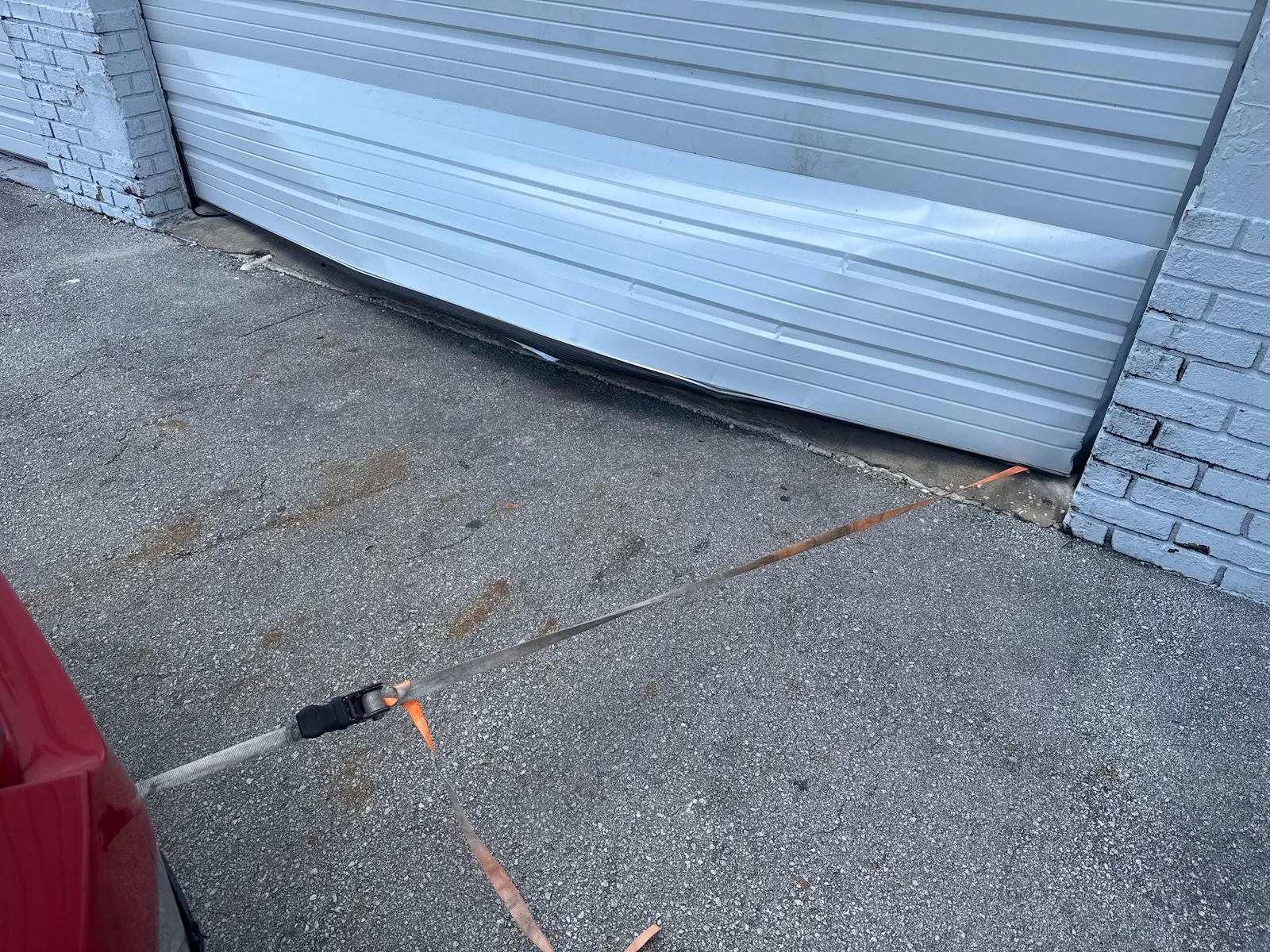
A derailed door is one of the more alarming things to find in a garage. It hangs crooked, one or more rollers sit outside the rail, and the door may be jammed halfway. Common causes: a bumper nudging the door, one cable letting go, or an opener still driving after the door had jammed.
Leave a door in that state exactly as it is. It is unstable, and running it with the opener or pushing it by hand can bring it down. We clamp the door, unload its weight from the rails, straighten or swap the kinked track, seat the rollers again and match the two cables to one another before the door makes a single trip. The off-track repair page covers it at more length.
Choosing who comes out
Your neighbours on the next street may have the same garage and the same door, and the repairs we carry out on one tend to look like the repairs on the next. Garage door repair in Everett, as we approach it, is built around the doors this housing stock actually has: older single-car sectional doors, extension springs and torsion conversions, detached garages with their own driveways, and openers fitted to doors that were first designed to be lifted by hand. Our wider garage door repair page sets out everything handled across Greater Boston, and the Everett area page gathers the local services together.
Getting a door booked in
A door picks its own moment to quit, so calls are taken at any hour, Sundays and holidays too. If your door has stopped, is hanging crooked or will not close, call us or book online to arrange garage door repair in Everett. Describe the symptoms, anything visibly broken from where you stand on the driveway, and whether the car is stuck behind the door. A garage that cannot be shut for the night is covered on the urgent repairs page for Everett, along with sensible steps until we get there.
Questions from Everett
My garage is detached and the opener has stopped. Is it the power?
It can be. A detached garage usually runs off a separate feed from the house, so a tripped breaker or an outlet that has died will stop the opener entirely, with no light and no sound. If the opener light comes on but the door does not move, the fault is more likely in the door or the opener itself.
The door goes up fine but slams down the last foot. Why?
A door that drops hard at the end of its travel is usually short of spring force. On older single-car doors with extension springs, one spring may have stretched more than the other or be close to breaking. Leave the door shut and unused until someone has checked it.
Can one rusted panel be swapped on an older door?
Occasionally. Everything hinges on finding a section that still matches the door’s height, width and pattern. Where none exists, or the remaining panels are tired as well, a whole new door tends to make more sense.
A cable looks frayed. Can I keep using the door?
Best not. A cable with broken strands can fail without warning, leaving the door supported on one side only. Close the door if it is safe to do so, leave it closed, and arrange a repair.
Do you work on doors that were originally hung without an opener?
Yes. Many doors on garages of this age were first operated by hand and had an opener added later. Those doors sometimes need a reinforcing strut on the top section to cope with the opener’s pull, and that is checked during the visit.