
Small garages, short driveways and air that tastes of salt
Off Broadway, and in the streets that sit back from the beach, most houses are two-families or single-families with a modest garage tucked beside or behind them. Driveways are short, often just long enough for one car, and the garage itself is small. What sets these garages apart from ones a few miles inland is the air. Salt carried in off the ocean settles on springs, cables, hinges, rollers and track, and it is the single biggest reason the garage doors Revere MA homeowners rely on wear out the way they do.
Corrosion is slow and quiet. Nobody hears rust forming on a spring coil or inside a cable strand. The first sign is often a part that fails earlier than it should, or a door that has grown stiff and noisy over a winter without anyone noticing the change.
Most of the faults we find on these doors come back to salt in one way or another:
- Springs and cables weakened by rust until they snap.
- Rollers, hinges and bearings that seize or grind as corrosion builds up inside them.
- Bottom fixtures, brackets and fasteners that rust through and let go of the door.
Garage doors Revere MA owners bring to us
There is a page for each of our main services here. A door that sticks, scrapes or stops partway is covered by garage door repair in Revere. A door that suddenly weighs far too much after a coil has parted goes to Revere spring repair. If the opener buzzes without result, quits midway, turns the door around or shrugs off its remote, see Revere opener repair and replacement. A failure in the small hours, with the car trapped or the garage standing open, belongs with emergency garage door repair in Revere.
The coast-side neighbours Chelsea and Winthrop are on our patch too, as the service areas page shows.
How sea air gets into a garage door
A garage door is mostly steel. The panels are usually painted or coated steel, and so are the track, the springs, the cables, the hinges and the brackets. Paint and galvanising hold off rust for a long time on a flat panel face, but the working parts are a different story. Every time the door moves, rollers turn, hinges flex and cables wind over their drums. That movement wears away any protective coating at exactly the places where salt can then get in.
Moist, salty air finds its way into the garage every time the door is open, and a small garage with the door often up fills with it. On damp nights it condenses on cold metal. As it dries, it leaves salt behind, and the next damp spell turns that salt back into a film that eats at the steel. Near the coast that cycle repeats over and over through the year.
The result is a door that ages faster than its inland twin. A coil that could have run for years in a dry inland garage gives out early once rust has pitted its surface. A cable that looks fine from a distance turns out, close up, to have rusty broken strands near the bottom bracket. Hinge pins seize, so the sections stop flexing smoothly and the door shudders on the curve of the track.
Springs eaten from the outside in
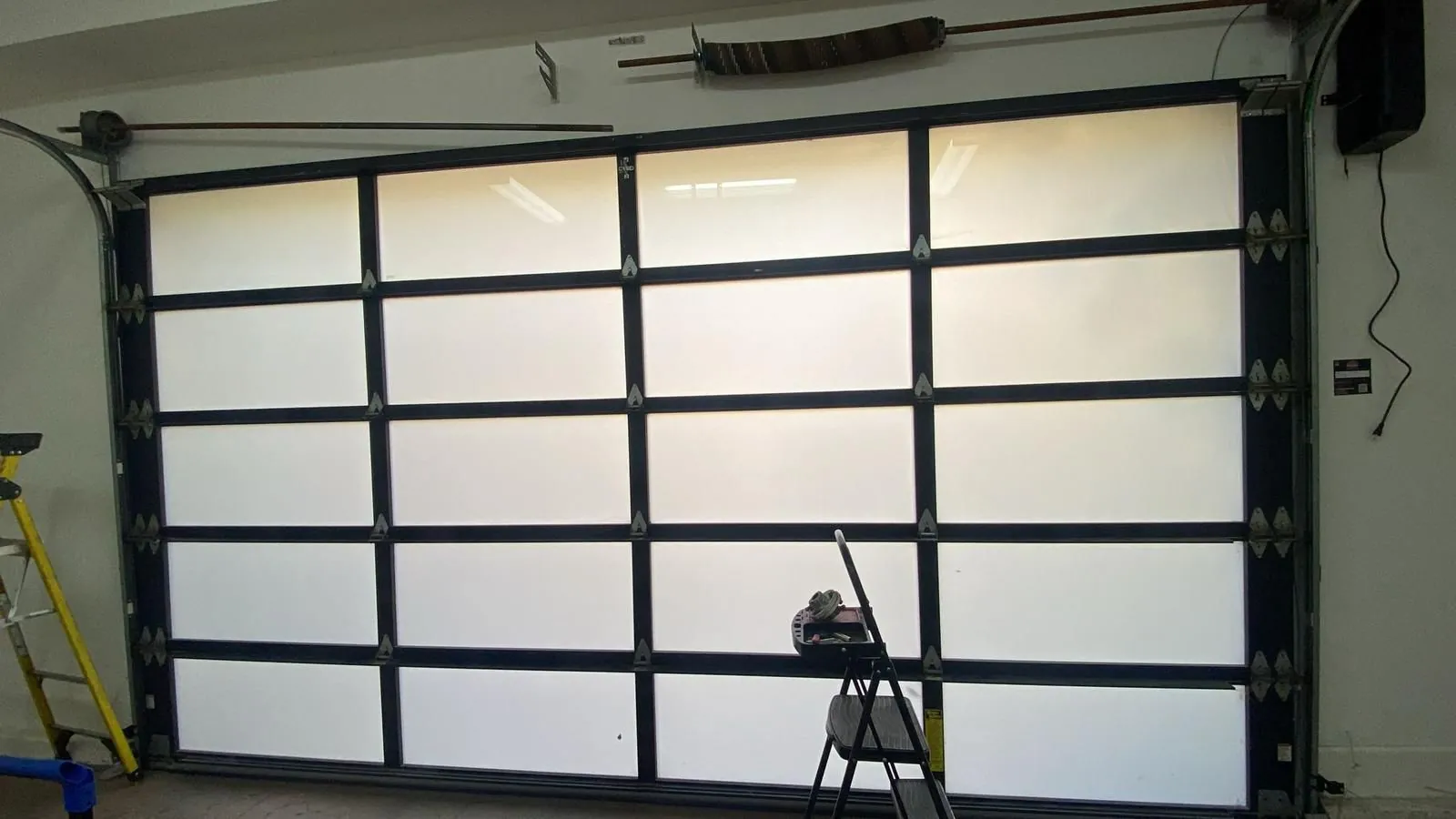
Springs are where corrosion does its most dangerous work. On most doors a torsion spring is wound around the shaft over the opening, coiled tight to offset the door’s weight. Rust pits the surface of the coil, and each pit is a weak point where a crack can start. Eventually the coil gives way, usually with a sharp crack that people describe as like a gunshot.
Torsion springs store dangerous tension, and swapping one is no DIY job, whatever a video may suggest. The spring, the cones at each end and the bar stay loaded until someone with the right winding bars lets the tension off in a controlled way. Suspect a broken spring? Keep the door down, disconnect the opener at its outlet, and keep clear of the door’s path.
Some smaller garages here still run on extension springs, the long ones that stretch beside each horizontal track. They rust just as readily, and each one should have a restraint cable threaded down its centre so that a snapped one stays contained instead of lashing about. Any pair we renew without those cables gets them fitted. Either kind of spring is normally replaced as a pair, since salt has been working on both.
Openers in a damp, salty garage
Openers are electrical, and salt air is no friend to electrics. A small garage close to the water can leave an opener’s circuit board, its terminals and the wiring to the sensors and wall button exposed to damp. Terminals corrode, connections loosen, and faults come and go with the weather. A door that works on a dry afternoon and refuses on a foggy morning is often an electrical problem of exactly this kind.
The safety sensors are the most exposed part of the system. Mounted just above the slab at each jamb, they are the first thing blown rain or tracked-in water reaches. Their lenses film over, their brackets rust and bend, and their wiring corrodes at the terminals. When a sensor stops seeing its partner, the opener refuses to close the door or sends it back up.
We repair openers, wall buttons, keypads and sensors, rewire corroded connections and replace openers when they are past it, including LiftMaster openers. When a new opener goes into a garage near the coast, we think about where its wiring runs and how the sensors are mounted so they stay clear of standing water.
Cables, rollers and hinges
Lift cables are made of many fine steel strands twisted together, which gives salt plenty of surface to work on. Rust tends to begin low down, at the loop that ties each cable to the door’s foot bracket, a spot where water and grit settle. A cable can lose strand after strand there without looking very different from a few feet away. When it finally parts, that side sinks and the door is left skewed in its frame.
A crooked door is a stop sign. Leave it alone: the remaining cable and spring are holding a load meant for two. With the tension safely bled off, both cables are renewed together, the drums are inspected for pitting, and the door is tested until it rises level. More on that work is on our cable repair page.
Rollers and hinges seize in the same air. A roller with a rusted bearing stops turning and skids along the track, grinding as it goes. A hinge with a rusted pin stops flexing, and the door judders over the curve at the top. Enough of that and a roller can be forced right out of the rail. Doors that have jumped their track are covered on our off-track door repair page.
When the door picks a bad moment
Corroded parts tend to fail with no warning, and they do not wait for office hours. A spring snaps at night, or a cable goes on a Sunday with the car shut inside. We take calls at any hour, on any day, so there is always a person on the end of the phone.
Tell us the door’s position and whether a car is stuck behind it, and we will go over the safe next steps with you. Usually that means leaving the door alone and pulling the opener’s plug; if the garage opens into the house, it may also mean locking the inside door until the repair is done. We will not give you an arrival time we cannot stand behind.
Signs the salt is winning
Corrosion gives fair warning to anyone who looks. These are the signs worth acting on before a part fails:
- Orange or brown streaks running down from the hinges and the bottom brackets.
- Rollers that squeal, wobble on their stems or skid instead of turning.
- A spring coil with a rough, pitted surface or flakes of rust on the floor under it.
- Loose or broken strands sticking out of a lift cable near the bottom of the door.
- Bubbling paint along the bottom edge of the lowest section.
None of these needs a panic call in the middle of the night, but each is a reason to book a visit before the part concerned lets go. A rusty spring or a fraying cable is far easier to replace on a calm afternoon than after it has snapped and jammed the door with the car inside.
Short driveways and working in a small garage
Short driveways make access easy in one sense: the garage is close to the street, and parts do not have to be carried far. They also mean the car often sits right up against the door, sometimes inside the garage with very little room to spare. Nothing should be within reach of a door under repair, so please shift any vehicles before work begins.
Inside, a small garage leaves little room to stand beside a ladder, set out a new spring or lay a track section down. Shelves, bikes and storage along the walls often sit right where a technician needs to reach the track brackets or the spring bar. Pull those things back from the door’s edges and from beneath the opener head before the visit, and the work goes more safely.
Headroom can be tight too. A small garage with a low ceiling restricts the spring arrangement and the opener choice. When we replace parts in a garage like this, we choose them for the space the building actually has.
Two-families and a door used by two households
Many of the two-families here share one small garage between the units, or split a pair of single doors between them. Either way, the door moves more often than it would for one household, and each extra cycle is one more pass of salty air over freshly exposed metal. A roller that turns a few more times a day wears its bearing faster; a hinge that flexes more often opens its pin to rust sooner.
Shared use also blurs who notices what. One household hears a new squeal and assumes the other has mentioned it. A useful rule for a shared garage is that whoever hears or sees something new mentions it that evening.
Remotes multiply on a shared door, too. When a tenant leaves, the opener still remembers their handset. We clear the opener’s stored codes and re-learn only the remotes still in use, so a handset that has left the building stops working.
Panels, paint and the bottom edge
Panels are usually the last part of a door to give in to the air, but the bottom section is the exception. It sits closest to puddles, snowmelt and grit, and its lower edge and the retainer that holds the weatherseal are often the first places rust breaks through the paint. Once the retainer corrodes, the seal falls out and water runs in under the door.
A new seal and retainer is a modest job and well worth doing. Small scratches and chips in the paint elsewhere are worth touching up before winter, since bare steel near the coast does not stay bare for long. For garage doors Revere MA owners want to keep going, those small jobs buy time.
What we do when we arrive
- A careful look at the door as found, and a few questions about how it stopped.
- Salt-weakened springs are de-tensioned and the opener unhooked before any tool touches the door.
- We show you what the salt has done, explain the options and wait for your go-ahead.
On a door near the coast, we look beyond the part that failed. If one spring has rusted through, we check the other spring, the cables, the rollers, the hinges and the bottom fixture too, because they have all lived in the same air. You decide what gets done; we make sure you know what we saw.
Repair, or a door that will stand up to the air?
Plenty of corroded doors can be put right with new springs, cables, rollers and hinges. If the panels are sound and the door is the size and style you want, a repair is usually the sensible answer.
When the panels themselves are rusting through, the bottom section has corroded along its edge, or the door needs one salt-damaged part after another, a replacement is often money better spent. Our new garage door installation service covers that, and for a house this close to the sea we will talk through how the new door’s finish and hardware will stand up to the conditions. For garage doors Revere MA houses carry this near the coast, that conversation matters as much as the choice of style.
Habits that slow the salt down
Owners can do a few things to help a door live longer here. Rinse the bottom section and the lower part of the tracks with fresh water now and then, especially after winter, when road salt from the cars adds to the sea salt. Let the garage air out on dry days rather than keeping the door shut on a damp interior.
Every few weeks, stand by and see the door complete an up-and-down run. It should move smoothly and evenly, without a lean, a judder or a grinding noise. Check the cables close to the foot brackets for rusty or broken strands, from a safe distance and without touching them. With the opener released, raise the door a short way yourself. Extra weight compared with what you remember means the springs are losing strength. Do not try to adjust them; mention what you noticed when you call.
Book a visit
If your door is grinding, sticking, hanging crooked or simply refusing to move, let us know what you are seeing and whether the car can be moved clear. For garage doors in Revere, a person answers whenever you ring. From Broadway or the beach streets, call us or book online.
Questions from Revere
Why do parts on our garage door rust so quickly?
Salt in the air. It settles on the springs, cables, hinges and rollers and draws in moisture on damp days. Moving parts lose their coating fastest, so they corrode first, which is why these doors often need parts sooner than ones further inland.
Our door works on dry days but not when it is foggy. What is wrong?
Often a corroded connection in the opener wiring or at the safety sensors. Moisture tips a marginal connection into failure, and the opener then balks at closing or turns the door back. The wiring and terminals can be cleaned up or replaced.
There are rusty, broken strands on one of the cables. Is the door safe to use?
No. A cable losing strands can snap without warning and drop one side of the door. Stop using it, keep the car and people clear and get both cables replaced.
Is it worth fixing an old door that has started to rust?
If the rust is in the springs, cables and hardware and the panels are sound, yes, a repair is usually sensible. Once the sections themselves are rusting out, replacing the door usually makes more sense. We will tell you which we think it is.
Can a broken spring wait until the morning?
Yes, as long as nobody tries to open the door. Keep it closed and cut the opener’s power. A trapped car or a garage left gaping open is reason enough to ring straight away, whatever the time.