
Motors, rails and sensors in salty, damp air
An opener is the one piece of a garage door that combines moving steel with circuit boards and wiring, and out on this peninsula, ringed by salt water, both halves of it suffer. The chain or screw on the rail, the trolley and the hangers that tie the unit to the ceiling all corrode, while moisture creeps into the terminals, the wall station and the slim wires that run down to the sensors. Our garage door opener repair in Winthrop, MA covers every one of those pieces on the garages that sit between Winthrop’s tightly spaced single- and two-family homes: openers repaired, openers replaced and installed, plus handsets, wall stations and the safety eyes.
Three things you can note from the floor before you phone:
- Does the bulb or light on the motor head come on when the button is pressed?
- Are the small lamps on the two floor-level sensors steady, flashing or out?
- Does the motor hum, click, or make no sound whatsoever?
Opener faults we deal with
A humming motor and a motionless door
Commonly a worn-out gear inside the head, a trolley locked on its rail, or panels so badly balanced the motor cannot budge them. A snapped spring produces the same symptom.
A door that bounces back up
Mostly the sensors: a misted or salt-coated lens, an eye pushed off its aim, or green, corroded wire ends. Occasionally the closing force needs resetting for a stiffer door.
Handsets that have gone quiet
Spent batteries, a handset that has dropped its pairing, or a receiver aerial that is bent or tucked out of sight. Short driveways put the car close to the door, which hides range problems until they are bad.
A lifeless wall station
Corroded contacts at the wall or on the back of the head, a wire nicked by a staple, or a worn-out switch. Damp garages are hard on these small contacts.
Rattles, slaps and judders
A loose or rusted chain, a dry rail, slack hangers or a tired trolley. Between close-set houses the sound carries indoors and next door.
A new opener
When a unit is worn out or lacks modern safety features, a replacement is supplied, installed and tuned to the door. LiftMaster openers are repaired and replaced too.
Who does the lifting: springs or motor?
People are often surprised to learn that the motor is not what raises the weight. The springs carry it. With good springs, a grown adult can raise the panels by hand without real strain, and all the opener has to do is steer that already-weightless door along its rails, halt at the right points top and bottom, and back off if something is in the path.
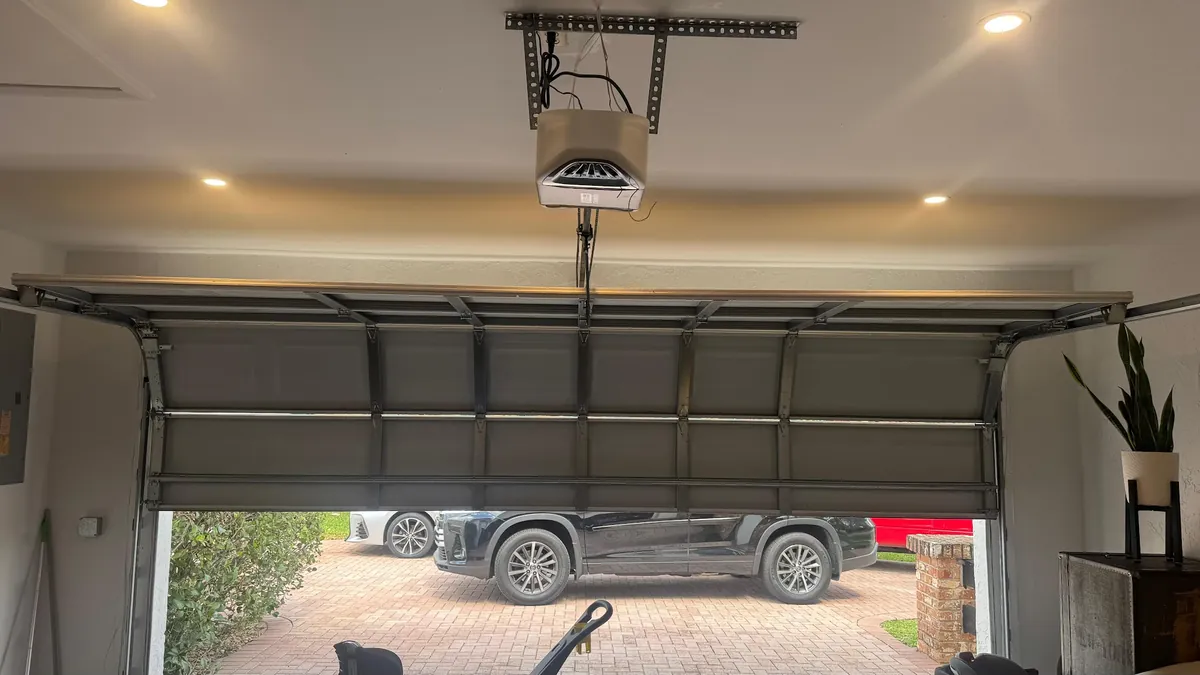
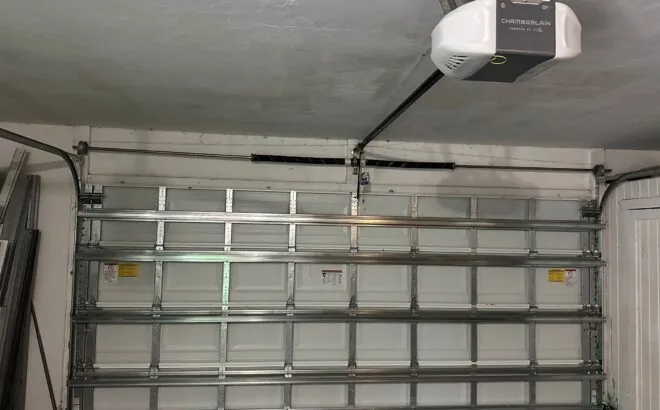
The usual home layout has a motor housed in a head unit hung from the ceiling, with a long rail reaching forward to the header above the opening. A carriage, often called the trolley, slides along that rail, pulled by a chain, a rubber belt or a long threaded rod, and a bent arm joins the carriage to the top panel. Hanging from the carriage is a red cord; a tug on it unhooks the panels from the motor so you can work them manually.
Some garages use a jackshaft opener instead, a compact motor fixed to the wall at one side of the opening that spins the spring shaft itself. Because the ceiling stays clear, this type suits a garage where headroom is tight or where the ceiling is needed for storage.
On top of the motor, modern home openers carry three layers of protection. The floor-level eyes watch the opening while the door descends and send it back up if anything breaks their beam. A force limit sends the panels upward if they meet unexpected resistance. Travel limits set the exact stopping points. A fault in any of these makes the door behave badly even with a perfectly healthy motor.
Garage door opener repair in Winthrop, MA and corrosion
Salt hangs in the air around the peninsula through every season, and an opener and its accessories contain a lot of metal that reacts to it. The damage tends to collect in three places.
The drive. A steel chain picks up a bloom of rust, its links stiffen, and it stretches unevenly along its length. It then flaps against the rail, the carriage lurches, and the panels move in jerks. Threaded-rod drives build up a gritty crust along the thread and begin to groan. Belts shrug off rust better, though the sprockets and the carriage are still steel.
The wiring. Screw terminals on the back of the head, behind the wall station and on each eye are tiny and exposed. Salt and condensation leave white or green deposits on them, and the connection turns intermittent. A door that behaves in dry weather but acts up after a muggy night usually has a corroded contact somewhere along that circuit.
The eyes. Sitting just above the slab, they live in the dampest, chilliest corner of the garage. Their lenses mist up, salt dulls them, and their thin steel brackets rust and sag until the eye points at the concrete rather than its partner.
On the peninsula, a good deal of opener work comes down to cleaning, reconnecting and re-aiming those parts, and replacing whichever ones the salt has beaten.
Short driveways and remote range
Many homes here have short driveways, and the garage door often sits only a few steps from the pavement. That suits daily life, yet it shapes how an opener and its handsets are used.
Cars tend to stop close to the panels, sometimes nose-in, so the door needs to respond the instant it is asked, and the floor-level eyes need placing where a parked bumper will not sit in the beam. An eye on a protruding bracket can be clipped by a bumper and nudged off its aim, and that is among the most common reasons a door abruptly stops agreeing to close.
Range is the other concern. A handset that responds only when it is almost touching the panels may simply need a battery, but it can also point to an aerial that is snapped, coiled or tucked behind a light cover, or a receiver on its way out. With houses packed closely, nearby wireless gadgets can add interference as well. Each of those is checked on a visit, and an outside keypad beside the garage can be fitted where that makes more sense than a handset.
What happens on an opener visit
Garage door opener repair in Winthrop begins with the panels, not the motor head. The red cord is pulled and the technician works the panels by hand to judge how they hang. Panels that feel leaden, catch, or slide down when released have a spring or track fault, and no opener will run well until that is corrected. If a spring has snapped, our spring repair page for Winthrop explains what follows.
Once the door itself checks out, attention moves to the motor. Power to the head is confirmed and any fault code on its light or display is read. The drive comes next: chain slack and rust, belt cracking, the condition of a threaded rod, the carriage and the arm. The rail and its ceiling hangers are inspected for corrosion and play.
Then the controls. The wall station is tried and its wire followed back to the head. Each handset is tested for battery, pairing and reach. The eyes are cleaned, re-aimed and proven by passing an object through the beam while the panels descend. Force and travel are adjusted so the door lands gently on the slab, stops cleanly at the top and reverses when it ought to.
Nothing extra is fitted until you have heard what was wrong, what has been done, and which parts are close to the end of their working life.
Safety sensors deserve their own attention
Those two small eyes are what stop a descending door from landing on a toddler, a dog, a bicycle or a car bonnet. They are also blamed more than any other part when a door refuses to shut, and on the peninsula they lead a harder life than most.
A few checks are perfectly safe to make on your own:
- Look at the small lamp on each eye. On most openers one glows steadily all the time and the other lights once it sees the beam; flashing or darkness suggests poor aim or a wiring fault.
- Clean both lenses gently with something soft and dry.
- Clear the path between them of mats, bags, boots or brooms.
- Make sure neither eye has been bumped so it now faces the slab or the wall.
If none of that helps, suspect corroded wiring, a loose bracket or a failed eye. Never bypass the sensors, tape them or jumper the terminals to force the door shut. Doing so leaves the door blind to whatever is under it.
When to repair and when to replace an opener
Plenty of openers are worth fixing. A worn gear, a tired carriage, a stretched chain, a failed control board, a dead wall station, a lost handset and a pair of sagging or damaged eyes are all parts that can be swapped on their own.
Replacing the whole unit becomes the sensible route when:
- The opener predates the safety reverse and floor-level eyes that every home unit should now have.
- Salt has got into the motor housing, the rail and the board all at once.
- Spares for that model can no longer be found.
- The unit has had repeated repairs and still keeps failing.
- A different type would serve the garage better, such as a jackshaft unit where headroom is scarce or a belt drive where a bedroom shares the garage wall.
When a new opener is the better answer, it is supplied, fitted and tuned to the door, and the old head and rail are taken away. Both choices are laid out plainly so the decision is yours.
Outages and the red cord
During an outage, an opener without a battery backup simply stops, and a car can be left on the wrong side of the door. The red release cord exists for exactly this. Pull it with the door fully closed, and the panels can then be raised by hand, provided the springs are sound. Panels that feel leaden or slide back down mean a spring has failed, and they belong on the floor until it is replaced.
Do not pull the release with the door partly or fully open unless someone is holding it, because a door with weak springs can drop the moment it is unhooked. Once power returns, run the opener and the carriage will usually reconnect itself as it travels; if it does not, the release mechanism may need attention.
In a garage with no side door, the release cord is the only way in or out during an outage. Where a garage has no other entrance, an outside release, fitted to the door and opened with a key, gives a way to unhook the opener from the driveway. On the peninsula, its lock and cable need the same protection from salt as every other part.
Quieter openers for close-set houses
Where homes sit close together, a garage can back onto a neighbour’s lounge or sit beneath a bedroom. A clattering chain, a groaning threaded rod or panels that thump at the end of travel are heard well beyond the garage walls.
There are several ways to bring the sound down. Taking up slack in a chain and lubricating it, swapping worn rollers on the door, and resetting the travel so the panels settle softly all help a great deal. When the motor head is the culprit, a belt drive usually runs more quietly than a chain, and a jackshaft unit takes the rail off the ceiling altogether. Rubber isolators on the ceiling hangers keep vibration from travelling into the joists.
Remotes, keypads and lost handsets
Handsets go missing, get dropped in puddles or are left in a car that has been sold. When that happens, the opener’s memory should be cleared and every remaining handset paired again, so a lost one can no longer open the garage. That is a quick job on most openers and worth doing whenever a handset disappears.
Outside keypads are handy for anyone who walks or cycles home, and on short driveways where the door is a few steps from the pavement they are easy to reach. On the peninsula they take the full force of salt spray, so a keypad is best mounted under some shelter where possible, and its battery and seal checked from time to time. A keypad whose buttons have begun to stick or whose display has faded has usually let damp in, and replacing it costs less trouble than living with a door that opens only on the third try.
Looking after an opener between visits
Some simple routines help an opener cope with sea air:
- Every month or so, lay a rolled towel on the slab under the door and close it; the panels should touch the towel and climb back up.
- Wipe the sensor lenses whenever you sweep out the garage.
- Give a chain drive a light coat of lubricant a few times a year and keep the rail clean; belt drives can be left alone.
- Change handset batteries before they die completely.
- If the door starts to move slower or louder than usual, get it checked before a small fault turns into a car trapped inside.
Never raise the force setting to make a stubborn door close. A door that needs more force has a mechanical fault the extra force will only hide, and a higher setting makes the safety reverse slower to react.
Other services in Winthrop
An opener fault is often a symptom of a bigger problem with the door itself. For springs, cables, tracks, rollers and panels, see our garage door repair page for this town. If the door is jammed open or shut and cannot wait until morning, see our page on urgent repairs in Winthrop. For the full range of opener work across Greater Boston, our opener repair and replacement page has the detail, and the Winthrop town page gathers every local service together.
Book garage door opener repair in Winthrop
Motor humming with no movement, panels reversing out of nowhere, a handset that has quit: tell us what happens when the button is pressed and what the little sensor lamps are doing, and the right parts can travel with the technician. For garage door opener repair in Winthrop, MA, the next move is simple: call us or book online.
Questions from Winthrop
The door goes up fine but refuses to come down. Why?
Most often the culprit is the pair of eyes by the floor. Damp mist or a salt film on a lens, an eye nudged off line by a bin or bumper, or corroded wiring will all hold the door open. Clean the lenses and look at the sensor lamps; if that changes nothing, the wiring or one of the eyes may need replacing.
What does it mean when the motor runs but the panels stay put?
The motor is turning but its effort is not reaching the door. A worn gear inside the head, a carriage jammed on the rail, or the red release cord having been pulled are the usual reasons. A broken spring can also leave the door too heavy for the motor. Stop pressing the button, because the motor can overheat.
Can a LiftMaster unit be fixed here?
It can. LiftMaster heads are repaired and replaced on the peninsula, handsets, wall stations and eyes included.
Does the sea air really affect an opener?
It does. Salt attacks the chain or threaded rod, the rail and hangers, and the electrical contacts at the head, the wall station and the eyes. Keeping the lenses clean, the chain lightly oiled and the contacts checked slows that wear.
Should an old opener be repaired or replaced?
Repair is usually worthwhile when one part has failed and the unit still has a working safety reverse and eyes. Without those, or with corrosion right through it, or when it keeps breaking down, a new opener tends to be the better buy, and the visit will tell you which case yours is.