
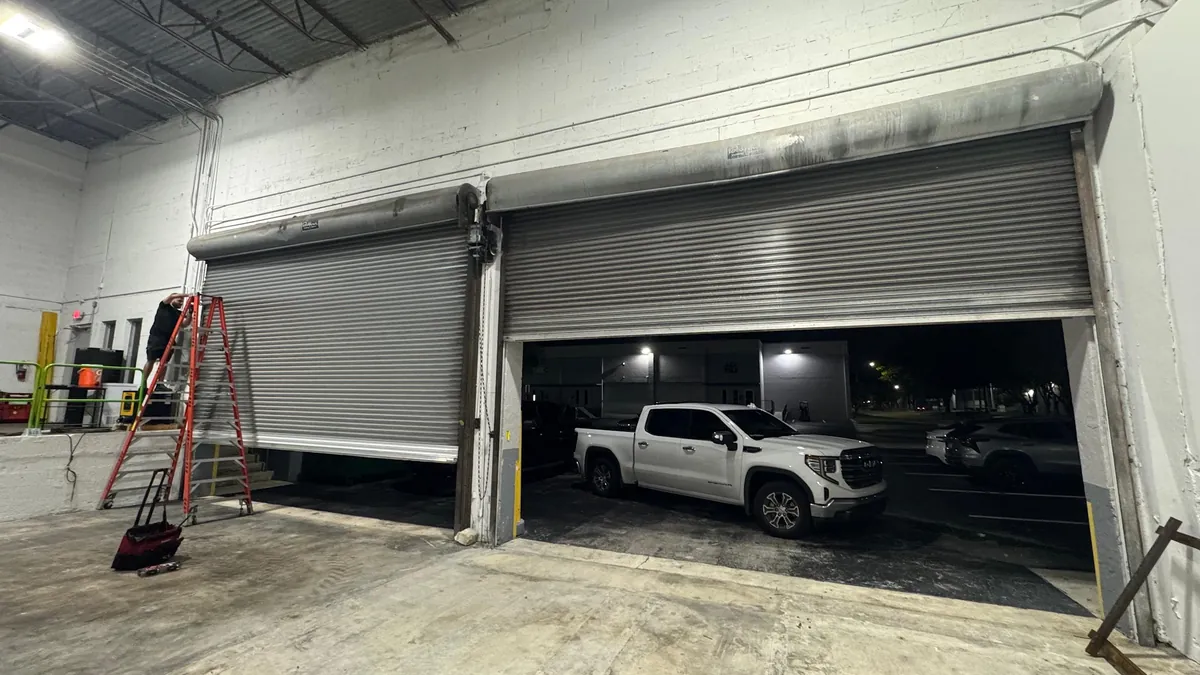
When a back-lot garage door fails after dark
Around Roslindale Village the garage tends to be out of sight. It sits behind a single- or two-family house, reached by a long driveway, and was mostly built in the 1920s or 1930s around a single-car opening. When its door jams, snaps a spring or slips its rails late in the evening, nobody may notice until someone strolls out jangling the car keys. Emergency garage door repair Roslindale MA homeowners call about usually starts like that: a door that will not budge with the car parked behind it, or a door yawning open on a building nobody can see from the kitchen window.
Calls are taken at any hour of every day. What follows is how to read what you are looking at, which parts are harmless to handle in the meantime, and what putting it right will involve.
Before ringing, stand well back and take in three things:
- Where the door has come to rest: shut, raised, or wedged midway with a tilt to it.
- Whether a spring above the door shows a break in its coils, or a cable dangles slack near the floor.
- Whether any roller has escaped its rail, or a length of rail is buckled or torn off the wall.
Breakdowns that cannot wait for morning
Car trapped inside
The door refuses to rise, or creeps up a hand’s width and sinks again. If a spring has gone, muscling it up is not safe.
Garage left gaping open
The door is stuck high, or only travels part of the way down. On a building at the bottom of the garden, that leaves bikes, tools and the car on show all night.
A coil that snapped tonight
A crack like a starting pistol from the garage, and suddenly the door is a dead weight. The Roslindale spring repair page explains why the spring must be left alone.
Rollers out of their rails
The door leans, one side wedged, sometimes with a section bowed outward. A shove can bring it down.
Door hit by a car
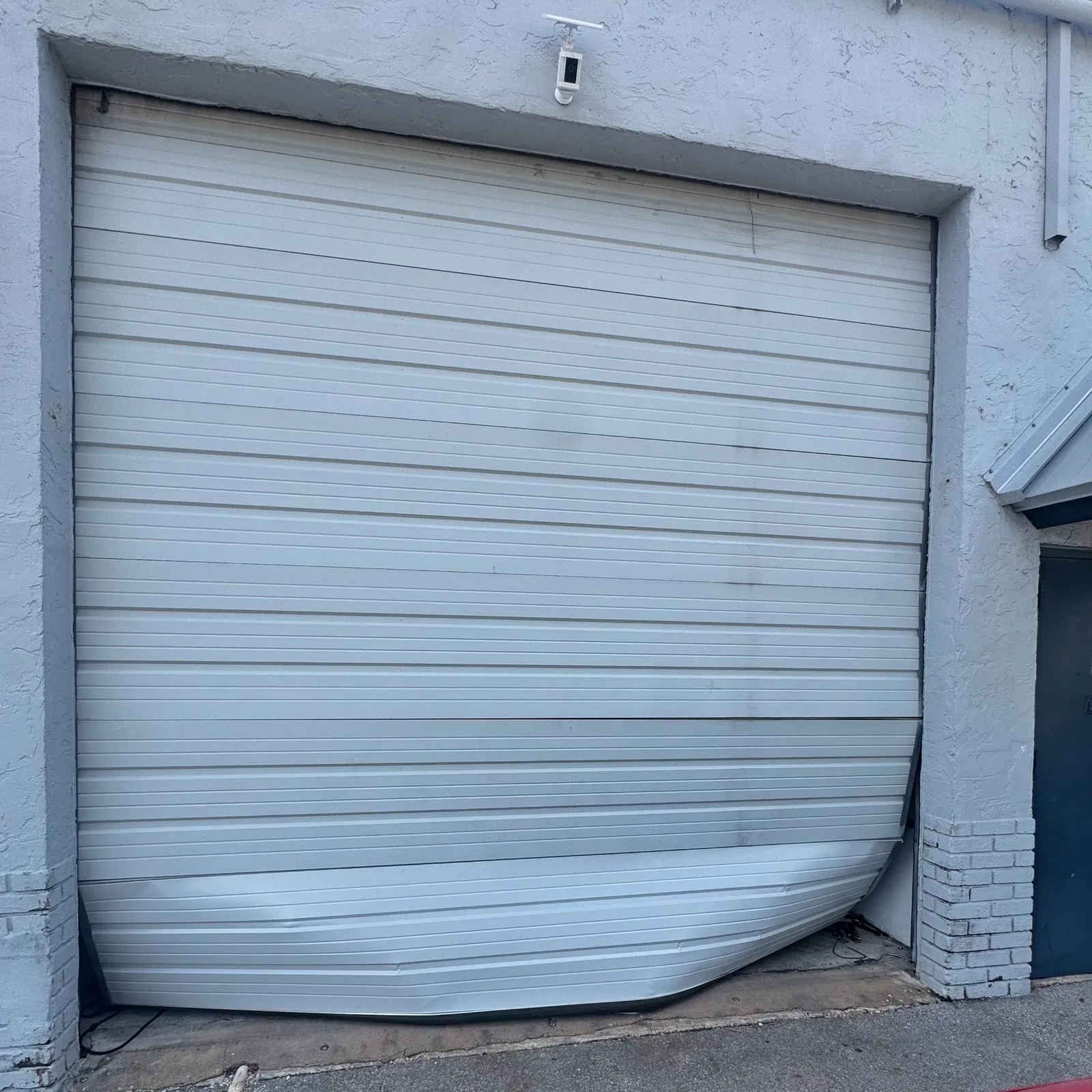
A bumper catches the lowest section while reversing, buckling the panel, kinking the rail or ripping a bracket out of old timber.
Is it really an emergency?
Plenty of faults can sit until a weekday morning. A door that rattles but still opens, closes and backs off when it should can wait. A dead handset, while the button inside still drives the door, can wait. A door that crawls a little on frosty mornings can wait.
Others deserve a call the moment they are found. A door that will not shut exposes the garage and its contents through the night. A door that will not lift with the car inside can stand between someone and an early shift or a hospital visit. A snapped spring, a broken cable or rollers torn from their channels each leave a heavy door poorly held up, and those are exactly the faults most likely to injure someone who tackles them by hand. If you cannot tell which kind you have, describe it on the phone and you will get a straight answer.
Before anything else: keeping everyone safe
Whatever has happened, a handful of steps make things safer at once:
- Take your finger off the button for good, and unplug the opener overhead so nobody else can set it going either.
- Keep youngsters, dogs and vehicles well away from the door, all the more if it is raised or skewed.
- Never walk or stand beneath a door jammed partway up.
- After dark, carry a proper torch down the drive instead of trusting the garage’s single bulb.
And a few things to avoid. Leave a heavy-feeling door alone: once its spring has failed, every pound of it would rest on you. Leave the red release cord untouched on a door stuck high, because once freed the door can drop under its own weight. Keep hands off the spring, the winding cones, the cables and the two lowest brackets where those cables tie on. Every one of them is loaded, and a torsion spring in particular stores enough force to maim someone who disturbs it. None of it is a DIY job, and certainly not by torchlight.
The walk down a dark driveway
Around here the garage is seldom a few steps from the back door. It is more often a long trudge down the drive, past the house and sometimes past a row of parked cars, to a building lit by one bulb on a rafter. When something fails after dark, that trek becomes part of the problem: it is hard to see what has gone wrong, and impossible to watch an open door from the sofa.
That distance shapes what is worth doing while you wait. Light matters most: a bright torch or a phone lamp lets you spot a spring gap or a drooping cable without stepping into the doorway. If the door is stuck high and you cannot stand guard, carrying valuables indoors or locking the garage’s side door helps. If the car is inside, find out whether anyone at home needs it before morning, and mention that on the call.
Tell us too how far the garage sits from the road and whether there is any light out there, so the technician turns up prepared.
Securing a garage nobody can see
A detached garage at the back of a lot is easy to forget once the house door is shut. If the door is jammed open and there is nobody to watch it, think about what is inside: bicycles, power tools, a lawnmower, the car itself. Anything that can be carried indoors is safer there. A side door into the garage, if there is one, should be locked, and a motion light on the house that covers the drive is worth switching on.
Resist any urge to haul the door down or prop it closed with lumber. A door hanging on one cable or held up by a broken spring can come down suddenly and hard. It is better to have an open garage for a few hours than an injury. The door is closed and secured as part of the visit, and if a part has to be fetched, it is never left in a state that is dangerous to anyone walking past.
Old single-car openings under stress
Garages of this vintage were framed around the cars of their day, and most now carry an overhead door fitted long after the walls went up. The opening may be a touch out of square, the jambs may have been packed more than once, and the rail brackets may be screwed into wood that has dried and cracked over the decades. In ordinary use that rarely shows. Under the jolt of a spring breaking or a car strike, it can.
A torsion spring that snaps sends a shudder through the door and every fixing holding it. A bracket on tired timber may tear loose, letting a rail drift and a roller escape. A car clipping a door in a cramped single-car opening often kinks the rail as well as the panel, since there is no slack to either side. That is why emergency garage door repair Roslindale MA garages need rarely stops at one part. The fixings and the framing behind them are checked along with the obvious break, so the door is properly anchored afterwards.
How an emergency call is handled
On the phone, you will be asked how the door is behaving, what is visibly wrong, whether a vehicle is inside, and how the garage is reached. That is enough to judge the likely parts and tools, and to talk you through what to do in the meantime. No arrival time is promised, because that hangs on the hour, the weather and what is already under way; you are kept honestly informed instead. Good emergency garage door repair Roslindale MA households can lean on is about sound advice in the first conversation as much as the work that follows, because the safest thing in many cases is simply to stop, unplug and wait. A few clear questions on the phone can save a sprained back, a crushed bumper or a door brought crashing onto the drive.
On arrival, the first priority is making the door harmless. A door sagging out of its rails is clamped so it cannot drop. A door held high with a snapped spring is braced before anything else is touched. Then the real diagnosis begins: which spring, which cable, which roller, which bracket. You hear what broke and what the fix involves, and the repair goes ahead once you say yes.
Should the full repair need a part that is not on the van, the door is still left safe: shut and secured, or locked open with the car freed, whichever suits you better. The repair is then completed on a return visit once the part is in hand.
A door that will not come down
Doors that refuse to close are usually stopped by the photo eyes, a broken spring, rollers out of their rails, or the opener itself. The eyes are quickest to check: a bin or a bicycle brushing either of those two little lenses near the floor halts the door. If clearing the obstruction and wiping the lenses changes nothing, stop there.
If the door is stuck high because a spring has broken or the rollers have jumped, do not drag it down. With the opener unplugged and the door left alone, the garage is open but nobody is at risk, and that is the right state to wait in. On arrival, the door is propped and clamped, the fault is mended, and the door is lowered and tested before the technician leaves.
A door that will not go up
When a door stays down, a snapped spring is the usual reason. The opener strains against the full weight, gives up after a few inches, and sits there humming. Less often it is the opener itself, a bottom seal frozen to the slab on a January morning, or a slide bolt left across on an older door.
A frozen seal can sometimes be freed by gently chipping the ice along the bottom edge, never by forcing the door with the opener. A slide bolt is easy to check from inside. Past that, if the door feels leaden or the opener stalls, stop and phone. Emergency garage door repair Roslindale MA owners can trust begins with being told plainly whether the door should be touched at all.
Doors pushed out of their rails
A door out of its rails is among the riskiest sights in any garage, because all that holds it is the cables and whichever rollers are still seated. Out at the end of a long drive, the culprits tend to be a car striking the door, a gust catching a door left partly raised, or an opener that ploughed on after the door had stuck.
Do not push the door, press the button, or linger near it. Putting it back means bearing the door’s weight with clamps and props, coaxing the rollers home, straightening or renewing the kinked rail, refixing loose brackets into solid wood, and making sure each cable pulls as hard as the other before the door is powered again. For a closer look at that work, read about off-track garage door repair.
A cable that has let go
A lift cable can snap or unspool from its drum, often in the same instant a spring goes or after the door has hit something. The door then sags at one corner and may jam. The loose cable may still be under load at one end, so it should not be tugged or rewound by hand.
Cables are changed as a left-and-right pair so the door rises level. While they are off, the drums, the corner brackets and the spring get checked too, since a cable seldom fails without its neighbours showing wear.
Two households, one door
Where a two-family house shares one garage, a door failure lands on everyone at once. Two cars may be shut in, or the garage may stand open with both households’ belongings in it. It helps if all the adults know where the opener’s plug is, what a broken spring looks like, and that nobody should force the door. One person placing the call and passing on the news keeps things simple. Agreeing in advance who that person is, and writing the opener’s plug location on a card pinned inside the side door, saves a confused scramble at night when the car keys are already in hand and the door will not move.
Winter weather and a detached garage
The bitterest nights are when springs most often snap and seals most often freeze to the floor. A drift banked against the door can stop it closing, and ice in the rails can lock the rollers. With no warmth borrowed from the house, the door endures whatever the sky throws at it.
Clear drifts off the lowest section and the foot of each rail where you can, and never let the opener batter a frozen door. If the door will not move on an icy morning, look for ice along the bottom seal before assuming something has broken. If it still refuses, or something cracks, unplug the opener and phone.
Once the emergency is over
An emergency visit fixes the immediate fault, but a door that has thrown a spring or left its rails has often been wearing out for a while. Once it is safe, you are told what else is close to failing so you can plan. That may be the other spring, the cables, a set of rollers, or a bracket on tired wood. Sometimes it is the opener, covered on the Roslindale opener repair page. Sometimes it is the door, and the new garage doors in Roslindale page is worth a read. For everyday wear, the Roslindale garage door repair page sets out the full range.
Calling tonight
Day or night, a person picks up. For emergency garage door repair Roslindale MA homes need, have ready how the garage is reached, what the door is doing, anything you can see broken, and whether a car is inside. Across the city, our emergency garage door repair service page tells the wider story, and the Roslindale page brings together everything we do in the neighbourhood. Then call us or book online; meanwhile give the door a wide berth.
Questions from Roslindale
Is a call at two in the morning really all right?
It is. Calls are taken at any hour of every day. Say what the door is doing, and you will be told what to do next.
Our door is jammed open and will not lower. Should I yank the release cord?
No. If a spring has broken or the rollers are out of their rails, releasing the door can let it crash down. Unplug the opener, stay clear, carry anything valuable indoors if you can, and ring us.
My car is shut in and the door stays down. Can I heave it up?
Not if it feels heavy. A door that will not lift usually means a broken spring, and its whole weight would be on your arms. Leave it down and phone.
Our garage is well down the drive. Does that hold anything up?
Only in practical terms: parts and tools get carried down the driveway. Mention the distance and the lighting when you call.
Can a door that has jumped its rails be left until daylight?
Only if nobody goes near it. Unplug the opener, keep people, animals and vehicles away, and leave it where it is. If the garage is needed tonight, ring now.