
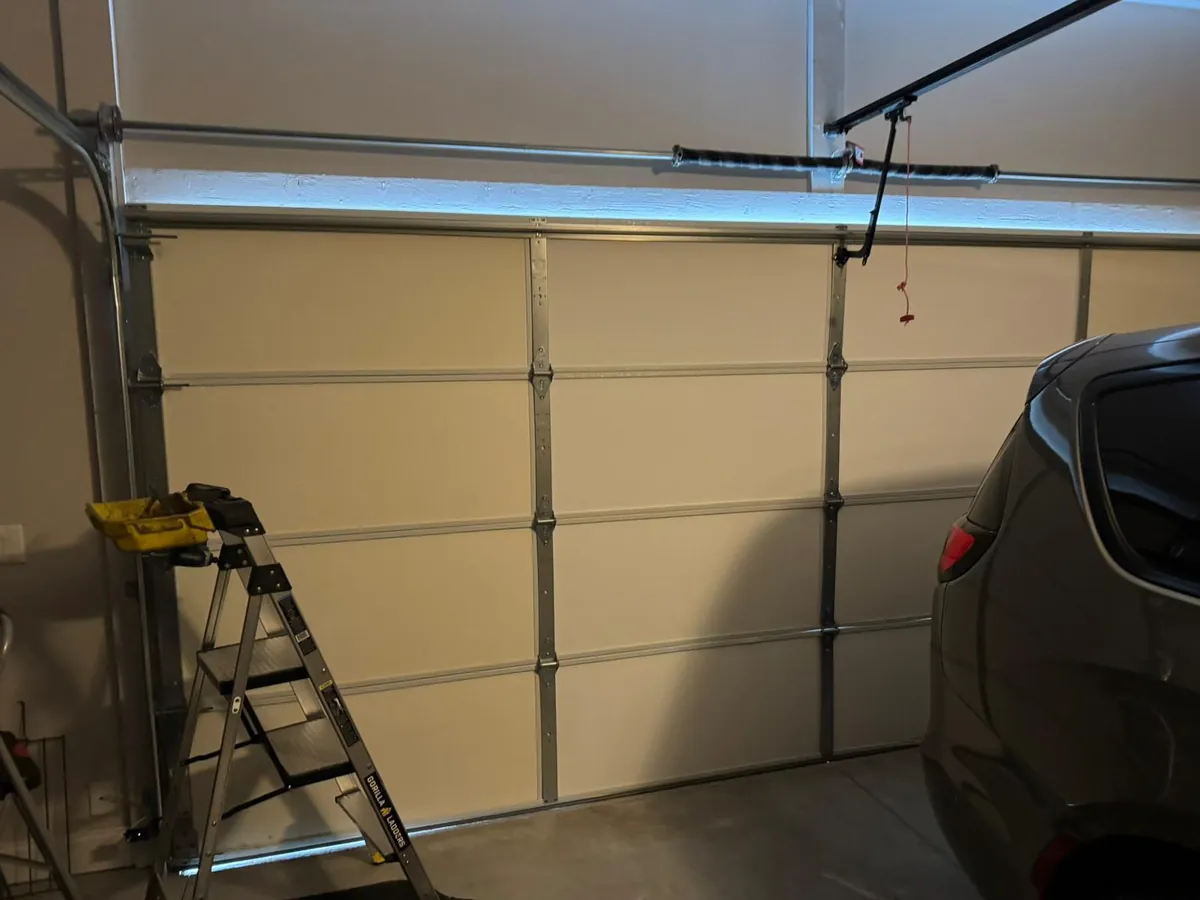
Charlestown garages on tight, sloping lots
Most of the Federal row houses around the Training Field and along Main Street were built without a garage, so the doors that need fixing here tend to sit in the newer townhouses near the Navy Yard, set into the ground floor beneath the rooms upstairs. Our garage door repair in Charlestown deals with every moving piece of those doors: the springs and lift cables, the sections and their hinges, the motor unit overhead plus every handset and console that commands it, the rollers riding in the tracks, the photo-eye sensors, and any door that has slipped its rails.
The conditions are particular. Streets climb and drop, and many driveways are barely deep enough for one car, so the bumper often stops a hand’s width from the bottom panel. Standing back from the door, you can learn a lot without touching anything:
- Whether the door sits level along the floor or leaves a wedge-shaped gap at one end.
- Whether either lift cable hangs loose beside the door instead of running taut to the bottom corner.
- Whether pressing the button brings a hum from the opener with no movement, or total silence.
The parts a Charlestown repair usually involves
Springs that have let go
A snapped torsion spring above the opening, or a stretched extension spring along the tracks, leaves the door too heavy to lift. See our spring repair in Charlestown.
Cables and drums
Frayed or slipped lift cables, which let one side of the door drop lower than the other on a sloping floor.
Bumped bottom panels
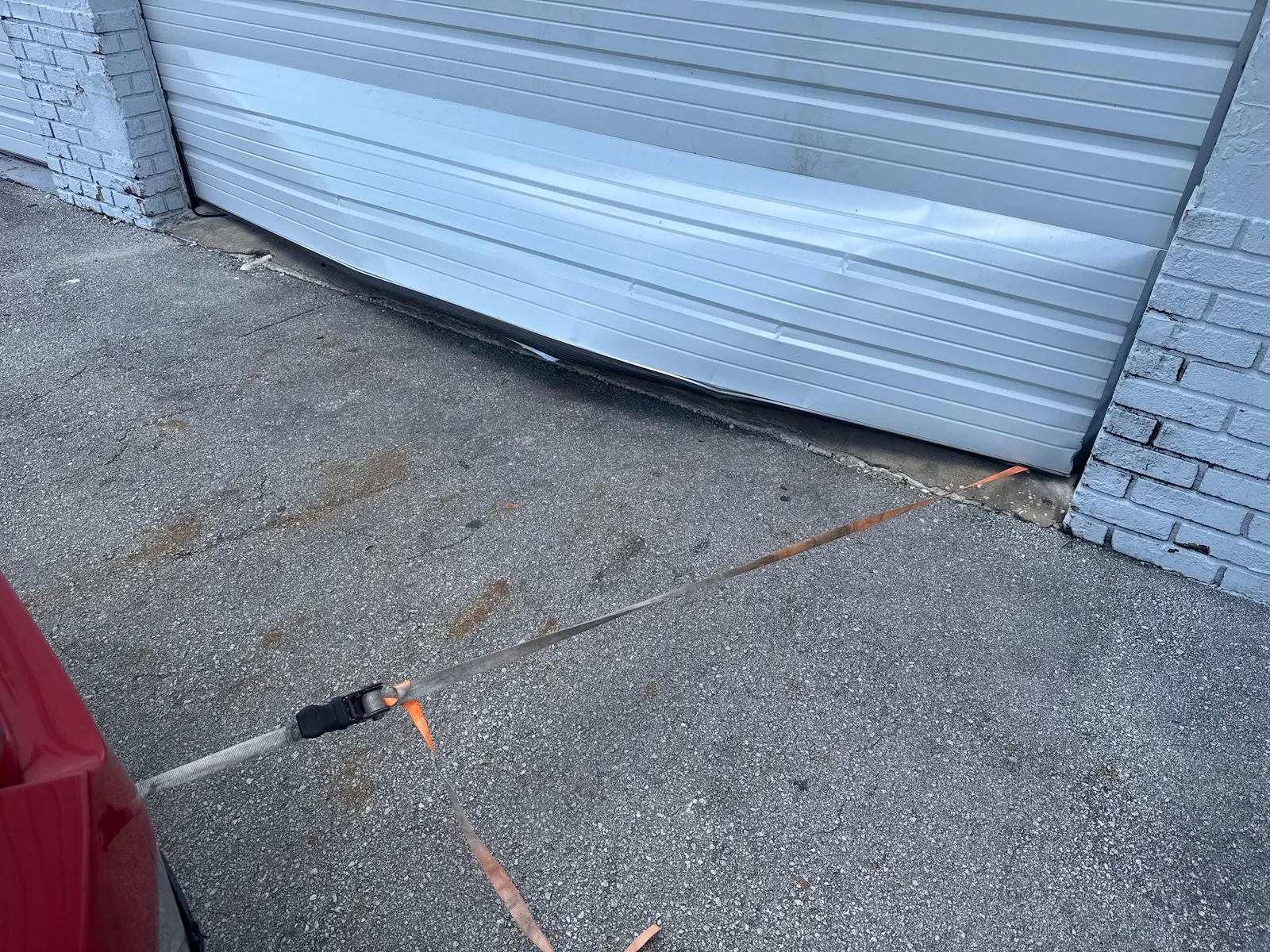
Dents and cracks in the lowest section, the usual result of a driveway with no room to spare in front of the door.
Openers, remotes and wall buttons
An opener that strains without lifting, a handset that no longer gets a response, a dead push button by the inside door. See our opener repair in Charlestown.
Tracks, rollers and brackets
Worn rollers, loose brackets and tracks knocked out of line, including doors that have come off them entirely.
Safety sensors
The pair of small beam units at ankle height on each side, easily nudged out of alignment in a tight garage full of bikes and bins.
Where the garages are, and why that matters
The housing here splits in two. Around the Training Field and along Main Street, the Federal row houses were laid out long before anyone needed to store a car, and most have no garage at all. Where one does exist, it has usually been carved into the street level of an older building, and the opening, the headroom and the side clearances reflect that: little space above the door for a spring shaft, walls close to the tracks, and a ceiling that is somebody’s floor.
Closer to the Navy Yard, the newer townhouses were designed with a garage from the start. These are the doors most repair calls involve. They tend to be single sectional doors in a recessed bay under the house, opening onto a short apron that meets the sidewalk almost immediately. The equipment is conventional, but the setting is not: the garage shares walls and ceilings with living space, the approach slopes, and there is very little room to work in front of the door when the car is parked outside.
Knowing which of the two you have tells us a good deal before anyone arrives. A carved-in bay in an older building points to short headroom, a low-clearance spring setup and tracks that may have been fitted to an opening that is not quite square. A purpose-built townhouse garage points to a standard torsion setup with an opener on the ceiling, where wear on the springs, the rollers and the bottom panel is the more likely story.
Short aprons and the bottom of the door
When a driveway is barely a car deep, the car ends up close to the door. That has consequences for every part of it. The bottom section takes most of the knocks, from a bumper that creeps forward, a door that comes down while a hatchback is still open, or a bin rolled against it in a hurry. A dented bottom panel changes the way the door seats on the floor and can bend the bottom brackets where the lift cables attach.
A bent bottom bracket is one of the less obvious problems we find. The cable still looks attached, but it now pulls at an angle, and over time it rubs, frays, or jumps the drum at the top. If your door has started closing slightly crooked after a bump, it is worth having the bracket and the cable on that side checked before the cable gives way.
Short aprons also mean less room for the door to be worked on from outside. A repair on a door in these garages is usually done from inside the bay, which is one reason it helps to move the car out, if the door allows it, before the visit.
Steep streets and a door that will not sit level
Many approaches here slope, and some garage floors are not perfectly flat either. A sectional door is built to meet a level floor along its whole width, so on an uneven sill it touches down at one end first. The opener senses resistance earlier than expected, the bottom seal wears unevenly, and the door may bounce or reverse. Owners often blame the opener for this, but the cause is the meeting point between door and floor.
Water follows the slope too. Rain and meltwater running down a driveway toward the opening sit against the bottom seal, and in winter that water freezes the seal to the floor. A door frozen down will strain the opener and can tear the seal or pull the bottom bracket loose when the ice finally lets go. When a frosty morning leaves the door stuck fast and the motor sounds strained, stop pressing the button: a gentle thaw along the seal, without prying, is safer than letting the opener pull against the ice.
When the floor itself is the problem, the fix is usually in how the door is adjusted and sealed, rather than in a new part. The cable lengths, the spring tension and the opener’s close limit can all be set so the door meets the floor as squarely as the floor allows, and a bottom seal can be chosen to fill an uneven gap.
Reading the symptoms before you call
Garage door repair in Charlestown goes faster when the call describes the door’s behaviour accurately. A few patterns point to specific parts:
- A sharp crack heard through the house, and afterwards the door refuses to rise. Almost always a broken torsion spring. The door is now carrying its full weight with nothing to counterbalance it.
- One corner of the door leads the other on the way up. A cable has slipped or frayed, or a drum has loosened on its shaft.
- A grinding or scraping at one point in the travel. A roller has cracked or seized, or the track has been knocked inward at that spot.
- The motor turns over but the door stays where it is. The release cord has been pulled and the trolley is unhooked, the drive gear inside the opener has worn, or the door is jammed in the tracks.
- The door starts down, then reverses. The photo eyes have lost sight of one another, or the door is binding on an uneven floor and the opener is reading that as an obstruction.
- Nothing happens from the remote, but the wall button works. The remote’s battery has run down or the remote has lost its pairing.
You do not have to diagnose the problem yourself, but saying which of these matches what you are seeing helps the visit begin in the right place.
What a visit involves
A repair visit looks at the whole door, whatever part was named on the phone. Where the springs are intact, the trolley is released and the technician raises the door a little by hand to judge its weight and how smoothly it travels. Spring coils are inspected for gaps and for stretch, each cable is followed from its drum down to its bottom bracket, and the rollers and hinges are looked at one by one. Each rail is checked from end to end for kinks and for brackets working loose, which matters more in an older bay where the tracks may be fixed to uneven masonry.
Before any part is changed, you are told what has broken, why it broke, and what the fix involves. After the work, the door is set so it hangs halfway open without creeping up or sinking, the up and down stops on the opener are set again for the door’s new behaviour, and a test object is placed under the closing door to prove that it reverses on contact. On a sloping floor, the close limit gets particular attention, so the door seals along its length without reading the floor as an obstruction.
Townhouse garages beneath living space
The townhouse garages near the Navy Yard put the door directly under bedrooms and living rooms, often with the opener bolted to a ceiling that has a floor above it. Two things follow. A noisy door or opener is heard throughout the house, and vibration from a worn opener or a loose track carries into the structure. Second, a failure at night is not just an inconvenience in a detached shed; it is happening underneath the household.
Much of that noise has a mechanical cause that can be fixed, and quieting a door is a routine part of garage door repair for Charlestown townhouses. Worn steel rollers, dry hinges, a loose track bracket and a stretched chain on the opener are the usual sources. Replacing worn rollers, tightening the hardware and adjusting the opener take a good part of the rumble out of the house.
Older openings carved into row houses
Where a Federal row house does have a garage, the opening was rarely designed for an overhead door. The side walls are close, the header may be low, and the opening may be a little out of square. Each of these affects how a door is repaired. Low headroom limits where a torsion spring can sit, so some of these bays run on a rear-mounted spring or on springs stretched along the horizontal rails instead. Tight side clearances make it harder to reach the bottom brackets and cables. An out-of-square opening means a door can bind on one side, which loads that side’s rollers and cable more heavily and wears them out sooner.
None of this rules out a repair, but it shapes the work. A replacement part has to fit the space that is there, and an adjustment has to account for the opening as it is, rather than as a catalogue drawing assumes it to be.
What is safe to do, and what is not
Some checks are safe while you wait:
- Pull the opener’s plug when the door has halted mid-travel, so a stray press cannot set it off again.
- Wipe both sensor lenses and move anything out of the beam between them.
- Swap the remote’s battery, then compare the remote with the wall button.
- Look along both tracks for something pushed against them.
Leave the rest alone. Overhead, the torsion spring holds dangerous tension wherever the door happens to sit, and that same load runs down the cables into the bottom brackets. Prying at a bracket, backing off a set screw or putting a bar into the winding cone lets that energy out all at once. Spring work is not a DIY repair, however simple the parts look. Do not try to raise a door whose spring has snapped, and do not use the opener to force it.
Sensors and openers in a crowded bay
A single-car garage on a small lot ends up holding far more than a car: bikes on hooks, recycling bins, strollers, beach chairs, a workbench squeezed against one wall. In that kind of space the safety sensors take a steady stream of knocks. A sensor bracket bent by a bike pedal can tilt a lens just far enough that the beam misses its partner, and the door then refuses to close from the remote. The tell is a blinking or unlit indicator on one of the two eyes. Re-aiming and securing the brackets, and routing the low-voltage wire out of harm’s way, cures most of these calls.
Openers in these bays work hard as well, because a household with one garage door uses it as a front door for groceries, bikes and deliveries. A drive gear worn smooth, a chain that slaps against its rail, or a logic board that no longer responds are the usual faults. We can look at the opener during any garage door repair Charlestown residents book, even if the main complaint is elsewhere on the door, because a strained opener is often a sign of a spring that has weakened.
Repair or replace
Repair is the right call for most doors here. New springs, fresh cables, replacement rollers or one new bottom section will keep a sound door running for years. A new door starts to earn its place once three or four parts are wearing out at the same time, once the lowest sections have rusted or rotted beyond patching, when a door has been bumped so often that the frame of the sections is distorted, or when a heavy older door no longer suits the opening. You will get a straight answer about which of those describes your door, along with the reasons. If a new door makes more sense, our page on new garage doors in Charlestown walks through choosing a door that suits a tight opening and having it put in.
Repairs that cannot wait until morning
A door stuck open after dark, a car trapped behind a closed door before work, a spring that snaps in the middle of the night: someone answers the phone in the small hours as well as in the daytime, so nobody has to sit on a stuck door until the office opens. Our emergency repair page for Charlestown covers what to do in the meantime, and how to leave the door safe until help arrives.
Getting the door working again
For garage door repair Charlestown MA homeowners can book in a few minutes. Describe what the door is doing, mention whether the garage is a townhouse bay or an opening in an older building, and say whether a car is inside. The broader garage door repair page covers the same work across Greater Boston, and the Charlestown page brings every service for the neighbourhood together. When you are ready, call us or book online.
Questions from Charlestown
Our townhouse garage door closes, then pops back up a few inches. Why?
On a sloping or uneven floor, one end of the door touches down first and the opener reads that early contact as an obstruction. The close limit and the cable lengths can usually be adjusted so the door meets the floor properly. It is also worth checking that nothing is breaking the sensor beam.
The door was bumped by the car and now closes crooked. Is that urgent?
It should be checked soon. A bump often bends the bottom bracket, which makes the cable on that side pull at an angle and wear. Left alone, that cable can fray or come off its drum. If the door now hangs visibly tilted, leave the opener switched off.
We live in an older row house with a carved-in garage. Can that door be repaired?
Yes. Low headroom and tight side walls change which parts fit and how they are reached, but springs, cables, rollers, tracks and openers in those bays are all repaired. The work is planned around the opening as it actually is.
The door is frozen to the floor. What should we do?
Stop pressing the opener. Let the seal thaw gently, without prying, then try again. If the door still will not move, or the opener strains, call us; repeated attempts can tear the seal and pull the bottom bracket loose.
Is Elite Boston Garage Door Repair & Supply well reviewed?
The business is rated 5.0 on Google. You can read the reviews on our reviews page, and every repair is explained before work begins.