
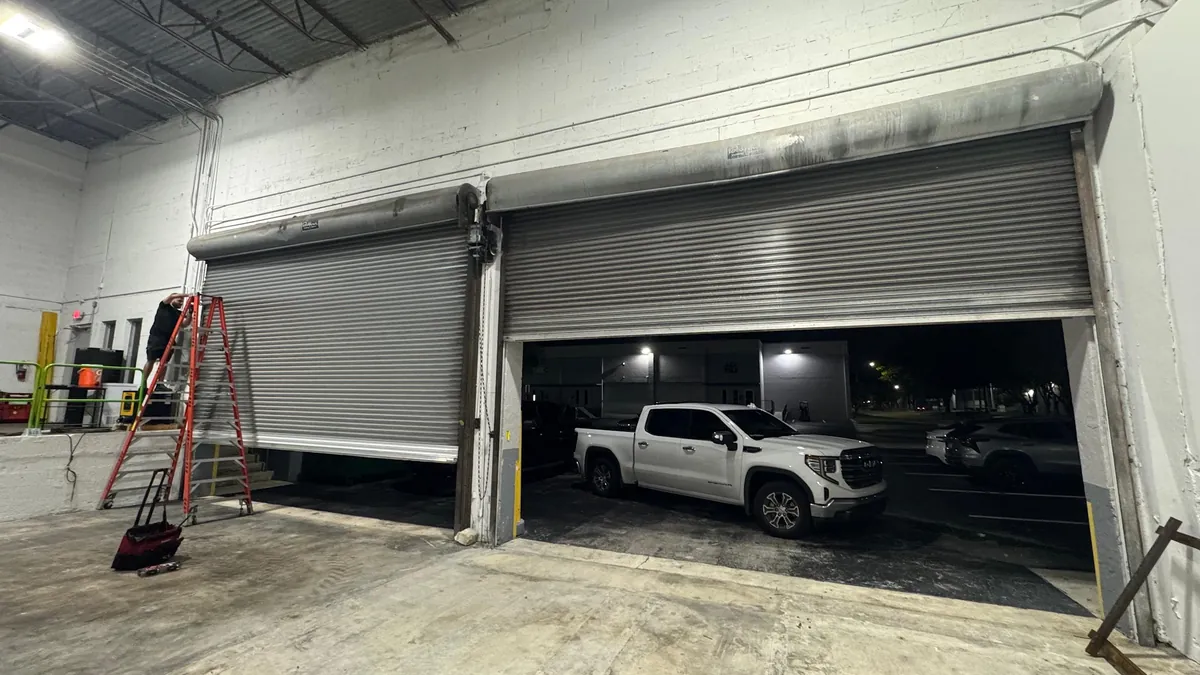
When a tower’s only garage door stops at a bad hour
The West End is almost wholly post-renewal towers, and their residents park in shared garages behind building roll-ups and gate systems. When that single door fails, it fails for everyone at once. Cars are shut in or the garage stands open to the street, and it seldom happens at a tidy hour. Emergency garage door repair in the West End exists for exactly that: a door that will not open, will not close, has dropped on a broken spring or has come off its tracks, at any time of day or night.
Someone answers the phone through every hour, seven days a week. That describes who picks up, not when a van turns up, and any timing you are given on the call will be honest.
In these buildings everything runs through management, so the concierge or manager on duty is usually the person who rings. Three things to establish first:
- Is anyone hurt, or is anyone or anything under or close to the door?
- Is the door shut with cars inside, open with the garage unsecured, or hanging partway?
- Has anyone heard a bang, seen a cable hanging loose or noticed the door sitting crooked?
Failures that justify a call at night
Door stuck shut
Residents cannot drive out, often first thing in the morning. A broken spring or a failed operator is the usual cause.
Door stuck open
The garage, and the doors from it into the building, are exposed to the street. Often a sensor fault, a tripped operator or a door that has jumped its guides.
Spring snapped
A sharp crack from the ramp, after which the door is dead weight. The spring holds dangerous tension and must not be touched. See West End spring repair.
Off its tracks or guides
A door that is crooked, with rollers or curtain ends out of their rails, after a car has hit it or a cable has given way. It can fall and should be left alone.
Hanging on one cable
One side lower than the other, a cable slack or wrapped wrong on its drum. Do not run the door.
Struck by a vehicle
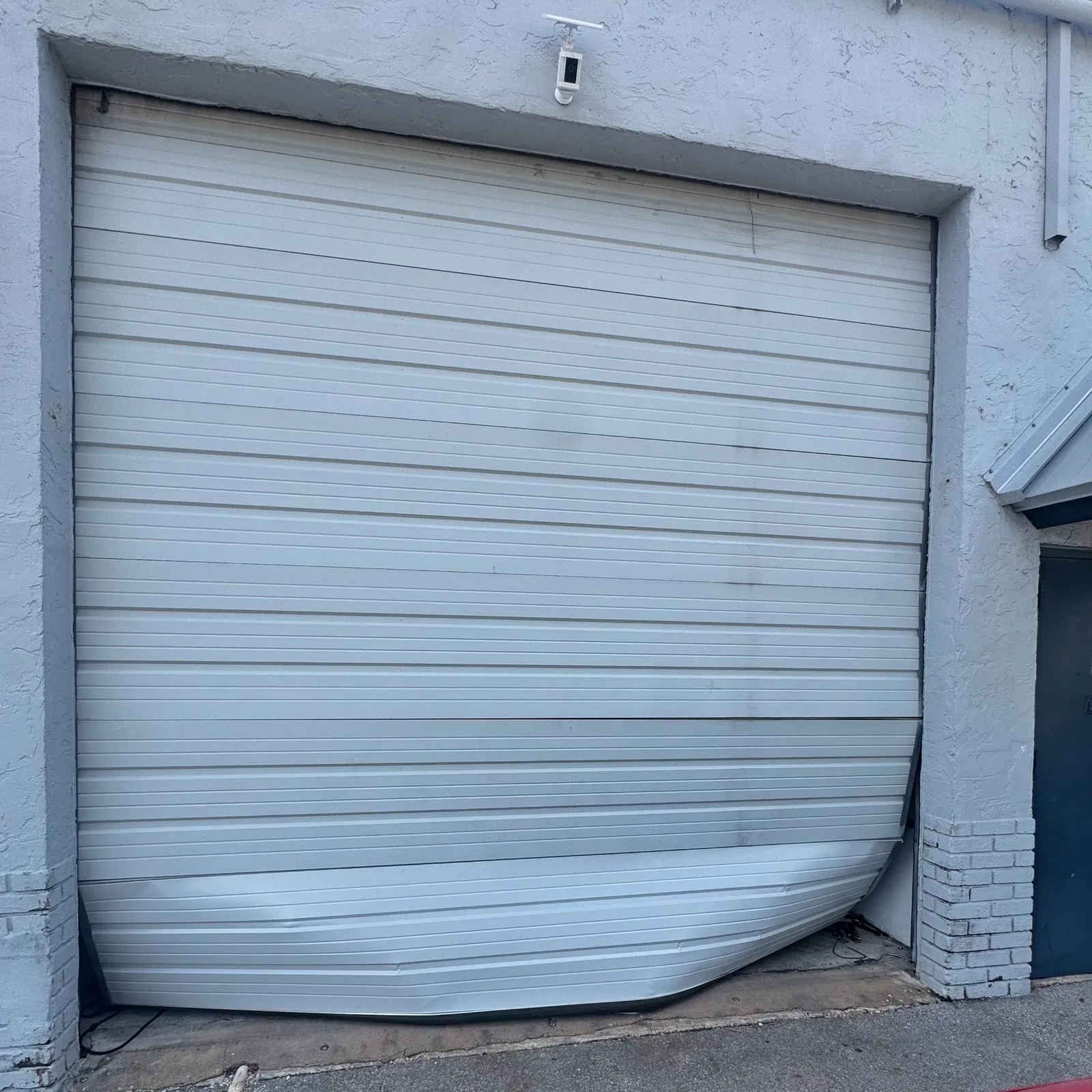
A bent bottom bar, kinked slats, a pushed-in section or a twisted guide. The door may still move, but should not be used until it is checked.
Make the door safe before anything else
Any emergency garage door repair in the West End really begins with the night staff, well ahead of a technician. The first job, for whoever is on duty, is to stop the door from hurting anyone. These steps are safe and sensible:
- Stop all use of the door. Tell residents, put up a sign, or have someone stand by the entrance if the garage is busy.
- If the operator can be switched off safely at its control box or isolator, do it, so no remote or timer calls the door while it is damaged.
- Keep people, bikes and cars out from under a door that has stopped partway or is hanging at an angle.
- If a vehicle is trapped half under the door, do not try to drive it out until the door has been made safe.
Nobody should haul the curtain upward, jam lumber beneath it, or pull it down with a rope. Do not loosen any bracket, set screw, cable or bolt. Springs on these doors, whether torsion springs above a sectional door or the spring inside a roll-up’s barrel, hold dangerous tension even when the door is still. Releasing it by accident can throw parts across the garage or let the door drop. This is not a DIY repair.
Details worth having ready
A clear picture over the phone helps us understand what the door needs before anyone sets out. Useful details:
- The building and which garage entrance or ramp.
- Whether the door is a roll-up curtain or a sectional door with panels.
- Where it is resting: closed, open, or partway, and whether it is level.
- Anything heard or seen: a bang, grinding, a cable dangling, rollers sitting outside their rail, a buckled guide.
- Whether vehicles are trapped inside, or whether the garage is open and unsecured.
- Who can let us in, and how to reach them.
That information also helps us tell you honestly what is likely to be involved, and whether the door can be made secure on the first visit or will need parts.
Springs that give way after dark
A spring that snaps is the most common reason a shared door suddenly refuses to move, and it sits behind more requests for emergency garage door repair in the West End than anything else. Steel coils fatigue with every cycle, and a door that serves a whole tower cycles a great many times. Cold nights make the steel more brittle, so breaks cluster when temperatures drop sharply. The tell-tale sign is a loud report from the garage, after which the operator raises the door a little and gives up, or cannot shift it at all.
Do not let the operator keep trying. With the counterbalance gone, the whole load falls on the motor, the cables and the drums, and repeated attempts can burn out the operator or pull a cable off its drum. Switch it off and call. When the spring is replaced, the door is balanced again and the operator’s settings are checked against the new spring.
Off-track doors and why they are dangerous
A door that has left its tracks or guides is the most unstable kind of breakdown. On a sectional door, one or more rollers will have popped out of the rail, and the door may be twisted or leaning. On a roll-up, the curtain’s ends may have pulled out of their guides, leaving the curtain bowed or hanging loose at one side. In either case the door is no longer held properly and can fall or swing.
The usual causes on a busy ramp are a vehicle catching the door or a guide, a lift cable parting so that one corner sags, or a motor grinding on against a door that was already wedged. Do not try to push the door back into place or run it with the operator. It has to be supported and its tension released before the rollers or curtain can be guided back, bent rails straightened or replaced, and both sides set level again.
Open to the street after dark
A garage entrance that refuses to shut is a security problem for every household above it. The garage often connects directly to lift lobbies and stairwells, so an open door can mean an open building. Common causes include a photo eye that has been knocked out of line, a damaged sensing edge on the bottom bar, an operator that has lost its limits after a power cut, or a door that has come partly off its guides.
Before calling, check the photo eyes: wipe the lenses, make sure nothing stands in the beam, and look for a steady light on each. If the curtain then comes down properly, still log it with management, because an eye that wanders off aim once tends to wander again. If it stays up, leave it there rather than dragging it down, and ring us with a description.
What an emergency visit involves
Access is arranged with whoever is managing the building that night. Once at the door:
- The area is checked and kept clear, and the operator isolated so the door cannot be called.
- The door is examined to pin down which part gave out: spring, cable, rollers, guides, operator or sensors.
- The door is supported and made safe, whatever position it is in.
- Management learns the cause and the remedy before work proceeds.
- The failed parts are repaired or replaced where that can be done there and then.
- The door is balanced, the operator reset, and the safety reverse tested before it goes back into use.
Where a component must be ordered in, the aim is to leave the door in a safe, stable position in the meantime, and you will be told exactly where things stand.
Who in a tower should make the call
In a private house, the person whose door has failed simply picks up the phone. In a West End tower the picture is less tidy. A resident discovers the problem, tells the concierge, who tells the overnight manager, who may need to reach the property company before agreeing to a repair. Every handover adds delay while the door sits broken.
It helps if each building settles this in advance. Decide who on the night staff may report a garage door breakdown and let a technician in, where the keys and fobs for the garage and the operator’s control box are kept, and who must be told afterwards. A short note at the concierge desk with that information, and with our number from the Business Details on this site, saves confusion when the door goes at an awkward hour. Residents can still call us directly; we will simply ask who in management needs to be involved before work starts.
Keeping residents informed while the door is down
A shared garage out of action affects every driver in the building, and many of them will find out only when they reach the ramp. A sign at the lift lobby and at the top of the ramp, a message through whatever channel management uses, and a clear word to the concierge all help. Tell residents whether cars can get out, whether the garage is unsecured, and that they should not try to operate the door or move it by hand.
Once we have looked at the door, you will know whether it can be put back into service there and then or whether a part has to come in first. That is the information residents most want, and passing it on promptly keeps the entrance clear while the work is done.
When the operator is the emergency
Now and then the curtain and springs are sound and only the drive has quit. An operator that has burned out, lost power, tripped its thermal cut-out or suffered a board failure can leave the door shut or open with no way to call it. Many commercial operators carry a hand chain or release lever for this situation; use it only if you are confident with it and the counterbalance is unbroken. A door with a broken spring must not be released from its operator, because the operator may be the only thing holding it.
If the operator turns out to be the fault, the West End opener repair page explains how operators, remotes and sensors are repaired or replaced. For Boston as a whole, urgent call-outs are explained on the emergency garage door repair page.
Overnight trouble on the ramp
The ramp itself causes a share of night calls. Late arrivals swing into the entrance tight to the guide rail, a delivery van misjudges the height of the hood, or a car follows another through and the closing door catches its roof. A door struck like that may still move, but a bent bottom bar or a guide pushed out of line can make it jam on the next cycle, or let the curtain escape its rails. If a door has been hit, take it out of use until it has been seen, even if it seems to work, and tell us what struck it and where.
Winter emergencies under the towers
Cold brings its own kind of night call. A door frozen to the slab after slush has refrozen at the threshold may refuse to lift, and an operator straining against it can trip or tear the bottom seal. Rock salt and grit carried down the ramp work into the bottom bar and the lower guides, and a bottom bar eaten by corrosion can snag in its guides and jam. Springs, as noted above, are more likely to break when it is bitterly cold.
When ice has locked the bottom bar to the concrete, repeated button presses only add strain. Switch the operator off, and if you can safely clear ice from the threshold without touching the door’s hardware, do so. If it still will not move, call.
Emergency fix or replacement
Most emergencies end with the door repaired. A spring, a pair of cables, a few rollers or a straightened guide restores a sound door. Occasionally the breakdown reveals a door that has reached the end of its life: badly rusted at the bottom, struck so often that slats will not lock, or so weighed down by patching that springs can no longer counter it. Then the emergency work makes it safe, and the conversation about replacement can happen afterwards, in daylight. Choosing and fitting a successor door is set out under West End new garage doors, and the everyday fixes that follow a crisis are on West End garage door repair.
The morning after
With the entrance running again, the useful question is what set the failure off. A broken spring on a busy door suggests its partner may be worn too. A door that came off its guides after a knock may have a weakened bracket elsewhere. An operator that tripped repeatedly may be working against a door out of balance. You will be told what was seen, so management can plan any further work at a convenient time rather than facing another emergency garage door repair in the West End a short while later. For an overview of everything we do in the neighbourhood, see the West End garage doors page.
Reporting a breakdown
If the door under your building has failed, make it safe, keep people clear and gather the details above. The line is staffed through the night, weekends included, so you can ask for emergency garage door repair in the West End the moment the breakdown is found. Whatever the hour, call us or book online.
Questions from West End
Our concierge found the door broken well after midnight. Should they phone then?
They should. A person answers whatever the hour, weekends and holidays alike. That covers taking the call and talking the problem through; when someone can be on site depends on the night, and you will be told honestly.
Our entrance will not shut and the building feels exposed. What can the night staff do?
Check the photo eyes for a blocked beam or a dirty lens, and try the wall station once. If it still will not close, do not force it. Keep someone near the entrance if you can, and call.
A resident’s car is trapped inside. Can the door be lifted by hand?
Only if no spring has broken, no cable is slack, and the door has a manual release or hand chain you know how to use. If there was a bang, or the door feels very heavy, the spring has probably broken; leave it shut and call.
A car clipped the door and knocked it out of its rails. Should the staff shove it back in?
Please do not. A derailed door is unstable and under spring tension, and pushing it can make it fall. Keep everyone clear, switch off the operator and call us.
Is it worth calling at night, or can it wait until morning?
If the door is shut with cars inside, open and unsecured, hanging crooked or damaged by a vehicle, it is worth calling straight away. If it is working but noisy, a daytime visit is usually fine.