
Why doors on Arlington’s hillside lots wear the way they do
Most calls for garage door repair Arlington MA homeowners make start with a door on a slope. Off Massachusetts Avenue and up toward the Heights, the single- and two-family houses sit on ground that rises, and the driveways that reach their garages are often steep. Some of those garages are built into the house; others stand on their own behind it. Either way, the door lives at one end of an incline, and that changes how the floor meets the door, where water goes and how hard the moving parts work.
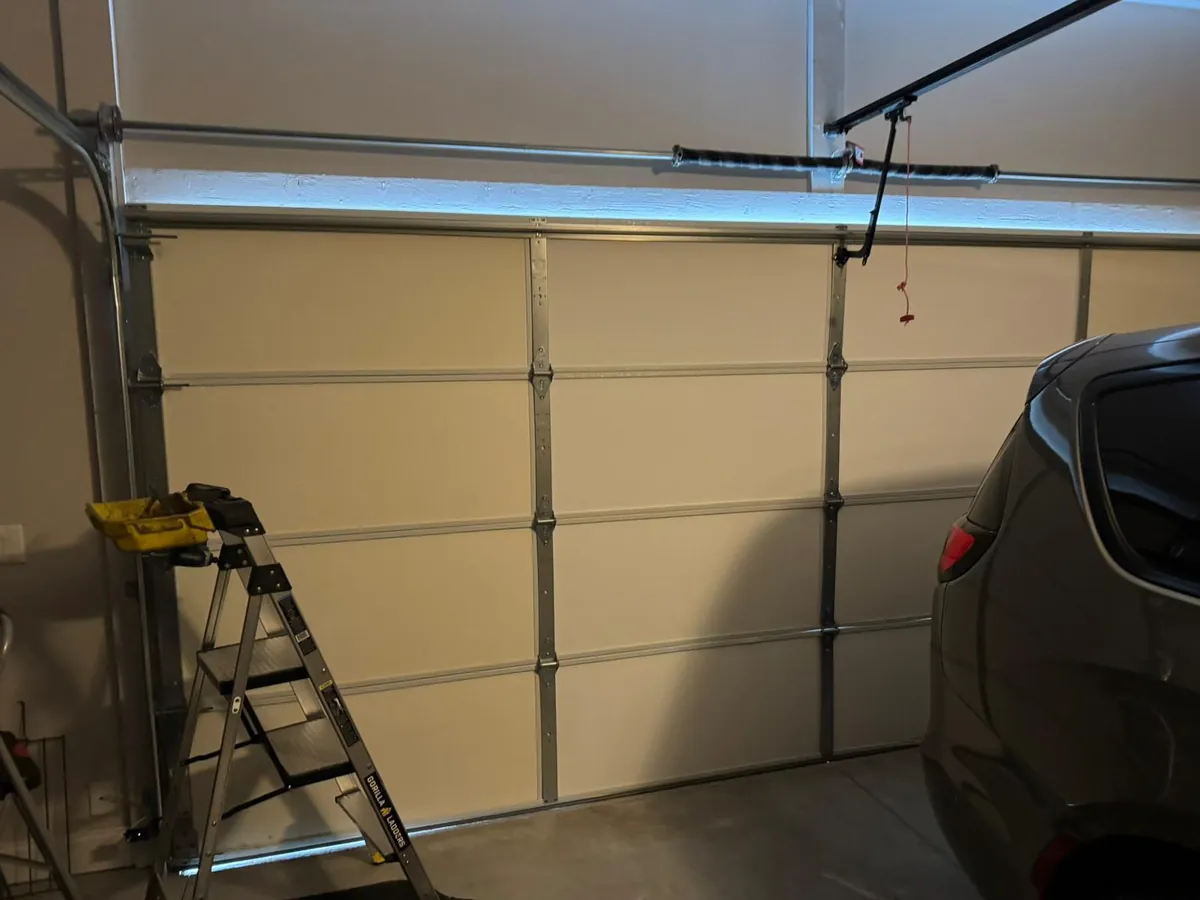
A door is a balanced machine. Springs hold up its mass, cables hand that pull down to the lower corners, rollers keep it in the tracks and the opener only nudges it along. When the slab under it is pitched, or when meltwater runs down the driveway and freezes at the threshold, that balance gets tested every morning.
Before calling, three checks from where you stand can narrow down the trouble:
- Look along the bottom edge: a gap on one side only suggests a slipped cable or a slab that slopes.
- Look up at the bar over the door: a split in the coiled spring means it has snapped.
- Look at the small lights on the photo eyes near the floor: one that blinks or stays dark usually points to sensor misalignment.
Faults we fix on Arlington garage doors
Springs, torsion and extension
The coiled spring on a shaft above the door, or the stretched pair along the side tracks on older installations. Once one snaps, lifting the door by hand feels like hoisting a slab. Read the Arlington spring page.
Lift cables and drums
Braided steel lines reeling onto grooved drums beside the spring. Once a line frays or jumps its groove, the door hangs crooked, low at that end.
Dented or split panels
Sections that have taken a bumper, cracked along a seam or pulled loose at a hinge. A single section can sometimes be repaired rather than the whole door.
Motors, handsets and wall controls
An opener droning without moving the trolley, a handset whose clicks achieve nothing, a doorway control that has stopped answering. Details on the Arlington opener page.
Tracks, rollers and brackets
Rollers worn flat or seized, track sections knocked out of line, brackets working loose from framing. Includes doors that have jumped clear of the track.
Photo-eye sensors
Two small lenses mounted near the slab, facing each other across the doorway; break their invisible line and a closing door backs up.
Which part carries which job
It helps to know which part does which job, because the symptom you see is often a long way from the part that failed. Picture the door as hinged slabs piled edge on edge. Little wheels poke out from each slab’s ends and ride inside upright rails, which bend over at the top and run flat beneath the garage ceiling. The whole door can weigh as much as a large adult or more, and neither a person nor the motor on the ceiling is supposed to raise that mass alone.
The lifting is done by springs. On most modern installations a torsion coil is threaded onto a bar spanning the header. Lowering the door twists that coil; raising it releases the twist, spinning a drum on each end of the bar so they gather in the lines fixed at the door’s lower corners. On older and lighter doors, extension springs run alongside the horizontal tracks and stretch as the door comes down, pulling it back up through a set of pulleys.
The opener sits in the middle of the ceiling and drives a trolley along a rail. Its task is steering a door that the coils have already made nearly weightless, while keeping an eye on the sensor beam so it can back off when something blocks the way. That arrangement explains the most common confusion we hear about: an opener that strains, hums or gives up is frequently a healthy opener attached to a door whose springs or cables have quit.
Steep driveways and what they do to a door
The local feature that shows up most in our garage door repair Arlington MA calls is the grade. Many driveways off the Avenue climb or drop sharply to reach the garage, and a door at the end of one is affected in ways a door on flat ground is not.
The first is the floor itself. A slab poured to drain water away from the house may be pitched toward the opening, or across it. A sectional door closes until its bottom edge meets the floor, and if the floor is not level from side to side, one corner touches first. The opener reads that as the door being closed while the other corner still has a gap, which lets in drafts, rain and leaves. Over time the bottom seal wears unevenly, and on doors where the opener’s closing force has been turned up to compensate, the bottom panel and its brackets take a beating.
The second is water. A driveway that runs downhill toward a garage delivers rain and snowmelt straight to the threshold. On a frosty night that runoff can glue the rubber seal to the concrete. Ask the motor to haul a door stuck down like that and the weakest link pays: the seal tears, the bottom bracket bends, a cable slips off its drum, or the opener’s gear strips. A door that will not budge on a winter morning is worth leaving closed and looking at in daylight rather than forcing.
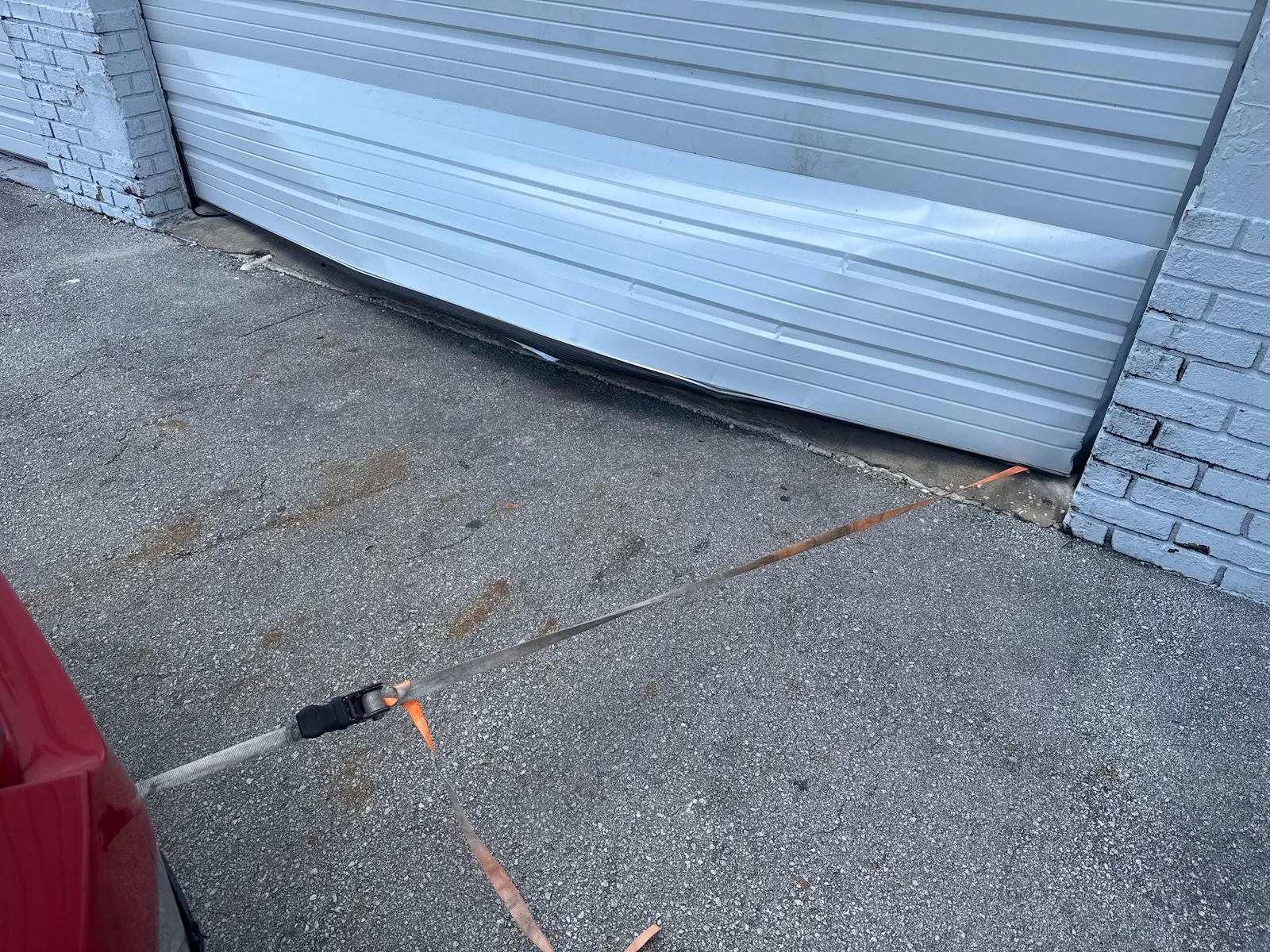
The third is load on the car side. On a steep approach, cars tend to stop close to the door, and a bumper that rolls an inch too far meets the bottom panel. Dented lower sections are a regular repair on sloped lots, and a dent that bends the hinge line can stop the door from tracking straight.
Attached and detached garages bring different faults
Arlington has both kinds side by side, sometimes on the same street, and each has its own pattern.
Attached garages
With the garage tucked into the house itself, a bedroom or kitchen may sit right beside it or overhead. Households often treat that door as their front entrance, so it cycles many times a day, which wears springs and rollers faster. Noise matters more, too: worn rollers grinding in the track or an opener chain slapping on its rail carries straight into the bedroom above. Nylon rollers and a well-adjusted opener make an attached door much quieter. The wall button and the door into the house are close together, which makes a button fault very noticeable when it happens.
Detached garages
A freestanding garage behind the house is often older, unheated and less sheltered. Its door may be a lighter, older design with extension springs, its tracks may be fixed into framing that has shifted, and its opener may be fed by a power line that runs out from the main house. Remote range can be an issue at the back of a long lot, and damp in an unheated building speeds up rust on springs, cables and bearings. These doors also see fewer cycles, so a fault can sit unnoticed until the day the door is needed.
Two-family houses and shared doors
In a two-family house, a garage may serve both households, or each unit may have its own bay. A shared door gets used by more people on more schedules, with more remotes in circulation. That means more cycles on the springs and more chances for a remote to be lost or for the opener’s memory to be cluttered with codes nobody remembers adding. When one door is used by two households, it is worth thinking about which repairs to do together, because the door will keep getting heavy use once it is back in service.
What a repair visit involves
Our visits for garage door repair Arlington MA homes book run in much the same sequence, whatever brought us out:
- Listen to the symptom. What you noticed, roughly when, and the position the door stopped in. A loud bang before the door stopped points one way; a slow decline over weeks points another.
- Make the door safe. If it is partly raised or hanging crooked, it is secured before anything else is touched.
- Check the balance. With the trolley released, the technician raises the door manually to waist height and lets go. Hovering there means the springs are doing their share; sinking or creeping upward reveals that they are not.
- Work through the system. Springs, cables and drums, rollers and hinges, tracks and brackets, the bottom seal, the opener and its rail, and the photo eyes are each looked at, because one failure often hides another.
- Explain before working. Nothing gets unbolted until you have heard the findings and agreed the plan.
- Repair, then test. Once the fix is in, the door goes up and down repeatedly, manually and under power, a test object is placed across the beam to prove reversal, and the force limits are set.
That last step matters more on a sloped slab. The reversal test confirms the door will back off when it meets resistance, and on a floor that is not level the close setting needs to be right for the low corner and the high one.
Panels, sections and the bottom seal
Not every repair involves the moving parts. Sections on a sectional door can be dented, cracked at a seam or pulled loose where a hinge has torn out. Depending on how badly a panel is damaged and whether a matching section is available, a single section can sometimes be replaced while the rest of the door stays. A deep dent that has bent the panel’s frame, or damage spread across several sections, usually makes a section swap a poor use of money.
The bottom seal deserves its own mention on hillside lots. It is the rubber strip along the lowest edge of the door, and it is the only thing between the garage and the water running down the driveway. A seal that has hardened, torn or been frozen and pulled off lets water, leaves and cold air in. Replacing it is a modest job, and on a slab that slopes from side to side it can be paired with an adjustment of the door’s closing limit so that both corners seal.
Tracks, rollers and doors that have come off
Rollers are small wheels that take a great deal of wear. Steel rollers rust and seize; worn nylon ones go flat on one side and start to drag. A dragging roller makes a scraping noise and loads the opener, and a seized one can eventually climb out of its track. Tracks themselves can be knocked out of line by a car, bent by a door forced against an obstruction, or pulled out of true by brackets working loose from framing that has dried and shrunk.
A door hanging out of its rails is unpredictable. It may lurch or drop, and the coils overhead remain loaded. Resist nudging it back; cut power to the opener and keep children and pets clear. Rehanging it involves unloading the springs under control, truing or swapping the damaged rail, adding fresh wheels where the old ones are chewed and rebalancing everything before the first test run. For a door that derailed late at night, our Arlington emergency repair page sets out sensible interim steps.
Springs and cables: the parts not to touch
The coil across the header is wound tight enough to counter the door’s entire heft. That stored energy is released instantly if anything slips during removal or winding, and a winding bar flung by a spring can break bones. This is a job for a trained technician with the right bars and clamps, never a weekend project. Cables are part of the same system, under tension whenever the spring is, so a frayed cable should be left alone too.
A snapped coil usually announces itself with a crack like a dropped plank, then shows a visible break in the winding and leaves the door far too heavy to raise manually. Cable faults look different: a door tilted in its opening, a slack line looping beside the rail, or a drum with nothing wound on it. Both lead to the same advice: do not run the opener, and call. Our spring repair page for Arlington goes into the spring side in more depth.
Openers, remotes and the photo eyes
Opener faults are common and are often not the opener at all. Before assuming the motor has failed, a few simple things are worth checking: the outlet the opener is plugged into, the lock button on the wall control, the batteries in the remote, and the lights on the two photo eyes near the floor. Bump one lens askew with a pedal or a trash barrel and the door refuses to come down, with the opener’s bulb blinking in protest.
Genuine opener failures range from a chewed drive gear or a stretched chain to a dead circuit board or a handset that has forgotten its code. Openers are repaired and replaced, LiftMaster units among them, and handsets and keypads are reprogrammed. For an attached garage where the door is the everyday entrance, a quieter belt-drive opener is often worth considering at the replacement stage. The Arlington opener page covers this in detail.
Fix this door, or start over
Most doors that come to us for garage door repair Arlington MA owners request are worth keeping. Coils, lines, wheels, seals and motors are consumables on any door in daily use, and renewing them returns it to duty. Replacement starts to make sense when problems pile up: sections rusted or rotted along the lower edge, timber so waterlogged that no sensible spring could counter it, repeated track damage from a frame that has moved, or a door so old that replacement sections no longer exist. In those cases we will say so plainly and talk through the options. For any single fault on a sound door, a repair is the place to start.
When the door picks a bad moment
Garage doors fail at the worst times: before the school run, during a snowstorm, with the car on the wrong side. If a door is stuck open, the house is not secure, and on an attached garage that matters even more because the garage leads straight indoors. If a door is stuck closed with the car inside, you may have to make other plans for the day. Whichever it is, someone picks up whatever the hour and whichever weekday it is, letting you explain the situation and get it on the schedule without waiting for the morning. For the safe steps to take in the meantime, see the emergency garage door page for Arlington.
How to book an Arlington repair
The quickest way to get a door sorted is to tell us the basics: is the garage part of the house or a separate building, does a steep driveway lead to it, what the door is doing now, and anything you heard before it stopped. A photo of the spring over the door and the bottom corners helps too. Our broader garage door repair page explains the full service, and the Arlington page gathers every service available locally. For garage door repair Arlington MA homes can count on, from a seized roller to a door hanging off its cables, take the next step now: call us or book online.
Questions from Arlington
Our driveway is steep, and daylight creeps in beneath one end of the shut door. Is that fixable?
Usually, yes. The gap often comes from a slab that slopes across the opening. Depending on what is causing it, a new bottom seal, an adjustment to the closing limit or attention to a cable that has slipped on one side can close it up. It is looked at on site because the cause varies from door to door.
The door froze to the ground overnight. Should I keep pressing the button?
No. Repeatedly running the opener against a door frozen to the slab can tear the bottom seal, bend the bottom bracket, slip a cable or strip the opener’s gear. Leave it closed and let it thaw, or call us if you need it opened.
Is our old detached garage door worth repairing?
More often than not. Older doors take new coils, lines, wheels and seals readily. If the sections have rotted or rusted through, or water has made the door too heavy for any spring, we will say so and talk through whether a new door makes more sense.
How can I tell whether it is the opener or the door?
Pull the red emergency release cord with the door fully closed, then lift the door by hand. If it moves smoothly and stays where you leave it, the door is balanced and the opener is the likely culprit. If it is very heavy or drops, stop and call: the springs or cables are the problem.
Do you work on attached garages under living space?
Yes. Attached garages are a big share of what we work on in town. A noisy door or opener carries into the rooms above, so quieter rollers and opener adjustments are often part of the repair.