
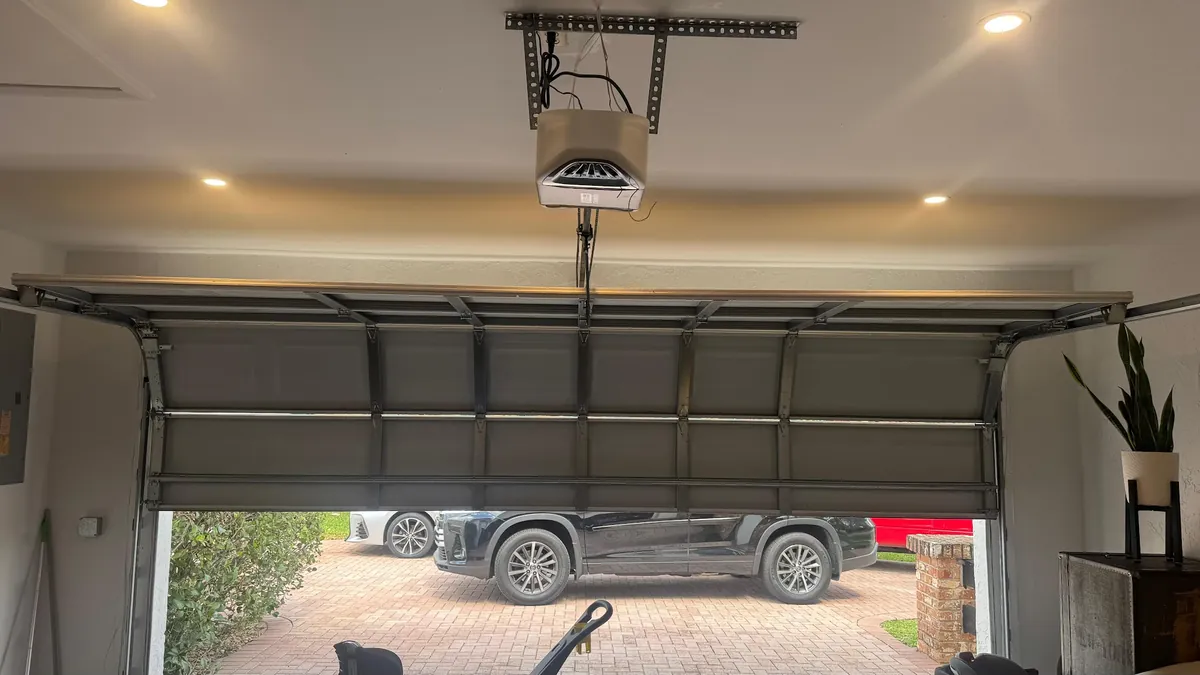
The motor in a garage you cannot hear from the house
Most single- and two-family houses across Wollaston, North Quincy and Squantum park the car in a separate building at the end of a modest driveway, and for most of them the opener is what turns that walk into a button press. It is also a piece of electronics living in an unheated shed, sometimes within sniffing distance of salt water, and asked to run a heavy steel door through every season. Our garage door opener repair in Quincy, MA looks after the whole system: the motor head and its gears, the rail and trolley, every handset and keypad paired to it, the wall button inside the garage with its thin run of wire, and the low-mounted pair of photo eyes that give permission for the door to close.
Three quick tests from inside the garage narrow it down:
- Try the button mounted on the garage wall. A door that responds to it, but not to the handset, has a remote or keypad fault rather than a motor fault.
- Watch the lamp on each sensor by the floor. A blink or no glow at all means the beam is broken or a sensor is unpowered.
- Listen at the motor head. A hum with no movement, a click with no hum, or total silence each point to a different part.
Opener faults on Quincy garages
Motor hums, door stays put
Often the nylon gear inside the head has lost its teeth, the carriage has locked up on its rail, or the door has grown too heavy for the motor to budge. The motor is trying; something downstream has quit.
Door closes, then pops back up
Something is tripping the safety reverse: a photo eye knocked off target, a panel snagging in its track, or a force limit set for the door as it used to be.
Remote works only at close range
Weak batteries, a damaged antenna on the motor head, or a handset whose code has drifted. Distance from house to garage makes range matter more here.
Keypad or wall button dead
A cracked keypad cover letting in rain, corroded terminals at the wall button, or a wire chewed or pinched along the joists.
Chain slapping or belt sagging
A drive that has stretched rattles along the rail and can jump off its sprocket. Tensioning or replacing it quietens the door and protects the gears.
Opener past saving
When the circuit board, the motor and the gears are all worn, a replacement unit is fitted and tuned to the weight it has to move.
Rail, trolley and arm: the opener’s moving parts
An opener is a carriage on a rail. The motor head hangs from the ceiling near the back of the garage, and a rail runs from it to a bracket above the door. A trolley shuttles along that rail, dragged by whichever drive the unit uses (chain, rubber belt or long threaded rod), and a bent steel arm couples the trolley to the uppermost panel. When you press a button, the motor turns, the trolley runs toward the head, and the arm hauls the door up its tracks. Reverse the motor and the trolley pushes the door back down.
Lifting dead weight is not its job. The door’s springs carry almost all of it, so the opener only has to overcome a little friction and inertia. That is why the first question on any opener call is whether the door itself is healthy. If a spring has broken or a cable has come off its drum, even a brand-new motor will strain, stall or reverse, and the real repair belongs on the door. The spring repair page for Quincy covers that side.
Inside the motor head sit a small circuit board, a radio receiver, a set of gears, and the limit and force controls. Limits are the opener’s memory of its two end points, fully raised and fully shut. The force setting tells it how hard to push before assuming something is in the way. Together with the photo eyes, those settings are what stop a closing door from crushing a car roof, a bicycle or a person, and they are checked on every visit.
The safety system, and why it gets the closest attention
Every opener should have two independent ways of stopping a closing door. The first is the photo-eye pair: a small transmitter on one side of the opening and a receiver on the other, mounted just above the floor, with an invisible beam between them. Cut across it while the door is lowering and the motor changes direction at once. The second is the force sensing inside the head: if the door meets resistance before it reaches the floor, the motor backs off.
Both can go wrong quietly. A sensor bracket gets knocked by a bin or a mower and the eye drifts out of aim, so the door refuses to close at all. A corroded wire at the sensor terminal gives an intermittent signal, so the door closes some days and not others. A force setting turned up years ago to push a sticky door through a bad patch may now be high enough to keep pushing against something it should have stopped for. None of these is visible from the driveway, which is why the safety reverse is tested at the end of every job, whatever the job was.
If your sensors are out of line and the door will not close, you can usually clear the problem by wiping the lenses and nudging the bracket until the lamp on the receiver goes steady. What we ask you not to do is bypass the sensors, tape them together, or turn up the force to make the door obey. Those shortcuts remove the only things standing between a heavy door and whatever is underneath it.
Salt, damp and an unheated building
Near Squantum the shore air is rough on anything metal, and an opener is metal wrapped around a circuit board. Moist, salt-laden air finds its way into the motor head through its vents, and over time it corrodes the connections on the board, the terminals where the wall button and sensor wires attach, and the contacts in a keypad mounted on the outside of the garage. The steel rail and its hanging brackets rust from the surface inward, and a trolley riding on a rough rail drags. Sensor brackets bolted near the bottom of the track sit closest to puddles and road salt, and they are often the first part to corrode loose.
The temperature swings in a building nobody heats are another quiet strain. Grease in the gears thickens on a freezing morning, so the motor works harder for the first few runs. Plastic gears grow brittle in the cold. Condensation forms inside the head when a cold garage meets a mild, damp day, and water and electronics do not mix. Whenever garage door opener repair in Quincy, MA takes us to a shoreline garage, the board, the terminals and the sensor brackets are inspected for corrosion even if the call was about a remote, because that is where the next failure usually starts.
Remotes, keypads and range from the house
A detached garage puts some distance between the car and the opener, especially when the car is still out on the street. Remotes have to reach the receiver through the garage’s own walls and door, and range that was fine on day one can shrink as a battery weakens, as the antenna wire on the motor head gets bent or tucked away, or as a metal-faced door or nearby wiring gets in the way.
Most remote problems are simple to sort out. A handset that has lost its code can be paired again, a cracked case can be replaced, and the antenna can be repositioned or extended. Keypads mounted outside take the weather head on; a cover that no longer closes lets in rain, and the buttons stop responding. Wall buttons fail less often, but their thin bell wire runs along joists and through framing where it can be pinched by a stored ladder or chewed by mice, and a break anywhere along that run leaves the button dead. Each of those is traced and fixed during a visit, and new handsets or keypads are paired before we leave.
When the motor head is completely silent
A garage that stands apart from the house draws its electricity through a cable run out from the main panel, and the opener usually plugs into a ceiling outlet on that circuit. Total silence, no lamp and no hum, often means the power never reached the head: a tripped breaker back in the house, a safety outlet in the garage that has cut out after a damp night, or a plug that has worked loose from its socket. Those are worth checking before anything else, and they are safe to check. If power is present at the outlet and the head is still dead, the fault is inside the unit, often a failed circuit board or a blown transformer, and that is where a visit begins.
What happens on an opener visit
The first step is always to take the opener out of the equation. A tug on the red release cord disconnects the door, which is then raised and lowered manually to judge its weight and balance. Should it prove heavy, crooked or tight in the track, that problem comes first; there is no point tuning an opener to fight a broken door.
With the door cleared, the opener gets the same treatment, one component after another. Power reaching the head is checked. The motor is run with the trolley disconnected to listen to the gears. The drive chain or belt is looked at for stretch and wear, the rail is checked for straightness and its brackets for rust and looseness, and the trolley is run along it. Each photo eye is checked for aim and for a sound connection, every button and handset gets pressed, and the limits and force are reviewed.
Nothing is swapped until you have heard the diagnosis and agreed the work. Repairs are then carried out, whether that is a new gear set, a new drive, a re-aimed sensor, a rewired button or a reprogrammed remote. The door is reconnected, the limits are set so it closes fully and stops cleanly at the top, the force is trimmed to the lightest push that still moves the door, and a block laid on the slab proves the door turns back when it meets one. Every garage door opener repair in Quincy, MA ends with that test carried out in front of you.
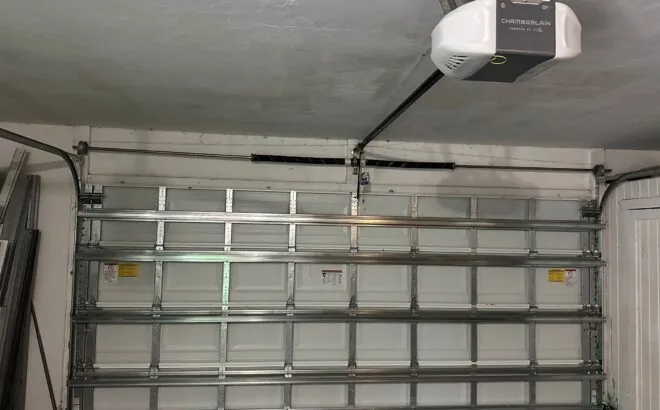
Repair the opener, or install a new one
Much garage door opener repair in Quincy, MA comes down to a straightforward fix: a worn gear, a stretched chain, a sensor that has lost its aim or a remote that needs pairing. Repair makes less sense when the board and the motor are both failing, when the unit is old enough that its safety system no longer meets what a modern opener provides, when replacement parts for it are hard to find, or when corrosion has spread through the head. In those cases a new opener is installed, mounted to the garage’s ceiling framing, connected to the door, and set up for that door’s weight and travel.
LiftMaster units are among the openers we fix and swap out on Quincy garages. When a new unit goes in, handsets and keypads are linked to it, the photo eyes are fixed and aimed, and we demonstrate the release cord so the door can be operated by hand during a power cut. Our main garage door opener repair page covers opener work across the region.
When the opener is the symptom, not the cause
Plenty of what gets reported as an opener fault is really the door complaining. A motor stalling midway may be battling a coil that has gone weak. One that reverses near the floor may be meeting a bent track or a seized roller. One that has burned out may have spent months lifting a door with a broken spring, because nobody noticed in a garage nobody visits until the car needs to leave.
That is why a door check comes before any opener work. If the door needs attention, our Quincy repair page explains how cables, rollers and panels are put right. Fixing the door first protects the opener that is there, or the new one that replaces it.
Small habits that keep an opener going
A few things are safe for any owner to do, and they extend an opener’s life:
- Once in a while, lay a roll of kitchen towel on its side beneath the door and close it. It should bump the roll and climb back up at once.
- Keep the sensor lenses clean and the space between them clear.
- Replace remote batteries before they fade completely.
- Keep the keypad cover closed so rain stays out.
- Listen for new noises at the motor head and the rail, and call before a grinding gear strips altogether.
Keep clear of the coil over the header, the lift cables and the corner brackets: they hold the door’s tension, and that is no place for a screwdriver.
Getting the opener looked at
Openers fail at awkward moments, often with the car inside and somewhere to be. The line is answered day or night, so a dead opener can be reported as soon as it lets you down, and if the door is jammed open or the car is trapped, the emergency page for Quincy covers what to do first. The Quincy area page lists every other service offered locally. For garage door opener repair in Quincy, MA, describe the noise or silence from the motor head, say whether the inside button and the handset behave alike, and mention the colour and state of the sensor lamps when you call us or book online.
Questions from Quincy
Our handset is dead, yet the button inside the garage still runs the door. Is the motor going?
Unlikely. Begin by fitting a fresh battery. Still nothing? Then the handset may have forgotten the code it shared with the motor, or the receiver’s antenna on the motor head may be bent or tucked out of reach. Both are quick to sort out on a visit.
Our door kisses the concrete, then rises again. What is going on?
The motor believes it has struck an obstacle. That can mean the close limit is set too far, the door is binding in its track near the bottom, or the force limit was set for a lighter, smoother-running door than the one now hanging there. A misaimed sensor usually stops the door closing at all rather than reversing at the floor.
Could I simply raise the force setting so it shuts?
Please do not. The force setting is part of the safety system, and raising it means a closing door bears down with more weight on whatever lies beneath, a car hood or a child included. If the door needs more force to close, something on the door is wrong and should be fixed.
Our garage is near the water. Does that affect the opener?
Yes. Salt and damp corrode the circuit board’s connections, the wire terminals, the outdoor keypad and the sensor brackets. On shoreline garages those parts are checked closely on every visit, and a corroded terminal can often be cleaned or replaced before it causes a failure.
How do I open the door during a power cut?
Find the red cord dangling from the trolley and pull it down; the door is now disconnected from the motor and can be raised manually. If it seems impossibly heavy, or settles back the instant you release it, suspect a broken spring: ease it down, keep it shut and phone us.