
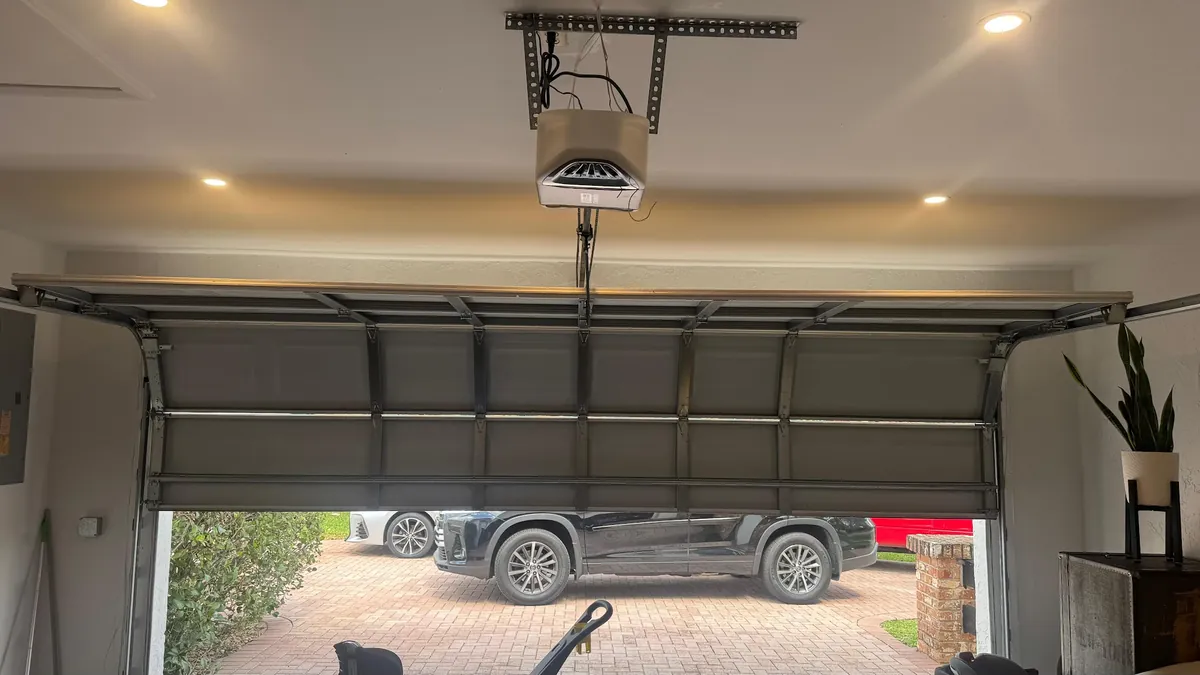
Two or three bays at the end of a long drive
Wellesley’s colonials tend to sit well back on wooded lots, with an attached garage of two or three bays at the far end of a long driveway. Each bay usually has its own door, its own pair of springs and its own opener, and many of those doors are dressed as carriage-house doors: overlay boards, decorative handles and strap hinges, and a band of glass lites in the uppermost panel. Work on garage doors Wellesley MA homes like these rarely involves one simple door. It usually means a set of them, side by side, ageing at different speeds.
The bay nearest the kitchen door does most of the work, while the far bay may hold a car that moves once a week, a lawn tractor or nothing at all. So one door can be worn out while its neighbour looks barely touched, even though both were hung on the same day.
What to notice before you call:
- Which bay is affected, and whether the others still run normally.
- Whether the door rises crooked, with one side leading, which points at a cable or a spring on one end.
- Whether leaves, needles or twigs have collected along the bottom of the vertical tracks.
Garage door services in Wellesley
Garage door repair
Hinges, rollers, track brackets, weather seals and sections on multi-bay garages, carriage-house doors included. The broad picture is on our garage door repair page.
Spring repair
A carriage-house door carries extra weight in its overlay trim, and its torsion springs work hard for it. When one lets go, keep away from it; the garage door springs page says why.
Openers, remotes and keypads
Two or three openers on one wall, remotes for several drivers, a keypad at the far end of a long drive. All of it is covered under opener repair and replacement.
Emergency calls
A bay that refuses to close as night falls, leaving the whole garage open to the dark. We take the call whenever it comes; see emergency garage door repair.
Cables and drums
A cable unspooled from its drum leaves a heavy door hanging lopsided in the opening. Read about cable repair.
Off-track doors
A fallen branch, a car nosed in too far, or rollers clogged with woodland debris can push a door out of its rails. See off-track repair.
New doors
Replacing one bay to match the others, or all of them at once, including carriage-house styling. See new garage door installation.
Several doors, several ages of wear
With two or three doors on one garage, the first job on any visit is working out which door is actually the problem, and whether its neighbours are heading the same way. Garage doors Wellesley MA owners call about are often a matched set that has stopped being matched: the everyday bay has made far more trips than the guest bay, and its springs, rollers and opener gear show it.
That raises a practical question when one spring breaks. Springs on the busy door have used up their cycles; springs on the spare door may have years left. There is no sense in replacing good parts on a door that barely moves, but it is worth checking the busy door’s partner spring, and the second-busiest bay, while the ladder is already up. A quick look at each door’s balance, cable condition and rollers takes little time compared with a second visit a month later.
Openers follow the same pattern. A garage with three openers usually has three different ages of opener, sometimes three different makes, each with its own remotes. If a car’s built-in buttons or a keypad have been programmed to several doors, a new opener on one bay means reprogramming just that bay, without disturbing the others.
Carriage-house styling and the weight it adds
Carriage-house doors are popular on Wellesley colonials because they suit the architecture: the look of two swing-out barn doors, built as an ordinary overhead sectional door that rolls up into the ceiling. The styling is applied to the face of each section, and it adds weight. Overlay boards, thicker frames, decorative strap hinges and handles, and glass in the top row all make the door heavier than a plain raised-panel door of the same size.
That weight matters for every moving part. The torsion springs have to be sized to the actual weight of the finished door, not a plain one. Cables and bottom brackets carry more load. The opener needs enough power to move the door smoothly without straining. And the top section, with its windows, needs to be handled carefully whenever the door is serviced, because glass panes in a moving door are the first thing to crack if the door is forced or drops.
Wooden carriage-house doors bring a second set of concerns. Wood swells in damp weather and shrinks in dry cold, so a door that runs sweetly in spring can bind in its frame in late autumn. Paint or stain that has worn through at the bottom edge lets water into the end grain, and the bottom section rots first. Composite and steel doors with a carriage-house face avoid most of that, though they still carry the extra trim weight.
Where the decorative hardware is purely ornamental, it is bolted to the face of the door and does nothing mechanical. The real hinges, rollers and brackets are on the inside, where they do the work. Loose decorative handles can be retightened, but they are never a sign of how the door itself is running.
Wooded lots: leaves, needles, branches and shade
Tall trees around a Wellesley lot are part of its appeal, and they also leave their mark on a garage door. Each October, oak leaves and pine litter drift into the lowest stretch of each upright rail, right in the rollers’ path, and pack down into a mat that the rollers have to climb over every trip. Twigs wedge behind the bottom seal. Sap drips onto the top of the door and the upper track, and dust sticks to it.
Shade has its own effect. A door in deep shade dries slowly after rain and holds damp longer in the cold months, which encourages rust on steel parts and rot on wooden ones. Moss and mildew grow along the bottom seal, and the seal stiffens and cracks sooner than one that dries in the sun.
Then there are branches. A limb that comes down in a storm can strike the face of a door, dent or crack a section, and in a bad case knock the door out of its tracks. If that happens, do not run the opener. A door out of its tracks is unstable, and the opener can drag it further out of line.
Simple upkeep goes a long way on a wooded lot:
- Once the last leaves are down, clear the lowest foot of every upright track with a brush or a leaf blower.
- Clear debris away from the bottom seal so the door closes flat.
- Wipe sap off the top of the door before it hardens.
- Watch for low limbs over the garage roof and the front of the doors, and have them trimmed by a tree service before they fall.
Springs on a heavy door: what not to touch
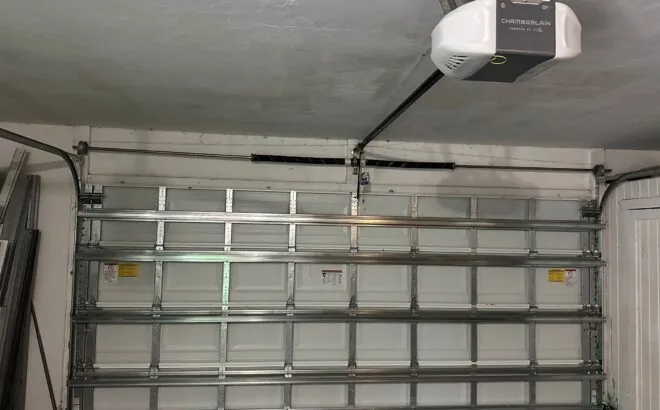
Most two- and three-car garages on colonials use torsion springs, mounted on a shaft above each door. On a heavy carriage-house door there are usually two springs per door. The springs are wound tight while the door is closed, and that winding is what makes a heavy, trimmed-out door feel light. A broken torsion spring, or one that someone tries to unwind with the wrong tools, can release that energy all at once. Torsion springs are dangerous, and they are not a DIY repair.
The signs of a broken spring are usually plain. A report like a gunshot from inside the garage, a door that the opener can only heave a hand’s width off the slab, a visible gap in one of the coils over the door, or cables lying loose against the door’s sides. If you see any of these, leave the door closed, pull the opener’s plug if it is within easy reach from the floor, and call.
When springs are replaced, they are matched to the door’s real weight, and on a door with two springs both are replaced together so that each side lifts evenly. Afterwards the door is checked for balance manually, and a well-sprung carriage-house door will float at mid-height without drifting.
Openers at the end of a long driveway
A long driveway changes how an opener is used. Remotes are pressed from further away, often from inside the car before it reaches the garage, and a weak remote battery or a poorly placed antenna shows up as a door that only responds when the car is almost at the bay. A keypad mounted beside a far-off door is exposed to weather and tends to fail before the opener does.
Typical opener complaints in Wellesley garages:
- A door that responds to the remote only close up, which can be a remote battery, an antenna or interference.
- One motor in the row droning away while its door stays put, usually a gear inside that has lost its teeth.
- Safety sensors misaligned by a garden cart or a stored bicycle, stopping the door from closing.
- A door that reverses partway down because the force setting no longer suits a heavy carriage-house door.
- A keypad that has stopped responding after a hard winter.
We repair and replace LiftMaster openers, and work on other makes as well. When a new opener goes onto a heavy door, it is set for that door’s weight and travel, and its safety reverse is tested before the job is finished.
How a visit runs
- The affected bay is checked first, without forcing it, and secured if it is open or partly open.
- That bay’s opener is unhooked, and the door is lifted manually to feel how evenly the springs carry it.
- Springs, cables, drums, rollers, hinges, tracks and seals are inspected, and the neighbouring doors are given a quick look while we are there.
- We go through the findings with you door by door, and nothing is started until you have chosen what to do.
- After the repair the springs are trimmed for balance, rollers and hinges get oil, and the opener’s limits, force and safety reverse are set.
Ahead of the appointment, pull the cars out of whichever bays need work, clear the area just inside those doors, and make sure the long drive is passable for a work van.
Replacing one door, or the whole row
On a garage with several matching doors, replacement raises a question that a single-car garage never faces: should one door be replaced, or all of them? If only one door is damaged beyond repair, a new door can be chosen to match the others as closely as possible in style, colour and window layout. When the existing doors are old and the style is no longer available, a close match may not exist, and replacing the whole row may be the only way to keep the front of the house consistent.
Replacement tends to be the right answer when:
- The bottom sections of wooden doors have rotted from water getting into the end grain.
- A falling limb or a vehicle has damaged more than one section.
- The doors are heavy, poorly insulated and hard on their openers.
- The style no longer suits the house after other exterior work.
New doors are supplied and installed, carriage-house styles among them, with springs and cables sized to each door’s real weight. The openers can often stay if they are in good order.
Snowbanks, plough ridges and the garage apron
A long driveway has to be cleared after every snowfall, and the snow has to go somewhere. Very often it ends up in a ridge across the apron in front of the doors, left by a plough blade turning at the top of the drive, or in banks heaped against the corners of the garage. A door closed down onto a ridge of packed snow cannot seal, and a door that tries to open while its bottom edge is frozen into that ridge puts all the opener’s force into tearing the seal or bending the bottom section.
The fix is mostly prevention. Ask whoever clears the drive to keep the area right in front of each door clear, and to push the snow away from the doors rather than toward them. If a door does freeze down, release the opener first so the motor cannot keep straining, chip or melt the ice clear of the bottom seal, and only then try lifting by hand. On a heavy carriage-house door, a frozen bottom edge is a good reason to wait for help rather than heave on it.
Meltwater is the other winter problem. Water running down a sloped drive toward the garage collects against the bottom seal, gets under it and freezes again overnight. On wooden doors it soaks into the bottom rail; on steel doors it eats at the steel corner brackets that anchor each cable. A seal that has gone hard and cracked lets more in each time. Replacing a tired bottom seal before winter ranks among the easiest ways to shield a door, and it is usually done at the same visit as any other repair.
For the larger garage doors Wellesley MA driveways lead up to, that winter wear is worth having checked each autumn, before the first heavy snow, so the springs, cables and seals start the cold months in good order.
Nearby towns
Wellesley sits between Needham and Weston, and their garages are covered on our Needham garage door page and Weston garage door page. For every town we work in, see our service areas.
A door that is stuck right now
A bay that will not close at night, a carriage-house door hanging crooked after a cable slipped, or a spring that has just snapped: leave the door alone, keep people and pets clear of the opening, and do not keep pressing the button. For garage doors Wellesley MA homes rely on to keep cars and storage secure, call us or book online.
Questions from Wellesley
One of our three garage doors stopped working. Should all of them be serviced?
The broken door comes first. While we are there, it makes sense to check the balance, springs and cables of the other bays, especially the one used most. Parts are only replaced where they need it.
Are carriage-house doors harder to repair?
The mechanics are the same as any sectional door, but carriage-house doors are heavier, so springs, cables and openers have to be sized for the extra weight. The windows in the top section also need care when the door is worked on.
Leaves keep collecting at the bottom of the tracks. Can that cause problems?
Yes. Packed leaves and needles make the rollers climb over debris, which strains the opener and can push a roller out of the track. Clearing the bottom of each track after leaf season prevents most of it.
Can you match a new door to the ones we already have?
Among the garage doors Wellesley MA colonials already carry, many styles are still made. Where a matching style, colour and window pattern can be supplied, yes. When the existing style is no longer available, we explain the closest options, including replacing the full row so the front of the house stays consistent.
A branch hit the garage door. Can we still use it?
Leave the opener switched off until someone has looked the door over. If the door is bent or has come out of its tracks, running it can make the damage worse and the door can become unstable.