
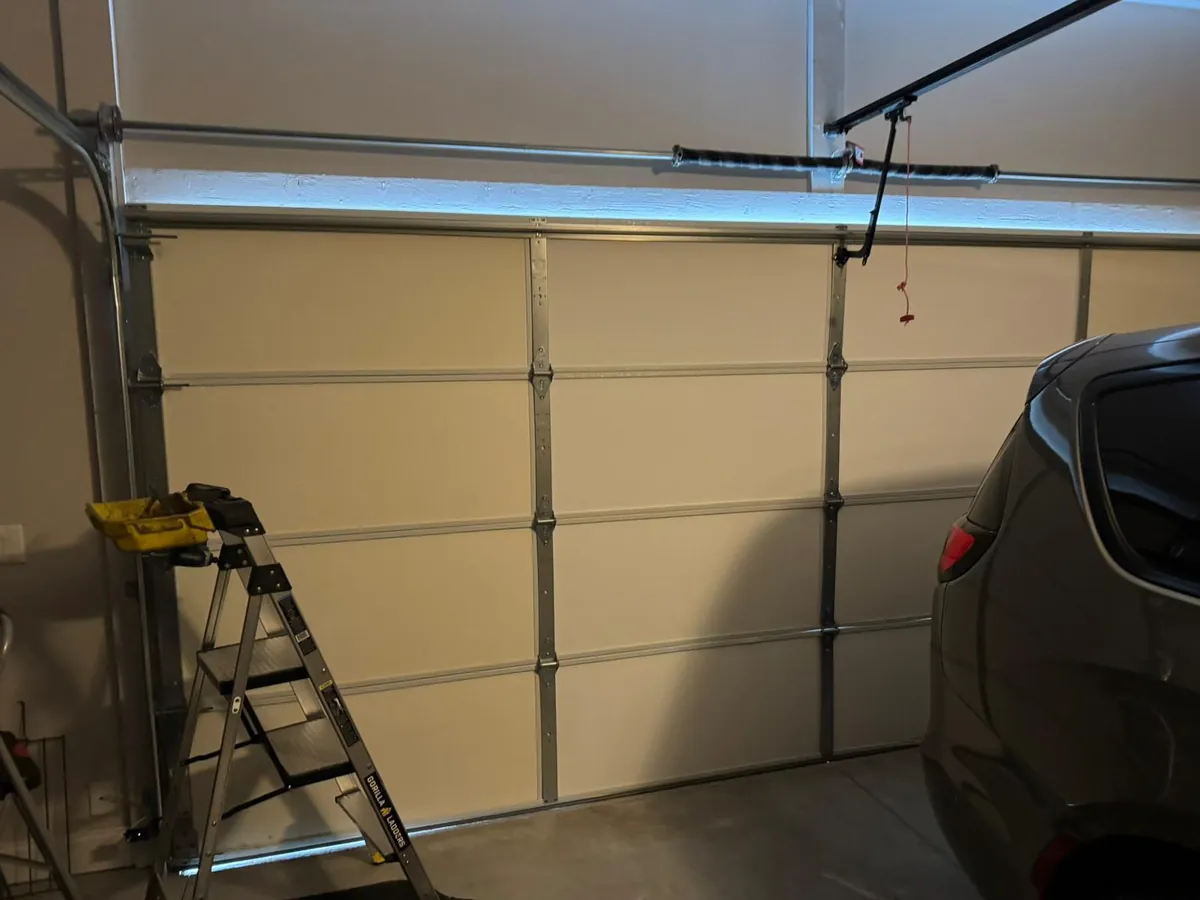
Why the doors in Chinatown take a beating
Chinatown has almost no private garages of the kind found in the outer neighbourhoods. The doors here are street-level roll-ups and the odd sectional door set into the ground floor of dense mixed-use buildings, mostly on the side streets off Washington. They guard loading entrances, storerooms and service bays, and many of them are raised and lowered far more often in a day than a family garage door is in a week. Our garage door repair Chinatown MA work starts from that: a door that cycles constantly, opens straight onto a sidewalk, and has to be working when the next delivery pulls up.
Before you call, three things can be checked from a safe distance:
- Whether the door moves at all from the wall button, or only hums.
- Whether the curtain or bottom bar sits level across the opening, or hangs lower on one side.
- Whether a slat, a guide or the bottom bar shows fresh damage from a truck, a cart or a pallet.
Parts a repair visit can cover
Springs in the barrel or on the shaft
A roll-up door hides its torsion springs inside the barrel above the opening; a sectional door carries them on a shaft. Either way, a tired or broken spring leaves the door too heavy to lift.
Cables and drums
Sectional doors hang from lift cables wound on drums at each end of the shaft. A frayed or slipped cable lets one side drop and the door twist.
Slats, panels and the bottom bar
Dented curtain slats, cracked sectional panels, a bent bottom bar and a torn bottom seal, the parts that meet carts, bumpers and weather first.
Openers and remotes
Operators that hum without moving, run in one direction only, or ignore the remote and the wall station.
Guides, tracks and rollers
Bent side guides on a roll-up, and tracks, rollers and brackets on a sectional door, including doors that have come out of line.
Safety sensors
The pair of photo eyes either side of the doorway, there so a closing curtain reverses before it reaches a person, a hand truck or a parked bumper.
A roll-up door is not a garage door in miniature
Most people picture a garage door as a set of hinged panels that rise on rollers and slide back under the ceiling. That sectional design does turn up on some ground-floor bays here, but the more common door on these side streets is a rolling door: a curtain of interlocking steel slats that winds up around a barrel mounted above the opening and sits inside a hood when it is fully raised. There are no horizontal tracks running back into the room, which is exactly why it suits a ground floor where the space behind the door is a storeroom, a corridor or a loading area rather than an empty bay.
The weight of the curtain is balanced by torsion springs inside the barrel. As the door comes down and unrolls, those springs wind tighter; as it goes up, they unwind and help the curtain coil back onto the barrel. The ends of each slat ride in vertical side guides fixed to the wall or the jambs, and a heavier bottom bar finishes the curtain and meets the ground. The operator, if there is one, sits at the end of the barrel or on a bracket beside it and turns the whole assembly through a chain or a gear.
Knowing which kind of door you have helps you describe the problem on the phone. A sectional door that will not open is often a spring or a cable. A roll-up that will not open is often a spring, an operator, or a curtain jammed in its guides. Garage door repair in Chinatown means being ready for both, because a single block can have a sectional door on one bay and a rolling door on the next.
Doors that open straight onto the sidewalk
On a suburban driveway, a door that misbehaves has a few metres of concrete in front of it. On the narrow side streets off Washington, a street-level door often opens directly onto the sidewalk, with pedestrians passing within arm’s reach of the bottom bar. That changes the repair in practical ways.
A door that drops unevenly, or creeps down on its own, is a hazard to anyone walking past, not only to the person operating it. Safety sensors and a working bottom edge matter more here than almost anywhere, and a photo eye jolted sideways by stacked crates deserves fixing at once, never bypassing. When the work itself starts, the area in front of the door usually has to be coned off or kept clear so that a curtain, a length of guide or a spring assembly can be handled without anyone walking underneath.
The exposure is also different. A street-level door takes splashes, grit, salt and slush from the road all winter, and the bottom bar and lowest slats corrode first. The side guides collect dirt at the base, which the slat ends then drag through on every cycle. Over time that grit wears the guides and the slat ends, and the curtain starts to bind or shudder near the bottom of its travel.
Working around loading access and delivery windows
In most of the outer neighbourhoods, the question when a door breaks is how to get the car out. Here the question is usually how to get the next delivery in. Loading access and delivery windows set the pace for a lot of buildings in Chinatown, and a door that is stuck shut when a truck arrives, or stuck open when the space has to be locked, is a business problem as much as a mechanical one.
That has a few consequences for how a repair is planned:
- Timing. If the door can still be operated safely, it can make sense to book the work for a quieter part of the day, away from the busiest delivery period, so the opening is not out of action when goods need to come through it.
- Access for the technician. The same narrow streets that make deliveries awkward make it awkward to park a service vehicle. Telling us where the door is, which street it faces and whether there is anywhere to stop nearby helps the visit go smoothly.
- What stays behind the door. If the door cannot be closed, the space behind it is open to the street. Making the opening secure is often the first job, before the full repair.
None of this changes the mechanics of the repair, but it changes the order in which things are done, and it is why describing the building and the door’s use on the phone is worth a minute of your time.
What a visit involves
Each visit looks at the whole door rather than only the component mentioned when you rang. Garage door repair Chinatown MA calls tend to come in describing a single symptom, and the cause is often somewhere else in the system.
- Making it safe. The operator is isolated so the door cannot run unexpectedly, and the stretch of sidewalk outside is cordoned off.
- Looking at the whole door. The springs are checked for breaks and for lost tension, the curtain or panels for damage, the guides or tracks for bends and loose fixings, the bottom bar and seal for wear, and the cables and drums on a sectional door for fraying or slack.
- Running it by hand where it is safe to. A balanced door should move without fighting back. A roll-up that is very heavy, or one that runs away downward, tells its own story about the springs.
- Checking the operator and controls. The operator is run on its own, the limits and force settings are looked at, the wall station and remotes are tested, and the sensors are checked across the opening.
- Explaining what was found. The fault and its cause are put to you in plain words, and nothing is changed until you have agreed.
- Repairing and testing. With the failed parts replaced, the springs are set so the door hangs balanced, it is opened and shut a good number of times under power, and an object is placed in its path to prove the reversing system works.
Springs that have lost their strength
On a door that cycles many times a day, springs do not usually fail all at once without warning. More often they lose tension gradually, and the door becomes heavier to lift, the operator strains more, and the curtain begins to drift down if it is stopped partway. Eventually a spring breaks, and the door either refuses to open or comes down hard.
A torsion spring, whether inside a roll-up barrel or on a sectional shaft, holds dangerous tension, and it stays loaded while the curtain sits shut on the ground. Releasing it, winding it or loosening anything that holds it is not a DIY repair and should be left to someone with the right tools and the training to use them. The garage door spring repair in Chinatown page explains how springs fail on these doors and what replacing them involves.
Curtains and guides that bind
A roll-up curtain that catches, shudders or stops at the same point on every cycle is usually telling you something about its guides. A bent guide, often from a vehicle or a cart, pinches the slat ends. A guide that has worked loose from its fixings lets the curtain wander. Grit packed into the bottom of a guide makes the last part of the travel rough.
On a sectional door, the same symptoms come from bent track, a cracked roller or a loose bracket. In both cases, carrying on running the door makes the damage worse: a pinched curtain can tear a slat end or pull a slat out of the guide entirely. Straightening or replacing the damaged length of guide or track, replacing broken rollers or slat ends, and realigning the door is the usual repair.
Doors that have come out of line
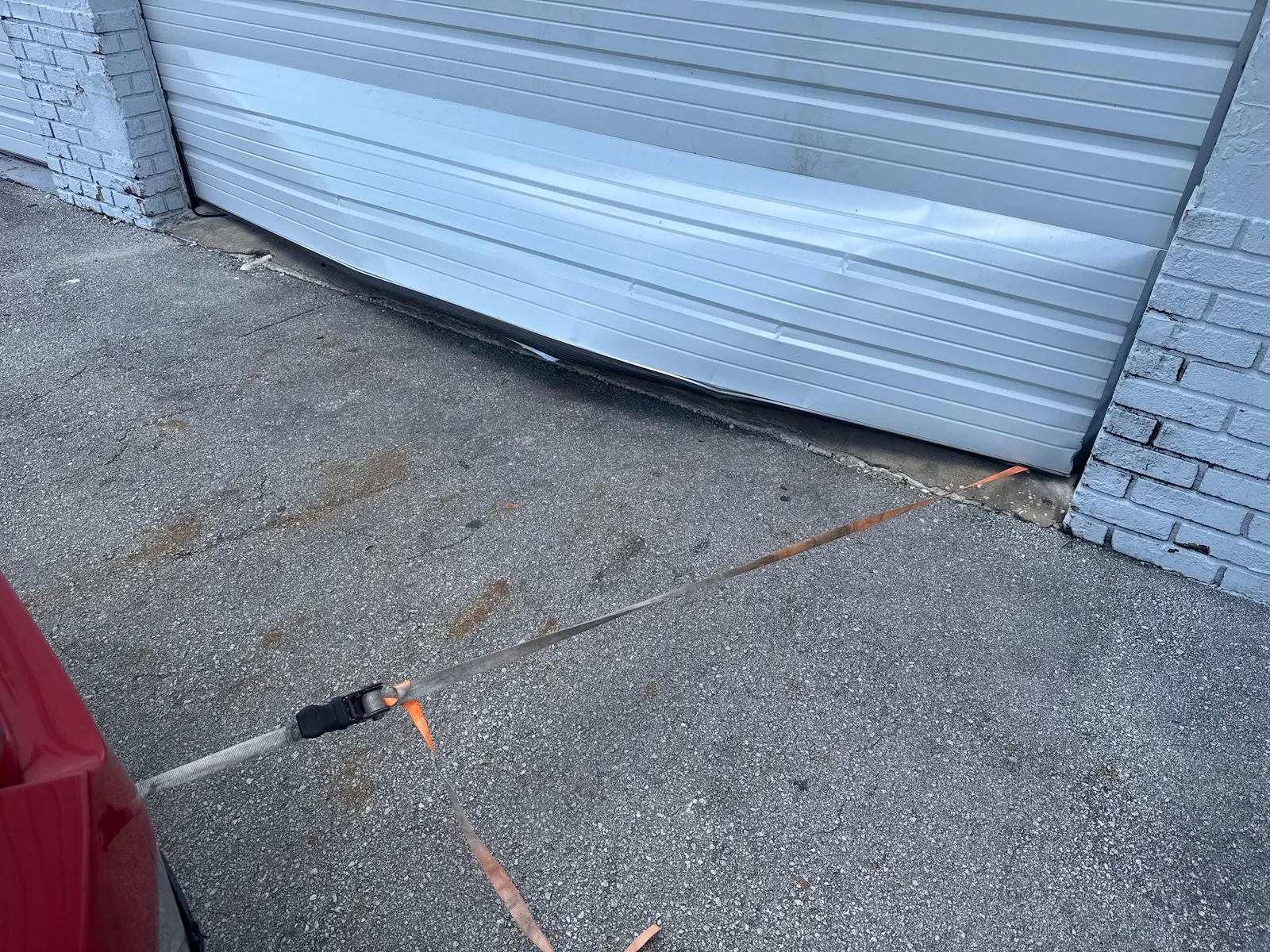
When a curtain jumps its guides, or a sectional door leaves its track, the door hangs crooked and is unstable. On a roll-up, a section of curtain may have torn out of a guide and buckled. On a sectional door, rollers may be hanging outside the rail and one cable may be slack. Either way, the door should not be run with the operator or forced by hand, because it can fall or bind further. The fix starts with supporting the curtain or panels so nothing can drop, then easing the slats or rollers back where they belong, straightening or renewing the damaged guide or track, and checking the door sits level before it is powered again.
Openers, remotes and wall stations
Many street-level doors here are opened from a wall station inside the building rather than a remote, and some have both. When nothing happens at the press of a button, the cause can be as simple as a tripped circuit or a damaged wall station, or as involved as a burnt-out motor or a worn drive. An operator that runs the door up but not down usually points to the sensors or the limit settings. An operator that hums but does not move may be fighting a broken spring, so the spring gets looked at before anyone blames the motor. The opener repair page for Chinatown goes through operators, remotes, wall buttons and sensors in more depth, and LiftMaster units are among the openers this work covers, for repair or replacement.
Panels, slats and the bottom of the door
The lowest part of any street-level door takes the most punishment. Bottom bars get bent by pallet jacks and bumpers, bottom seals tear and flatten, and the lowest slats or panels rust where salt and water sit against them. A damaged bottom bar stops the door sealing at the ground and can stop it closing fully, which may leave the operator reversing because it thinks it has met an obstruction.
A single damaged slat on a roll-up can often be replaced on its own by sliding it out of the curtain, and a single sectional panel can sometimes be swapped if a matching section is available. Bottom bars and seals are routine replacements.
Repair or replace
Most doors can be repaired, and most of the time repair is the right call. A spring, a length of guide, a few slats or a bottom bar keeps a sound door in service. Replacement starts to make sense when the curtain is rusted through in several places, when the slats have been patched so many times that the door no longer runs true, when the barrel or the guides are badly damaged along with the curtain, or when a sectional door has several panels beyond saving. You get a straight answer on whether your door is worth mending. For a curtain beyond rescue, read how we handle replacing a door in Chinatown.
A few checks you can make safely
Some things are safe to look at yourself first, and they can narrow the fault down:
- Make sure the operator has power and that the wall station has not been knocked or damaged.
- Wipe the lenses of the safety sensors and clear anything stacked in the beam between them.
- Look at the bottom of each guide for a crate, a wedge or packed debris.
- If the curtain has jammed halfway, switch off the operator’s supply so nobody can set it moving.
Keep your hands off the springs, the barrel, the cables and the brackets that anchor them, and never stand beneath a door that has stuck halfway up.
When a door fails out of hours
Doors on loading entrances do not choose a convenient time to break. If a door will not close at the end of the day, or will not open before the morning delivery, ring as soon as you find it: a person answers at whatever hour you ring, seven days running. The emergency garage door repair page for Chinatown covers what happens on an urgent call.
Arranging the work
On the phone or the booking form, mention what kind of door it is, roll-up or sectional, what it is doing or failing to do, whether anything looks visibly broken, and whether the opening is currently secure. Mention the street and any delivery times the repair needs to work around. For garage door repair Chinatown MA, your next step is to call us or book online. Our garage door repair hub lists every kind of fix, and the Chinatown page covers each local service.
Questions from Chinatown
Do you repair roll-up doors as well as sectional doors?
Yes. Rolling steel doors and sectional doors are both repaired, on commercial premises and residential buildings alike. The springs, guides, curtain, bottom bar, operator and sensors on a roll-up are all covered.
Our shutter rises fine but refuses to close. Why?
On a powered door the usual culprit is the pair of safety sensors, blocked by a box, filmed over with grime, or nudged out of alignment. It can also be a limit setting or a fault in the bottom edge. Check the beam and lenses first; if the door still will not close, isolate the operator and call.
Can the door be repaired outside our delivery window?
In most cases, yes. Tell us when the opening is busiest and when goods are expected, and the visit can be planned around it where the door can still be run safely in the meantime.
Our door is loud and shudders near the bottom. Is it about to fail?
Not necessarily, but it is worth looking at. Shuddering near the ground usually means grit in the guides, worn slat ends or a bent section of guide. Left alone it tends to get worse and can damage the curtain, so it is better dealt with early.
Is garage door repair in Chinatown different from the rest of Boston?
The parts are the same; the doors are mostly commercial roll-ups at street level, and the work is shaped by sidewalks, narrow side streets and delivery times rather than by driveways.