
Newer openers on wide doors: what goes wrong and why
Openers in this part of the city tend to be recent models. The single-family homes on and off Centre Street, and up toward Bellevue Hill, mostly have attached garages, wide driveways and double doors, and the motors driving them are commonly quiet belt units with keypads, app control and battery backup. Those features are welcome, but they add layers that can fail, so garage door opener repair west roxbury ma owners ask about is often a sensor, a setting or a lost code rather than a burnt-out motor.
A good opener does a surprising amount of thinking. It counts how far the door travels, measures how hard it has to push, watches the beam across the bottom of the opening, listens for its handsets and, on many units, talks to a phone. When any one of those checks fails, it stops and flashes a light, which can look exactly like a dead unit from the doorway.
Before ringing us, three quick looks will tell us a great deal:
- Do the opener’s own lights come on when you press the wall console, or is the unit completely dark?
- Is a small light on either photo eye, low beside the opening, blinking or out?
- Does the motor run with the door staying put, or does the door start and then reverse?
Openers, controls and sensors we look after
Opener units
Chain, belt and screw-drive openers, along with wall-mounted jackshaft units beside the door. We work on LiftMaster units too, repairing them or putting in a replacement.
Remotes and car buttons
Handsets that have lost their code, buttons built into a car’s visor or mirror that need pairing, and remotes whose range has shrunk to the end of the drive.
Wall consoles and keypads
The control by the house door, often with its own light and lock switch, and the outdoor keypad on the trim beside the opening.
Safety sensors
The two photo eyes on either side of a wide opening, their brackets and wiring, and the alignment that keeps a closing door from touching anything in its path.
Rails, trolleys and arms
The rail from the motor to the header, the trolley that rides along it, and the arm linking it to the top section of the door.
Motor and springs: who does the lifting
An opener is not a crane. A sectional door weighs far too much for any residential motor to lift on its own; the springs carry nearly all that weight, and the opener’s real job is steering a door that the springs have rendered nearly weightless, then halting it safely. On a double-width door, that balance matters even more, because a slight imbalance across a long panel turns into a heavy load at the motor.
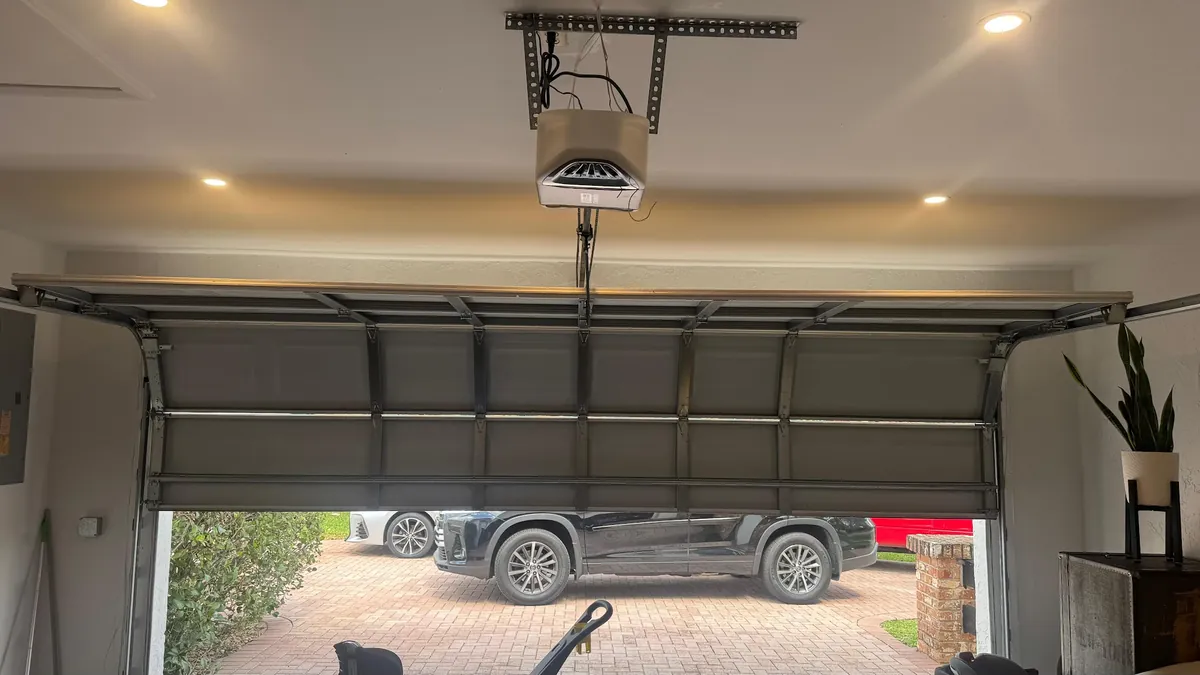
The opener’s arm connects to a bracket on the top section. Press the console and the motor sends a belt, chain or threaded rod along the rail, or rotates a jackshaft mounted beside the door, and the trolley tows the arm and door behind it. Limit settings mark the two ends of the journey, floor and fully raised. The force setting is the opener’s tolerance: the amount of push-back it will put up with before it assumes an obstruction and backs off.
This is why the first thing we test on any opener call is the door, not the opener. With the opener’s release pulled, a balanced door lifts easily by hand and stays put halfway up. If it does not, a spring or cable is at fault and the opener has simply been protecting itself. For that half of the story, see the West Roxbury spring repair page.
The faults we find most often
A few complaints come up again and again on the attached garages here. Each tends to point somewhere particular.
The door starts closing, then goes back up. Usually the sensors: one has been knocked, the lenses are dirty, or the low sun is shining straight into one of them. If the sensors are clear, the close limit or force setting may need resetting, often after the door itself has shifted or settled.
The unit whirs away and the panel never budges. On a chain or belt unit, the trolley may have been released and not re-engaged, the drive gear inside the head may be stripped, or the belt or chain may have slipped. On older units a worn gear is the common cause.
The door lifts a hand’s width and gives up. Nearly always the door, not the opener. With a spring snapped, the panel is suddenly far heavier than the opener will accept, and it quits.
A handset has died while the console by the house door still works. A flat battery, a handset that has lost its pairing, or, occasionally, a new nearby signal causing interference.
Total silence from the unit. The opener has no power, the wall console’s lock switch has been turned on, the console wiring has come loose, or the logic board has failed.
The opener is far louder than it was. A loose rail, a slack chain, a worn trolley, or a door whose rollers and hinges are dry and dragging.
Why sensors on wide doors need care
The two photo eyes on a double door sit much further apart than on a single, at opposite sides of a wide opening. The beam has a longer path to travel, and the brackets holding the sensors on a long run of trim are easier to knock out of line with a bin, a bicycle or a car door.
Alignment is the most common sensor fault we see. When the eyes cannot see each other, the opener will raise the door but refuse to close it, often with a flashing light. Each sensor has a small light that shows its status, and the pattern of those lights is the first clue to what is wrong.
The wiring is the second. Sensor wires run along the wall at floor level, where a broom, a mower or a stored ladder can pinch or cut them. On attached garages, where the space is often used for storage as well as cars, damaged sensor wiring is a regular find.
Sun can also play a part. A sensor facing open sky can be dazzled at certain times of day, and the door may refuse to close only in the late afternoon. Swapping the sensors from side to side or shading the receiving eye usually solves it.
What a visit involves
Whatever the reported problem, the visit follows a clear path:
- Door before opener. We pull the release and raise the panel ourselves to feel its balance, so a spring or cable fault is never blamed on the motor.
- Controls and sensors checked. The wall console, keypad, remotes and photo eyes are tested, along with the wiring between them and the opener head.
- The opener itself. The drive, the trolley and rail, the limits and force settings, and, where needed, the inside of the unit are inspected.
- You hear the findings. We explain the cause and whether the opener is worth repairing before doing the work.
- Repair or fit, then set up. Parts are replaced, or a new opener installed. The limits, force setting and safety reversal are then set, remotes and keypads are paired, and the door is run until it opens and closes cleanly.
Testing the reversal matters. A closing door that meets an obstacle has to reverse, and part of every garage door opener repair west roxbury ma visit is checking that it does, with the sensors and with the force setting.
What you can safely check yourself
Openers are among the few parts of a garage door that a homeowner can safely look at. Before booking:
- Make sure the unit has power: plug a lamp into the ceiling outlet, then look at the breaker panel.
- Many consoles carry a lock button that shuts out every handset; make sure it has not been pressed.
- Change the batteries in the handset and in an outdoor keypad.
- Wipe both sensor lenses and check that each sensor’s light is steady.
- If the trolley has been released with the cord, pull the door by hand until it re-engages, or run the opener and let it reconnect.
What is not safe is anything to do with the springs, cables or bottom brackets, which are under heavy tension. If the opener problem turns out to be a door problem, leave the door down and call.
Repair or replace the opener
Most opener problems are repairs. On a unit that is basically healthy, a new sensor pair, console, keypad, handset, gear kit, trolley or circuit board puts it right, and that is usually where we start.
A new opener becomes the better answer once the motor has burnt out, once parts for that model have become hard to source, or when an older unit lacks the safety reversal and photo eyes that modern doors depend on. It is also worth weighing on a double door with a heavier panel, an insulated upgrade or added glass, where the opener may now be working harder than it was matched for.
On attached garages, many owners also choose to replace a noisy chain unit with a quieter belt drive, because the sound carries into the rooms next door. Others want battery backup so that the door still runs in a power cut, or app control so they can check from a phone that the door is closed. Each garage door opener repair west roxbury ma call where the unit cannot be saved ends with an explanation of the options.
Double doors and the opener they need
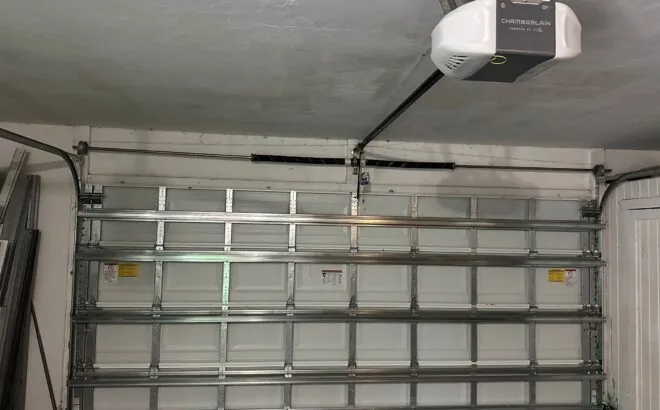
A two-car door asks more of its opener than a single. The panel is longer and heavier, the top section flexes more where the arm pulls on it, and any imbalance in the springs is multiplied across the width. Many double doors carry a steel strut across the top section so the arm’s pull does not bow it; where that strut is missing, a cracked top panel or a bent opener bracket is a common find.
The size of the motor matters too. An opener that suited a lighter door may struggle once a heavier insulated door has gone in, or once glass has been added to the top row. The signs are a unit that slows near the top of its travel, a motor that runs hot, and a door that reverses on the way up for no visible reason. Any garage door opener repair west roxbury ma owners book on a double door starts by checking the opener is a fair match for the door it drives.
Attached garages here usually have reasonable headroom, so a conventional ceiling unit fits. Where a room sits over the garage, though, a ceiling-mounted opener passes its vibration straight into the floor above. A jackshaft unit, mounted on the side wall and turning the spring shaft directly, keeps the ceiling clear and moves the noise away from the room upstairs. It suits torsion-spring doors and is worth asking about if a replacement is on the cards.
Keypads, car buttons and the wide driveway
A wide driveway changes how an opener is used. People tend to open the door from the car while still out on the street end of the drive, so remote range matters more than on a short city lot. When a handset that used to work from the road now only works close to the door, the cause is usually a weak battery, an aerial on the opener head that has been bent or tucked away, or a new source of interference nearby.
The outdoor keypad on the trim beside the opening takes the brunt of the weather. Its buttons wear, its battery runs flat in the cold, and water can work in behind the cover. Replacing a failed keypad and setting a new code is a short job. Car buttons built into the mirror or visor need to be paired with the opener, and on newer openers with rolling codes the pairing steps have changed; we set those up during the visit.
Power cuts and battery backup
A power cut traps a car behind any door without a battery-backed opener. In that situation the release, a cord with a red knob dangling from the trolley, uncouples the trolley, after which the door can be raised manually, provided no spring is broken. Once power returns, run the opener and it will normally pick the door up again.
If your opener has a battery backup, the battery itself wears out over time and should be replaced when the unit warns you. A backup that has failed silently is a common surprise in the first winter storm. If a spring has snapped, leave the release cord alone: the moment it is pulled, the door falls.
Attached garages: noise, security and the house door
Because most garages here are joined to the house, opener faults affect daily life more than on a detached garage. A rattling chain or a grinding gear carries through the framing, and a door that refuses to close leaves the house open through the inner door. Garage door opener repair west roxbury ma homeowners need is often prompted as much by noise or by a door that will not shut at night as by a complete failure.
Security features on newer openers help here. Rolling-code remotes, keypads with changeable codes and openers that report the door’s status to a phone all reduce the risk of the garage being opened without you knowing. If you have moved into a house with an existing opener, it is wise to clear the old remote codes and pair your own.
Booking an opener repair
An opener that stops working usually does so when you are heading out or coming home late. Calls are taken at any hour, on weekdays and weekends alike, so the problem can be described the moment it shows itself. If the door is stuck wide and refuses to come down, read our emergency repair advice for West Roxbury first. For problems with the door itself, see the West Roxbury garage door repair page, and for the full range of opener work, our main opener repair and replacement page. The West Roxbury page collects every service we offer locally, and if the opener is a LiftMaster, our LiftMaster opener repair page covers it.
It helps to know the type of opener, whether it is chain, belt or a unit on the side wall, what the lights on the opener and sensors are doing, and whether the panel will shift when pushed by hand. Scribble that on the back of an envelope. With the envelope scribbled, call us or book online.
Questions from West Roxbury
Our opener is fairly new. Why has it stopped closing the door?
New openers are strict about safety. Most often, one photo eye has been nudged off its aim, a film of dust is clouding a lens, or the low sun is shining into it. Both eyes should show a solid light. Where they do and the door keeps bouncing back, the limits or force setting probably want resetting.
There is a humming from the opener and no movement. Why?
Three usual suspects: the trolley has been unhooked from the rail, the drive gear inside the head has worn its teeth away, or a spring has failed and the panel now weighs more than the motor will accept. Resist the urge to keep jabbing the console. Pull the plug on the unit and book a check.
Can you set up the keypad and our car’s built-in button?
Yes. Pairing remotes, keypads and car buttons, and clearing old codes from a previous owner, is part of opener work.
Is a belt drive worth it on an attached garage?
Many owners find it is, because a belt is much quieter than a chain and the noise does not carry into the rooms beside the garage. We will talk through the choices if the existing opener is beyond repair.
Can I fix an opener problem by adjusting the springs?
No. The springs and cables carry dangerous tension, and work on them is never a DIY task. If the opener is struggling because the door is out of balance, leave the door down and call; you can safely check power, batteries and sensors.