
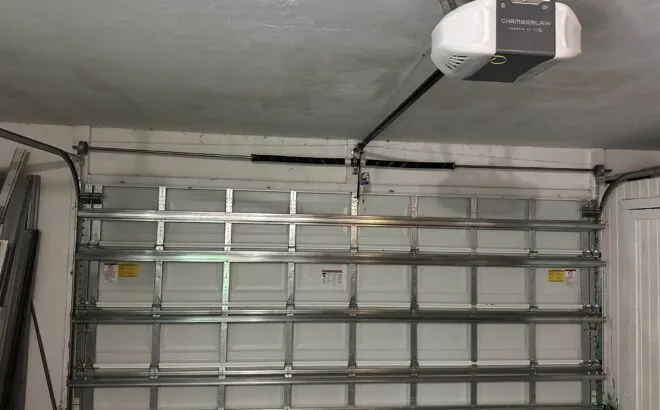
Springs, salt air and the small garages of East Boston
A garage door spring does nearly all of the lifting, and near the harbour it does that work in damp, salty air that eats into bare steel. No wonder garage door spring repair in East Boston comes up so often, whether the door hangs in a cramped garage out behind a triple-decker on Eagle Hill or in Orient Heights or in a newer Jeffries Point townhouse garage. We replace broken torsion and extension springs and set the door up again so it lifts evenly.
You can usually tell a spring has gone without touching anything:
- A loud bang from the garage, often on a cold morning, with nothing visibly fallen.
- A torsion spring above the door showing a clean gap of a couple of inches between two coils.
- A door that rises a hand’s width under the opener and then stops, or feels like solid lead when lifted by hand.
Which spring does your door have?
Torsion springs
Wound coils on a steel bar across the top of the door, turning drums at each end. They twist as the door closes and give that energy back as it opens.
Extension springs
Long springs running beside each overhead track, stretched as the door closes. They pull on the door through pulleys and cables.
Single or paired
Many single-car doors run on one torsion spring; heavier doors use two. On a pair, when one goes the other is usually close behind.
Safety cables
On extension springs, a cable threaded through the middle of each spring stops it whipping across the garage if it breaks. Doors without them need them.
How a broken spring shows itself
Springs rarely give a polite warning. Most of the time, the first sign is the noise: a spring under load that cracks through releases its energy all at once, and the sound in a small garage is like a dropped steel plate. If the door was closed at the time, it stays closed, and the next press of the remote produces a short, strained lift before the opener gives up. If the door was open, it may come down faster than it should, because nothing is holding it back.
A spring on the way out shows earlier hints. Lifting by hand takes more effort than last season, the door drifts downward when left half open, or it refuses to hold any position. The opener sounds as if it is working harder. On a torsion spring, rust and a rough, scaly surface on the coils are signs that the steel is under strain. On an extension spring, coils that have stretched apart and stopped closing up tight when the door is open are a sign it has lost its pull.
When any of that turns up, garage door spring repair in East Boston is best done before the spring lets go completely, since a break with the door open can bring it down hard.
Why springs fail sooner near the harbour
Much of the garage door spring repair in East Boston comes down to two things, cycles and salt. Every spring is built for a number of open-and-close cycles. Each cycle flexes the steel a little, and eventually the metal tires and cracks. Salt air shortens that life in two ways.
First, rust roughens the coil surface. A spring is under stress all the time, and corrosion pits on the surface are exactly where cracks like to start. A spring that might have lasted many more years inland can fail sooner when it lives in a damp, unheated garage a short walk from the water.
Second, rust adds friction between the coils. A torsion spring’s coils rub against each other as it winds and unwinds, and when that rubbing is on rough, rusted steel the spring works harder and wears faster. You can often hear this as a creaking or grinding from above the door.
Cold makes things worse. Steel is more brittle on a frozen morning, and the first few hard frosts of the season are when a tired spring is most likely to break. Out in the unheated single bays behind the triple-deckers, the spring sits at outdoor temperature all winter.
A thin coat of garage door lubricant on the coils of a torsion spring a couple of times a year slows corrosion and quietens the spring. Wipe off the excess so it does not collect dust.
Leave spring work to us
This section matters more than any other on this page. Throughout the door’s travel, a torsion spring holds dangerous tension. Winding or unwinding one means turning its cone with steel bars against everything the coil has stored. Should a bar slip, or a set screw is loosened without a bar in place, the cone spins and the bar or the spring end can strike whoever is standing there. A torsion spring swap is not a DIY repair, however simple it looks in a video.
Extension springs carry their own kind of danger. They are under the most tension when the door is closed, and one that snaps with no safety cable inside it can be flung across the bay. Undoing the pulleys or the hook at the end of an extension spring while the door is down releases that tension.
The cables, and the brackets at the foot of the door that anchor them, are loaded too. Undo a fixing there and a cable can let go with real force.
What you can safely do:
- Stop using the opener and unplug it, so nobody presses the button again.
- Keep the door where it is. If it is open, keep cars and people out from under it.
- Look at the spring from the floor to see whether it is a torsion spring above the door or extension springs beside the tracks, and whether there is a gap in the coils. That helps when you call.
What a spring repair visit involves
- The door is made safe. The opener is unhooked and the door clamped in place so it stays put during the work.
- The spring is identified and measured. The wire size, the length and the inside diameter of the spring, the direction it is wound and the weight and height of the door decide what replacement fits. A spring that is wrong for the door leaves it too heavy or makes it fly up.
- The old spring is unwound or released with the proper tools, in the correct order.
- The new spring goes on. Where a door has two torsion springs, the pair is normally renewed at once, keeping wear and balance even.
- The cables, drums and bottom brackets are checked, since the jolt of a breaking spring can unseat a cable or bend a bracket.
- Balance is checked. Lifted by hand, the door should rise with modest effort and hover when released halfway. Only then is the opener hooked back up, its force and travel adjusted to the new spring, and its reversing tested.
Nothing is started until you know what broke and what the fix involves.
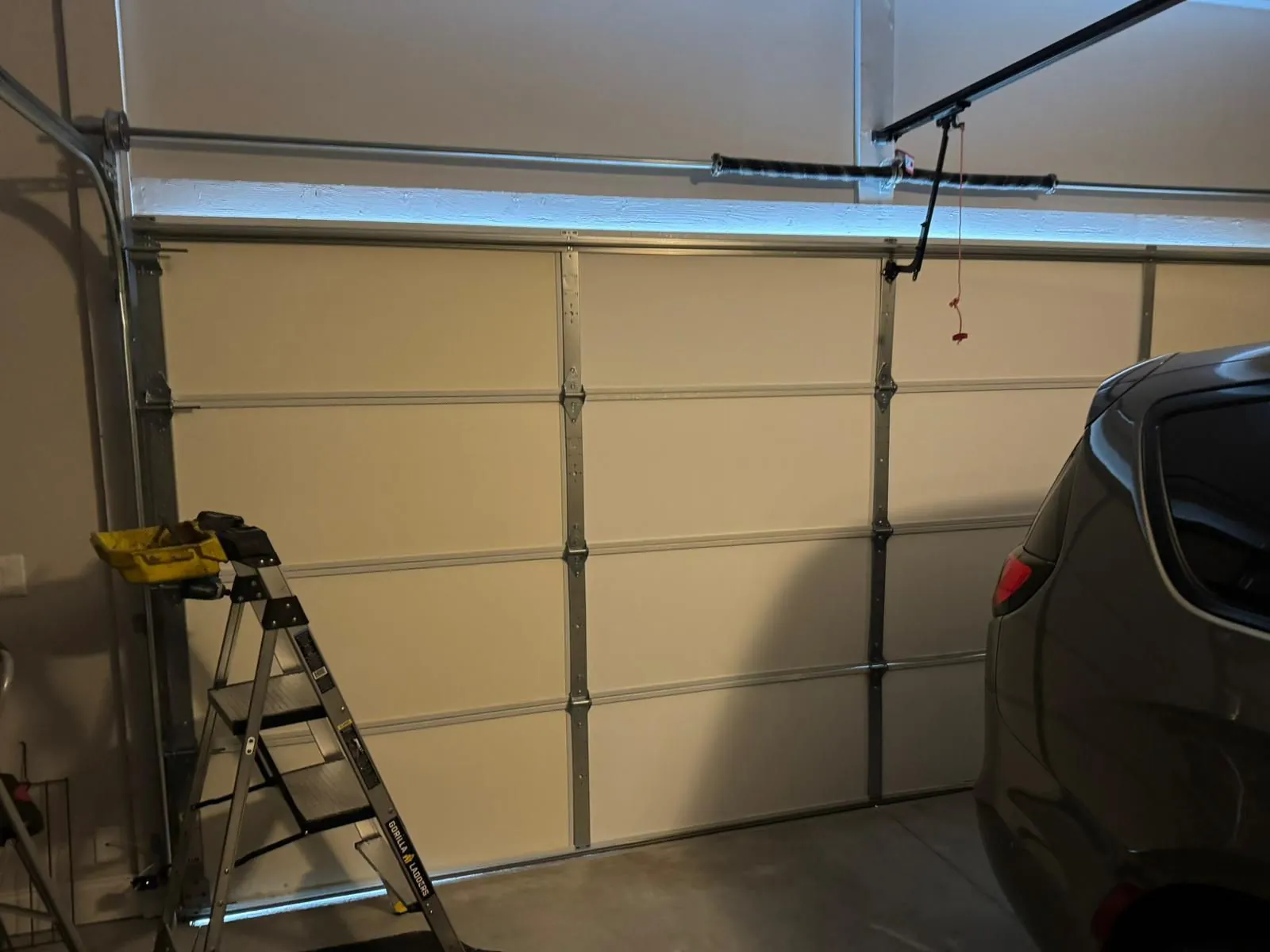
Springs on Eagle Hill and Orient Heights garages
Garages behind the triple-deckers tend to be cramped, with little clearance over the door. Low headroom limits where a torsion assembly can sit, and in some of these garages the door runs on extension springs along the side tracks because there was never room for a bar across the top. Either way, the space available makes the job more careful rather than more difficult: winding bars need room to turn, and stored items along the walls need to be moved away from the tracks before the spring work starts.
Many of these doors are opened by hand every day, especially in garages without a dependable power supply. A hand-lifted door puts every cycle straight onto the spring, and when that spring weakens, lifting the door turns into a two-handed struggle. A door that suddenly feels much heavier than last week has a spring problem, not a stiffness problem, and should not be heaved open.
Extension springs on older detached doors
Where a detached garage runs on extension springs, look for the safety cable running through the middle of each spring, fixed at either end. It is there to catch the spring if it breaks, so the broken halves cannot whip across the garage. Older installations sometimes have none, or have cables that have rusted through. Fitting new extension springs is the moment to put safety cables in, and the pulleys and hook ends are checked at the same time, since a cracked pulley or a worn S-hook fails much like a spring does. Extension springs also stretch their way out of shape over time; a pair where one hangs visibly longer than the other is pulling the door up unevenly.
Springs on Jeffries Point townhouse garages
Garage door spring repair in East Boston is just as common on the newer townhouse garages, which are usually opener-driven and get used several times a day, which runs up the cycle count quickly. Because these garages sit close to the water, the springs see the same salt exposure as the older bays on the hill.
When a spring breaks in a garage built into the house, the opener is often the next thing to suffer. It keeps trying to lift a door it was never designed to carry, strips gears or burns out its motor, and the household ends up needing two repairs. Unplugging the opener as soon as you hear that bang protects it.
Matching a spring to the door
A replacement spring is not picked off a shelf by eye. Every door has a weight, a height and a drum size, and the spring has to be wound to a strength that balances that weight exactly. Too weak, and the door is heavy, the opener strains and the door drifts down when stopped halfway. Too strong, and the door shoots up, will not stay closed without the opener holding it, and puts extra load on the cables and the top brackets.
Several things are measured to get it right. On a torsion spring, wire gauge, coil diameter measured inside, the overall length and the direction of the wind all matter, and a left-wound spring will not do the job of a right-wound one. On extension springs, the length and the colour coding or rating tell you how much pull they give. The door’s own weight is worked out from its size and what it is made of, and a door that has had panels replaced, a window section added or water soaked into old timber may weigh more than it did when it was new.
Doors that have been patched over the years with mismatched springs are common in older garages. One spring stronger than the other on an extension-spring door pulls the door up unevenly and wears the rollers on one side. When a spring is replaced, it is matched to the door as it is today, not to whatever was fitted before.
Signs a spring was set up wrong
Some doors have springs that never broke but were never right either. A door that will not stay down without the opener holding it, one that flies the last few feet up and bangs into its stops, or one that takes real effort to lift by hand even though nothing is broken, was probably given the wrong spring or the wrong tension at some point. So was a door where the opener struggles to close against springs that are pulling too hard.
These faults wear the rest of the door out early. Cables stretch, rollers wear flat on one side and opener gears strip. Setting the spring up properly is often the fix for a door that seems to have a different problem every few months.
Replacing one spring or two
Two torsion springs on one door went in together and have lifted the door exactly as many times as each other. Once one gives up, its twin is living on borrowed time, and a door with one new and one old spring is harder to balance. Replacing the pair is the sensible choice in most cases. Extension springs are likewise replaced in pairs, one on each side, so the door is pulled up evenly.
On a single-spring door, the question does not arise, but the drums and cables still get a look, since a spring that snaps can unspool a cable from its drum.
When the spring is not the only problem
Often a snapped spring is the whole story. Sometimes the inspection finds more: a cable frayed by salt, rollers seized in a rusted track, or an opener that has been straining against a weak spring for months. Those are mentioned so you can decide whether to deal with them on the same visit. For the rest of the door, see general repairs in East Boston; for an opener hurt by a spring failure, see East Boston opener work.
If the door itself is in poor shape, with rusted-through sections or a waterlogged wooden door too heavy to balance, new springs may not be worth fitting. When replacing the whole door makes more sense is set out under new doors for East Boston.
More on spring repair
The main spring repair page covers spring work across Greater Boston. If a spring goes at night with the car shut in or the door left open, read the East Boston emergency repair page. Every service offered locally is gathered on the East Boston page.
Arranging a spring repair
Springs choose their own time to break, and it is usually not a convenient one. The phone gets answered at any hour on any day, which means a snapped spring can be reported the moment you hear it. Tell us whether it is a torsion spring above the door or extension springs beside the tracks, which position the door is stuck in, and whether a car is shut in. Whenever you need garage door spring repair in East Boston, by night or by day, call us or book online.
Questions from East Boston
I heard a bang in the garage but the door looks fine. What happened?
Almost certainly a spring broke. With the door closed, it can look completely normal until someone tries to open it. Look at the spring above the door, or the springs beside the tracks, for a gap in the coils, and pull the opener’s plug so no one runs it by mistake.
Can I heave the door up by hand to get the car out?
Not while the spring is broken. With no spring, the door’s entire weight bears on the person lifting, and it may drop at any moment. Leave the door closed and call for the spring to be replaced first.
Why do springs seem to break in winter?
Frost makes spring steel more brittle, and the first hard frosts often finish off a spring that was already tired. In the unheated detached garages behind the triple-deckers, the spring is at outdoor temperature all season, and salt from the harbour air has usually roughened the coils.
One spring broke. Should both be replaced?
On a two-spring door, usually yes. Both have worked through identical cycles, so the survivor is near its end as well, and a matched pair keeps the door balanced.
How can I make my new springs last longer near the water?
Keep the coils lightly lubricated with a garage door lubricant a couple of times a year, wipe off the excess, and make sure the door is balanced so the opener is not fighting it. A door that lifts smoothly by hand puts less strain on the spring every cycle.