
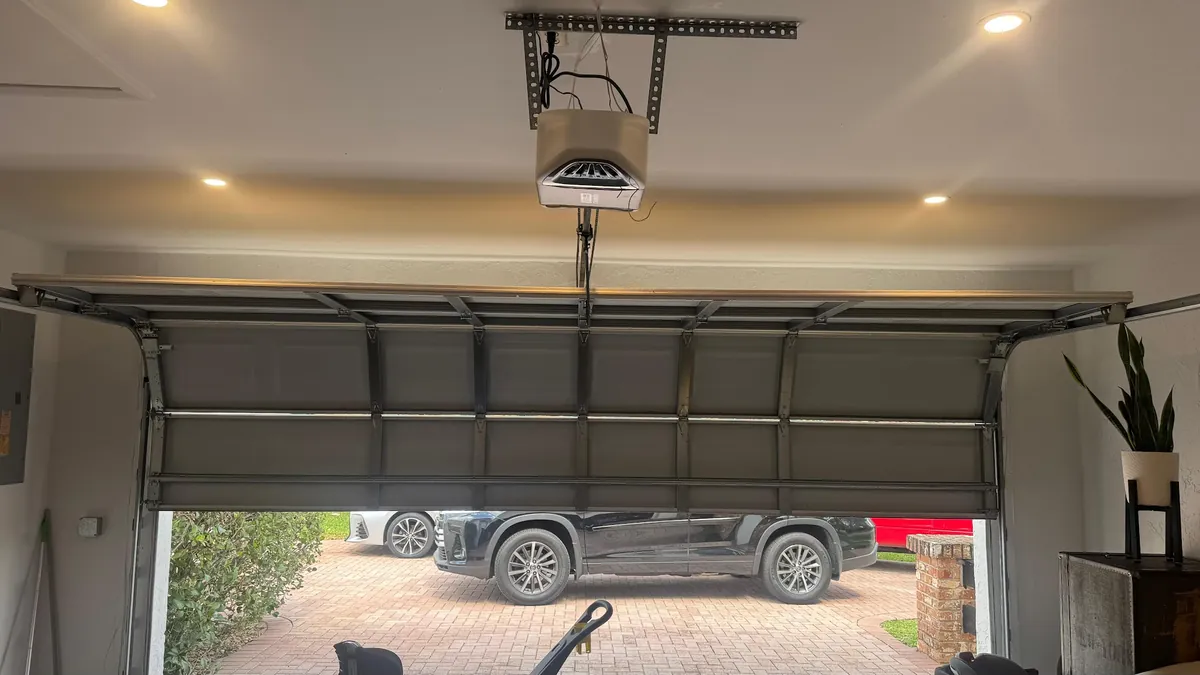
An opener that has to work in a tight space
The opener is the part of a garage door that people notice most, because it is the part they use every day. In the handful of Back Bay houses that have a private garage, it also has a harder job than usual. Our garage door opener repair in Back Bay covers openers that have stopped, remotes that have lost their reach, wall buttons that do nothing and safety sensors that refuse to let the door close, on single bays cut into brownstone ground floors along Commonwealth Avenue and Marlborough Street and on carriage houses facing the service alleys behind Newbury Street.
An opener only moves a door that the springs already hold in balance. When it fails, the cause may be the opener itself, its controls, its sensors, or a problem with the door that the opener is simply reporting. Before calling, three quick checks narrow it down:
- Does the motor make any sound at all when the wall button is pressed?
- Do the small lights on both safety sensors near the floor glow steadily?
- Does the door move freely by hand once the release cord is pulled?
What we look after
Openers repaired
Motors that hum without moving, worn gears, stretched chains and belts, faulty logic boards and limit settings that have drifted.
Openers installed
A replacement opener chosen to suit the door and the ceiling it hangs from, set up and tested. LiftMaster openers are among those repaired and replaced.
Remotes and keypads
Remotes that work only at close range or not at all, programmed or replaced, plus outdoor keypads.
Wall buttons and safety sensors
Wall controls with failed wiring and photo eyes that have been knocked out of line or damaged by water.
How an opener works with the door
A residential opener is a motor, a drive and a set of controls. The motor turns a chain, a belt or a screw along a rail, and a trolley on that rail is attached to the top section of the door. When the button is pressed, the trolley pulls the door back along its tracks or pushes it down to the floor. Two limit settings tell the opener where to stop at the top and bottom, and a force setting tells it how hard it may push before deciding that something is wrong.
Safety comes from two systems. A pair of photo-eye sensors near the floor send an invisible beam across the opening; if the beam is broken while the door is closing, the opener reverses. And if the door meets resistance on the way down, the force setting tells the opener to stop and back up. Both systems must work for an opener to be safe to use.
The springs do the lifting. A healthy door feels light by hand and stays put when stopped halfway, and the opener simply moves that balanced weight. When a spring weakens, the opener ends up lifting far more than it was designed for, which wears its gears and motor and often makes it reverse for no obvious reason. That is why opener problems and spring problems so often arrive together.
Garage door opener repair in Back Bay bays below living space
A garage cut into the ground floor of a brownstone usually has rooms directly above it. The opener rail hangs from that ceiling, and the motor is bolted to the joists or to a bracket fixed into them. Every time the door runs, vibration travels through those fixings into the floor above. A chain-drive opener with a stretched chain, a motor whose mounting has loosened, or a rail that flexes as the trolley moves all make that worse.
That makes noise one of the most common reasons for garage door opener repair in Back Bay. Tightening the chain or belt, replacing worn sprockets, resetting the mounting brackets with proper isolation and making sure the door itself runs smoothly all reduce the sound. Where the opener is near the end of its life, a quieter belt-drive unit or a wall-mounted opener that sits beside the door rather than on the ceiling can be a better choice.
Low headroom adds a second constraint. A rail-mounted opener needs space between the top of the door’s travel and the ceiling. In a bay where that gap is very small, the rail may sit so close to the ceiling that a standard unit barely fits. Wall-mounted openers, which drive the torsion shaft directly from the side of the door, avoid that problem altogether and suit some tight bays well.
Alley-facing doors and the controls that serve them
Carriage houses on the service alleys bring a different set of problems. The remote is used from a car in a narrow lane, often while lining up a tight turn, and the signal has to pass through thick brick walls to reach the receiver. A remote that worked well from the end of the alley when it was new may now work only right in front of the door. That can be a weak battery, a damaged antenna on the opener, or interference from other devices in the building. Each is tested in turn.
The safety sensors sit close to the floor on either side of the opening, which in an alley is exactly where bins, recycling and deliveries end up. A bump is enough to knock a sensor out of line, and a sensor that cannot see its partner stops the door from closing. Water is the other enemy. Slush and runoff pooling at the bottom of an alley-facing door can get into the sensor housing or its wiring and cause intermittent faults that come and go with the weather.
Sensor wiring runs low along the wall from each photo eye back to the opener, and in a carriage house that wire is often tacked across old brick. A staple driven through it, a wire chewed or pinched behind a stored bike, or a connection corroded by damp can all cause the same blinking light as a misaligned sensor, so the wire is traced along its length when realignment does not cure the fault.
Keypads mounted on the alley side of the door take a beating from the weather as well, and a keypad that has become unreliable is often just a matter of a new battery, a reset code or a replacement unit.
What an opener visit involves
- The door is checked first, by releasing the opener and lifting the door by hand, to see whether it is balanced and moves freely. If it does not, the door problem is dealt with before the opener is blamed.
- The opener is run on its own: the motor, the drive, the trolley, the limits and the force setting. The wall button, the remotes and any keypad are tested, and the sensors are checked for alignment, wiring and steady lights.
- You are told what has failed and what the options are, whether that means a new chain or gear, a reprogrammed remote, realigned sensors or a replacement opener.
Once the work is done, the limits and the force are reset to suit the door, the safety reverse is tested by placing an object in the door’s path, and the sensors are tested by breaking the beam as the door closes. On an alley-facing door, the remote is also tried from where you would normally use it, not just from inside the bay.
Common opener faults and what they mean
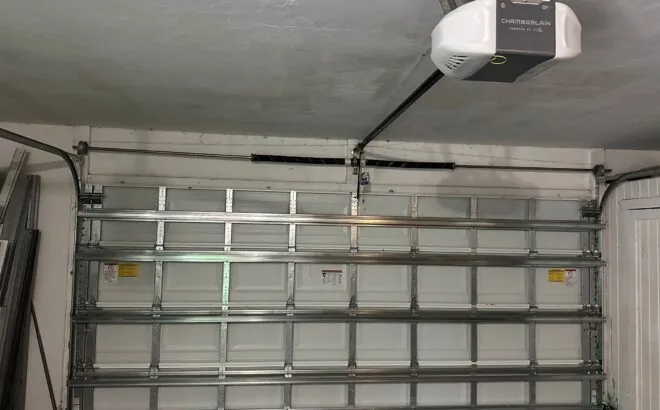
The motor hums but the door does not move. Often a stripped drive gear, a jammed trolley, or a door that is too heavy because a spring has failed. The door is checked by hand before the opener is opened up.
The door starts down, then reverses. Usually the sensors, or a force setting that no longer suits the door. A door that drags in its track can also make the opener think it has hit something.
The opener works from the wall button but not the remote. The remote’s battery, its programming, or the opener’s receiver. Wall button working is a good sign that the motor and drive are fine.
Nothing happens at all. Check that the opener is plugged in and that the outlet has power. In a ground-floor bay, the circuit may be shared with other parts of the house. If there is power and still no response, the logic board or the wall control wiring is the likely cause.
The opener runs but the light does not come on. A bulb, a light socket or a fault on the board. Minor, but worth fixing in a bay where there may be little other lighting.
Chain, belt or wall-mounted
When an opener is replaced, the type of drive matters as much as the motor. A chain drive is the traditional choice: strong and simple, but the metal chain running over metal sprockets is the noisiest arrangement, and it slackens over time. A belt drive does the same job with a reinforced rubber belt, which runs far more quietly and passes less vibration into the ceiling. A screw drive turns a threaded rod inside the rail; it has few moving parts but can be sensitive to cold. A wall-mounted opener does away with the rail altogether and turns the torsion shaft directly, leaving the ceiling clear.
For a bay cut into a brownstone’s ground floor, with rooms above and little headroom, the quieter options and the wall-mounted type are usually the ones worth considering. In a carriage house with solid walls, a separate roof and more height, a rail-mounted unit often fits without trouble. The choice also depends on the door: a wall-mounted opener needs a torsion spring system, so it does not suit a door that runs on extension springs.
Looking after an opener between visits
A few habits keep an opener healthy. Test the safety reverse every so often by laying a soft object, such as a rolled towel, in the door’s path and closing the door; it should reverse as soon as it touches. Wave something through the sensor beam while the door closes to make sure it stops. Keep the sensor lenses clean and the area in front of them clear, which on an alley-facing door means keeping bins and deliveries away from the bottom corners. Watch and listen to the door from time to time: new grinding, slowing or hesitation is worth reporting before it becomes a breakdown.
Avoid using the opener to force a door that is sticking. If the door binds, judders or stops in the same place every time, the problem is in the door, and running the opener harder only wears its gears faster.
When the door, not the opener, is the problem
A large share of opener calls turn out to be door calls. An opener is designed to sense trouble, and when a door is out of balance, dragging in its track or bound against the jamb, the opener is the first thing to complain. It slows, reverses, or stops with its light flashing. Replacing the opener in that situation only hands the same faulty door to a new motor.
In the tight openings of this neighbourhood, a few door faults show up again and again. A track that has crept out of line as old masonry moves makes the rollers bind at one point in the travel. A bottom section clipped by a car in the alley can catch on the jamb. A cracked hinge lets the door bow as it rounds the curve of the track, and in a low bay that bow can touch the opener rail. Each of these makes the opener work harder than it should. Putting the door right first, then setting the opener’s limits and force to suit it, is what gives a repaired or replaced opener a long life.
Power cuts and the manual release
Every opener has a manual release, usually a red cord hanging from the trolley. Pulling it disconnects the door from the opener so it can be moved by hand. During a power cut, or when an opener fails with the car inside, that cord is how the door is opened. It should only be used when the springs and cables are intact; if the door feels very heavy once released, the spring has failed and the door should be left where it is. Some openers carry a battery backup that lets them run through a short power cut, which is worth considering for an alley-facing bay where the door is the only way in or out of the garage.
LiftMaster openers
LiftMaster openers are among the units we repair and replace. Their drives, boards, remotes, keypads and sensors are handled in the same way as any other opener, and the main opener repair and replacement page goes into more detail. A separate page covers LiftMaster opener repair on its own.
Repair the opener or replace it
Most opener problems are repairable: a gear, a chain, a sensor, a wall control or a remote. Replacement makes sense when the motor itself is failing, when the logic board is no longer available, when the opener is too weak for a door that has been made heavier over the years, or when it is simply too loud for a bay below living space. When we carry out garage door opener repair in Back Bay and replacement turns out to be the better answer, you will be told why, along with which type of opener suits the ceiling and the door.
A new opener should always be fitted to a door that is balanced. If the springs are tired, the spring repair page for Back Bay explains how that is dealt with first. If the door itself is near the end of its life, the new garage doors page for Back Bay explains how a door and opener can be replaced together, bearing in mind that alley width and resident permit rules decide when a door can be delivered.
Booking an opener repair
When you get in touch, say what the opener does or does not do, whether the door moves by hand, whether the bay is in the house or a carriage house on the alley, and whether a car is trapped inside. If the door is stuck open at night, the emergency repair page for Back Bay explains what to do while you wait, and the general repair page for Back Bay covers springs, cables, tracks and panels. For garage door opener repair in Back Bay, call us or book online. The Back Bay page lists everything else we do in the neighbourhood.
Questions from Back Bay
The opener is very loud in the room above the garage. Can that be fixed?
Often, yes. Tightening the drive, replacing worn sprockets and rollers, and resetting the opener’s mounting so it does not pass vibration into the joists all help. If the opener itself is the source, a belt-drive or wall-mounted unit is usually much quieter.
My bay has very little headroom. Will a new opener fit?
In most cases. Where a ceiling-mounted rail will not fit, a wall-mounted opener that drives the torsion shaft from the side of the door is often the answer.
The remote only works when I am right in front of the carriage house. Why?
Start with a fresh battery. If that does not help, the opener’s antenna, the receiver or interference inside the building may be the cause. Thick brick walls also reduce range, so the antenna’s position matters.
The door will not close and the light on one sensor is blinking. What should I do?
The sensors cannot see each other. Wipe both lenses, check that nothing is in the beam and look at whether either sensor has been knocked. In an alley-facing bay, a bin pushed against the sensor is a common cause.
Do you replace LiftMaster openers?
Yes. LiftMaster openers are repaired and replaced, along with remotes, keypads, wall buttons and sensors.