
Why openers in Somerville’s back-lot garages have a hard life
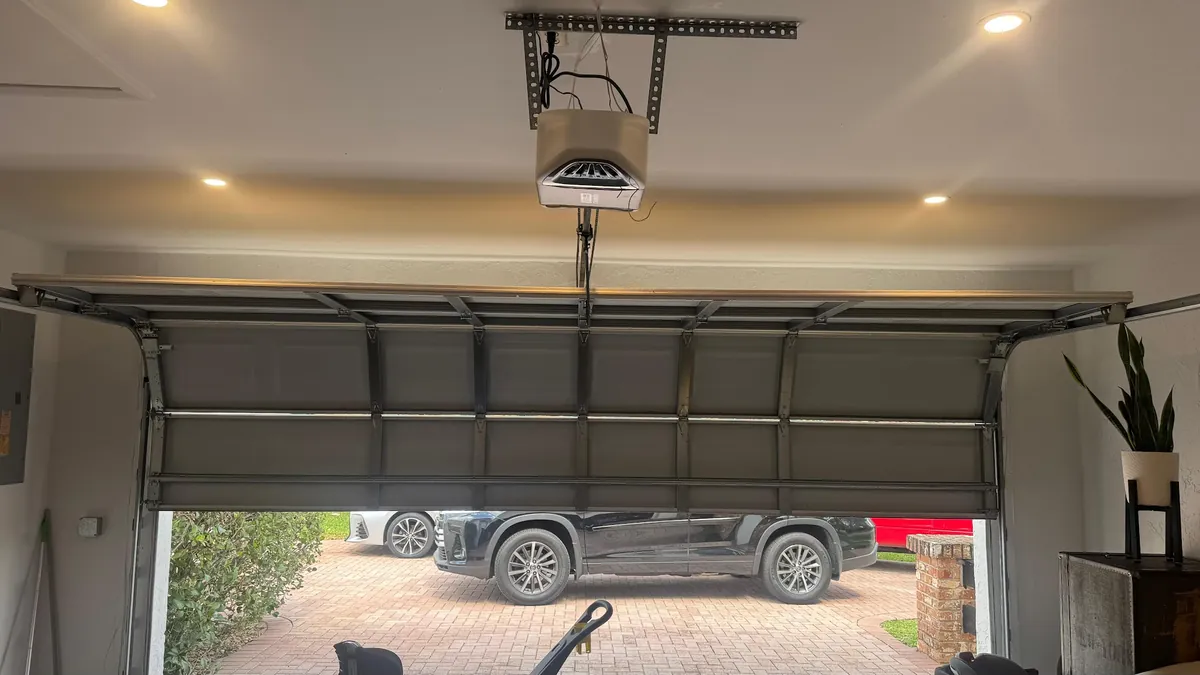
Somerville packs more homes onto its blocks than any other city in New England, and its garages squeeze in wherever a lot allows: single bays tucked behind triple-deckers, at the far end of driveways barely a car deep. Inside, the motor unit dangles from the joists with shelving, bikes and offcuts of lumber crowded around it. Garage door opener repair Somerville MA homeowners ask for is very often a story of a drive unit that has been bumped, boxed in, or worn out hauling a door whose springs have gone soft, and that crowding shapes how the repair is carried out.
In a bay like this the motor counts for more than it would in a roomy suburban garage. A side entrance is rare, and edging between the car and the wall to wrestle a door upward by hand is clumsy at best. Once the drive unit quits, the garage is effectively shut.
Three observations before you phone make the conversation shorter:
- Pressing the wall console: silence, a click, a hum, or a whirr with no movement?
- The tiny indicator LEDs on the two photo eyes: lit and steady, flickering, or dark?
- With the emergency cord pulled, does the door glide up easily or feel like a slab of concrete?
Opener faults we fix in Somerville
A drive unit that drones without turning
Current reaches the motor yet nothing travels: a worn-out nylon gear, a blown capacitor, or a door so badly out of balance the motor cannot budge it.
Handsets gone deaf
Flat coin cells, codes erased by a power cut, or a receiver that has stopped recognising any handheld at all.
Consoles and keypads
Buttons that do nothing, thin bell wire nicked or crushed along the joists, and exterior keypads worn down by winter spray.
Photo eyes
The low beam pair at the base of each upright rail, knocked off aim, coated in grime or cracked by a recycling bin.
Stopping short or turning back
Drifted limit and force adjustments that send the door back up before it seals, or halt it short of fully open.
A replacement unit
A fresh unit fitted when the old powerhead is past sensible repair, specified and hung to suit both the door and the space above it.
What the motor is really doing
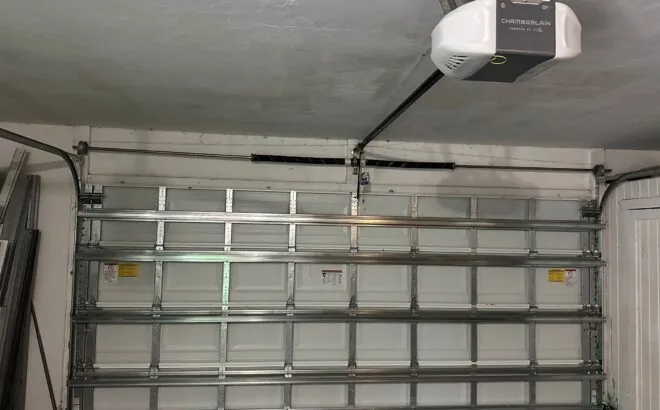
The motor is not what raises a sectional door; the springs carry that load. The drive unit’s job is to shove and draw a door the coils have already rendered almost weightless, steering it along the rails and halting it where it should halt.
On the usual ceiling-hung unit, a carriage known as the trolley rides along a rail that runs from a bracket on the header back to the powerhead under the joists. That carriage is pulled by chain, by belt, or by a spinning screw rod, and a bent arm links it to the uppermost section. Two adjustments govern every trip: limit settings, which mark the stopping points up and down, and a force setting, which caps how much effort the powerhead will spend before it concludes something is in the way and backs off.
Low on the jambs, two photo eyes project an infrared line from side to side. Interrupt that line during a downward trip and the controller reverses the door. A console on the wall and one or more handsets talk to a receiver inside the powerhead, while an emergency cord hanging off the trolley uncouples the door so it can be worked by hand in a blackout.
Because the springs do the lifting, a drive unit that suddenly labours is very often pointing at a fault elsewhere. A coil that has lost its wind, or snapped outright, leaves the powerhead trying to haul the entire door. Every call in the city therefore begins at the door’s balance before anyone touches the powerhead.
Tight bays and what they do to an opener
Behind a triple-decker, nothing in the garage is far from the drive unit. Shelving reaches the joists and rubs the rail. Bikes slung from ceiling hooks swing into the trolley. A shovel leaned in the corner topples onto a photo eye. Every one of those bumps leaves a mark.
A rail shoved off centre makes the carriage drag, and the controller mistakes that drag for an obstruction. An eye nudged a few degrees off aim keeps the door from shutting at all. Bell wire stapled along the joists gets pinched by a bracket, and the console goes quiet. In a packed city garage these are the ordinary, everyday reasons a motor misbehaves.
Clearance also governs where a unit can hang. Where there is only a sliver of space above the top section, or racks fill the zone beside the rail, the layout has to be worked around what is already there. The answer can be lowering the rail, shifting a hanger onto a different joist, or picking a unit that bolts to the end of the spring tube at the side of the opening, which leaves the ceiling over the car completely clear.
Handsets, keypads and wall consoles
A good share of motor calls end up being about the controls rather than the powerhead. A handset that has gone dead may only want a fresh coin cell. Where more than one household in the building uses the same garage, though, handsets are easily mislaid, reset, or never matched to the receiver in the first place.
Some receivers lose their stored codes after a blackout or a lightning storm. Older units can also suffer from radio clutter in a district this densely built, which can shrink a handset’s reach until you have to be practically at the bumper of the door to use it. Pairing new handsets, purging stale codes and checking the receiver’s antenna wire all belong to the visit.
Consoles usually fail at their wiring, not their button. A thin two-strand cable runs from the console to the powerhead, normally stapled along wall and ceiling, and in a cluttered bay that run is easily cut, squashed or tugged out of its terminals. Keypads mounted outside on the short driveway sit in snow, slush and road salt all winter and their contacts corrode. Each control is repaired or replaced and then tried from inside and outside the garage.
Photo eyes: the most common call of all
If one component brings in more motor calls in a packed garage than anything else, it is the pair of photo eyes. They are bolted low on each side of the opening, exactly where bins, bikes, boots and sacks of rock salt pile up, and one bump can tilt a lens enough to lose the beam.
The usual result is a door that heads down, covers a little ground and rises again, or will not head down at all while one eye’s LED flickers. Wiping both lenses with a soft cloth and clearing the line between them is safe and frequently does the trick. If it does not, the eyes are re-aimed, their brackets tightened or renewed, and their wiring traced back toward the powerhead.
Photo eyes are a safety device, not a nuisance. They must never be bypassed, taped over or raised up the jamb to keep them out of harm’s way. After any adjustment, a carton or a block of wood goes on the threshold and the door is sent down onto it so you can watch it touch and lift away.
What an opener visit in Somerville involves
- The trolley is uncoupled and the door is worked by hand, to find out whether it is balanced and rolling cleanly in its rails before the powerhead gets the blame.
- Coils, cables and rollers are inspected, since a heavy or sticking door is the leading cause of a motor giving out.
- With the door still uncoupled, the powerhead is cycled alone, listening for gear chatter and watching the chain, belt or rod.
- Handsets, console, keypad and the wiring between them are tried, and the receiver’s memory is checked.
- Both photo eyes are cleaned, aimed and their cable followed back.
- You are told what is at fault, and whether a fix or a new unit is the better buy, before tools come out. Afterwards the stop points and the push setting are tuned for this particular door, and the reversing test is repeated on the threshold.
In the narrowest garages, a few minutes go on finding firm footing for the ladder beneath the powerhead and moving whatever hangs close to the rail. That keeps the work safe and stops a freshly trued rail from being knocked straight back off line.
Fix the powerhead, or fit a new one?
Plenty of drive units are well worth fixing. Chewed gears, failed capacitors, slack chains or belts, broken trolleys, faulty control boards and misaimed photo eyes can be put right on most units, and when the powerhead is otherwise healthy and parts are still made, repair is normally the sensible route.
A new unit earns its place when the old one is so dated that parts have dried up, when faults pile up together, when the motor has burned itself out straining against a snapped coil, or when it predates the photo-eye reversing system every current opener carries. LiftMaster openers are included in the work, repaired or replaced like any other unit. Either way, you hear the reasoning first, and garage door opener repair Somerville MA owners book never comes with pressure toward a replacement the door does not need.
A replacement unit is installed to match the door and the room: a rail cut to the door’s height, hangers screwed into solid framing, the trolley arm set at a sound angle, and both photo eyes mounted at the proper height on their rails.
Noise, vibration and the rooms nearby
A motor that rattles, grinds or thumps is usually describing its own fault. A chain slapping on the rail has stretched and wants tensioning. A grinding powerhead may mean a gear wearing through. A thump at the end of each trip suggests the limits run past the point where the door meets the slab or the top stop.
On a small lot with neighbours close on all sides, sound carries. Snugging up loose hangers, adjusting the chain and renewing worn rollers on the door often cut the racket sharply. If the noise is a failing powerhead, a belt-drive replacement tends to run quieter than a chain unit, worth knowing when a garage sits a few steps from someone’s bedroom window.
Keeping an opener working through the winter
Frost thickens grease and makes the bottom seal cling, so a door that runs sweetly in July may stall or turn back on a January morning. A slight seasonal tweak to the force setting can be fair, but force must never be cranked up to bully a sticking door; that masks a rail or spring problem and defeats the reversing system.
Salt and slush tracked in on tires corrode the photo-eye brackets and the lower ends of the rails. Keeping the floor by the eyes clear, wiping the lenses now and then through the winter, and checking that the seal is not frozen to the slab before pressing the button all help. If the door is frozen down, break it loose by hand, gently, instead of letting the powerhead fight it.
Openers that serve more than one household
Where a single garage behind a triple-decker is shared, the drive unit can see far more trips in a day than a single household would give it. More trips mean faster wear on gears, trolleys, chains and belts, and more handsets floating around the building. When several people use the door, it pays to keep track of which handsets exist, to have stale codes cleared when someone moves out, and to listen for the early signs of a tired powerhead, such as a slower trip or a new grinding note. Any call-out for garage door opener repair in Somerville can include clearing the receiver and pairing a fresh set of handsets for everyone who needs one.
Signs a drive unit is near the end
Powerheads rarely die without some warning. A trip that takes noticeably longer than it used to, a new grinding or clicking note from the motor housing, a door that stutters partway up, a handset whose range keeps shrinking even with fresh cells, or a unit that trips its own reversing for no visible reason are all hints. So is a motor housing that feels hot after only a couple of trips. Any one of them is worth a look before the unit gives out for good while the car is shut in behind it, and catching the problem early leaves time to weigh a repair against a new unit calmly rather than on a freezing morning.
When the opener fails at night
Drive units tend to quit just when they are wanted, late in the evening or early on a frosty morning. Somebody answers the line whatever the hour. If the motor dies with the door down and the car inside, our Somerville emergency repair page explains what can be done safely before help arrives. If the motor stopped because a coil broke, the Somerville spring repair page covers that side of the job, and the wider Somerville garage door repair page deals with cables, rails and panels. Our opener repair and replacement service page covers motors across Greater Boston, and LiftMaster opener repair has a page of its own.
Booking garage door opener repair Somerville MA visits
When you reach out, describe what the powerhead does at the press of a button, how the photo-eye LEDs look, which handsets and consoles still respond, and how cluttered the space around the motor is. Our Somerville town page gathers every service in the city, and for garage door opener repair Somerville MA homeowners simply call us or book online.
Questions from Somerville
The motor drones but the door stays put. Where should I look?
Look at the springs before the powerhead. With a snapped coil the door is far too heavy, and the drone is the motor failing to shift it. Unplug it, then check whether the coil above the opening shows a break. If the coil is whole, the drive gear or start capacitor is the likely culprit.
The wall console works, yet my handheld does nothing. What gives?
Begin with a fresh coin cell. Still nothing? Then the receiver may have forgotten the handset, which some receivers do after a blackout. It can be matched to the receiver again, or swapped if the handset itself has died.
My door heads down, then rises again before reaching the slab. Is the motor faulty?
Rarely. That is the safety system working. Make sure nothing sits in the line between the two photo eyes and that both lenses are clean and pointed at each other. A sticking rail or a drifted force adjustment can produce the same symptom.
There is hardly any space above my door. Will a motor still fit?
In most cases it will. The rail and hangers can usually be set to suit a low ceiling, and some units bolt to the end of the spring tube beside the opening, off the ceiling entirely. The right choice is settled once the space has been measured.
How do I get the door up during a blackout?
Provided the springs are sound, pull the emergency cord on the trolley and raise the door by its handle. Should it feel extremely heavy, or refuse to stay up, stop there: a coil has likely broken, and the door is safer left shut.