
Why springs fail on Arlington’s sloped lots
A door that refuses to rise after a single loud crack from the garage is the classic start to a call for garage door spring repair Arlington MA homeowners make. Off Massachusetts Avenue and up the rising streets toward the Heights, single- and two-family houses keep their cars in a mix of built-in garages and separate ones out back, frequently at the end of a steep driveway. The springs on those doors are doing the heaviest work on the property every time someone leaves or comes home.
Coil steel is not forever. It flexes with each opening and each closing, and at the end of its working life it breaks, usually without much warning. Steep approaches, cold unheated buildings and doors shared by two households all bring that day nearer.
From a safe spot, without reaching up or pulling anything, three clues confirm a spring problem:
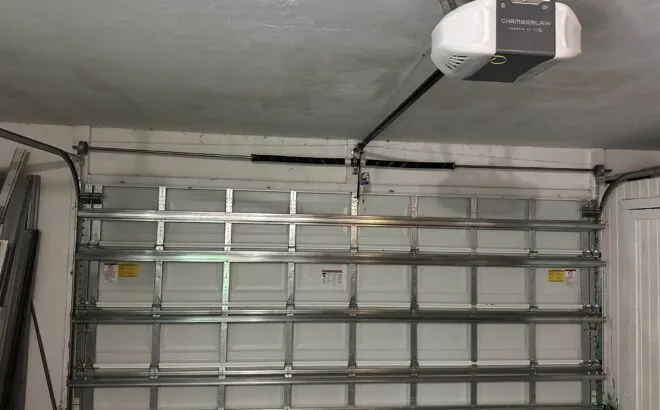
- On the bar across the header, a split in the winding with daylight between the two halves.
- Along a side rail on an older door, a coil hanging slack or stretched far longer than its twin.
- With the opener’s release pulled, a door that feels as heavy as a loaded fridge and will not stay put.
Spring jobs on Arlington doors
Snapped torsion coils
The single most frequent urgent call we get. The coil cracks in two on its bar, and the door suddenly weighs its full weight.
Worn-out extension springs
Matched coils lying beside the ceiling rails of older, lighter doors, frequently found in the freestanding garages behind Arlington houses.
Springs losing their pull
Coils still in one piece yet too weak for their door: the opener groans, and a door paused mid-travel sinks back toward the slab.
Rusted springs in unheated buildings
Damp in a garage that is never warmed corrodes the coils, adds friction and shortens their life.
Safety containment for extension springs
A steel line threaded through each extension spring to tether a failing coil before its pieces go flying.
Torsion and extension: two ways to balance a door
A door is far too heavy to lift unaided, and springs are what make it feel light. There are two arrangements, and which one your door has changes how a repair goes.
A torsion arrangement threads one or two stout coils over a steel tube mounted along the header. While the door descends, its cables tug on a drum at either end of the tube, and the coils wind up like a clock mainspring. On the way up that stored effort pays out, the tube rotates, and each drum reels its cable home. Torsion setups give smoother, more even lift and are what most doors fitted over recent decades carry.
An extension arrangement hangs a long spring beside each horizontal rail, anchored to the rear hanger and pulling on a sheave that carries the lift cable. Lowering the door draws each spring out like a rubber band; raising it lets them shorten again. They are common on older installations and on lighter single doors, which is why we still meet them in the freestanding garages at the back of Arlington lots.
Either kind is built for a finite tally of trips up and down, and either weakens gradually as that tally is spent. Neither gives much notice before snapping.
Why the tension in a torsion coil is no DIY repair
This needs saying without softening. A wound torsion coil holds dangerous tension, enough to throw a winding bar or a loose cone with bone-breaking force. Whether fitting, unwinding or adjusting, this is not a DIY repair; the work calls for proper winding bars, a clamped shaft and a known procedure, and the order of steps matters. Online videos make it look routine; the injuries that follow mistakes are not.
Extension springs carry their own risk. Without a containment cable inside each one, a spring that breaks under stretch can shoot its end fittings across the garage. Should an older door of yours have side springs with nothing threaded through their middle, that is worth fixing at the same visit.
What is safe for you to do: look, from below and to the side, and leave the door down. Pull the opener’s release cord only with the door fully closed, so nothing can fall. Pull the opener’s plug, so a family member cannot set it running out of habit.
Steep driveways and spring life
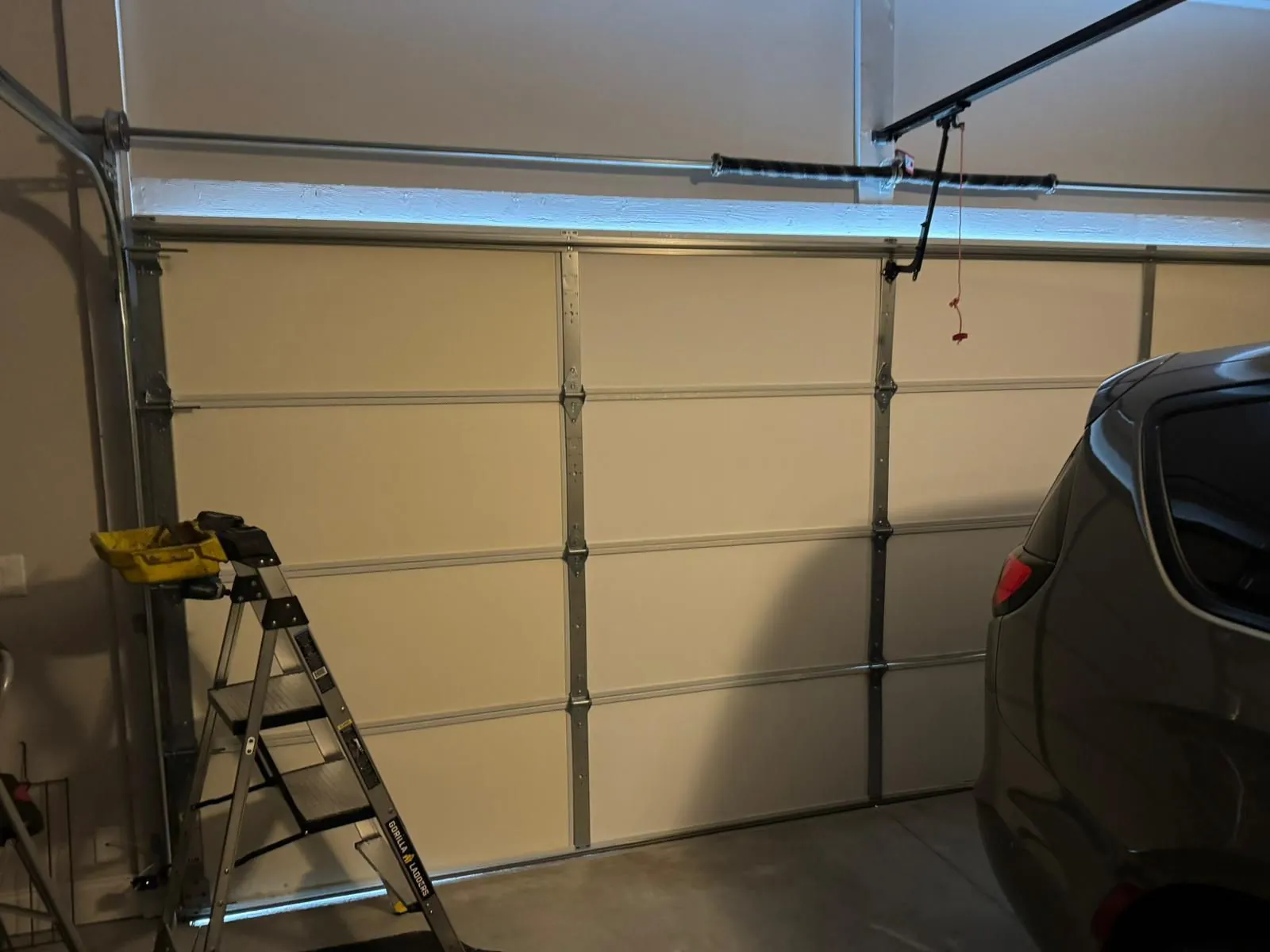
The steep grades leading up to many Arlington garages affect springs in quieter ways than they affect seals and panels. When a slab pitches toward the opening, the bottom of the door may not sit evenly on the floor when shut. A door that never lands flat can keep a little load on one cable and one side of the spring system, and over thousands of cycles that unevenness wears drums and cables faster and puts extra strain on one coil of a pair.
Winter makes it worse. Snowmelt trickling down a steep driveway can lock the rubber edge to the concrete overnight. If the opener tries to lift a stuck door, the coils unwind against a door that will not move, cables jump their drums, and any coil close to retirement is the part most likely to give. A quick look at the threshold on an icy morning, and patience until it frees up, saves a lot of springs.
On a sloped lot there is also the matter of what sits outside the door. A car parked tight to the door on a steep approach is trapped if a spring breaks. That is part of why a broken coil feels so urgent here, and why the phone being answered at any hour matters.
Built-in garages and doors used all day
Where the garage sits under or beside the living space, its door frequently doubles as the household’s everyday entrance. That means far more cycles than a detached garage door sees, and springs are counted in cycles, not years. A coil sized for a light-use door can be worn out quickly by a door that opens and closes many times a day.
During garage door spring repair Arlington MA houses with attached garages need, it is worth asking whether a higher-cycle spring suits the door. Spring choices vary in wire size and length, and a heavier-use door can be set up for longer life. That decision depends on the door’s weight and how it is used, so it is made on site, not guessed over the phone.
Built-in garages also put noise next to bedrooms and kitchens. A dry, rusted spring creaks and groans as it winds; a fresh spring and a light coat of the right lubricant quiets things noticeably.
Freestanding garages out back
The separate garages behind many Arlington houses tend to be older, unheated and damp. Damp is hard on coil steel: surface rust forms between the turns, the coils rub as they wind, and friction eats into their life. These garages are also where we meet most extension springs, sometimes missing their safety cables, and sometimes on a door that has been retrofitted more than once.
Because a detached garage may be visited less often, a spring can be weak for months before anyone notices. The warning signs are a door that is slow to rise, that drifts down if stopped halfway, or that the opener struggles with on cold mornings. Catching it at that stage lets the work be planned instead of happening in a hurry.
Two households, one door
In a two-family house the garage may be split between units or shared outright. Two households on one door means two sets of schedules, more remotes and more cycles. The springs on a shared door reach the end of their life sooner than on a door used by one family, and when one breaks both households are affected. For a shared door, replacing both springs at once and choosing ones built for heavier use is usually the sensible route.
What a spring visit involves
- Secure the door. First job on arrival: clamp or block the door where it has stopped, whether shut, part open or hanging unevenly.
- Identify the system. Torsion or extension, single coil or pair, and the condition of drums, cables, bearings and brackets are all noted.
- Weigh and measure. The door’s weight and the existing springs’ wire size, inside diameter and length guide the choice of replacement. A spring that does not match the door leaves it out of balance.
- Talk it through. You hear what is broken, what is worn and what we recommend before any tension is taken off.
- Replace and wind. The old springs are unwound under control and removed, the replacements installed and given the turns their size and the door’s weight call for, with cables and drums checked as they are reattached.
- Balance and test. A manual lift checks that the door hovers about halfway up, then run on the opener, with the safety reversal and force settings checked.
On a steep driveway the final test includes watching how the bottom of the door meets the floor at both corners, because an uneven landing can undo a good spring job over time.
One spring or both
Whether to change one coil or two is the first decision in most garage door spring repair Arlington MA owners face.
On doors with a pair of torsion coils, the surviving coil has done exactly the same number of cycles as the one that failed. It is very likely to follow before long. Renewing both at once keeps the lift even and saves you booking a repeat visit soon after. The same logic holds to a pair of extension springs: a new spring on one side and a tired one on the other pull unevenly and can make the door rack in its tracks.
Single-coil doors are simpler, but even there the cables and drums deserve a look, because the snap of a breaking spring often shocks them too.
What breaks along with a spring
When a spring lets go, the rest of the door takes the shock. Cables can slacken and slip off their drums. The opener, trying to lift a door that now weighs its full weight, can strip its gear or strain its rail. Drums can crack, bearings at the ends of the shaft can wear, and center brackets can loosen. Part of every spring visit is checking those parts, and where the opener has suffered, the Arlington opener page covers what can be done. Wider problems on the door, from rollers to panels, are on the Arlington garage door repair page.
Signs a spring is wearing out before it breaks
Springs rarely fail with no history at all. Looking back, most owners recall that the door had been getting slower, noisier or harder for the opener for some weeks. Catching those clues early lets the work be booked for a convenient time instead of in the middle of a frozen morning.
Watch for a door that no longer stays put when stopped partway up, or that creeps down once the opener stops. Listen for the opener working harder than it used to, especially on the first trip of a cold day. Look at the bottom edge as the door rises: if one side lifts before the other, a spring or cable on that side may be losing its grip. On extension springs, compare the two sides with the door shut; one hanging longer than its partner has lost tension. On torsion coils, visible gaps opening between the turns, heavy rust or a coil that looks stretched are all reasons to call.
None of these signs make the door dangerous to look at, but each means the springs are nearer the end than the beginning. Booking garage door spring repair Arlington MA homes need at that stage means the replacement can be matched carefully to the door rather than fitted in a rush.
Matching the spring to the door
No coil off a shelf suits every door. It has to suit the door it lifts: its weight, its height, the size of its drums and the space above the opening. Undersized, a coil leaves the opener hauling dead weight; one that is too strong makes the door fly up and refuse to stay closed without help from the opener. Either mistake shortens the life of everything else on the door.
That is why a proper spring visit starts by measuring the old springs and weighing the door rather than reaching for the nearest coil in the van. Doors change over the years, too. Insulation added to a once-bare door, a replaced section or water soaked into old timber all change the weight the springs must carry. On a door that has been modified since it was hung, the springs that came with it may no longer be the right ones.
When a new spring is not the answer
Sometimes the door itself is the problem. Timber that has drunk in water through many winters can leave a door heavier than any sensible coil can counter. A steel door with rot or rust along the bottom section, or panels that have been patched repeatedly, may not be worth fresh springs. In those cases we say so plainly and talk through whether a replacement door makes more sense. For most doors, though, a properly matched spring brings them back to smooth, balanced running.
Getting a broken spring sorted
Coils pick their own moment to break, seldom a convenient one, and in Arlington it often strands a car behind a door at the head of a steep driveway. Someone mans our phone overnight and over weekends, so nobody has to sit on a broken coil until morning to report it. If the door is stuck part open or the car must come out tonight, the emergency page for Arlington explains the safe steps while you wait. Our wider garage door spring repair service is described separately, while the Arlington page lists everything we do locally.
For garage door spring repair Arlington MA homes can rely on, have a quick note of whether the door has one coil or two, whether the garage is built-in or separate, and how the door was left, and with that ready, call us or book online.
Questions from Arlington
We heard a crack from the garage and now the opener just hums. Is that the spring?
Very likely. A torsion coil breaking makes a loud report, and without it the opener cannot raise the door’s full weight. Standing well back, check the coil on the header bar for a split, then disconnect the opener’s power and keep the door down.
Can I swap a torsion spring myself if I watch a video?
Please don’t. The tension stored in a wound coil can cause serious injury in an instant if a step goes wrong. It needs proper winding bars and a trained hand, which is why it is not a DIY repair.
Our door has springs along the side tracks. Are those safe?
Extension springs are fine when they are in good order and have a safety cable running through each one. If yours have no cable, or one has stretched or snapped, have them looked at before using the door again.
One coil of our pair broke. Do we need two new ones?
Usually. The remaining coil has shared every lift with its broken partner, and it seldom outlasts it by long. Replacing both keeps the door balanced and spares a second call.
Our garage is shared between two units. Does that change anything?
Usually it means the door opens more often, which wears springs faster. It is worth considering springs built for more cycles when they are replaced, and both households should know not to run the opener while a spring is broken.