
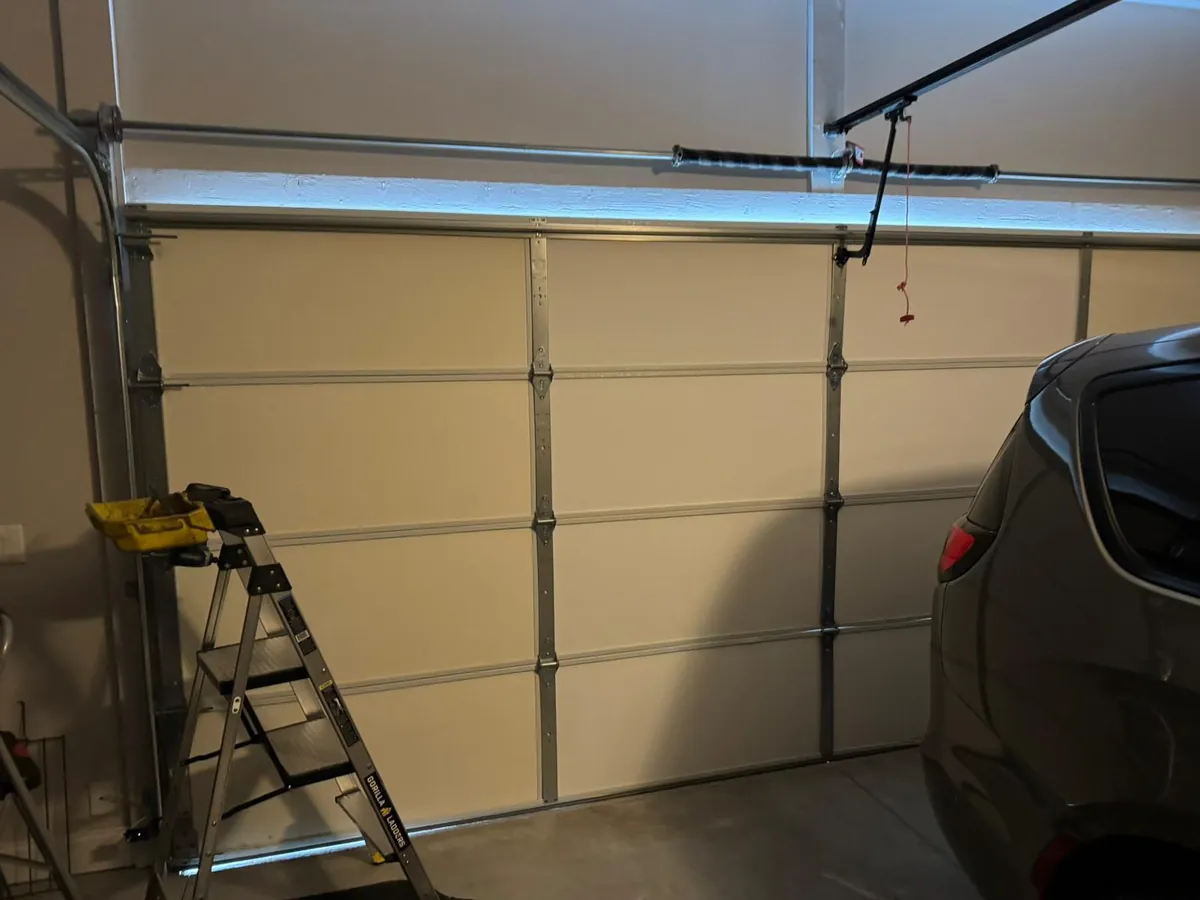
Why the roll-ups and service doors on the North End’s old streets need repair work
The North End has some of the oldest and tightest streets in the city, and it has almost no private garages. The doors that need work here are of another kind: commercial roll-ups across ground-floor openings, and the service entries that let deliveries, bins, bikes and building equipment in and out of the buildings people live in. Garage door repair North End MA calls bring us to usually means one of those doors, set into an opening that its builders never meant to hold an overhead door and that gives straight onto a street with very little room in front of it.
That setting is hard on the hardware. A door that opens onto a busy, narrow street gets knocked by passing vans and handcarts. A service entry used by every flat in the building cycles many times a day. Old masonry and old framing around the opening make mounting a hood or a track a careful job, and getting a ladder and a set of parts to the door depends on when the street can be reached at all.
Before you call, have a look from a safe distance, without touching the door, for three things:
- Whether the door hangs level across the opening or sits lower on one side.
- Whether the curtain or the sections have come out of the guides or tracks at either edge.
- Whether the door moved at all when the button was pressed, or the motor ran with nothing happening.
What a repair on a North End door can cover
Springs
On a roll-up the springs live inside the barrel above the opening; on a sectional service door they sit on a shaft over the door or along the tracks. Either way, once a spring snaps the curtain or panels become a dead weight that no motor should be asked to haul. See North End spring repair.
Cables and drums
A sectional door hangs from a cable at each bottom corner, reeled onto a grooved drum on the shaft overhead. When one frays or jumps its drum, that side sags and the door racks crooked between the tracks.
Slats, sections and the bottom bar
A roll-up curtain is made of interlocking slats; a sectional door of hinged panels. A bump from a vehicle bends a slat or creases a panel, and the bottom bar takes the hardest knocks of all.
Openers, remotes and wall buttons
Motors that hum and stall, remotes that have stopped answering, a wall button that does nothing. The North End opener repair page goes into the detail.
Guides, tracks and rollers
Curtain guides on a roll-up and tracks and rollers on a sectional door keep the door square in the opening. Once they are bent or loose the door binds, scrapes or comes out altogether.
Safety sensors
A pair of photo eyes near the ground, one either side of the doorway, sends a closing door back up when the beam is broken. On a doorway that opens onto foot traffic they matter more than anywhere.
Roll-up curtains and sectional service doors
Two families of door turn up on these streets, and they fail in different ways.
A roll-up door is a curtain of narrow steel slats that wraps around a barrel mounted above the opening. Inside that barrel is a torsion spring, wound up so that it does most of the work of lifting the curtain. At each side, the ends of the slats ride in deep steel guides fixed to the wall. At the bottom, a heavier bar carries a rubber edge that seals against the ground. A hood often covers the coil of curtain at the top, and the door is driven either by an electric operator on the side of the barrel or by a hand chain. When a roll-up goes wrong it is usually a slat that has been bent and now catches in the guide, a guide that has been knocked out of plumb, a worn bottom bar, or a spring inside the barrel that has lost tension or broken.
A sectional door is the more familiar overhead type: hinged panels whose rollers travel up two tracks and curve back to lie under the ceiling. Its weight is balanced either by torsion springs coiled on a horizontal bar just above the doorway or by extension springs stretched beside the horizontal track. Cables run from the bottom corners up to drums or pulleys. Faults show up in the rollers, the hinges between panels, the cables, the springs and the tracks themselves.
Knowing which type is in the doorway tells us which parts to bring before anyone sets out, and it is the first question asked on any call about garage door repair North End MA buildings need. If you are not sure, describe what you see when the door is open: a coil of slats rolled up above the opening means a roll-up, and panels lying flat under the ceiling mean a sectional door.
The parts that wear first on a door facing the street
On a quiet suburban driveway a door might travel up and down a couple of times a day. A service entry in a building with several flats, or a roll-up that opens for deliveries morning and evening, travels far more. Every trip puts wear on the rollers or the slat ends, flexes the hinges, works the spring and runs the opener. Parts that would last for years in a private garage reach the end of their life sooner here.
The commonest early signs are noise and roughness. A grinding or squeal from the guides usually means slat ends or rollers that are dry or worn. A clunk as the door passes one point often means a bent slat, a split hinge or a track joint that has opened up. A door that starts to come down faster than it used to, or that feels heavier to lift by hand, is pointing at a spring that is tiring. Any of these is cheaper and easier to deal with while the door still runs than after it has jammed half open across the entrance.
The bottom of the door takes punishment of its own. The bottom bar or bottom panel meets the ground every time the door closes, and on an old street the ground at the threshold is rarely flat or level. The rubber edge splits, the bar bends where it has been shut onto something, and water sits against it. Replacing a worn bottom seal, or straightening and resetting a bottom bar, is a small job that keeps rain and debris out and stops the lowest slat from rusting through.
What a visit involves
- When you call, we ask what kind of door it is, what it is doing, and how the doorway can be reached from the street, so the right parts come along.
- On arrival the door is looked over while it is still and closed or secured, before anything is adjusted, and the fault is traced to its cause rather than its symptom.
- Before a tool touches the door, you hear what has failed, what else looks close to failing, and the fix we would recommend.
- Spring tension is released or set only by the technician, with the door secured and passers-by kept back from the doorway.
- Once the repair is made the door is run through several full cycles, the balance is checked by hand, and the safety reverse is tested.
- You are shown how the door should sound and move now, so a change is easy to notice later.
Reaching a door on Hanover Street or Salem Street
Access is the part of a North End job that has to be settled before the van leaves. Hanover and Salem are slender streets with time limits on who may drive through and when. A repair van cannot always stop beside the doorway, and parts, ladders and tools often have to be carried the last stretch on foot.
Planning goes far better with a few answers to hand:
- Which street the door opens onto, and whether there is a quieter side street or rear access nearby.
- Whether the building has a time when deliveries are allowed or when the street is easier to reach.
- How much room there is directly in front of the door, and inside behind it, for a ladder.
- Whether the door can be reached from inside the building if the street side is blocked.
None of this stops the repair. It shapes how the visit is set up: what is carried in, where the van waits, and how long the doorway needs to be kept clear while the work is done. Doors in tight spots are a normal part of garage door repair North End MA buildings need, and planning the approach is simply the first step of the job.
Hands off, and what you can do
Some things are fine to do while a door is waiting for repair, and some are not.
Safe to do: keep people and vehicles away from the doorway; unplug the opener or switch off its isolator if you can reach it without standing under the door; take a photo of the door, the guides and anything that looks broken, which helps us bring the right parts; and keep the remote out of reach so nobody presses it by mistake.
Not safe to do: wind, unwind or loosen any spring; undo the bracket at the bottom corner where a cable is fixed on a sectional door; take the end stops off a roll-up guide to release a slat; or try to force a jammed curtain up or down by hand or with the hand chain while it is binding. Torsion springs hold dangerous tension, both the one inside a roll-up barrel and the ones over a sectional door, and they are not a DIY repair. A spring released the wrong way can spin a bar or a winding tool with enough force to cause serious injury.
If a roll-up is jammed partly open and the building needs to be secured, call and describe exactly how it sits. We can talk through what to leave alone while the visit is being arranged.
Doors that have come out of their guides or tracks
A roll-up curtain can work its way out of a guide when a slat is bent, when a guide has been struck and pushed out of line, or when the door is driven down onto an obstruction and one end lifts out. Once a slat end is outside the guide the curtain can twist, and running the operator again tends to pull more of it out and crease the slats further.
A sectional door comes off its tracks for similar reasons: a vehicle catches the bottom panel, a roller breaks, a cable snaps on one side, or the track bolts loosen in old mounting. A door hanging out of a track is unstable and can drop.
For either type, stop using the door, keep everyone back, and leave it as it is. The fix starts with taking the load off the spring, releasing the curtain or the panels, straightening or replacing the damaged guide, track, slat or roller, and resetting everything square before the door is run again. Bent guides and tracks are not reused if they cannot be brought back true, since a door that runs in a crooked guide will come out again.
Dents, bent slats and a worn bottom bar
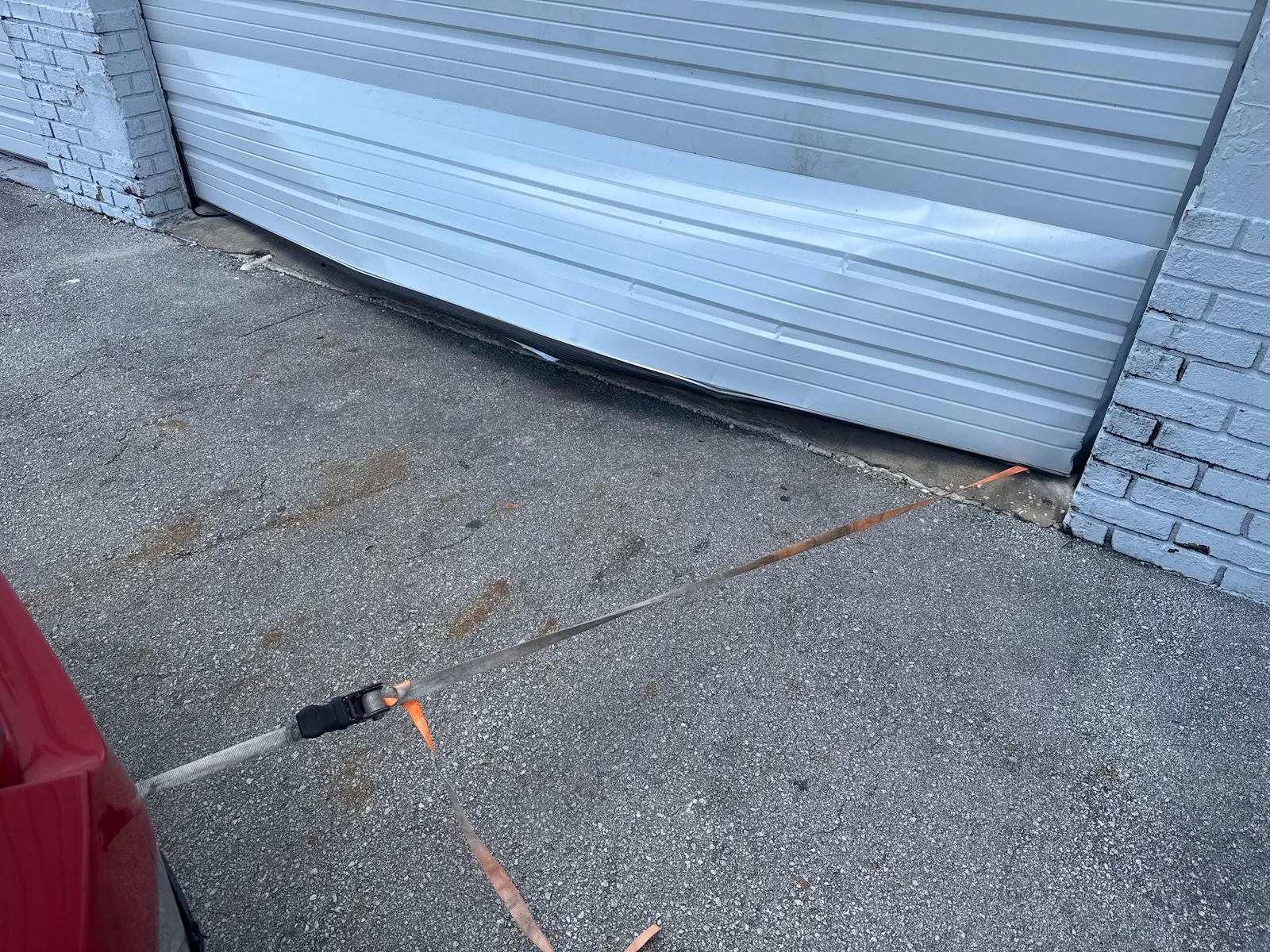
Narrow streets bring vehicles close to the doorways. A van reversing to make a turn, a handcart swung too wide or a delivery stacked against the door all leave marks. On a roll-up, one dented slat is often enough to stop the curtain winding cleanly, because the bent section catches as it enters the guide or as it rolls onto the barrel. Where matching slats can be found, the damaged ones are usually swapped out and the rest of the curtain stays.
On a sectional service door, a creased panel weakens the door across its width, and a hinge that has been strained by the knock will split before long. A single panel can sometimes be swapped; where the damage runs across several sections, the honest answer may be a new door.
The bottom bar, or the bottom panel of a sectional, deserves a look whenever the door has been hit low down. If it is bent the door no longer lands level, the seal leaves a gap at one end, and the opener may read that uneven landing as an obstruction and send the door back up.
Repair or replace
Most roll-ups and service doors on these streets are worth repairing. Springs, cables, rollers, slats, hinges, seals and openers are parts that wear and are designed to be renewed, and a door whose curtain or panels are still sound can carry on for a long time once they are.
There are cases where repair stops making sense:
- A roll-up curtain with many bent or rusted slats, where replacing slats one by one would leave little of the original.
- A sectional door with several creased or rotten panels, or steel rusted through along the bottom.
- Guides, tracks or a barrel so badly damaged that the door can no longer be made to run square.
- A door that no longer suits how the entrance is used, for example one that is too slow or too heavy for a doorway in use all day.
When a door reaches that point we say so plainly, and the new garage doors in North End page explains how a replacement is measured and fitted to an old opening. Whichever way it goes, any garage door repair North End MA owners book starts with a straight answer about whether the door is still worth the money spent on it.
Getting the door looked at
A door rarely fails at a good moment, and on these streets a door stuck open over a building entrance is a problem the same evening. Someone picks up our line late at night and on Sundays just as on a weekday morning, so a door that fails late in the evening can be reported there and then. For a doorway left wide open, a curtain that refuses to rise or a door hanging out of its guides, North End emergency repair lists the precautions worth taking until a technician reaches you. The citywide picture is on our main garage door repair page, and the North End page gathers every service we offer in the neighbourhood.
When you ring about garage door repair North End MA doorways need, tell us which street the door is on, whether it is a roll-up or a sectional door, what it is doing now and when the street can be reached. Then call us or book online, giving the street name as you do.
Questions from North End
Our building’s service door is a roll-up. Do you repair those as well as overhead garage doors?
Yes. Commercial roll-up doors and sectional doors are both repaired, including the spring inside the barrel, the slats, the guides, the bottom bar and the operator. Tell us which type it is when you call so the right parts are brought.
The street outside is narrow and only open to vehicles at certain times. Can the repair still be done?
Yes. Let us know about the restriction when you call. The visit is planned around when the street can be reached, and parts and ladders are carried in on foot where a van cannot stop beside the doorway.
The operator hums away yet the door stays put. What is wrong?
It may be the spring, the drive between the operator and the door, or a curtain jammed in a guide. Stop pressing the button, switch the opener off, and do not try to force the door. A look at the barrel and guides usually shows the cause quickly.
One slat on our roll-up is dented. Does the whole curtain need changing?
Often not. Single slats can usually be replaced if matching slats can be had. If many slats are bent or rusted, replacing the curtain or the whole door may be the better choice, and you will be told which before work begins.
Can I wind the spring on our roll-up myself if the door feels heavy?
No. The spring inside the barrel holds dangerous tension, just like a torsion spring over a sectional door, and adjusting it is not a DIY repair. Leave it alone and call.