
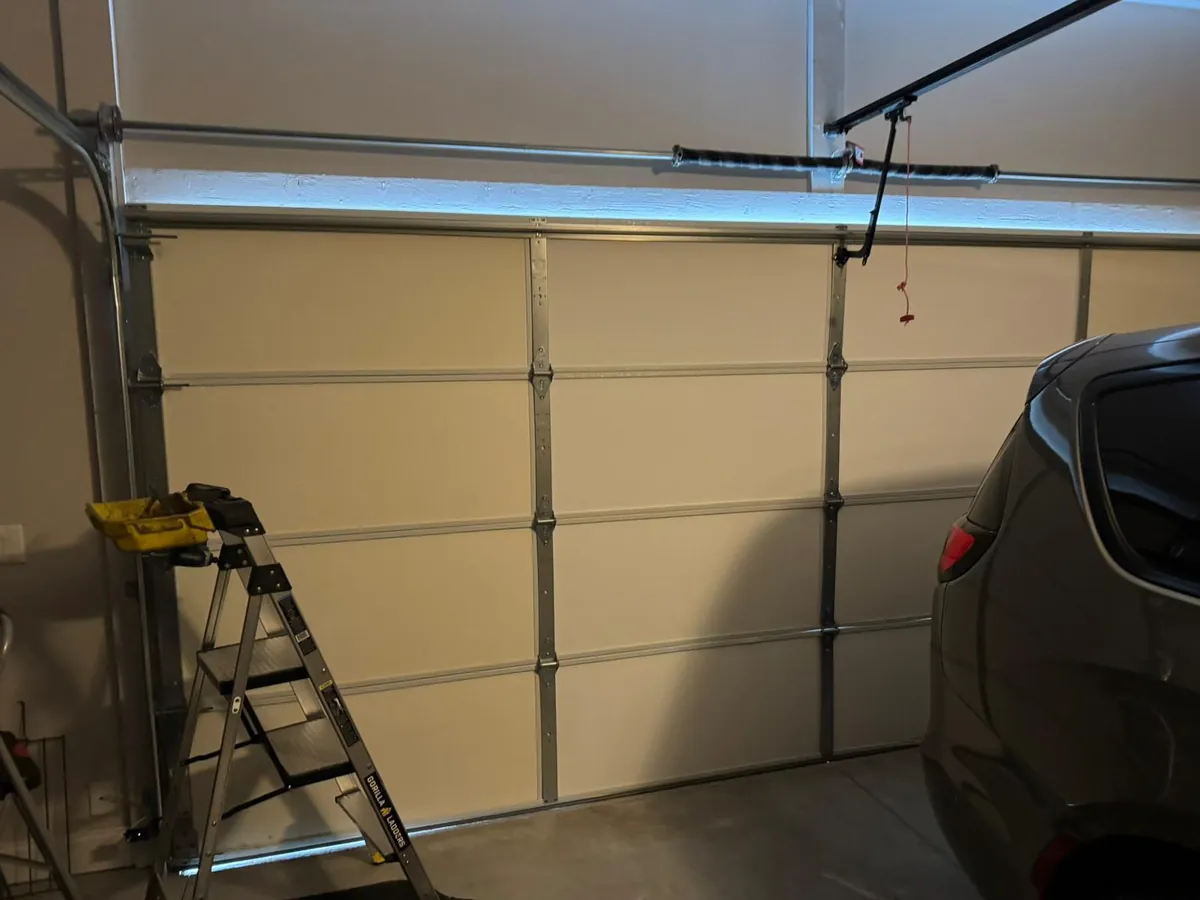
One attached bay, one door: the Capes and ranches of Weymouth
Across North and South Weymouth the usual pattern is a Cape or a ranch with one garage bay built onto the end of the house. One door, one opener, one set of springs, and very often a connecting door straight into a kitchen, a mudroom or a laundry. When people search for garage doors Weymouth MA homeowners can rely on, this is almost always the door they mean: a single opening that the household treats as its real front entrance, far more than the actual front door with its knocker and its doormat.
That makes a single attached door unusually busy. It goes up for the school run, down after it, up again for groceries, and it is often left to an opener that has been doing the same job for many seasons. Closer to the Back River the houses also take the wind and the damp that come off the water, and the steel parts of a door feel it first.
Before calling, stand inside the garage and look, and leave the springs and cables untouched while you do:
- Is the coiled spring across the header split into two pieces with daylight between them, or has a stretched side spring parted?
- Does one lift cable dangle loose at a bottom corner, or has it peeled off its drum?
- Is there orange bloom on the bottom brackets, the lowest track sections or the hinges nearest the slab?
Garage door services in Weymouth
Garage door repair
Cracked sections, loose hinges, worn rollers, weather seals and photo eyes on the one-bay doors attached to Weymouth Capes and ranches. Unsure which part has quit? Begin with our garage door repair page.
Spring repair
Once the torsion coil over the header or a side spring along the track lets go, the door turns into dead weight. Read how both types work on the garage door springs page.
Openers, remotes and sensors
A motor humming away with the door going nowhere, a remote that will not pair, a wall button gone silent, photo eyes nudged askew. See opener repair and replacement.
Emergency calls
A door stuck open after dark, or jammed shut with the only car inside. Ring whenever it happens, weekends included; more on our emergency garage door repair page.
Cables and drums
Lift cable that has worn thin near the drum lets a corner sag, and sea air rots strands from the inside. Read about cable repair.
Off-track doors
Rollers popped out of the rail after a bumper nudge, or a vertical track bowed inward. The door gets propped and made safe first; see off-track repair.
New doors
A single door that has rusted, split or sagged beyond saving is swapped for a new one sized to the same opening. Our new garage door installation page covers the choices.
When the only door is also the busiest entrance
Working on garage doors Weymouth MA families depend on every day means working on doors with no understudy. On a house with two or three bays, one door can be out of action for a while without much fuss. A Cape or a ranch with one attached bay has no such slack. If that door will not move, the car is either trapped inside or locked out, and the household often loses its everyday route into the house as well. That is why a single attached door here tends to be called in sooner, and with more urgency, than a spare bay somewhere else.
The amount of use also changes how the parts wear. A door cycled up and down again and again between breakfast and bedtime puts its springs through far more cycles than one used morning and evening only. Springs are rated for a number of lift cycles, and once that life is used up a spring breaks, usually with a single sharp crack that sounds as if a shelf has come down somewhere in the garage. Rollers flatten on one side, hinges loosen at the pins, and the opener’s drive gear wears its teeth down. None of these happen overnight, but on a single busy door they tend to arrive together, and a visit for one worn part often finds two or three more close behind it.
The connecting door into the house raises a separate point. In an attached garage, the opener’s safety sensors and the auto-reverse setting are not niceties; children, pets and bags of shopping cross that opening all day. A closing door that presses on instead of bouncing back when it meets a box, or that carries on downward while the photo eyes are blocked, needs attention before anything cosmetic does.
Salt air and damp on the Back River side
The houses closest to the Back River take wind and moisture that come straight off the water, and steel parts on a garage door do not like either. The damage tends to start low and on the outside face, where rain and spray sit longest.
The first casualty is usually the bottom bracket, the steel piece at each lower corner where the lift cable attaches. It sits close to the floor, collects grit and standing water, and rusts quietly behind the weather seal. A rusted bottom bracket is not a cosmetic problem: it is loaded by the spring through the cable, and if it lets go the door can drop on one side. Swapping one out is done only after the spring has been unwound, which makes it a technician’s job and not a Saturday project.
Next come the cables themselves. Galvanised lift cable holds off corrosion for years, but once the outer strands start to go, the core weakens unseen, and the first broken wires usually poke out right where the cable wraps its drum or meets the bottom bracket. The lower track sections, the hinges on the bottom panel and the floor-level fasteners follow. Springs rust too, and a scaly coat on a torsion coil makes the turns grind against each other, which wears the spring out sooner.
A few habits help a door on the water side last longer:
- Keep the bottom seal in good order, so water is not pooling against the bottom panel and brackets.
- Hose salt spray off the outside face of the door now and then, especially after a coastal storm.
- Ask for the cables and bottom brackets to be looked at whenever the door is serviced, and change them as a pair once rust has set in.
- Use a light garage door lubricant on hinges, rollers and springs, never a heavy grease that holds grit.
Further inland, in the middle of North Weymouth or South Weymouth, the same rust appears, just more slowly. Wherever the house sits, the lowest steel on the door is the place to look first.
Springs squeezed under a Cape roof
Many Capes and ranches were built with modest garage ceilings, and the springs have to live in the narrow gap left over the door before the roof framing begins. Two kinds are common.
A torsion spring rides on a steel tube spanning the opening just over the header. As the door comes down, cables pay off the drums at both ends of that tube and the coil twists tighter, banking the energy that will lift the door next time. That banked energy is the reason a torsion spring is dangerous. It holds a great deal of tension, the winding cones can spin with real force if they are loosened wrongly, and people are seriously injured trying to adjust or replace one with the wrong tools. A torsion spring is no job for a homeowner with a toolbox. Leave the door down, leave the spring alone, and call.
Extension springs are the older arrangement, still found on many single doors. They run alongside each ceiling track and tug on a cable that loops over pulleys. They sit stretched and loaded while the door rests shut, and each should have a thin restraint cable threaded down its middle, so a snapped spring stays in line instead of lashing across the bay. Doors that never had those restraint cables can be given them during the same appointment.
Where headroom is very tight, a low-headroom track or a different spring layout may be needed, and the replacement has to suit the space the garage actually has. On a single door with two springs, both are usually renewed together so the door stays balanced side to side.
Openers mounted under a bedroom floor
With the garage joined to the house, the opener often hangs a short way from a bedroom or living room ceiling, so its noise and its habits get noticed. A rattling chain, a motor groaning through every lift, or an opener that changes its mind and reverses halfway down are the reports we hear most.
A struggling opener is usually reporting a problem rather than causing one. Openers are built to move a balanced door, one that the springs are holding up. If a spring is weak or a cable has stretched, the opener carries more of the load on every trip, its gears wear, and eventually it stops. Before a motor is condemned, someone pulls the red release cord and walks the door up to waist height: a healthy door glides up and then hovers there on its own. If it sinks or shoots upward, the springs are the real story.
Common opener faults on a Weymouth single door:
- Photo eyes jolted off their aim by a bike pedal, a recycling bin or a snow shovel, so the door balks at closing or bounces back partway.
- A remote that went dead after a battery swap, or after a power cut wiped the opener’s memory.
- A wall button with a broken wire where it runs along the garage ceiling.
- A stripped plastic gear inside the motor housing, so the motor spins and the chain never moves.
- Travel settings that have crept, leaving a gap under the closed door or driving it hard into the slab.
LiftMaster openers are repaired and replaced, and other makes are worked on too. When the motor is not worth saving, its successor is picked to match how heavy that door is and how much clearance there is under that low Cape ceiling.
What a visit involves
A visit to a Weymouth garage follows the same order whatever the complaint, because the part that seems broken is not always the part that failed first.
- The door is checked as it stands, without forcing it. A door stuck open gets clamped so it cannot fall. A door stuck shut has its springs and cables looked over before anyone tries to raise it.
- With the opener unhooked, the door is worked up and down manually so its balance and travel can be judged.
- Springs, cables, drums, bottom brackets, rollers, hinges and tracks are inspected, with extra attention to rust on the lower parts of the door.
- You hear what failed, what is wearing close behind it, and which choices are open to you, and nothing is touched until you decide.
- Once the fix is in, the springs are tuned so the door balances, moving parts get oiled, and the opener’s force, travel limits and safety reverse are set and tried.
To make the visit go smoothly, keep the car clear of the opening if you can, clear the floor in front of the door and the area under the opener, and let us know if the connecting door into the house is the only way into the garage.
Repair or replace an older single door
Plenty of single doors on Weymouth Capes and ranches have been on the house a long time, and at some point the question becomes whether to keep repairing or to fit a new door.
Among the older garage doors Weymouth MA owners ask us about, repair is the sensible answer in most cases. Springs, cables, rollers, hinges, sensors and openers are wear parts, built to be replaced, and renewing them on a sound door brings it back to good working order. Where a single section has taken a dent or a crack, that piece alone can usually come out and a new one go in, provided a section in the same pattern can still be found.
Replacement starts to make more sense when:
- Several sections are rotted, split or badly dented, especially the bottom one, where salt and puddles do their slow work.
- The door has been repaired piecemeal so many times that it hangs crooked in its frame.
- The bottom panel and its brackets have rusted through, rather than just showing surface rust.
- Sections in the old door’s pattern have gone out of production.
- You want an insulated door because the garage joins living space and the cold comes through the connecting door.
A new door is ordered to the size of the existing opening and fitted with springs, cables, tracks and rollers matched to its own weight, so every moving part starts fresh at once. If the opener is sound, it can often stay; if it was already struggling, this is a good time to replace it as well.
Weather on the South Shore and what it does to a door
Coastal winters are hard on any garage door, and a single attached door facing the street takes the brunt of them. Snow piles against the bottom seal, melts by day and turns to ice overnight, and the door is then asked to lift with its bottom edge locked to the slab. That is how bottom seals tear, how openers strip their gears, and how a weakened cable finally lets go.
If the bottom edge has iced to the concrete, stop pressing the wall button. Release the opener, then try to loosen the seal with gentle warmth or by chipping the ice clear of the edge, and lift by hand only if the door rises easily. Salt from the road and the driveway also gets tracked in on tyres and dries as a white crust along the bottom panel, which adds to the corrosion that the river air starts.
Hot weather wears a door differently. Panels on a street-facing door bake and swell through July, the weatherstripping along the jambs dries out and cracks, and rollers that were stiff in January can start to squeal. A spring visit that looks at seals, rollers and lubrication tends to catch these before they turn into a call at an awkward hour.
Getting help from neighbouring towns
The same work is done across the South Shore. Weymouth borders Braintree and Hingham, and the Braintree garage door page and Hingham garage door page cover those towns’ houses and garages. For the full list of towns we serve, see our service areas.
A door that will not move right now
If the door is stuck open after dark, will not lift with the car inside, or has dropped on one side, leave it where it is. Do not cut cables, unbolt brackets or try to wind a spring. Pull the car clear if it is safe to do so, keep people away from the opening, and call. For garage doors Weymouth MA households need back in service, from a broken spring at breakfast to a jammed door late at night, call us or book online.
Questions from Weymouth
My single garage door rose a few inches, then quit. What broke?
Usually it is a spring. With the spring gone, the opener feels the whole dead weight of the door, decides something is wrong and stops or reverses. Glance up at the spring over the header for a split, but keep your hands off it. Releasing the opener and hauling the door open by hand is risky with a broken spring, because with no spring helping, the full weight of every section lands on your arms.
Our house is close to the Back River and the bottom of the door is rusty. Is it dangerous?
Surface rust on the panel face is mostly cosmetic. Rust on the bottom brackets, the lift cables or the lowest track sections is different, because those parts carry spring tension. If the brackets are flaking or the cable looks frayed where it meets them, have them looked at and changed once the spring has been unwound.
Can you work on the original doors our houses were built with?
Yes. Plenty of the garage doors Weymouth MA houses were built with are still running. Older single doors are repaired in place where they are sound: springs, cables, rollers, hinges, sensors and openers are renewed, and damaged sections are swapped where a match exists. If the door is past saving, we explain what has gone and talk through a replacement.
Can we keep using the kitchen door into the garage while the overhead door is out of action?
The connecting door itself is fine to use. Just keep everyone, especially children and pets, away from the garage door opening and from under a door that is partly open, and leave the wall button alone until someone has inspected the door.
Do you replace openers on a single attached garage?
Yes. LiftMaster openers are repaired and replaced, and other makes are worked on as well. A motor that cannot be saved is swapped for one sized to the door and the ceiling, and the photo eyes and reverse setting are tested before the job is signed off.