
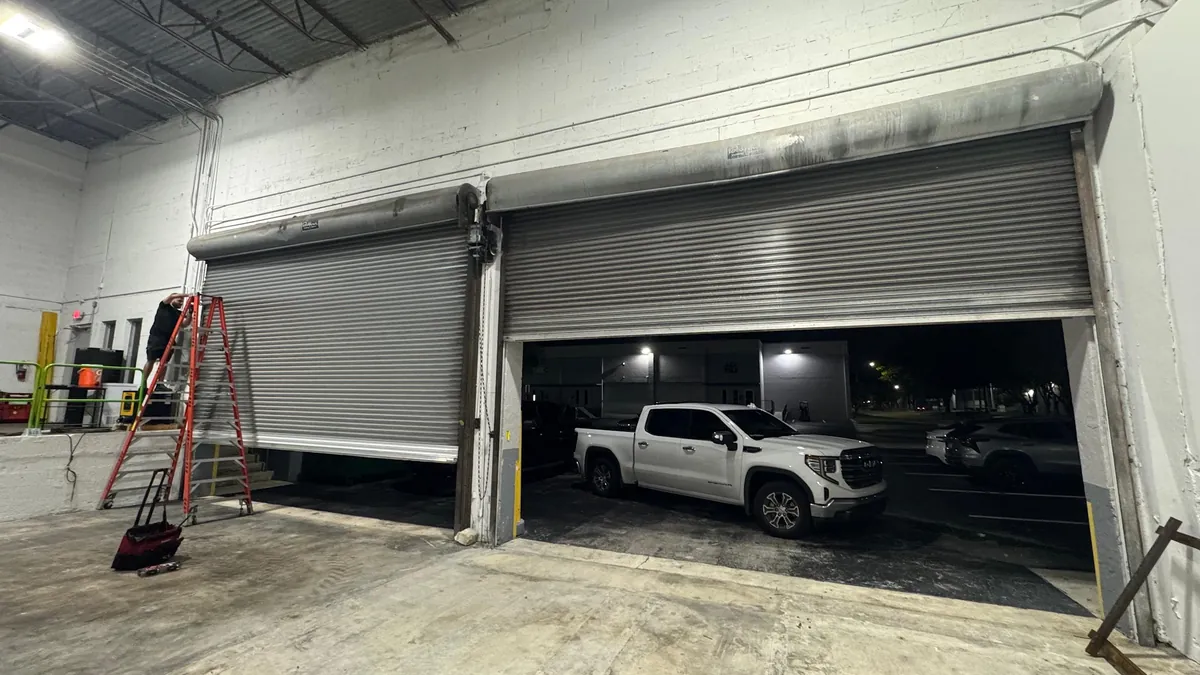
Why a failed door on a Hyde Park property cannot always wait
Around Cleary Square and out toward Readville, Hyde Park is mostly single- and two-family houses on generous lots, each with a garage either built onto the house or standing on its own where the driveway ends. Emergency garage door repair Hyde Park MA owners ring about tends to start in one of three ways: a vehicle boxed in by a door that stays stubbornly down, a door stuck up that leaves the garage gaping, or a sudden bang from the garage and a door that nobody now wants to go near.
Each layout raises its own worry. When the garage is joined to the house, a door jammed open is effectively an unlocked wall. When it is a separate building toward the back of the property, a door left up overnight may not even be visible from the kitchen window. And because two-car doors are ordinary here, whatever has broken is often carrying more weight, and storing more energy, than it would on a single bay.
Our phone gets answered late, early and at weekends. While you wait to speak to us, take stock from a safe spot:
- Is the door up, down, or hanging somewhere in between?
- Can you spot a break in the spring above the header, or a steel cable dangling at a bottom corner?
- Does the door sit level, or has one end dropped, with a roller pushed out of its channel?
Emergencies we handle in Hyde Park
Door will not open
The vehicle is inside, the motor hums or stays silent, and a broad, heavy door refuses to move when you try it.
Door will not close
Up at bedtime, bouncing back each time it nears the slab, or wedged a few feet off the ground with the garage on show.
Broken spring
A bang from the garage, a visible break in the coil above the header, and a door that now weighs what it really weighs.
Door off its track
Rollers knocked out of the rail by a bumper or a jam on the way up, leaving the door leaning and liable to drop.
Snapped or loose cable
A slack wire trailing from a bottom bracket, and a door tipped with one end high and one end low.
Opener failed mid-travel
The motor quit with the door halfway, and you cannot tell whether letting it go would bring it crashing down.
Before anything else
Whatever has failed, the opening moves are much the same.
- Stop pressing. Every further attempt loads the opener, and on a jammed door it can kink the top section or drag the door further out of line.
- Unplug the motor head at the ceiling outlet, so another member of the household does not try it.
- Clear the area: vehicles, children, pets and bins all stay well back from a door that is open or tilted.
- Without touching, look for a split spring, a slack cable at a bottom corner, or a roller sitting outside its rail.
- Ring us and tell us what you see.
Do not heave up a door with a snapped spring, and resist hauling down a door that has jammed open, above all a two-car one. Nothing on the spring shaft, the cable drums or the corner brackets low on the door should be loosened. Torsion springs hold dangerous tension, so spring work is never a DIY repair, and the cables wrapped around those drums share the same load.
A vehicle shut in behind a two-car door
The call we hear most after dark is from someone whose car must leave first thing and whose door will not rise. With a double-width door, raising it by hand is hard work even with healthy springs; with a snapped spring it should not be attempted, because nothing is counterbalancing a door far heavier than one person can safely hold.
If the springs look whole and only the motor has quit, the red cord hanging from the opener’s carriage disconnects it. Do this with the door fully down, then lift steadily from the centre of the lowest section. A correctly balanced door, wide or narrow, comes up with modest effort and stays where you leave it. If it fights you or starts to sink, ease it back to the floor and leave it closed, because that heaviness points straight at the springs.
With a spring gone, the vehicle stays in the garage until new springs are fitted. Emergency garage door repair in Hyde Park for a shut-in car means making the door safe to run again, never forcing it up.
A door jammed open on an attached garage
A garage joined to the house with its overhead door stuck up puts the whole home within reach. Plenty of these garages open straight into a kitchen, a hallway or a basement stair, so the lock on that inner door becomes the last line between the driveway and the rooms beyond. In January, freezing air floods a space that shares walls with heated rooms.
A door stalled partway up must not be dragged down by its handle. If a spring or cable has gone, it can drop much faster than anyone expects. Where the door is fully raised and the springs look intact, the opener may simply have lost power, or a sensor may be blocked or knocked askew. A door that travels down and then bounces back just before touching the floor nearly always points to the sensors. Check what you safely can: move anything sitting between them and wipe both lenses with a soft cloth.
Lock the connecting door into the house while the overhead door stays open. Until the main door is down, that lock matters more than anything else.
A standalone garage left open toward the back
Detached garages on the deeper Hyde Park lots can sit a long way from both house and street, so a door stuck up out there is easy to overlook. It still needs dealing with. Tools, bicycles and whatever else is stored inside are on show, rain and snow drive straight in, and a door left up all night presents its whole width to the wind.
These outbuildings usually draw power from the house, so a motor that goes dead with the door open may simply be starved of electricity. Check whether the garage lights work. If a breaker has tripped or the circuit is down, the door can generally be lowered by hand once the release cord has disconnected it, provided the springs and cables look sound and the door moves without fighting you.
A spring that lets go after dark
A torsion spring holds dangerous tension at every moment, and it is most likely to fail with the door shut, when it is wound tightest. Cold weather makes a tired spring more brittle. The noise is a single sharp crack, and afterward the door hardly moves.
On a two-car door hung on a pair of springs, one may break while its twin survives. The door might still crawl upward on the opener, lopsided and slow. That is exactly when to stop, because the surviving spring and the motor are now doing work they were never sized to do alone, and the door is on its way to twisting in the tracks. Unplug the motor and walk away from the door until help arrives. How snapped springs are replaced is covered on our Hyde Park spring repair page.
A door hanging out of its rails
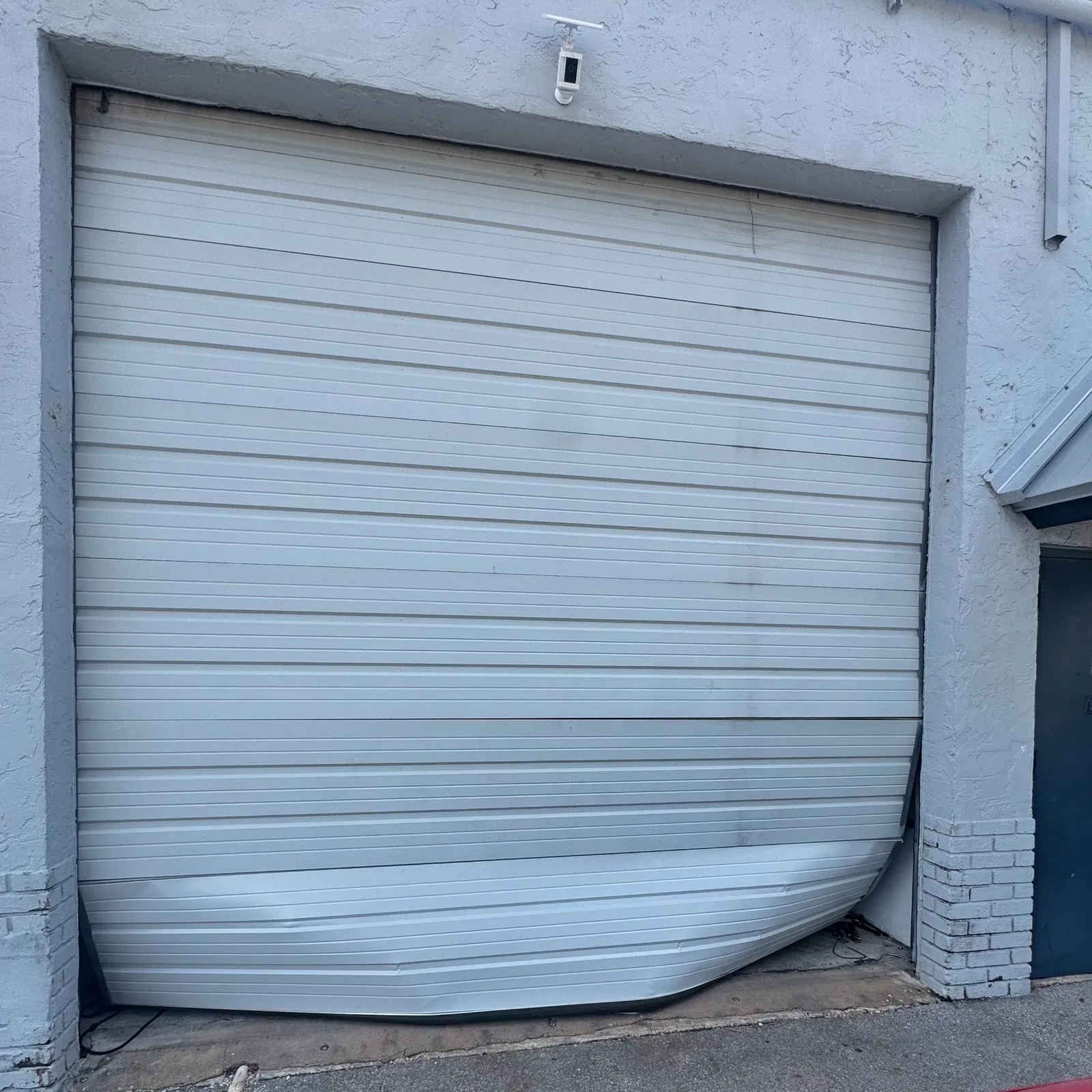
Few failures are as risky as an off-track door, since a door whose rollers have left the channel can fall. Causes include a car nudging the lowest section, a cable snapping on one side so the door tips and spits out its rollers, and a motor that keeps pushing after the door has bound.
If yours is leaning, twisted, or visibly outside the rail, keep everybody well away and do not shove it back. Keep the motor unplugged. A wide door out of its track can rack across the whole opening, and setting it right involves clamping it so the rollers carry no weight, feeding each roller back into its channel, straightening or renewing any bent rail, and equalising the cables before anything moves. More detail sits on the off-track garage door repair page.
On a property with a long driveway, the usual way a door ends up out of its rails is a car reversing out before the door has fully risen, or turning in while it is still on its way up. The bumper catches the bottom section, the rollers on that side are pushed out of the channel, and the vertical track may be bent where it is fixed to the jamb. If that has happened, note which side took the knock and whether the door has moved since. Do not drive the car out underneath a door that is leaning, even if there seems to be room; a door that has been knocked once can shift again without warning, and the wider the door, the further it has to fall.
What the call is like
You reach a person, not a recording. Expect a handful of questions: what position the door is stuck in, whether a vehicle is shut inside, whether the garage is joined to the house or stands apart, and whether you can spot a split spring, a slack cable or a roller outside its rail. Your answers shape what the technician brings and how the visit begins. You will also hear what is safe for you to do meanwhile and what to leave strictly alone.
No arrival time is promised here, because no two nights are alike. Timing is agreed with you during the call.
What an emergency visit involves
Safety comes first. The technician gets the door under control, perhaps by clamping it in its track so it cannot drop, taking the load off a broken spring or cable, or supporting a door that has come out of its rails. Nothing is released or wound up until that is done.
Then the cause is tracked down. It may be a snapped spring, a broken or slack cable, a door out of its track, a failed motor or sensor, or several of these together, since one failure often triggers another. You hear what has failed and what it takes to fix, and work starts once you say yes. When the door is working, its balance is checked, the opener’s travel and force are adjusted, and the reversing feature is tested against a block on the floor. Where the whole repair cannot be finished there and then, the aim is to leave the door lowered and locked until it can.
Two-family houses and a shared garage
Where a two-family house has a single garage serving both homes, or one household parks while the other stores things inside, a failed door touches more than one set of plans. One car may be trapped while another needs to get in; one person may already have pressed the button several times before the other knows anything is wrong.
A few habits make those nights easier. Agree where the opener’s plug is, so whoever finds the fault first can switch the door off. Tell both households the door is out of action until a technician has seen it. Keep the release cord where an adult can reach it but out of the way of children. And when you ring us, tell us if more than one vehicle or household depends on the door, because that can change how the visit is planned.
Where emergency garage door repair Hyde Park MA owners need involves a shared door, the technician will explain the fault and the fix to whoever is there, and it helps if the owner of the property can be reached by phone for any decisions about the work.
Snow, ice and the long bottom seal
Hyde Park’s real driveways put the bottom of each door straight onto open concrete or asphalt, out in the snow, slush and ice. The rubber seal along the base can freeze solid to the ground overnight. Press the button and the motor strains against a door that will not let go, which can rip the seal, strip a gear inside the opener, or bow the top section where the arm pulls on it.
On a frozen morning, if the door will not budge, stop pressing. Clear snow and ice away from the foot of the door, then warm the seal line gently; that usually loosens it. Never hack at the rubber with a shovel blade, and do not keep running the motor. A two-car door suffers more here because its seal is longer and its weight greater. Shovelling a strip in front of the door during storms, and keeping the opener’s force correctly set, heads off many winter call-outs.
Heading off the next late call
Most breakdowns give notice. A door that has grown heavier, sinks when left at half height, runs lopsided, scrapes in one spot or makes the motor labour is telling you something. Gaps opening between the coils of a spring, broken strands where a cable meets its bracket, or a roller wobbling in its channel are failures that have not happened yet.
Getting those seen to in daylight beats meeting them at midnight. Everyday faults belong with Hyde Park garage door repair, motors, handsets and sensors on the Hyde Park opener repair page, and replacements for doors past saving on the new garage doors in Hyde Park page. Booking a check of a door that is showing those signs is the surest way to avoid needing emergency garage door repair Hyde Park MA owners would rather never call for.
When the door has failed
The citywide version of this service has its own emergency garage door repair page, and the neighbourhood as a whole has its own Hyde Park page. Emergency garage door repair for Hyde Park homes starts the moment you reach us, whatever the hour. Keep your distance from the door, let the springs and cables be, then call us or book online right away.
Questions from Hyde Park
Our car is shut in behind a closed two-car door. Is lifting it by hand an option?
Only with sound springs. Disconnect the opener with its red cord, then lift steadily from the centre of the lowest section. If it fights you or starts to sink, lower it gently and stop. Should a spring have broken, the car has to stay put until it is replaced.
It is past midnight and the door will not come down. What now?
Lock the connecting door between the garage and the house, stay clear of the overhead door, and ring us. Never drag a partly raised door down by hand; a failed spring or cable can let it fall.
One roller has popped out and the door hangs at an angle. How risky is that?
Very. A door out of its rails can come down. Keep everyone back, pull the motor’s plug, and let the door hang where it is. It has to be clamped and supported before it is moved.
Will anyone answer if I phone late at night?
Yes. Our line is answered through the night and on weekends, so you can report a failure the moment it happens. Timing for the visit is agreed with you during the call.
On an icy morning the door refuses to lift. Has something broken?
Perhaps not. Its rubber seal may simply be frozen to the driveway. Stop pressing the button, clear snow and ice along the foot of the door, and try once it has loosened. If it still will not move, ring us.