
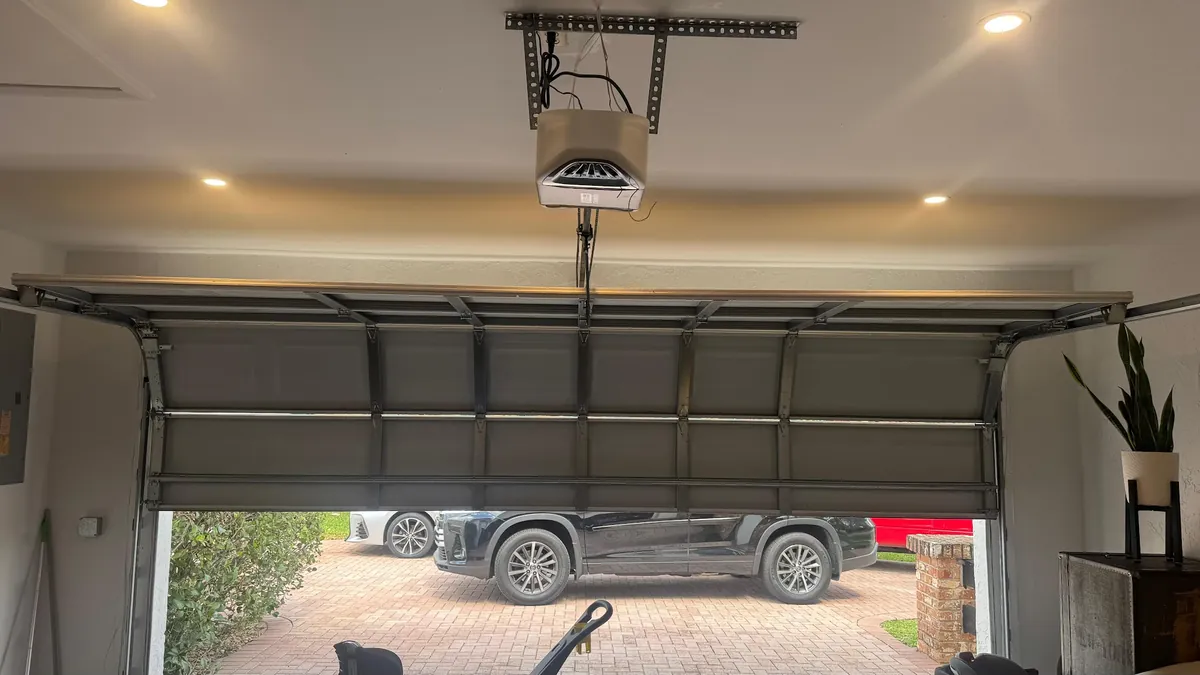
Why openers struggle in Dorchester’s back-lot garages
Savin Hill, Codman Square and Ashmont are full of triple-deckers and Victorians whose garage is a stand-alone shed at the back, a good walk up the drive from the street. Plenty of them date from the 1920s and were sized for one car, decades before motors were bolted to garage ceilings, and many still close with a heavy wooden door. An opener in that setting has a hard life: a door heavier than it should be, a power supply added as an afterthought, and a remote expected to work from the street. Garage door opener repair in Dorchester, MA deals with every link in that chain, from the motor unit to the handsets, the push button by the door and the beam sensors, and fits a replacement unit when the existing one is finished.
Before calling, three quick checks narrow the problem down:
- Is the light on the opener working? If not, the outlet or the circuit may be dead.
- Press the button on the garage wall. If the door answers that but ignores the remote, look to the remote or its programming.
- Are the small lights on both sensors steady? A blinking light usually means the beam is blocked or out of line.
What an opener visit can cover
The opener unit
Units that buzz yet stay still, gears stripped by a heavy or stuck door, worn drive chains and belts, and circuit boards that have stopped responding.
Remotes and keypads
Remotes that have lost their programming, remotes that only work up close, and outdoor keypads that no longer open the door.
Wall buttons
Buttons that do nothing, or work only sometimes, often because of a broken wire run along old framing.
Safety sensors
The beam units low on each side of the opening that reverse the door when something is in the way.
LiftMaster units
We fix and replace LiftMaster models, from the drive and the logic board to the remotes. See LiftMaster opener repair.
New openers
A replacement chosen to suit the door’s weight and the room above the opening.
What an opener actually does
An opener does not lift the door. The springs do that, by balancing almost all of the door’s weight. What the motor contributes is a nudge to a door that already floats, a halt at each end of the run, and a reversal when something is in the way. Inside the unit, a motor turns a drive, usually a chain, a belt or a screw, which moves a trolley along a rail. The trolley is linked to the top of the door by an arm.
Two settings govern how it behaves. The limits mark the two end points of the run. The force setting is a ceiling on effort: exceed it and the unit assumes a fault and halts. Most opener problems are either a fault in the unit, a fault in what tells it what to do (the remote, the wall button, the sensors), or a door that has become too heavy or too stiff for it to move within its force setting.
That last case is common in older garages. When a door is out of balance, the opener tries to carry weight it was never meant to carry, strains, and eventually gives out. A repair that replaces the opener without fixing the balance only sets the new one up to fail.
Heavy wooden doors and tired openers
Many 1920s single-car garages in the neighbourhood still have wooden doors. Wood takes on water through cracked paint and open joints, and a wooden door can gain a lot of weight over the years. If its springs have not been matched to that weight, the opener ends up carrying the difference. The signs are a door that opens slowly, an opener that sounds like it is labouring, and a door that stops partway up because the opener has reached its force limit.
The fix often has two parts. The door is balanced first, by checking and replacing the springs if needed, so that it feels light by hand. Then the opener is checked: its gear, its drive, its trolley and its arm. On many units the drive gear is designed to strip before the motor burns out, and a stripped gear on a sound motor can be replaced. Where the springs are the culprit, spring repair in Dorchester describes the work.
The arm where the opener meets the top of a wooden door is another weak spot. Bolts through old wood loosen, and the top section can crack around the bracket. Reinforcing the top of the door is part of fitting an opener to a wooden door that will take it.
Power, wiring and the detached garage
A garage that stands alone at the back of the lot was not always wired for an opener. Often the power was run out from the house later, and the opener plugs into a single outlet on the ceiling, sometimes on a circuit shared with the lights and anything else plugged in. When the opener goes dead, the first question is whether it is getting power at all: a tripped breaker, a ground-fault outlet that has tripped, or a loose plug.
The wall button’s wire usually runs along the framing from the button to the opener. In older garages, that wire is often stapled to wood that moves with the seasons, chewed by something living in the rafters, or crushed where it passes a bracket. A push button with good days and bad days, or a door that starts on its own, can be a wiring fault rather than a failed opener.
Power cuts are another reason a door stops responding. After an outage, some openers need their travel limits set again, and a remote may need re-pairing. If the power is out and the car is inside, the door can be opened by hand using the release cord, provided the springs are sound.
Remotes and the long driveway
A long driveway puts the remote to work at a distance. Pressed from a car still out at the kerb, the handset is often near the edge of its range, and anything that weakens the signal, a low battery, a bent antenna wire on the opener, a metal-backed insulation panel or a new light fixture near the receiver, can be enough to stop it working until the car is almost at the door.
The easy checks come first: a new battery in the remote, and a look at the opener’s antenna wire to make sure it is hanging down and not tucked up against the unit. When a fresh battery changes nothing, the remote may need reprogramming, the receiver may be failing, or an outdoor keypad may make more sense for someone arriving on foot. Garage door opener repair in Dorchester covers remotes and keypads as well as the opener unit.
Beam sensors in a tight one-car garage
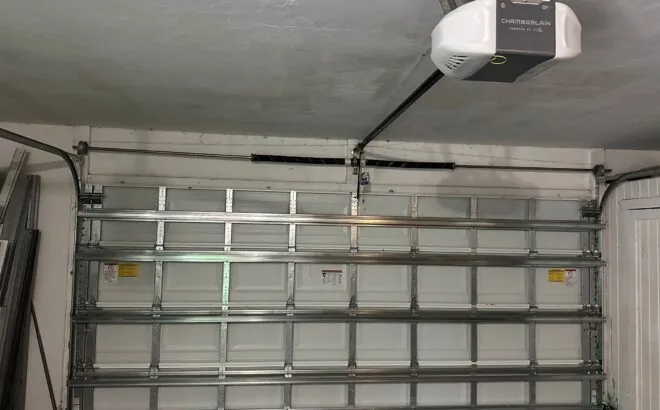
Low on each jamb, a small unit fires an invisible beam to its partner. Interrupt that beam during a downward run and the opener halts, then sends the door back up. In a narrow single-car garage, the sensors sit very close to everything stored along the walls, and a bike pedal, a bin or a snow shovel can knock one out of line. Once out of line, the sensors cannot see each other, and the door will open but will not close.
A sensor problem shows up as blinking lights on one or both sensors, a door that reverses as soon as it starts down, or a door that only closes if the wall button is held down. Cleaning the lenses and gently lining the sensors up again fixes many of these. Where the wiring has been damaged or a sensor has failed, it is replaced. On old wooden jambs, the sensor brackets sometimes need refixing to solid wood so they stay put.
What garage door opener repair in Dorchester involves
The opener is disconnected from the door first, using the release cord, and the door is checked by hand. If it is heavy, sticks or drops, the door is the problem and the opener is only a victim, so that is put right before anything else.
With the door sound, the opener is reconnected and tested on its own. Its power, its drive, its gear and its trolley are checked; each control is tried in turn, from the button by the side door to every remote on the household’s key rings and any keypad outside; a hand passed through the beam proves the sensors. The cause is explained before any work is done, along with the choice between repairing the existing opener and replacing it.
When the work is finished, the travel limits and the force setting are adjusted to suit the door, and a length of timber laid across the threshold proves the door will touch it, halt and climb back up. This step is what makes garage door opener repair in Dorchester, MA safe, especially where people walk past the door to reach a detached garage.
Openers and low headroom in old garages
Garages framed in the 1920s were built for a car and a door, not for a motor and a rail hung from the ceiling. In many of them, the rafters or a ceiling joist sit only a short way above the top of the opening, and there may be a beam or a collar tie right where the rail wants to run. That shapes the whole installation.
A ceiling-mounted opener needs a clear line from the header above the door back to where the unit hangs, plus room for the door to curve over into the horizontal tracks without hitting the rail. Where that space is tight, the rail may need to be hung lower, the door’s track may need a low-headroom arrangement, or a wall-mounted opener beside the door may be the better answer. Each option is checked against the garage as it is, not as a catalogue imagines it.
The hangers that hold the opener up matter as much as the opener itself. In older garages, they are sometimes fixed to a single thin board or to a joist that has dried and split. An opener that shakes on its hangers loosens them further every time it runs, and in time it can sag or drop. Refixing the hangers to solid framing, with proper bracing, is part of any opener visit where they are loose.
Sounds and behaviour that point to the opener
Some opener faults are easy to recognise once you know the signs. A rapid clicking with no movement often means the motor is getting a signal but cannot turn, sometimes because of a stuck relay on the logic board. A grinding noise from inside the unit as the door moves can mean a worn gear. A chain that slaps against the rail is too slack. A door that opens partway and stops in the same place every time may have a travel limit set wrongly, or may be binding at that point in its track.
Lights on the opener can also tell a story. Many units flash their lights in a pattern when something is wrong, often pointing to the sensors. Noting how many times the light flashes before you call can save time on the visit.
Repair the opener or replace it
Many openers are worth repairing: a stripped gear, a worn chain, a dead sensor or a handset that has lost its code are routine fixes. A new unit is the better route when the motor has burnt out, when the logic board has gone on an older unit, when parts are no longer easy to source, or when the door has been replaced and the old opener is not a good match for it.
Choosing a new opener for an older garage depends on the room available. A low ceiling or rafters close to the top of the door limit the length and position of the rail. Some garages are better suited to a wall-mounted unit that turns the torsion shaft rather than a ceiling rail. The door’s weight and size, the headroom and how often the door runs all feed into the choice. We repair and replace LiftMaster openers as part of this work. The garage door opener repair service page has more on how openers are handled across Greater Boston.
A manual lock that fights the opener
Some older doors in the neighbourhood still have a manual slide bolt or a lock bar, fitted before an opener was added. If the lock is engaged and someone presses the remote, the opener tries to pull the door through the lock, which can bend the top section, crack the wood around the opener arm, or strip the gear. If your door has a manual lock, make sure it is disengaged before using the opener, or have it removed or disabled once an opener is fitted.
Cold weather and the opener
In a cold, unheated garage, grease on the rail and the drive stiffens, and the door’s weatherseal can freeze to the slab. Both make the opener work harder. A door frozen to the floor can make the opener strain, stop and reverse, or strip its gear if it keeps trying. If the door is frozen down, unplug the opener, clear the ice and snow at the bottom edge, and try again only once the door moves without sticking. If it keeps happening, the bottom seal may need replacing and the opener’s force setting may need adjusting for winter.
Getting an opener looked at
When an opener stops working, the car is often shut inside or the door is stuck open at the end of the driveway. The phone is picked up late at night and early in the morning alike, weekends included. For garage door opener repair in Dorchester, explain what happens at the press of a button, whether its light comes on, whether the wall button and the remotes behave differently, and whether the door moves freely by hand. Faults in the door itself fall under garage door repair in Dorchester; a door jammed up or down at night belongs with emergency garage door repair in Dorchester; and the full local picture is on our Dorchester page. Then call us or book online.
Questions from Dorchester
I press the button, the motor hums, and nothing happens. Why?
Usually one of three things: a broken spring, so the door is too heavy to move; a stripped drive gear inside the unit; or a door that is locked or frozen to the floor. Unplug the opener and check the spring and the lock before trying again.
Why does my remote need to be almost touching the garage before it works?
Usually. Try a fresh battery first. Failing that, the aerial wire hanging from the motor may be tucked away or damaged, or the receiver may be weak. On a long driveway, an outdoor keypad can also be a good addition.
Why does my door go back up just before it closes?
That is most often the safety sensors. Check for anything in the beam and wipe both lenses. If the lights on the sensors are blinking, one has been knocked out of line. Rollers dragging in a rail, or a force limit set too low, will produce the same symptom.
Can an opener be fitted to an old wooden door?
Usually, as long as the door is sound, properly balanced and reinforced at the top where the opener arm attaches. A wooden door that is heavy with water or rotting at the bottom should be balanced or replaced first, or it will wear out the opener quickly.
Can you work on a LiftMaster opener?
Yes. We fix LiftMaster units, from a worn drive or a dead logic board to remotes and sensors that have stopped talking to the motor, and we fit a replacement when the old unit is beyond saving.