
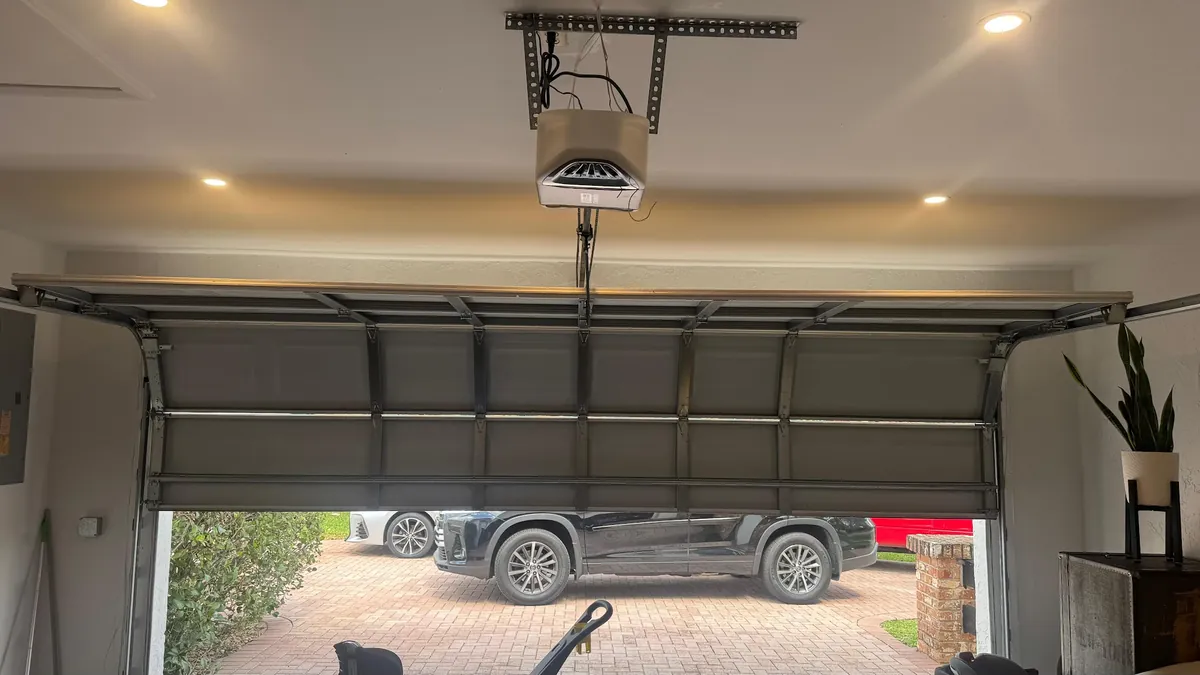
Why openers struggle on the detached garages off Blue Hill Avenue
Homes along the side streets of Blue Hill Avenue and River Street mostly keep the car out back, in a garage of its own where the full-length driveway runs out, and plenty of those garages are still closed by an old timber door on hardware dating from the 1950s. An opener was usually added to that door long after it went in. Garage door opener repair Mattapan MA homeowners call us about often comes down to that pairing: a motor designed to move a balanced door, attached to a heavy wooden one whose springs, rollers and hinges have seen decades of use.
When the door is out of balance or binding in its tracks, the opener takes the strain. Its gears wear, its force setting gets turned up to cope, and its safety reverse starts reacting to resistance that should not be there. Sooner or later it stalls, hums without moving, or reverses every time it is asked to close.
From the garage floor, with nothing touched, three quick checks are safe:
- Press the wall button and note whether the motor’s lamp lights or the unit makes a noise.
- Whether the small lights on the two safety sensors near the floor are lit steadily, or one is off or blinking.
- Whether the door moves smoothly by hand once the opener is released, or feels heavy and stiff.
Opener problems we put right
A humming motor and a door that stays down
Usually worn gear teeth inside the unit, or a snapped spring leaving the motor too much weight. Our Mattapan spring repair page deals with the springs.
A door that bounces back open
Usually the photo eyes, knocked out of line, dirty or dazzled by low sun, and sometimes a door binding near the bottom of its travel.
Remotes that have stopped working
A dead battery, a remote that has lost its programming, or a receiver on the opener that is no longer listening. Remotes are tested and reprogrammed.
Wall button does nothing
The button itself may have failed, its thin wire may be nicked where it is stapled along the wall, or the opener’s circuit board may be at fault.
Opener runs but the door stays put
The trolley has been disconnected from the door, or a chain or belt has come off its sprocket or snapped.
Openers past repair
When a worn-out unit is not worth fixing, a new opener is installed and set up to suit the door. We work on LiftMaster openers, fixing them and fitting replacements.
A motor added to a door built to be lifted by hand
Many wooden doors on Mattapan garages were hung at a time when most people opened them by hand, and some were never planned with an opener in mind. The motor was screwed to the ceiling joists later, sometimes decades later, and often fixed to a door that was already heavier than when it was new.
That matters because an opener does not lift a door. It moves a door that the springs are already holding up, which is why a properly balanced door can be pushed up with one hand. When a wooden door has gained weight from rain and coats of paint, or when its springs have weakened, the opener is left doing work it was not designed for. The first sign is usually a labouring sound and a slower lift. Later the motor overheats and cuts out, the drive gear strips its teeth, or the trolley pulls the top bracket loose from a soft wooden section.
So the honest starting point for garage door opener repair Mattapan MA owners need is the door itself. Replacing the motor on a door with poor balance only gives the new motor the same strain to wear itself out against. Checking the springs, rollers and hinges, and putting right whatever is making the door heavy or stiff, comes first. Our Mattapan garage door repair page goes into those parts in more detail.
Electricity to an outbuilding
A detached garage gets its electricity from the house, through a cable run underground or overhead to the outbuilding. On older properties that supply is sometimes modest, shared with a light or a single outlet, and often added well after the garage was built.
When an opener is completely dead, with no light and no sound, the cause is frequently upstream of the opener itself. A tripped breaker in the house panel, a ground-fault outlet in the garage that has switched off after rain, or an extension lead that has worked loose from a ceiling outlet will all leave a perfectly good opener lifeless. These are worth checking before calling, provided you are comfortable doing so: reset the breaker or the outlet once, and if it trips again, leave it and tell us when you call.
Moisture is the other factor. A detached garage is not heated, so condensation forms on cold mornings and dampness gets into wall-button wiring, sensor connections and the opener’s own circuit board. Corroded terminals and wires chewed through or pinched by a staple along the wall are common findings when an opener in an outbuilding behaves erratically.
Photo eyes looking straight down the drive
Every opener installed for many years now has two safety sensors, small photo eyes fixed either side of the opening a few inches above the floor. One sends an invisible beam across the doorway and the other receives it. Should something cut across that beam as the door descends, the unit stops and lifts the door again.
At a detached garage facing straight down a long driveway, those sensors have more to put up with than in an attached garage. Low sun in the morning or evening can shine directly down the driveway into the receiving eye and blind it, so the door refuses to close at certain times of day. Leaves, grit and snow blow into the doorway and collect around the sensor brackets. A sensor knocked by a bin, a mower or a shovel ends up pointing slightly off, and the beam no longer lines up.
Most sensor problems are easy to spot. A sensor lamp that is dark or flashing means the beam is blocked or the two eyes no longer face each other. Wiping the lenses with a dry cloth and checking that nothing is in the way is safe to do yourself. Bending brackets back by hand is less reliable, and a sensor whose wire has been damaged needs proper repair. Never disconnect or bypass the sensors to get a door to close: without them, nothing prevents the door closing onto a car, a pet or a child.
Remotes and range down a long driveway
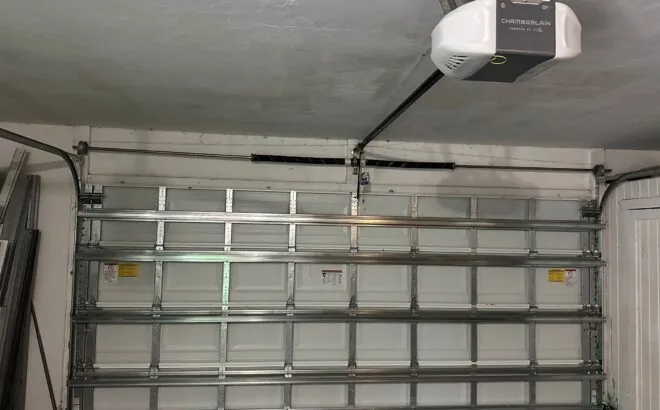
On a full-length driveway, the remote is often pressed from the street or from a car still some distance from the garage. When range starts to drop, the usual causes are a weakening battery in the remote, an aerial on the opener that has been bent or folded up against the ceiling, or a metal object such as a shelf or a tool rack placed between the opener and the door.
Remotes also lose their programming, particularly after a power cut or after the opener’s memory has been cleared. On a two-family lot where both units share the garage, there may be several remotes programmed to one opener, and the owner may not know how many are in use. It is a good idea to know that, and to have any lost remotes removed from the opener’s memory. During a visit, the remotes you have are tested, and those that need it are reprogrammed.
Cold weather and an unheated garage
Winter shows up the weaknesses in an opener quickly. In an unheated outbuilding the grease on the opener’s rail and the lubricant on the door’s rollers and hinges both stiffen as the temperature drops, so the door takes more effort to move on a frozen morning than it did in autumn. An opener whose force setting is already marginal may stop partway or reverse, reading that extra resistance as an obstruction.
The bottom of the door is the other trouble spot. Snow cleared off a long driveway usually ends up piled near the garage, and meltwater runs down to the door and freezes under the bottom seal overnight. When the opener tries to lift a door that is frozen to the slab, it strains against the ice, and something has to give: the seal tears, the top bracket pulls on the wood, or the opener’s gear takes the shock. A good deal of garage door opener repair Mattapan MA homeowners need in the depths of winter traces back to that moment.
Two habits help. Clear snow and ice from the bottom of the door before opening it on cold mornings, and if the opener struggles, stop and look rather than pressing the button again. Turning up the force setting to get through the winter is a false fix; it hides the resistance and removes some of the protection the auto-reverse gives.
What an opener visit involves
The opener is not the first thing examined. With the trolley unhooked, the door is moved by hand to judge its balance and how smoothly it runs, because a heavy or binding door is the most common reason openers fail. Springs, cables, rollers and hinges are checked, along with the top bracket where the opener’s arm meets the door.
Then attention turns to the opener. Power supply and wiring are checked, the drive gear, chain or belt, and the trolley are inspected, and the motor is run on its own. The wall button and every remote you have are tried. The safety sensors are tested and aligned. Garage door opener repair Mattapan MA homeowners agree to is based on what is found: the faulty part and the fix are explained, and work begins only with your go-ahead.
Finally the opener’s travel and force settings are matched to the repaired door, and the reversing is proved against a flat board in the doorway, which the door should touch, then pull away from.
Using the manual release safely
Hanging from the trolley on every opener is an emergency release, most often a red knob on a length of cord. A pull on it uncouples door and motor, letting you work the door yourself in a power cut or when the unit has died with the door down.
Only use it with the door fully closed if you can. If the release is pulled with the door partly or fully open, and a spring is broken, the door can drop suddenly. Before pulling it, look up at the springs: if there is a gap in a torsion spring or a slack extension spring, leave the release alone and call. When the door is lifted by hand after release, it should feel manageable and stay roughly where it is left. If it is heavy or wants to fall, lower it carefully and stop.
To reconnect, most trolleys latch back on when the opener is run and meets the carriage, or by pulling the release towards the door. If it does not catch cleanly, leave it for the visit.
One opener, two households
Where a two-family house shares one detached garage, the opener cycles more than it would for a single household, and it is pressed by more hands. That brings its own patterns of wear. The drive gear and the trolley wear sooner. Remotes multiply, get lost and get replaced, and the opener’s memory ends up holding codes for remotes nobody can account for. A fault noticed by one unit may not be passed on to the other until the opener stops altogether.
It helps for both households to know where the manual release is, where the opener’s plug is, and who to tell when the door starts behaving strangely. Clearing old remotes from the opener’s memory after a tenant moves out is a sensible precaution for a shared garage, and it can be done during a visit along with testing the remotes still in use.
Repair or a new opener
Many opener faults are repairable. Drive gears, sensors, wall buttons, chains and belts, trolleys and remotes can all be replaced on a sound unit. Replacement becomes the better choice if the motor has burnt out, if an ageing unit’s circuit board is gone, or when a series of repairs is adding up on an opener that has already had a long life.
Some signs point towards replacement rather than another repair. An opener that grinds or rattles loudly through its whole travel, one that cuts out from overheating after a single cycle, a rail that has bent or cracked where it meets the header bracket, or a unit that has needed several separate repairs in a short spell are all reasons to weigh up a new one. So is an older opener without working safety sensors, which no longer gives the protection a door closing at the end of a driveway should have.
When a new opener is fitted to an older wooden door, the door is checked and balanced first, and the opener is set up to suit its weight and the headroom in the garage. Options for the type of opener that fits the space and the door are discussed at the visit. For openers on garages elsewhere in the city, see our main garage door opener repair page. If the door is also past its best, new garage doors in Mattapan explains how door and opener can be replaced together.
When the opener fails out of hours
An opener that fails with the car shut inside, or with the door stuck open at night, cannot always wait. Calls are taken at any hour, weekends included, and the safe first steps are listed on our Mattapan emergency repair page.
Booking an opener repair
To set up the garage door opener repair Mattapan MA garages need, describe the opener’s response to the button, which of its lamps and sensor lights are lit, whether remotes and the wall button act alike, and how the door feels once released. Note too if the garage is a separate building, the way in, and if a car is trapped. Our Mattapan page lists all our local work. Got those answers? Call us or book online.
Questions from Mattapan
Why does the unit just hum when the button is pressed?
Commonly the drive gear inside the opener has stripped, or a snapped spring has left it with more weight than it can shift. Unplug the opener, look from a safe distance for a broken spring, and call. Do not keep pressing the button, as that can burn out the motor.
The door only refuses to close in the late afternoon. Why?
Low sun shining down the driveway into the safety sensor can blind it, so the opener thinks something is in the doorway. Checking the sensors are aligned and clean helps, and sometimes a small shade over the receiving eye solves it.
Our opener is completely dead, with no light. Is it broken?
Not necessarily. A detached garage takes its power from the house, so check the breaker in the house panel and any reset outlet in the garage. If the power returns and trips again, or the opener is still dead, call us.
Do you repair LiftMaster openers?
Yes. We fix LiftMaster openers, and replace them when a unit is beyond fixing. Tell us the make, if you know it, when you call.
Can a new opener be fitted to our old wooden door?
Often yes, provided the door is sound and can be properly balanced. The door is checked first, because a new opener on a heavy, unbalanced door wears out quickly.