
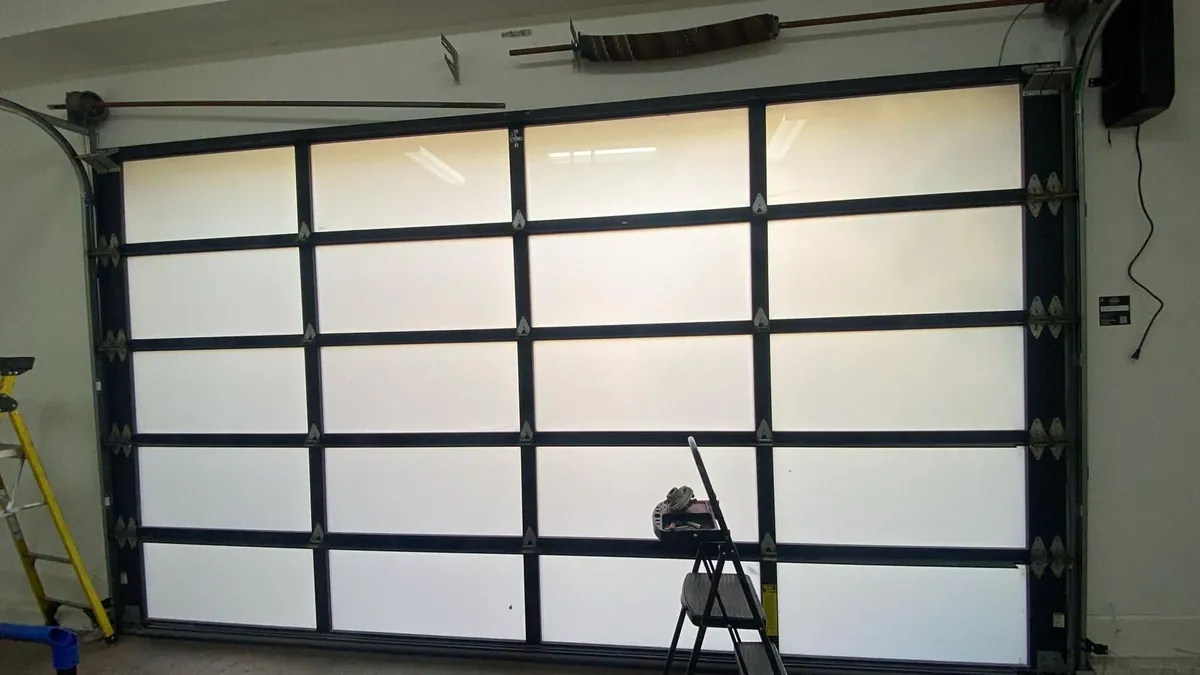
Living with salt on three sides
Winthrop is a peninsula, with water on three sides, and the single- and two-family houses on it stand close together with short driveways between them. There is hardly a garage in the town that is far from the shore, and that is the point. Salt air reaches every one of them, all year round, and corrodes the springs, cables and tracks on garage doors Winthrop MA homes rely on faster than it would anywhere inland.
Coastal corrosion does not wait for a door to get old. A spring that would last many years in a dry inland garage can pit and weaken much sooner here. A cable can rot from the inside while its outer strands still look serviceable. Track bolts rust into their holes until the bracket no longer holds firm.
What to look for, without touching anything:
- Rust bloom on the spring coils, or flakes of rust on the floor beneath them.
- Brown streaks running down from the track brackets and the hinge screws.
- Frayed or discoloured strands near the bottom ends of the lift cables.
Why the coast is hard on door hardware
A garage door’s working parts are steel. The springs are tempered steel wire; the cables are twisted steel strands; the tracks, brackets, hinges, shafts and fasteners are steel plate and bar. All of it leaves the factory with a coating, and all of that coating wears with use. Inland, the slow wear matters little. On a peninsula, every bare patch is an invitation.
Salt air is both damp and conductive, and it carries tiny salt particles that settle on surfaces and draw moisture out of the air. That keeps steel wet long after rain has stopped. Rust then starts at the places that move, rub or hold water: the spring coils as they wind and unwind, the cable strands where they bend round the drum, the inside of each roller bearing, and the threads of every bolt.
The result is not just cosmetic. Every pit in a spring’s wire is a spot where a fracture can begin. A cable rotted inside has lost strength that cannot be seen. A roller with a rusted bearing slides instead of turning, wears flat and drags. A bracket rusted at its fixings loosens and lets the track move. Each of these adds load to the parts around it, and the door’s failures tend to arrive in clusters rather than one at a time.
Close-set houses and short driveways
With houses close together and driveways short, a garage here is often only a car’s length from the street and a few feet from the house next door. That has two consequences for a door.
The first is exposure. A garage set close to the street, with its door facing the weather, gets the full wash of salty air every time the wind blows off the water. Garages whose doors face away from the prevailing wind tend to fare a little better, but none escapes it entirely.
The second is space. A short driveway leaves little room in front of the door, so a parked car may sit right against it. A narrow gap between houses may make it hard to reach the side of the garage. On the day of a visit, moving the car and clearing the floor just inside the door makes it possible to open the door fully and look at both faces.
On a two-family house the garage may also be shared, with one unit parking and the other storing bikes, beach gear or tools along the walls. Sand carried in on wheels and boots ends up in the tracks and around the sensors, and gear stacked against a wall can creep toward a vertical track until it rubs. Keeping a clear strip along each side of the door, and sweeping the sand out now and then, takes some load off the rollers and stops the photo eyes being knocked out of line. If one person on the lot knows where the opener plugs in and how many remotes are in use, a door that starts misbehaving can be stopped and reported before a small fault grows into a large one.
Springs on a coastal door
Springs do the heavy lifting, and on the peninsula they are generally the first thing to give. Whether it is one torsion coil on its shaft over the header or two extension coils beside the ceiling rails, the door’s full weight hangs from them. Once salt has bitten deep into the wire, a coil can let go with no warning, and the report often carries right through the house and next door.
With the spring gone, the door is at its full weight. The opener may lift it a short way and stop, or strain without moving it at all. Stop pressing the button, and resist hauling the door up yourself.
A torsion spring holds dangerous tension, and its winding cone and set screws are under that load all the time. Releasing or winding it takes the right bars and the right sequence; done wrongly, it can fling a bar or bracket hard enough to injure, so it is not a DIY repair. Replacement springs here are picked with the sea air in mind, and while they go in, the shaft, its bearings and both drums get inspected for corrosion.
The Winthrop spring repair page has more on spring faults and what to do when one breaks.
Cables that rust from the inside
Lift cables are made of many fine wires twisted together. On the coast, salt and moisture work into the gaps between them, and the inner wires corrode first, where nobody can see. By the time the outer strands begin to snap, usually near the bottom bracket where water collects, the cable may already have lost much of its strength.
A cable that breaks lets one corner of the door drop. The door twists, may jam, and may leave its tracks. Cables are always replaced in pairs, the drums are checked for rust and wear, and the door is rebalanced. On garage doors in Winthrop MA, cables are worth a look at every visit, whatever the visit was for.
Tracks, rollers and brackets
Rust at the fixings is the usual track problem here. Water and salt get into the bolt holes in the brackets, the threads corrode, and the bracket gradually loosens. A track that has moved even slightly out of line makes the door bind, jerk or rub at the same point in its travel.
Rollers suffer too. Their bearings fill with rust and stop turning freely. A seized roller slides, wears a flat, and makes a grinding noise that gets worse each week. Hinges between sections rust at their pins and screws, loosen, and eventually crack.
A door that has jumped its rails must stay put, because it can still come down and its springs and cables remain wound. Getting it back in means securing the door, guiding the rollers back into straightened or replaced track, re-fixing the brackets in sound material and checking the cables. The off-track garage door repair page explains the process.
The bottom section, the seal and the sand
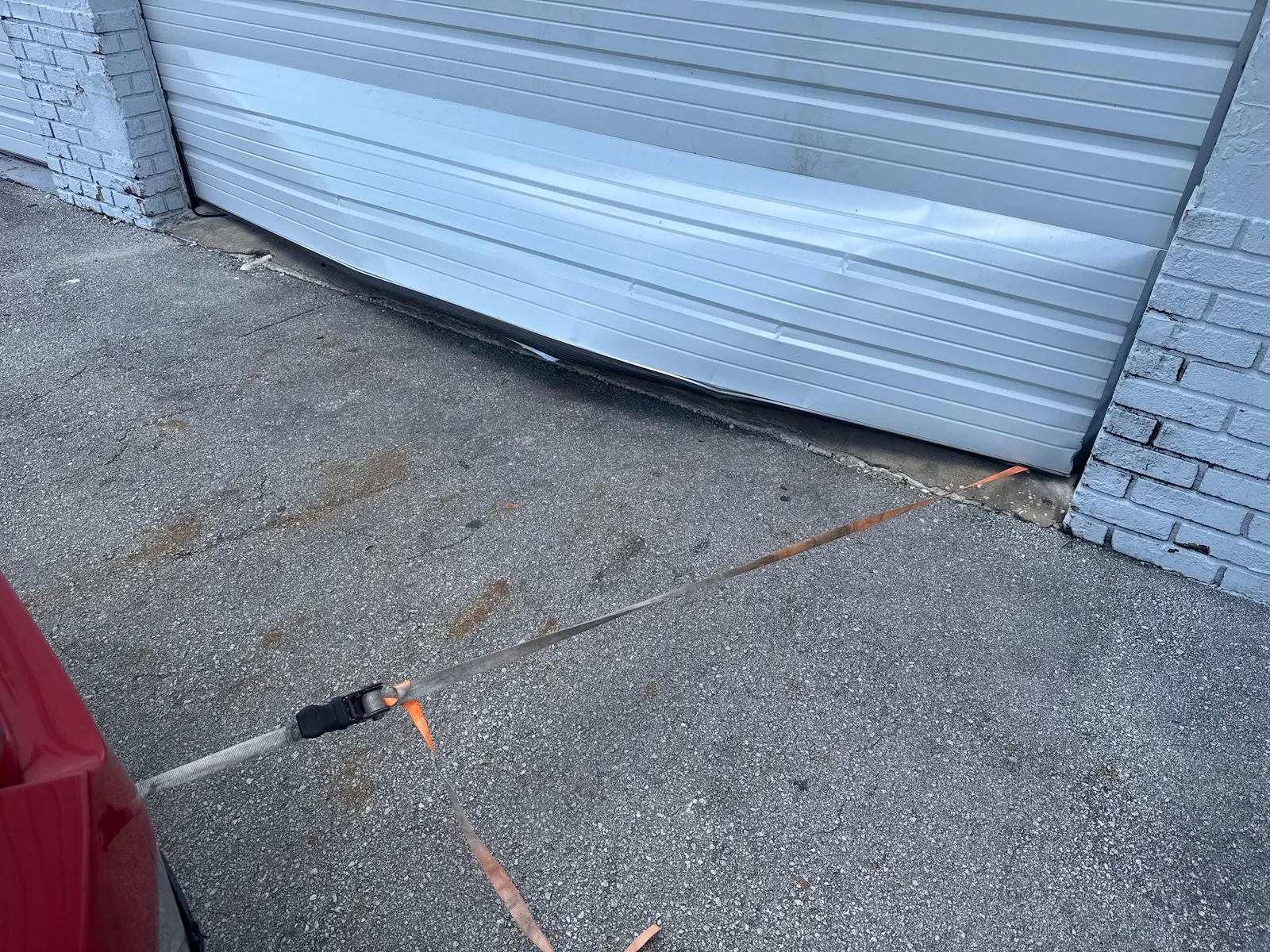
The lowest part of the door lives in the worst conditions. Wind-blown sand collects along the threshold, snow gets shovelled against the door from a short driveway with nowhere else to put it, and water sits where the slab meets the paving. On a steel door, rust begins at the bottom edge and creeps up the inside of the bottom section. On a wooden door, the bottom rail softens first.
The rubber seal along the bottom is the door’s first line of defence. Once it is cracked, torn or flattened, salty water and grit blow in beneath the door and the bottom brackets, which anchor the lift cables, sit in the wet. That is a large part of why cables tend to fail at their lowest point. Renewing a worn seal is a modest job, and on the coast it pays back in the life of the hardware above it.
Provided a matching panel still exists, a rusted or dented section can be swapped by itself. The hinges and roller brackets on that section are usually replaced at the same time, since they will have suffered the same exposure.
How often a coastal door is worth checking
Inland, many doors run for long stretches without anyone looking at them. On the peninsula that is a riskier habit. Corrosion builds steadily, and the first sign many owners notice is the bang of a spring breaking.
A sensible pattern is to have garage doors in Winthrop looked over whenever something changes: a new noise, a new jerk in the travel, a door that feels heavier when lifted by hand, or the first sign of rust on a spring or cable. A look at that point usually means replacing one or two parts before they take others with them. Leaving it means the spring, both cables and a bent track all at once.
Between checks, owners can watch for the warning signs without touching anything under tension. Standing back and watching the door through a full cycle tells you a lot: whether it moves evenly, whether both sides rise together, and whether it pauses or shudders at any point.
Openers and safety sensors in damp, salty air
Openers sit on the ceiling, out of the worst of the weather, but they are not immune. Damp, salty air reaches the circuit boards, the terminals at the back of the motor head and the wiring to the wall button and the sensors. Corroded terminals cause intermittent faults: a door that sometimes works and sometimes does not, a wall button that responds only on the second press.
The safety sensors, sitting at shin height beside each jamb, are the most exposed electrical parts of all. Corrosion on their brackets lets them drift out of line, and a film of salt spray on the lenses can stop the beam. A door that will not close, or closes and immediately reverses, often has a sensor problem. A soft cloth across both lenses, then a glance at the two indicator lamps, is a safe first step.
We repair and renew openers of all kinds, LiftMaster models included, plus their handsets, wall controls and photo eyes; Winthrop opener repair goes further.
A corroded part that picks its moment
Rusted parts tend to fail suddenly. A spring snaps on a raw night off the harbour, a cable parts as the door rises for the morning commute. Whenever it happens, ring: a person picks up after midnight just as at noon, Sundays included, so the fault gets logged straight away.
While you wait:
- Kill the opener’s power so the door cannot be cycled again.
- Keep everyone clear of a door that is crooked or stuck part open.
- Leave a spring-broken door down, and leave a derailed one hanging as it is.
- If the door is stuck open, secure the internal door to the house.
The Winthrop emergency repair page looks at urgent faults in more detail.
What a visit covers
Each visit opens with the opener uncoupled and the door raised by hand. If the springs are right, a door let go at hip height hovers; a weakened spring lets it sink, and a snapped one leaves it almost immovable.
On a coastal door, the inspection that follows pays particular attention to rust. Each spring and its winding cone, each cable along its full length, the drums and bearings, every roller, hinge and bracket, the tracks and their fixings, and the lower corner brackets that anchor each cable. Separately, the motor, every handset, the wall control and the photo eyes are tried, with their terminals examined for green or white crust.
Before any spanner turns, you hear which part failed, what corroded or wore it, and which neighbours are next in line. Once the work is done, balance is restored, the opener’s end stops and closing force get retuned, and a chunk of two-by-four on the slab proves the door retreats on contact.
Repair or replace by the water
Most coastal doors are repaired, not replaced. The hardware wears out by design, and renewing it brings a structurally sound door back to good order.
The scales tip toward a new door when salt has got into the panels themselves. Steel rusted right through along the bottom, a skin blistering with rust from the inside, wood soaked and soft, or a door that has had so many parts replaced that the remaining original parts are the weak link. When garage doors Winthrop MA homeowners have reach that stage, the opening and the room inside are measured, the corroded door comes out, and one of our new garage doors goes in.
Slowing the rust down
There is no stopping salt air, but a few habits slow its effect and none of them involve the springs or cables.
- Keep sand, piled snow and standing water away from the bottom of the door.
- Wipe the sensor lenses from time to time.
- Keep the garage dry where you can; a wet floor feeds rust on everything above it.
- Book a look at the first new noise or the first sight of rust on a spring.
Our general garage door repair service takes in the whole door, and Winthrop garage door repair focuses on the peninsula.
Neighbouring places
Over the causeway and the bridge, our work carries on through Greater Boston. East Boston and Revere, the nearest places by road, each have a page, and the others sit on the service areas list.
Getting help
When garage doors in Winthrop MA give out, it helps to tell us what you can see: rust on the spring or cables, a door hanging crooked, a door that will not close, and whether a car is shut in. Mention a short driveway that a car will have to leave. Google reviewers rate us 5.0, and the phone is picked up whether the tide is full or ebbing. Call us or book online.
Questions from Winthrop
Springs here seem to snap more often than they should. Why?
Salt air corrodes the spring wire, leaving pits where a fracture can start. A spring that would last a long time in a dry inland garage can fail sooner on the coast, which is why rust on a spring is worth acting on early.
The cables look a bit rusty but intact. Is that a problem?
It can be. Cables corrode from the inside out, so a cable with rust on the surface may be weaker than it looks. If you can see rust or any broken strands, have them looked at.
Can I spray the springs with something to stop rust?
Leave the springs and cables alone. They are under heavy tension, and working near them by hand is risky. Keeping the floor dry and the bottom of the door clear of sand and snow are the safe things to do.
The opener works some days and not others. Why?
Intermittent faults on the coast are often corroded terminals or wiring to the wall button or sensors, or salt film on the sensor lenses. Wipe the lenses first; if the problem continues, the electrics need a look.
Is it worth repairing a door that is already rusty?
Usually, if the sections are sound. Rust on springs, cables and rollers is fixed by replacing those parts. If the door’s own steel is rusted through, a new door is often the better choice.