
Old brick, and a door cut to suit it
Hanging a modern door in a building designed around carriages rather than cars is a particular kind of job. New garage doors South End MA carriage houses receive seldom come off a standard size chart; each one begins with a tape, a spirit level and a slow look around an opening that was laid in brick for a very different sort of vehicle. The shop is a stroll away, among the terraces of Shawmut, Columbus and Tremont, the carriage houses strung along their rear alleys and the odd bay built beneath a building, so openings like these are home ground.
New doors are supplied and installed, and worn-out ones replaced. The job takes in the door itself, plus its springs, cables, rails and rollers and, if you want one, the opener that will drive it.
Three hints that it is time to stop repairing and start replacing:
- Rust has eaten through the lowest panel, or a timber door has gone soft and crumbly along its foot.
- Breakdowns have begun arriving one after another, a cable this month, a roller the next.
- A car has creased more than one section, and the door no longer sits square however it is adjusted.
What a new door involves
Sections and panels
A fresh set of hinged sections, in a pattern and finish picked to look settled against old brick, glazed along the top row or left solid.
Springs to match
Coils calculated for the new door’s real weight, so it floats in balance from the moment it goes in, rather than on guesswork carried over from the old one.
Rails, wheels and seal
Plumb new rails, quiet rollers, fresh hinges and brackets, and a new rubber strip along the threshold.
An opener, if wanted
A fresh unit paired to the new door, or the existing motor tested and re-set. See opener repair in the South End.
Measuring an opening that is not quite square
Everything starts with numbers, and in a carriage house they take patience. Old masonry openings are rarely true rectangles. One jamb may lean a touch outward, the lintel may sag slightly at one end, and the threshold may fall toward the lane so rain drains away. A door built for a perfect rectangle would show a sliver of daylight down one side and scrape along the other.
So the opening’s width is read across its head, its waist and its foot, its height up both jambs and through the centre, and both diagonals checked against each other to reveal any twist. The door is then sized, and its rails positioned, so that it comes down evenly across the full width, its seal kissing the threshold from end to end even where the brick itself wanders.
Three further dimensions decide what hardware will fit. Headroom is the gap from the top of the opening up to the lowest obstruction above, whether joist, pipe or beam; it governs where the springs can sit and how tightly the rails must curve. Sideroom is the flat wall on each side, which carries the upright rails and, on some layouts, the springs. Backroom is the clear run of ceiling stretching rearward from the door, and the ceiling rails, plus any overhead opener, must fit inside it. Carriage houses tend to be generous in one of these and miserly in another, and the hardware is chosen to suit the tightest.
Doors for alley carriage houses
Behind the row houses the garages began as carriage houses opening onto rear alleys. A door there does a different job from one beside a suburban drive, and several points are worth thinking through.
Appearance counts, since the door sits in a brick elevation that has weathered a long time. Plenty of owners lean toward a carriage-house pattern, a plain flush face in a deep colour, or a raised-panel design that nods to older doors, instead of something glossy and suburban that jars against the brick. Colour can be picked to sit quietly beside the masonry and any painted trim nearby.
Privacy and security count as well. Lanes like these see people walking through at all hours, so glazing is usually kept to a high band of small lights, or obscured, letting daylight in without advertising what is inside. A stout, well-fitted door with a sound bottom seal and properly anchored rails is far harder to prise open than an old one that has warped away from its frame.
Toughness is the third point. A door facing a narrow lane gets bumped by cars, bins and delivery barrows. Steel with a stiffened bottom section takes small bumps in its stride far better than an elderly timber door softened by damp.
Doors for bays beneath buildings
A small number of garages here are single bays set into a building’s street level, with homes overhead. In those, the door forms part of the building’s outer skin, and replacing it can change how the rooms above feel.
An insulated door keeps winter out of the bay, which in turn takes the chill off the floorboards upstairs. A properly balanced door on nylon wheels, driven by a quiet opener, cuts the drumming that an old rattling door sends up through the joists. And since such a bay is often the only way a car gets in or out, a dependable new door spares everyone in the building the upheaval of a stuck one.
How new garage doors in the South End are installed
New garage doors in the South End follow one sequence, whether the opening belongs to a carriage house or a bay below a building.
- A detailed survey of the opening, noting headroom, sideroom and backroom as well as width and height.
- Agreement on style, panel pattern, finish, glazing and insulation, and on whether a new opener is part of the job.
- On the day, the old door comes down under control. Its springs are unwound and relaxed before any bolt is loosened, because they store dangerous tension.
- The opening is checked and made ready, so the new rails anchor into sound brick or timber.
- Sections, rails, springs, cables and seals go in, and the springs are wound to the new door’s weight.
- Hand-testing confirms the balance, then the opener is hooked up and adjusted, and the auto-reverse is proven against an object on the floor.
Before you take over, you are shown how everything works, including the opener’s emergency release.
Getting the old door out without drama
Removing an old door is far from a simple unbolting exercise. The springs that lift it store a great deal of energy, and a coil that has been wound tight for decades is every bit as dangerous as a new one. A torsion spring holds dangerous tension whenever a door is hung on it, and letting that tension off calls for purpose-made winding bars and a disciplined sequence. This is not a DIY repair, nor a DIY demolition. Extension springs and their cables also have to be slackened in the correct sequence.
Old doors also hide things. Behind them you may find timber jambs rotted where rainwater has run for years, rail brackets screwed into mortar that has turned to sand, or a lintel that was patched long ago. Anything like that is spotted as the old door comes out, and you hear about whatever affects the new installation before work carries on.
Pairing an opener with the new door
A new door changes the load an opener sees. An insulated steel door may weigh more than the thin panels it replaces, or less than a soaked timber door, and the opener’s force and travel settings have to be set again either way. Where the existing motor is healthy and up to the new weight, it simply gets reconnected and tuned. If it is noisy, elderly or lacks a reliable safety reverse, fitting a fresh opener at the same visit avoids pairing a new door with a tired drive. In low carriage houses a wall-mounted opener beside the door can free up the ceiling, and in a bay with flats above, a belt drive keeps the noise down. The openers we repair and replace include LiftMaster models.
Insulation, glazing and finish
Which door you choose changes how the garage feels as well as how it looks. An insulated steel door sandwiches a foam core between two skins: the garage stays warmer, the door runs more quietly, and the panels resist dents better. A single-skin uninsulated door is lighter and plainer, and perfectly suits a detached carriage house used purely to park a car.
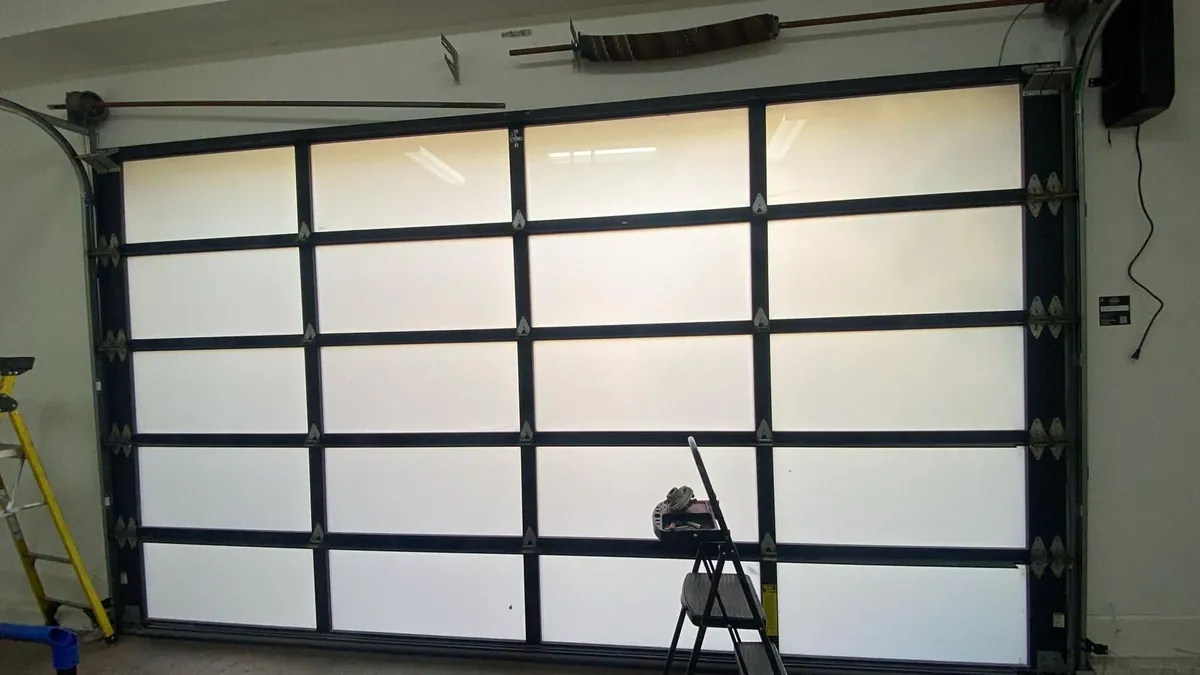
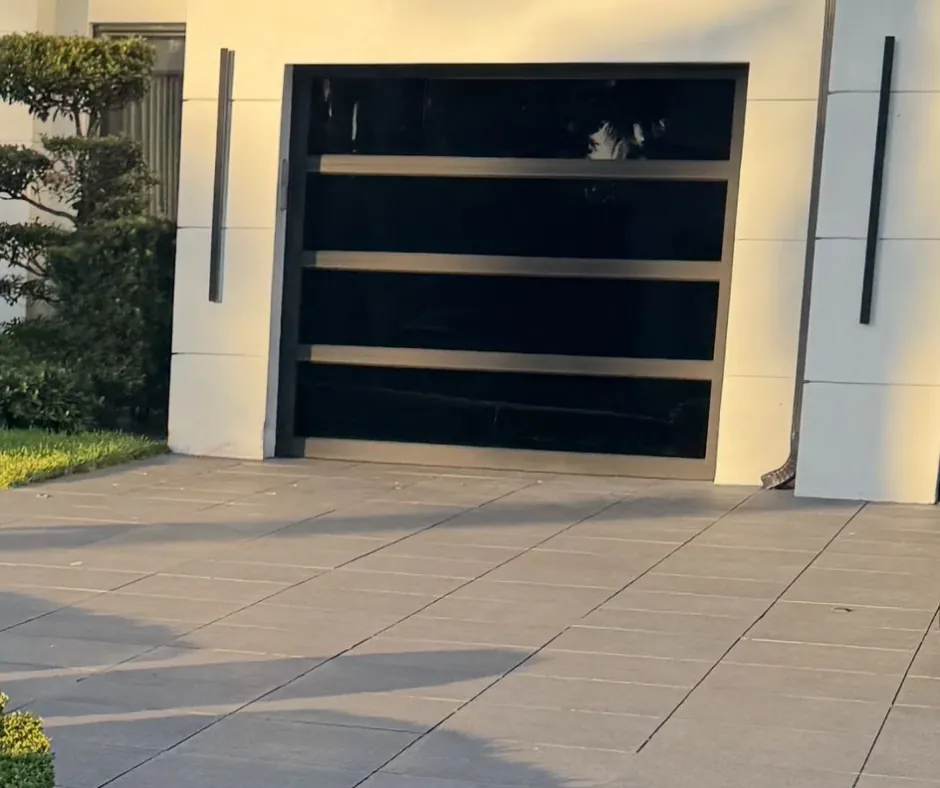
Glazing brings daylight into a carriage house that may have no window at all. A line of small panes in the top section is the usual alley choice, high enough to keep the interior private. For a more open look, full-view doors with aluminium frames and glass panels are supplied and installed as well; see full view glass garage doors for more.
Finish comes last. A shade that suits the brick and trim, on a surface able to shrug off the road salt and grime a lane throws at it, keeps the door looking right for many winters.
Panel styles and the row-house look
The brick terraces of this neighbourhood have a strong, even rhythm, and a rear garage forms part of that picture even when it faces an alley. Three broad approaches tend to work. A carriage-house pattern, with vertical boards and perhaps a cross-brace motif, recalls the swing doors these buildings once had. A recessed or raised panel in short, even rows gives a quieter, more formal face. A flush, smooth door in a dark colour almost disappears into the brick. Bright white with long ribbed panels, the default of many suburban developments, usually looks least at home.
Hardware can be chosen to suit as well. Decorative handles and strap hinges are purely cosmetic on a sectional door but help a carriage-house pattern read convincingly from the lane.
Wind, draughts and the bottom seal
An alley channels wind, and an old door that no longer meets its threshold lets that wind, along with leaves, grit and snowmelt, straight into the garage. A new door ends that with fresh weatherstripping on three fronts: a rubber bottom seal shaped to the threshold, and stops along the jambs and head that close the gap between door and brick. On a bay beneath a building, those seals also keep exhaust and cold air from creeping into the stairwell or the flats above. Where the threshold itself is badly worn or uneven, that is pointed out at the survey, since even the best seal cannot close a gap the floor has created.
Repair first, or replace
Replacement is not automatically right, and you will hear so when it isn’t. A sound door with one snapped spring, a frayed cable or a single dented section is usually better mended, and that work is covered on our everyday South End repair page, with coils in particular on the South End spring repair page. Replacement earns its place when rust or rot has broken through at the bottom, when a collision has creased panel after panel, when the door now outweighs anything a reasonable spring could lift, or when call-outs have become a habit. New garage doors South End carriage houses get also bring the chance to fit hardware that genuinely suits the opening, something many of the old doors never had.
Planning a replacement rather than suffering one
The worst time to buy a door is the night the old one gives up for good. A door that is clearly near the end, with a rotten foot, a string of recent breakdowns or panels that have been patched more than once, is better replaced on a day of your choosing than in a rush when it jams open in a storm. Planning ahead also leaves time to decide on style, colour and glazing properly, rather than accepting whatever suits a hurried fit.
Autumn is a sensible moment to look at a tired carriage house door. Springs fail more often once the hard frosts arrive, and an old door that already struggles to seal will let in more cold, salt and snowmelt as winter goes on. Having the survey done before the weather turns means the choice is made calmly.
Keeping a new door in good order
A new door asks for very little, but a few habits keep it running sweetly. A couple of times a year, uncouple the trolley and raise the door yourself, checking that it still floats at mid-height. Give the sensor lenses a wipe now and then, and sweep grit and ice off the threshold. Wipe salt and slush off the bottom panel and seal through the winter, since an alley sends plenty of both under the door. Hinges, rollers and springs stay hushed with an occasional mist of the lubricant sold for overhead doors. And if the door begins to sound or feel different, have it looked at early; small adjustments on a new door are quick, and they keep it that way.
Shopfronts and commercial doors
New doors are not only for homes. Businesses on these streets use roll-up doors across shop windows and sectional doors at their rear entrances and loading docks, and both are supplied and installed. A commercial door works far harder than a residential one, so the springs, rails and opener are chosen for a heavier daily load.
Booking a visit
Tell us a little about the garage: carriage house on a lane or bay under a building, the rough size of the opening, what the current door is made from, and what has prompted the change. If the old door has collapsed or jammed so the garage cannot be closed, our South End emergency page describes how a door is made safe while a replacement is arranged. Greater Boston as a whole is served through our main new garage doors page, and the South End page lists every local service together. For new garage doors in the South End, whether for a carriage house or a bay, call us or book online.
Questions from South End
Our brick opening is visibly out of square. Will a new door look right?
It will. Measurements are taken at many points around the opening, and the rails are positioned so the door lands evenly on the floor, its seal tight to the threshold all the way across, even where the masonry wanders.
Hardly any room exists above the opening in our carriage house. Does that rule out certain doors?
It restricts the hardware far more than the door. Low-headroom rail and spring kits are made for exactly that situation, and a wall-mounted opener can keep the ceiling free. The survey shows which layout suits.
Is insulation worth having for a bay with flats above?
Generally, yes. It keeps the bay warmer, which softens the cold reaching the floor above, and the thicker panels run more quietly and dent less easily than a single skin.
Could my current opener drive the new door?
Possibly. If it is healthy and suited to the new door’s weight and height, it can be reconnected and re-set. If it is elderly, loud or has no working auto-reverse, a new opener is the wiser choice.
How do I know whether my old door is worth saving?
When the door is sound and a single part has failed, repair normally wins. Replacement makes more sense once the bottom panels are rotten or rusted through, damage runs across several sections, or the door now weighs more than its springs can balance.