
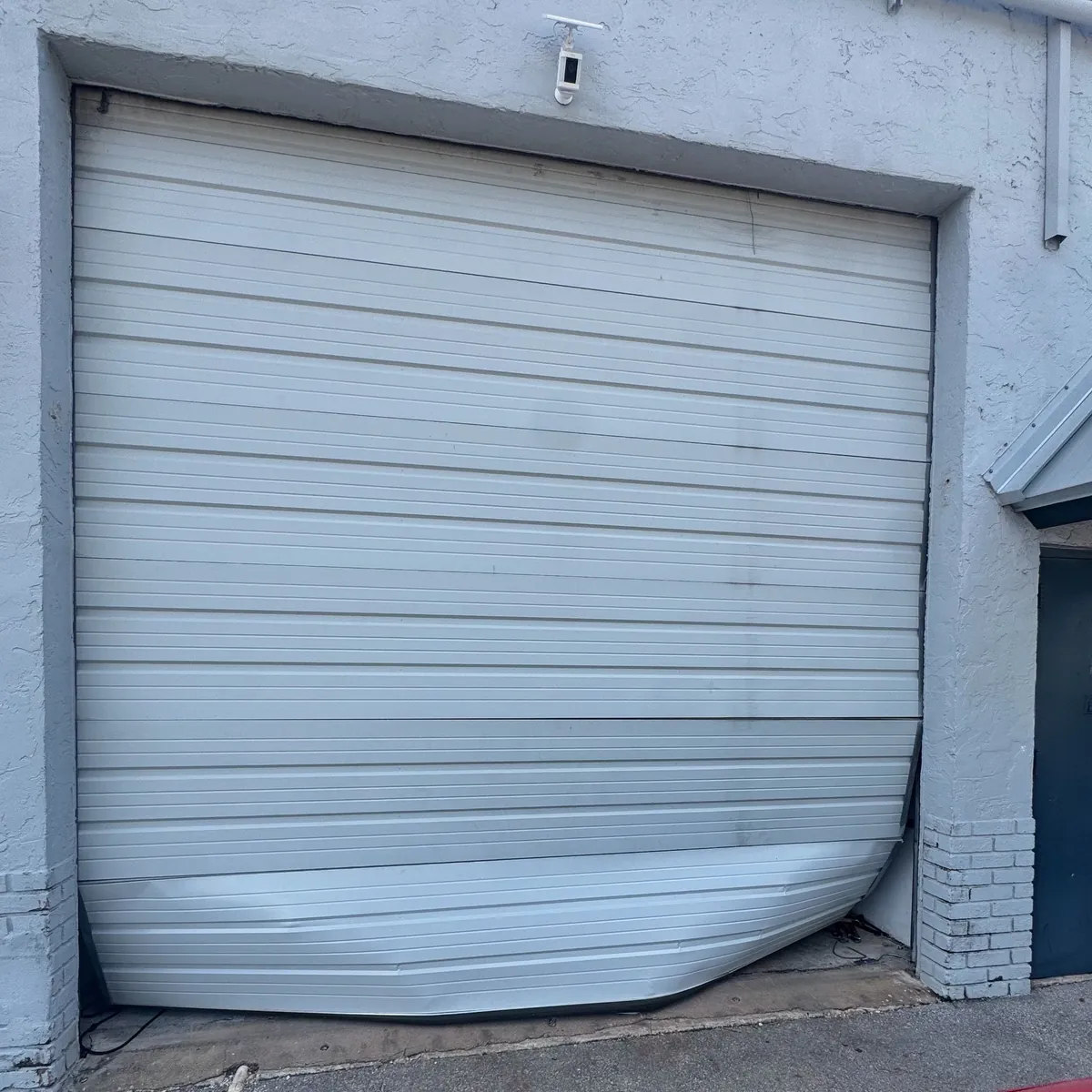
From a tight single near the square to a double in West Peabody
Peabody gives us two very different garages to work on. Close to the square, the two-families stand shoulder to shoulder, and any garage that fits on those lots is narrow, often a single bay with barely a hand’s breadth between the door track and the wall. Out in West Peabody, the post-war ranches sit on wider plots, and many of their garages now carry a modern double door. Work on garage doors Peabody MA homeowners ask us about falls somewhere between those two ends.
The opening decides a great deal. A tight single leaves little room beside the track for a hand, a tool or a spring, and little room overhead for an opener rail. A modern double has the space, but spreads a heavy door across a wide span that has to stay level from one end to the other.
So before anything else, it helps to know which you have, and what the door is doing:
- Is it a narrow single, a standard single, or a double-width door?
- Has it stopped dead, or does it move a little and then stall or twist?
- Can you see a break in a spring, or a cable hanging loose at a bottom corner? Look, but keep your hands clear.
Garage door services in Peabody
Repairs to the whole door
Hinges splitting at the section joints, rollers grinding in a rusted rail, a bottom panel kicked in, a door that judders all the way up. All of it falls under garage door repair.
Snapped springs
A tight single may carry a lone torsion coil or a pair of stretch springs; a double usually has heavier torsion springs across the header. Our spring repair page explains both.
Openers and controls
Motors that groan and stall, remotes that need to be inside the garage to work, wall buttons and the low safety eyes. Our opener work takes in LiftMaster units too. See opener services.
Urgent calls at any hour
A door jammed open on a narrow lot with no other parking, or a car stranded behind a snapped spring. Our phone line never closes. See emergency garage door repair.
Cables, drums and derailed doors
A loose or parted cable tips the door; a tipped door can climb out of its rail. Read about cable repair and off-track repairs.
Fitting a new door
A replacement made to suit the opening you actually have, from a slim single to a broad double. See new garage door installation.
The cramped single garages near the square
On the dense streets near the square, lots are narrow and the two-families take up most of them. Garages here, where a lot has room for one, are mostly single bays, squeezed in beside the house or set at the back of a strip of driveway. Many of these openings are tighter than a modern standard single, and the garage walls stand close to the door on both sides.
That tightness affects almost every repair:
- Side room. Vertical tracks are fastened to the jambs, and in a narrow garage the wall may be only a few inches past the track. Reaching a loose bracket, or swapping a roller, has to be done from an awkward angle, and a bent track is easy to cause with a car mirror or a bike handlebar.
- Headroom. A low ceiling or a beam just inside the header is common. Either one dictates the spring’s position over the opening and the path the opener rail can take. A low-headroom track layout is sometimes the only way to fit a new spring system properly.
- Clearance at the front. A door that opens straight onto a short driveway or the edge of the sidewalk leaves no space for the van right at the door, so parts are carried in.
A tight single is often shared by both units of a two-family, which means more cycles and more people with remotes. Each time a unit changes hands, have the opener forget every code, then re-link just the handsets that stay with the building.
The post-war ranches in West Peabody
West Peabody’s post-war ranches were built with the garage as part of a long, low house, and many of those garages have been widened or refitted over the years with a modern double door. The room is better: there is usually space beside the tracks, a clear run for the opener rail, and a driveway wide enough to park the van in front.
The challenges here are different:
- Weight across a wide span. A double door is heavy, and it is lifted by springs that must be matched to it. If one spring weakens, the door can rise unevenly, and the opener ends up doing lifting it was never meant to do.
- A level bottom edge. Across a wide opening, a slab that has settled or cracked can leave a gap under one end of the door, letting in rain and leaves.
- Older framing behind newer doors. Where a modern double door has been fitted to a ranch-era opening, the header and jambs may have been reworked. We check those fixings when we work on the door, because a spring bracket is only as sound as the wood it is screwed into.
Either way, these doors take a lot of use, and the hardware wears in proportion.
Springs and why they matter most
Among all the garage doors Peabody MA owners call us about, the snapped spring is the fault that turns a normal morning into an urgent one. One loud report from the garage, and the door either stays put or lifts a few inches before the opener gives up.
Picture the torsion spring as a coil wound hard around a shaft above the opening, holding enough energy to raise the entire door. Because of that stored energy it is genuinely dangerous, and swapping or adjusting one is not a homeowner’s job. The fittings that hold it, the cones and the shaft and the brackets, are all under that same load, and a wrench that slips can be thrown back hard.
Some older singles near the square still rely on extension springs, pulled taut beside the horizontal rails. Their hazard is different: if no containment cable runs through the coil, a snapping one lashes out sideways, and in a garage with walls this close there is nowhere for it to go.
With a failed spring:
- Leave the door as it sits; no lifting it by hand, no propping it on a stick.
- Pull the opener’s plug.
- Nobody, and nothing, should stand beneath that door.
We replace the spring to suit the door’s weight and size, check the cables and drums that go with it, and set the door so it holds its position at mid-height with no help.
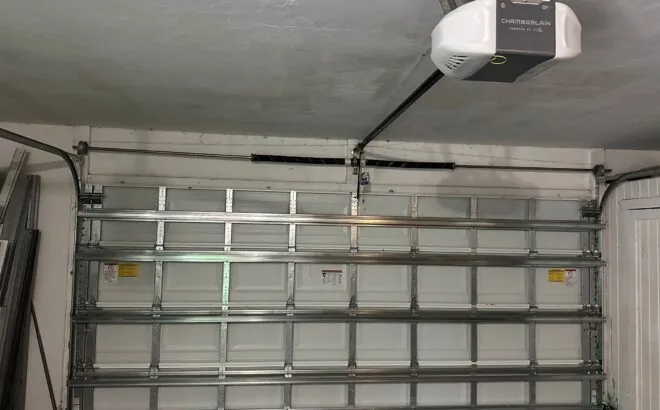
Openers in tight garages and wide ones
The opener has a different life in each kind of garage. In a narrow single, it may be mounted low because of a beam, and its rail may run close to a light fitting or a storage shelf. On a wide double, it is lifting a lot of door, and if the springs are tired, it will show it first.
Common opener complaints and what to check:
- The door rises a little and reverses. The door may be too heavy for the opener because a spring has weakened. Do not keep cycling it.
- The door lands and immediately climbs again. Check the low safety eyes on each jamb. In a narrow garage, a recycling bin nudging one is the usual suspect.
- The remote only works at close range. Try a fresh battery first; if that changes nothing, the handset may need pairing afresh.
- The motor runs with nothing happening. The drive may have stripped, or the emergency release may be pulled.
When an opener needs replacing, we look at headroom, door weight and how close the garage is to bedrooms. We service and replace LiftMaster openers as part of that work. A belt drive suits a garage tucked under or beside living space; a heavier drive may suit a wide door.
Cables, drums and doors that leave the track
A lift cable connects the bottom of the door to the spring system. When it frays or parts, the door hangs crooked, one corner higher than the other. On a narrow single, that tilt quickly jams the door between the jambs. On a wide double, it puts a twist into the whole door and can force a roller off the rail.
Should the door be hanging at an angle:
- Stop using it. The opener can drag a twisted door further out of its tracks.
- Cut the opener’s power, and resist the urge to shove the door straight.
- Look, without touching, for a loose cable or a roller outside its rail.
With a derailed door, the first job is to take its weight safely off the hardware. We then straighten or replace bent track, refit rollers, replace both cables so they share the load evenly, and rehang the door square. On tight singles, we pay particular attention to the side clearance, because a track bent once by a wing mirror tends to be bent again.
Snow with nowhere to go
Winter hits the two kinds of garage in different ways. On the packed lots near the square, there is very little room to put shovelled snow, and it tends to end up heaped against whatever is nearest, which is often the garage door itself. A bank of wet snow leaning on the lower section pushes it inward, and when the door is next opened, the bottom rollers are dragged against that weight. Meltwater seeps beneath, turns to ice after dark, and bonds the rubber seal to the concrete.
On the West Peabody ranches the problem is scale. A double door has a long bottom edge, and a ridge of ice along any part of it is enough to hold that end down while the other end lifts. The opener keeps pulling, the door twists, and a cable or a roller pays for it.
A few winter rules for garage doors Peabody MA homes rely on:
- Keep shovelled snow a little way back from the door, not banked against it.
- If the door is stuck to the ground, do not keep pressing the button. Clear the ice along the seal by hand, or wait for it to soften.
- If the opener strains and the door lifts unevenly, stop and check for ice under one end before trying again.
- After a thaw, look at the bottom seal. A seal torn by ice lets water straight back in.
If the door has already been dragged off line by ice, leave it where it is and call. Running it again usually turns a seal problem into a cable or track problem.
Measuring an opening that is not standard
Because the town’s garages run from slim singles to full doubles, we never assume a size. Many of the narrow openings near the square were framed before today’s standard door widths were common, and some were altered after they were built. Ranch garages that were widened for a double door may have a header or jambs that are not quite square.
Before a replacement door is ordered, we take the opening’s width and height, how much space sits between the header and the ceiling, the clearance at each jamb and how far the garage runs back. Those measurements decide which track layout fits, where the spring goes, what opener suits, and whether a door can be made to the opening as it stands or whether the frame needs work first. Careful measuring at the start saves a door that binds or rubs later.
Dented lower sections and worn seals
A narrow garage door near the square takes knocks from cars, bikes and bins, and the bottom section suffers most. A dented lower section can stiffen the door, make it catch in the track, and stop the bottom seal meeting the ground. On a ranch double, the bottom edge is long, and a worn seal across a wide opening lets in a surprising amount of water and leaf debris.
Damaged sections can often be changed one by one, provided the others are in decent shape. Bottom seals and side weatherstripping are straightforward to renew and make a real difference on an attached garage.
What to expect on a visit
- Before a tool comes out, every part of the door gets inspected, from the spring shaft down to the seal and the sensors.
- A clear explanation of the fault, and of anything else that is close to failing.
- Your decision on what is done. Nothing is swapped without agreement.
- Balancing, setting the opener’s travel and force, and testing the safety reverse.
For a tight single near the square, it helps to know where we can stop the van and how far the garage is from the street. For a West Peabody double, a clear driveway makes testing quicker.
Keep it, or replace it
A door that is structurally sound is usually worth keeping. Fresh hardware throughout, from springs to hinges, can keep a tired door going for a long while yet. That holds for most garage doors Peabody MA homes have, whether the narrow singles or the wider doubles.
Replacement deserves a thought when:
- Several sections are cracked, rusted through or badly dented.
- A narrow door has been knocked and straightened so often that the tracks no longer stay true.
- An attached ranch garage needs a better-sealed or insulated door.
- The door has been patched with odd parts until it no longer runs smoothly.
New doors are supplied and fitted to the opening, whatever its size. For the tight singles, that can mean a door made to suit an opening narrower than standard. For the ranches, plain long-panel and carriage-style doors both sit well on a low facade, and windows across the top section add light to a garage that may double as a workshop.
Small habits that help
- Every few weeks, open and close the door while you stand and listen. Grinding, popping or scraping means something has changed.
- Keep bins and bikes clear of the tracks and the safety eyes in a narrow garage.
- Brush leaves and grit out of the lower tracks after a storm.
- Glance at where each cable meets its bottom bracket for broken strands, keeping your fingers well away.
Next door to Peabody
Our vans also reach Lynnfield, Salem and Lynn. The complete town list lives on the service areas page.
If the door has given up
If your garage door has stopped, is hanging crooked, or has a cable fraying, call us or book online. A person answers whenever you phone, weekday or weekend, so a fault on garage doors Peabody MA homes depend on can be reported the moment it happens.
Questions from Peabody
Our garage near the square is very narrow. Can a standard opener fit?
Usually, yes, though the headroom and any beams decide where it goes and which drive suits it. We measure the space before recommending one.
Is our old ranch garage strong enough for a double door?
Many ranch garages already carry a double door. The header and jambs need to be sound, and we check those fixings whenever we fit or work on a wide door.
Our door has side springs along the tracks. Should we change to torsion?
It depends on the headroom and the door. A torsion system often runs more smoothly, but some tight garages do not have the room. We can tell you on a visit.
The door is shared by both units in our two-family. Can we limit who has a remote?
Yes. Wipe the opener’s code memory, then pair just the handsets you intend to keep. Doing this whenever a tenant leaves keeps the garage in your control.
The bottom of our double door leaves a gap at one end. What causes that?
Often the floor has settled or the bottom seal has worn unevenly. Sometimes it is the door itself out of balance. We check which before fixing it.