
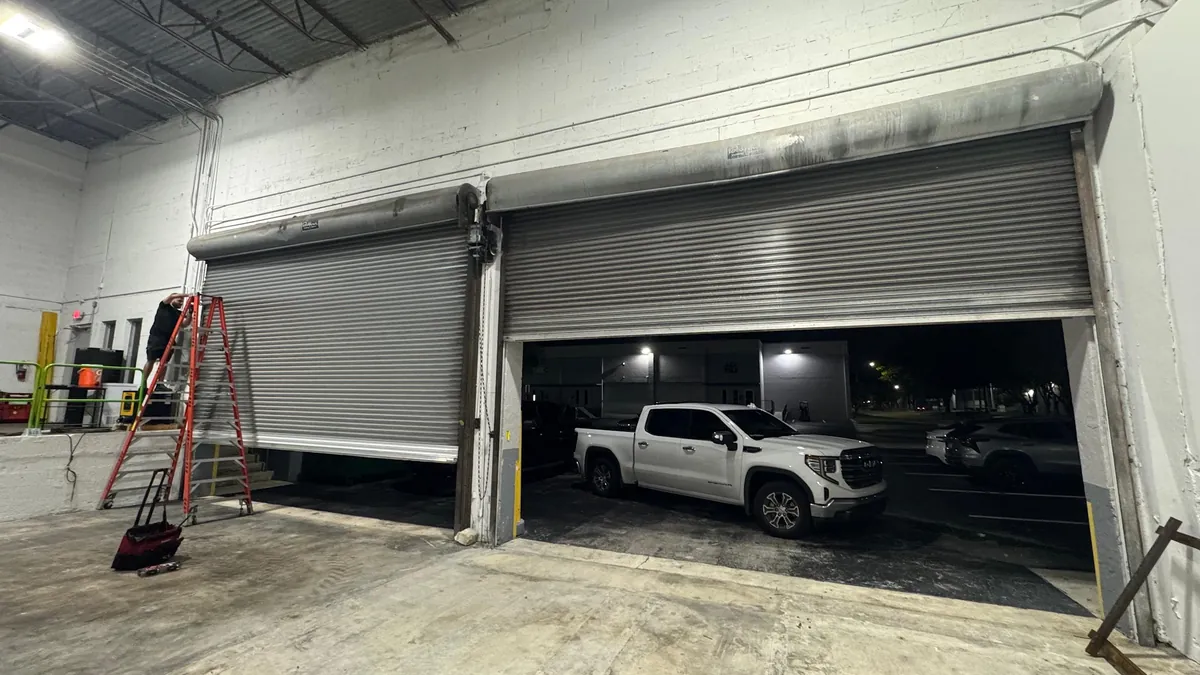
When a Fenway garage door fails at night
Garages are uncommon in this part of the city. Around the Fens, most apartment buildings and brownstones have no parking of their own, and drivers use the street or a shared lot. What garages there are tend to be lone bays cut into a building’s lowest storey, with their inner side opening off a lobby or a service passage. When one of those doors fails after dark, it is rarely just one person’s problem, and that is why emergency garage door repair Fenway MA buildings need tends to come in at odd hours.
A door jammed open leaves a gap in the base of the building that nobody can close. A door jammed shut keeps every car in the bay where it is until morning, or longer. A spring that snaps with a bang in the small hours wakes the flats overhead. Since somebody picks up our phone whatever the hour, on weekdays and weekends alike, a failure discovered in the small hours gets logged in the small hours.
Before you call, and without touching any spring or cable, take note of three things:
- How far up it is: down on the floor, raised all the way, or frozen at some point midway.
- Whether its bottom edge is square to the floor or one corner has sunk.
- Whether any car, person or animal is inside the bay or under the door.
Emergencies we answer in Fenway
A door that will not open
Cars shut in a bay under the building, often because a spring has broken or the opener has failed. The Fenway spring repair page explains what a broken spring looks like.
A door that will not close
The bay is left open to the street or the lot, and through it, the building. Sensors, a jammed rail and a failed opener are the usual causes.
A snapped spring
One sharp crack, and afterwards the door hardly shifts. The spring holds dangerous tension even after it breaks, so it is never one to deal with yourself.
A door off its tracks
Wheels clear of their guides, the door slanted in its opening and liable to drop. It needs securing before anything else is done.
Why a failed door under a building is urgent
A garage door in a detached garage protects a car and some storage. A garage door set into the base of an apartment building does more. It is part of the building’s outer shell. When it sticks open, the bay behind it is open, and in many buildings around the Fens the bay connects to a corridor, a service door or a lobby. That is a gap in the building’s security, not just an inconvenience to the person who parks there.
A door stuck closed matters in a different way. With most parking here on the street or in shared lots, a car shut in the bay is a car that cannot be moved for work, a hospital visit or anything else until the door is released. In a shared bay, one failed spring can hold several cars in place at once.
A door hanging off its tracks is the most dangerous of the three. A sectional door is heavy, and once its rollers are out of the rails its weight is held by whatever is left: a cable, a bent piece of track or a single roller still in place. In a cramped bay that residents cross on their way to the service entrance, that weight is close to everyone who uses it.
Calling at night: what to tell us
Emergency garage door repair in Fenway MA usually starts with a call from someone standing in a dark bay or at a door that will not respond. The more clearly you can describe what you see, the better the visit can be planned. These details help most:
- Where the bay is, and whether it opens onto the street, a shared lot or both.
- The indoor route to it, by lobby, passage or back door, and whether a key, fob or code is needed to use that route after dark.
- Who can open the inside route if the door from the street cannot be used.
- What the door is doing: stuck shut, stuck open, partway up, crooked, or moving and stopping.
- What you heard or saw before it stopped: a bang, a grinding noise, a cable hanging loose, a roller out of its rail.
- Whether a car is inside and whether anyone needs to get it out.
It is worth thinking about access before you call. If the building’s inner doors lock at night and the person with the keys lives elsewhere, say so. A visit that can reach the bay from inside is much easier to plan than one that cannot.
What to do while you wait
The first job is to keep everyone safe, and the second is to stop the fault getting worse. In a bay under a building, the people at risk include neighbours walking past, so a few simple steps matter:
- Pull the opener’s plug out of its socket so nobody presses the button again. In a shared bay, a stranger to the problem may do exactly that.
- Keep everyone, including children and pets, out of the doorway and away from a door that is hanging crooked.
- Keep your hands off the red cord while the door sits half raised. With a failed spring, nothing stops the door crashing to the floor.
- Never try heaving up a door whose spring has gone. It is far heavier than it appears and has nothing supporting it.
- Leave a note on the door or at the service entrance so other users of the bay know not to touch it.
- Where the bay is open to the street and the building feels exposed, close and lock the inner door between the bay and the lobby or corridor, if there is one.
The spring, the cables and the bottom corner brackets stay under load whatever the door is doing. Touching any of them can release that load suddenly. The spring deserves special mention. Any torsion spring holds dangerous tension, so working on it is never a job for an owner, whatever the hour.
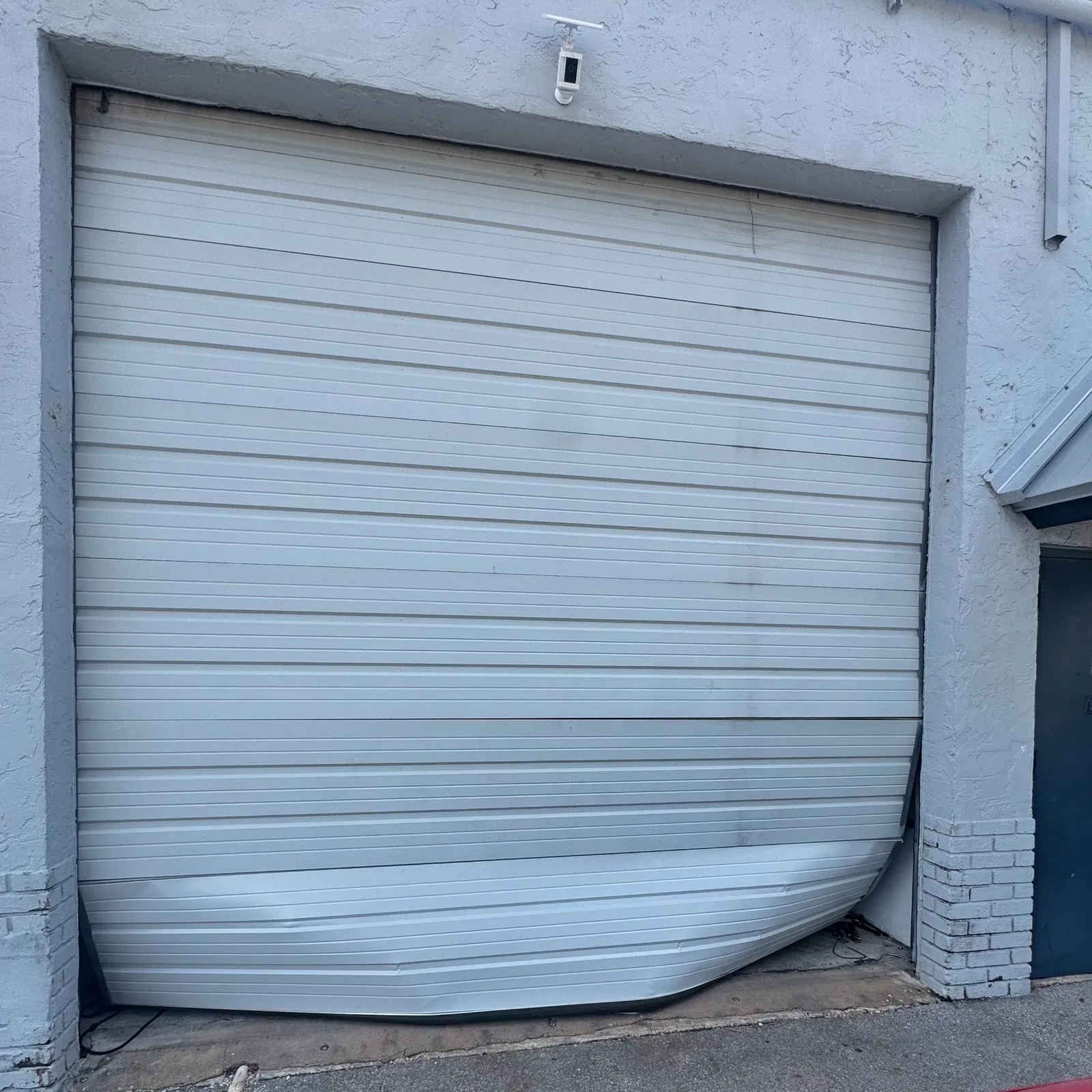
Cars shut in behind a stuck door
A door that stays down has usually lost its spring. The motor heaves, raises the bottom edge a few inches and cuts out. Less often the opener is to blame: a motor that hums without moving, a drive that has slipped, or a board that no longer answers the handsets or the push button.
Telling the two apart is simple and safe if the door is fully closed. Pull the release cord and try to lift the door a little by hand. If it rises easily, the spring is working and the opener is the likely fault. If it will hardly budge, take that as a failed spring and let the door stay on the floor. Either way, a car inside will have to wait for the repair, which is why the time to call is as soon as you find the problem. The Fenway opener repair page explains opener faults in more detail.
When the bay will not shut
A door that rises fine but refuses to come down is often an opener and sensor problem rather than a broken part. The two photo eyes near the floor watch the opening. Anything in the beam, or an eye bumped askew, makes the motor reverse the door after a short drop, or keeps it from setting off. In a narrow bay, that can be a bin, a bike, a box or the corner of a parked car.
Clear the beam, wipe the lenses and give it one more go. Should it still stay up, other causes include a bent rail, a roller that has jammed, a cable that has slackened or come off its drum, and a failed opener. Holding the push button down sometimes closes a door whose sensors are out of line, but if the door shudders, binds or tilts on the way, stop there and let it be. A door forced down on a bent rail can come out of its tracks.
A broken spring after dark
Springs usually break with the door down, when they are wound tightest, and the sound is loud enough to be heard upstairs. Afterwards, the door may look normal but will not lift, or will rise unevenly and stop. Standing well back, look up at the coil over the lintel; a clear break in it settles the question.
Leave everything as it is. Unplug the opener, keep people away from the door and call. Emergency garage door repair Fenway MA owners call about at night is very often a spring, and the work involves fitting a new one to suit the door, winding it to the correct tension, checking the cables and drums it may have damaged as it broke, and testing the balance before the opener is reconnected.
Rollers out of their rails
Once the rollers jump their rails, the door is loose in the opening. In a cramped bay beneath a building, the triggers are usually a bumper catching the door or the end of a rail, a cable that has snapped and let one side drop, or an opener that kept driving a door that had already jammed. The door hangs crooked, and one or both sides may be held by very little.
This is the emergency where touching the door is most dangerous. Clear the area round it and resist any urge to shove it back. Putting it right involves securing the door so it cannot fall, taking its weight off the rollers, guiding them back into the rails, straightening or replacing any bent track, and making sure both cables are at equal tension before it moves again. More on this sits on our off-track garage door repair page.
What happens when we arrive
Safety comes before diagnosis. A derailed door is clamped and propped so it stays put. A door whose spring has failed is kept down or held in place. Once nothing can move unexpectedly, the fault is found and explained: what failed, why it failed and what it may have damaged.
You hear what the repair involves before any work starts, and nothing goes ahead until you agree. With the work complete, the door’s balance is tried by hand, the opener’s limits and force are set to match, and the safety reverse is tested. Where the bay is shared, it helps if whoever looks after the building knows what was done, so that everyone using the door knows it is safe again. A short note by the service entrance saying the door is back in use, and that any odd noise should be reported rather than worked around, does that job well in a bay that several households share.
A dead opener during a power cut
Not every night-time failure is a broken part. When the building loses power, the opener goes dark with it, and a car in the bay is stuck until the power returns or the door is opened by hand. In a bay under a building, a power cut may also leave the lobby or corridor unlit, which makes the inside route harder to use.
If the door is fully down and its spring is intact, it can usually be raised by hand. Pull the red release cord, which hangs from the opener’s trolley, and lift the door from its bottom section. A balanced door rises steadily and stays up when it is fully open. Lower it the same way, then reconnect the trolley once the power is back, either by pulling the cord again or by running the opener until it catches. Never pull the cord with the door raised, and never try this if the door feels very heavy or tilts, because that points to a spring or cable fault rather than a power cut.
Ice at the threshold
On a cold night, a door that will not lift is sometimes frozen to the floor. Meltwater or slush that has run under the bottom seal freezes overnight and holds the door down. The opener strains against the ice, and if it keeps trying it may rip the rubber strip, buckle the lowest panel or wreck its own gears.
On a frosty morning, a door stuck fast calls for a look along its lower edge before any more button presses. Ice along the seal is usually easy to see. This is one of the commonest calls for emergency garage door repair Fenway MA bays produce in a hard winter, and often the door itself has come to no harm. Breaking it loose gently along its length, rather than forcing the door, avoids damage. If the opener has already been straining, or the door moves unevenly once released, have it looked at before it is used again: a door that has fought ice may have pulled a cable or a roller out of place on one side.
Avoiding the next night-time call
Plenty of night-time failures announce themselves weeks ahead. A door that has begun to feel heavier, rise unevenly or close with a thump is often a spring on its way out. A grinding or scraping noise points to a roller or a rail. A door that sometimes reverses for no reason may have a sensor that is close to being knocked out of line. In a shared bay, the person who hears these signs may not be the person who looks after the door, so passing them on early can prevent a late-night call later.
Our Fenway garage door repair page covers the routine repairs that keep a door from failing at a bad moment. When a door is beyond repair, the new garage doors in Fenway page explains replacement. Our citywide emergency garage door repair page describes this service across Boston, and the Fenway page brings together all our local work.
Calling about an emergency
Nobody needs to wait for office hours: the phone is answered at any hour. If you need emergency garage door repair in Fenway MA, explain the night-time route into the bay, the state the door is in, and whether anyone or any vehicle is trapped. Having got that far, call us or book online.
Questions from Fenway
It is late, and the bay door beneath our flats will not come down. What now?
Cut the opener’s power at its plug, keep people clear, and lock whatever inner door separates the bay from the rest of the building. Then phone, explaining the door’s position and the way in.
A car is shut in behind a door that will not open. Can I force it up?
No. With a snapped spring the door weighs more than anyone can safely hold and may drop. Keep it shut, pull the opener’s plug and ring us.
The bay can only be reached through the lobby, and it is locked at night. Is that a problem?
Not if it is planned. Tell us when you call who can open the lobby or service door, so the visit can reach the bay from inside.
The door went bang and now it will not move. Is it safe to stay in the garage?
Step away from the door and keep others away from it. The bang was most likely a spring breaking. Left shut it will stay put, so leave it there and keep hands off the spring and cables.
The door is hanging crooked after a car clipped it. Can I straighten it?
No. A derailed door may come down, and its spring and cables remain loaded. Keep people back, switch off the opener at the plug and phone.