
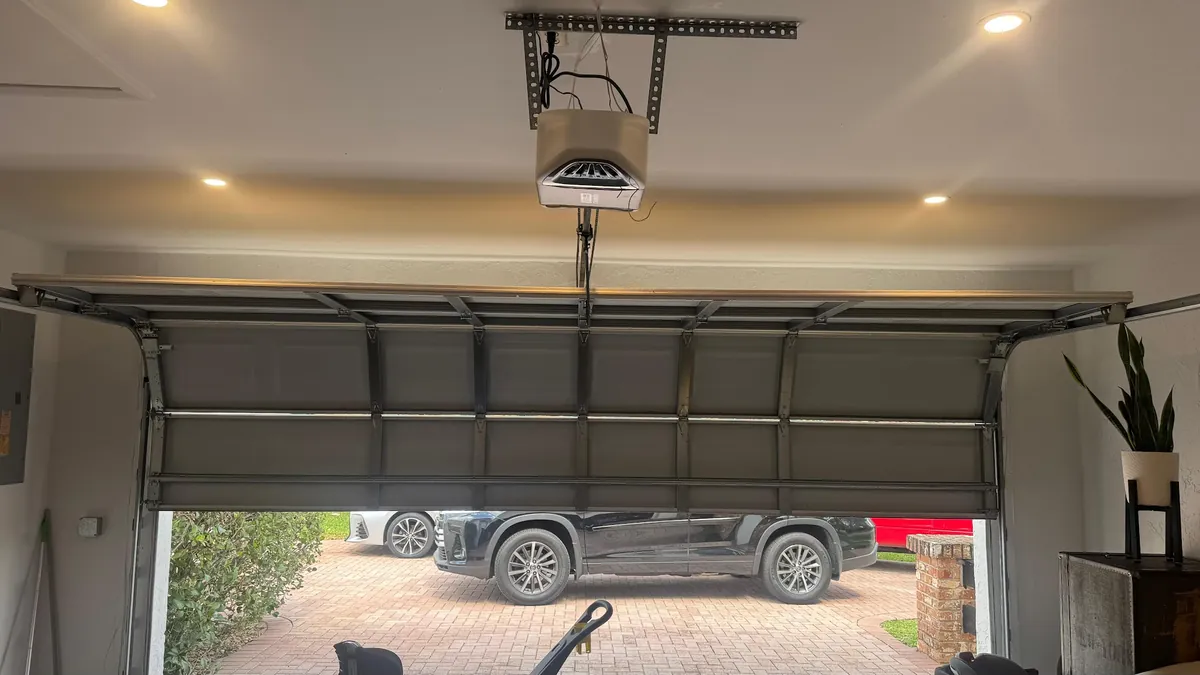
Openers in detached garages built for doors lifted by hand
Most of the garages tucked behind the two-families and single-families off Broadway and Ferry Street stand on their own at the head of a driveway, and a good many date from the nineteen-fifties and sixties. Their single-car doors were, for the most part, built to be raised by hand. The opener came later, sometimes decades later, bolted to a ceiling and a door that never expected one. That history sits behind a large share of the garage door opener repair in Everett MA that we carry out: motors working against tired springs, arms tearing at a thin top panel, remotes struggling to reach a building at the far end of the lot, and sensors fixed to old wooden jambs that drift out of line.
The good news is that opener faults are usually easy to narrow down once you know which piece has stopped doing its job.
Worth noting before you ring us:
- Whether the bulb in the motor housing lights up, and whether you hear a click, a hum or nothing.
- Whether each photo eye shows a steady glow, or one flashes or has gone dark.
- Does the wall button move the door when the remote does not, or neither?
Opener faults we fix in Everett
A motor that hums and goes nowhere
Typically worn-out nylon gearing, a carriage seized on its rail, or a door heavy enough to overpower the drive. Occasionally a failed start capacitor.
Remotes and keypads
Dead batteries, lost programming, a remote that only works close to the garage, or an outdoor keypad that has taken in water.
Wall buttons and their wiring
A button that does nothing, works only sometimes, or makes the light flicker. Old low-voltage wiring stapled along garage studs is often the culprit.
Photo eyes by the floor
Lenses nudged askew, dirty lenses, broken wires or a low sun shining straight into one eye, any of which stops the door closing.
Chain, belt and trolley
A slack chain slapping the rail, a frayed belt, or a trolley that has come apart where the arm attaches to the door.
Travel and force settings
A door that stops short of the floor, reverses for no reason, or presses down so hard it bows the top section.
A motor that steers rather than lifts
Think of an opener as a guide, not a crane. A motor head turns a chain, belt or screw; that drive tows a carriage along a ceiling rail; a bent arm links the carriage to the door’s upper edge. Its duties are modest: shove and tug a door already counterweighted by its springs, halt at each end of travel, and back off whenever an obstacle appears. The lifting itself belongs to the springs.
Keep that in mind, since lots of supposed opener faults turn out to live in the door. A motor that strains, slows and then gives up may be fine; it may simply be trying to lift a door whose springs have weakened or broken. Replacing that opener without fixing the springs only buys a new motor the same fate. That is why our first move on any opener call is to unlatch the carriage and feel the door’s weight ourselves. If it drags like lead, or slides back down once released, springs take priority, as set out on the Everett spring repair page.
A manual door, then an opener: what changes
A sectional door designed to be lifted by its handle is not always built to take the pull of an opener. The arm attaches to the top section at a single bracket, and every trip concentrates force there. On a lighter door from the fifties or sixties, that point can crack, the section can bow, or the bracket can tear through the skin of the panel.
Several things put that right:
- A reinforcing strut across the top section spreads the load so the panel does not bend.
- The arm bracket is moved to sound material, or backed with a plate, if the original fixing has loosened.
- The header bracket that holds the front of the rail is fastened into solid framing, not just into the trim around the opening.
- The old manual slide lock on the inside of the door is disabled, so it cannot be left engaged while the motor tries to lift.
That last point catches out plenty of owners. With the lock still in place, the opener pulls against a door that cannot move, which bends the arm, strips the gears or tears the top bracket loose.
Remotes, keypads and a garage at the end of the lot
With the garage set well back from the road, most drivers like the door rising before they have even turned in. That puts more demand on the remote’s range than an attached garage ever does.
Range problems usually come from something simple. A weak battery shortens range long before the remote stops working altogether. The antenna wire hanging from the opener’s motor unit can get tucked up against metal or knocked out of position. Some lighting, especially certain bulbs fitted in the opener’s own light sockets, can interfere with the receiver. Remotes and outdoor keypads can also drop their programming after a power cut.
On a two-family where both units use the same garage, there may be several remotes in circulation, and one lost or broken remote can mean reprogramming the lot. When we repair or replace an opener, every remote and keypad in use is programmed and tested before we leave, so neither household is stuck outside.
Power to a building that stands apart
An attached garage shares the house’s wiring. A detached one is usually fed by its own circuit, run underground or overhead from the house, and often ends at a single ceiling outlet for the opener and a light. If that circuit trips or the outlet’s protective device trips after rain, the opener goes completely dead: no light, no click, no hum.
Before booking an opener repair, check the breaker in the house and any reset button on outlets in the garage. With power confirmed yet a lifeless motor head, suspicion falls on its circuit board or transformer. If the opener has power but behaves strangely after a storm, a power surge may have damaged the board.
In a blackout, tugging the red release cord uncouples the door for hand operation, provided its springs are whole. A door that will not stay up on its own after release has a spring problem, and should be lowered gently and left down.
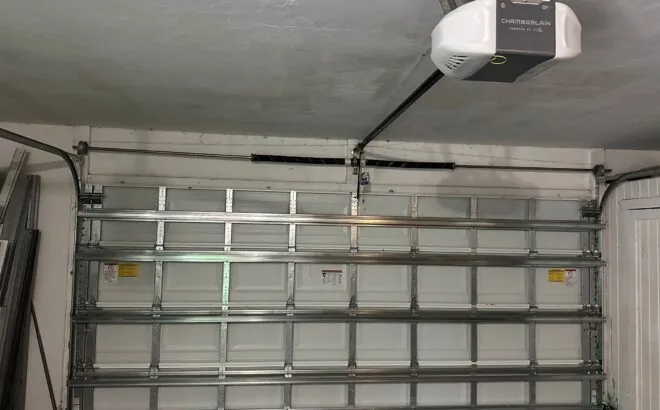
Safety sensors on old jambs and old slabs
Those two photo eyes near the floor are the reason a descending door backs off rather than landing on a bumper, a bicycle or someone’s foot. Each must stare straight at its partner, which is harder to keep up on an elderly building than you might expect.
Wooden jambs on a building of this age swell and shrink with the seasons, and a sensor bracket screwed into one can twist enough to break the beam. Concrete slabs that have heaved or sunk can put one sensor slightly higher than the other. A bin, a lawnmower handle or a shovel left against the jamb nudges a sensor out of line. And a garage facing down a long, open driveway can catch a low winter sun full in its receiver at certain hours, which can blind it briefly and send the door back up.
When the door refuses to close and the opener light flashes, look at the sensor lights first. A dark or blinking indicator usually means misalignment or a wiring fault. Clean each lens with a soft cloth, shift any clutter nearby and give both brackets a gentle wiggle to test they are tight. Should the indicators keep misbehaving after that, suspect the cable run or the eyes themselves.
What happens on an opener visit
Because these houses tend to have a full driveway, the van can usually park beside the garage, and the work happens with your car parked safely out of the way.
- We uncouple the door and work it by hand, feeling for weight, rubbing and rough spots.
- Next the motor head cycles with no door attached while we examine its gearing, drive, carriage and rail.
- Power, wall button wiring, remotes, keypads and both safety sensors are tested.
- You hear what is wrong, whether the opener is worth repairing, and what replacement would involve.
- Once repaired, the stopping points and pushing strength are tuned to this door, then a block laid on the threshold proves it reverses.
Fix the old unit, or fit a new one?
A good number of openers deserve a repair. Gearing, photo eyes, wall controls, remotes, carriages and circuit boards are all replaceable parts, so a fundamentally healthy unit often has years left in it.
A new unit becomes the sensible route once the motor has burned out, once spares for an old model have dried up, when a unit lacks photo eyes or an auto-reverse that actually works, or when repairs have started to stack up. A garage door opener repair in Everett on a unit that is decades old often turns into a replacement for exactly those reasons. LiftMaster openers are included in what gets fixed or swapped here, and any new unit is matched and adjusted to the particular door it drives rather than simply hung in the old one’s place.
Where the opener hangs in an older garage
The ceiling of a garage from the fifties or sixties was framed for storage and a light, not for a motor that jolts every time it starts. Many have open rafters with collar ties, and some have a low ceiling over a door that is taller than the original. The opener’s rail has to run straight back from the header to a hanger fixed to solid framing, at a height that leaves the door room to clear it at the top of its travel.
When a hanger has been screwed into a single thin board, every start and stop flexes it, the rail moves, and the door begins stopping short or reversing for no clear reason. Part of garage door opener repair in Everett on a garage of this age is often rehanging the unit properly: angle iron across two rafters, a braced hanger, and a rail set square to the door so the arm pulls straight.
Wall buttons and the thin wire behind them
Inside a freestanding garage, the push button by the side door is normally connected with thin two-strand cable, stapled along the studs to the motor unit on the ceiling. Over the years that cable gets pinched by a shelf bracket, chewed by mice or pierced by a nail when someone hangs a rake. A damaged wire can make the button work only now and then, or cause the opener to run by itself when two strands touch.
If the remote works the door but the button does not, the button or its wiring is the first suspect. Replacing a run of low-voltage wire is a small job, and it often clears up behaviour that looked like a failing opener.
A keypad on the outside wall
For a freestanding garage reached up a driveway, an outdoor keypad beside the door is handy: nobody needs a remote to fetch a bicycle or a bag of salt, and visitors or the other household can be given a code rather than a handset. The trade-off is weather. A keypad on an exposed jamb takes driving rain, frost and the occasional knock from a shovel, and once water gets behind the cover, the buttons stop responding or the unit forgets its code.
When a keypad fails, it is usually replaced rather than repaired, mounted where the eaves give it some shelter, and programmed to the opener along with every remote. Changing the code is worth doing whenever a tenant moves out of a two-family or a neighbour no longer needs access.
Chain noise and a building nobody sleeps in
On an attached garage with bedrooms above, a rattling chain drive is a nuisance. A detached garage at the bottom of the lot is more forgiving, but noise is still a useful warning. A chain that slaps the rail has stretched; a grinding note from the motor head usually means worn gears; a squeal at one point in the travel often comes from the door, not the opener. Listening to the door make one complete trip tells us a great deal before any covers come off.
Winter, stiff doors and the force setting
On cold mornings, grease in the hinges and rollers thickens, the bottom seal can freeze to the driveway, and the door becomes harder to move. Openers respond by hitting their force limit and reversing, or by stopping partway. The tempting fix is to turn the force adjustment up. Please do not. A high force setting means the door will press harder on anything beneath it before reversing, which defeats the safety system. The better fix is to clear the ice from the bottom edge, deal with the stiff hardware and leave the force where it belongs.
Faults that only look like the opener
Some calls for garage door opener repair in Everett end with no work on the opener at all. Seen from the driveway, a snapped spring, a fraying cable, a roller wedged in a kinked rail or a derailed door can all pass for a dead motor. That wider work lives on the general repair page for Everett. If the door is stuck open or will not close tonight, the urgent repair page for Everett explains what to do in the meantime.
Arranging opener work
Openers like to fail exactly when the car is needed, so the phone gets picked up late at night and on holidays too. On the phone, tell us about the motor-head bulb, the photo-eye indicators, and how the door behaves by hand after release. For the wider picture, our opener repair and replacement page covers Greater Boston, and the Everett area page lists what else is done locally. Garage door opener repair in Everett starts with a quick description of the fault. Call us or book online.
Questions from Everett
The motor-head bulb lights, yet the door stays put. Why?
Power is reaching the opener, so the fault is in the drive, the door or the controls. Listen for the motor. Humming without motion usually means worn gearing or a stuck door; silence may point to the logic board or a sensor problem.
Why does my door go down a little and then go back up?
Usually the safety sensors. Check that both indicator lights are steady, wipe the lenses and move anything near them. With the eyes in good order, look instead at a door dragging somewhere in its rails, or a force adjustment set too low.
Can an opener be fitted to an older door that has always been lifted by hand?
Usually, yes. The door needs to be balanced and in good condition, the top section may need a reinforcing strut, and the manual lock has to be disabled. All of that is checked before an opener is fitted.
The clicker works only when I am standing at the garage. Has the opener had it?
Probably not. Swap its battery, then check that the antenna wire on the motor unit is hanging down and clear of metal. Certain bulbs in the opener’s light sockets can also cut range.
Do you replace openers as well as repair them?
Yes. When repair is not worth it, the opener is replaced and set up for the door, and every remote and keypad in use is programmed before we leave.